
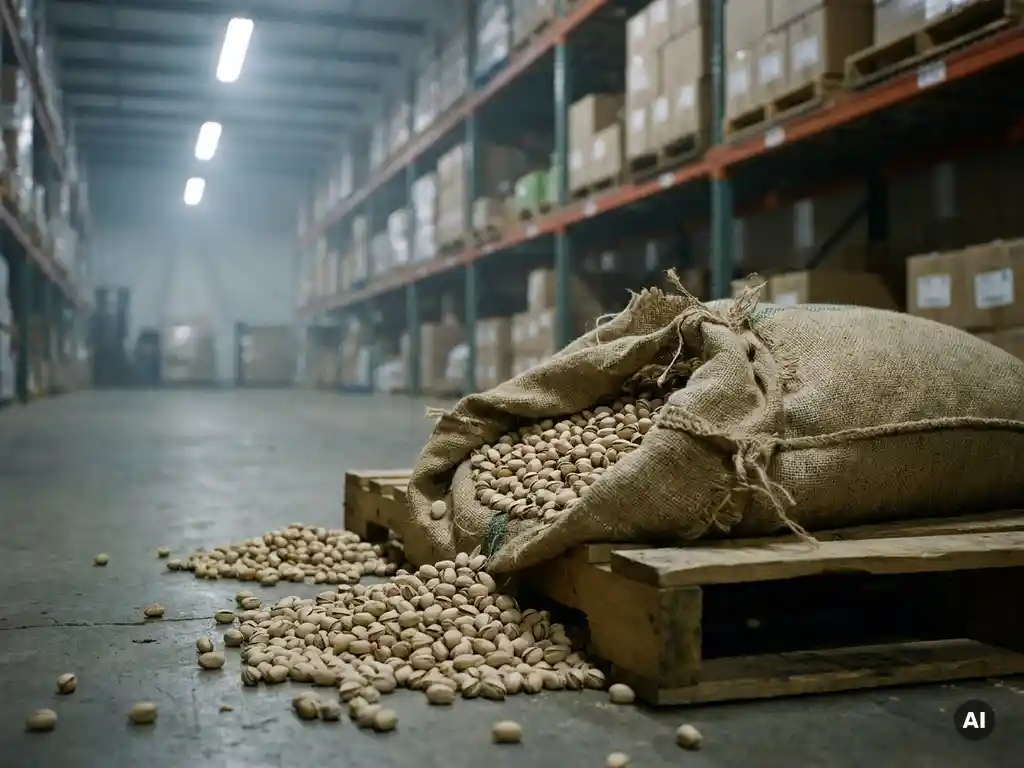
For ambient storage of pistachios in Europe, requirements apply regarding temperature, humidity, packaging, food safety, and certification. The core requirements are: a storage temperature between 10 and 15 degrees Celsius, a relative humidity below 65 percent, and compliance with EU regulations regarding aflatoxins and hygiene. These requirements apply to importers, wholesalers, and logistics service providers who store nuts for further processing or distribution. This article answers the most frequently asked questions about storage conditions, regulations, and practical requirements for pistachios.
What temperature and humidity are ideal for pistachios?
The ideal storage temperature for pistachios in ambient storage is between 10 and 15 degrees Celsius, with a relative humidity of no more than 65 percent. Under these conditions, mold growth is inhibited, the quality of the nuts is preserved, and oxidation of the fats present is slowed down. The more stable the climate, the longer the shelf life.
Pistachios have a relatively high fat content, making them susceptible to oxidation at excessively high temperatures or exposure to light. Furthermore, excessive humidity increases the risk of mold formation and the production of aflatoxins, a serious food safety issue discussed later in this article.
Good air circulation is just as important as the temperature itself. Stagnant air can trap moisture locally, increasing the risk of spoilage. Storage facilities for dry nuts must therefore feature active ventilation that keeps humidity uniformly low throughout the entire storage area.
Which European regulations apply to the storage of pistachios?
The storage of pistachios in Europe is subject to general EU food legislation, in particular Regulation (EC) No 178/2002 (the General Food Law) and Regulation (EC) No 852/2004 on food hygiene. These regulations require storage companies to ensure traceability, hygienic practices, and the prevention of cross-contamination. In addition, specific import control requirements apply to nuts from third countries.
For pistachios imported from countries outside the EU, such as Iran, the United States, or Turkey, increased border controls are in effect due to the risk of aflatoxin contamination. The European Commission periodically sets additional requirements for imports from specific countries via implementing regulations. In 2026, increased control frequencies still apply to pistachios from Iran and Turkey.
Storage companies are required to implement a HACCP (Hazard Analysis and Critical Control Points) system. This entails that risks in the storage process are systematically identified and controlled. Without a functioning HACCP system, a facility does not comply with the European hygiene regulation.
What are the aflatoxin standards for pistachios in the EU?
The EU applies strict maximum limits for aflatoxins in pistachios. For pistachios intended for further processing, a maximum content of 10 micrograms per kilogram applies to aflatoxin B1 and 15 micrograms per kilogram to the sum of aflatoxins B1, B2, G1, and G2. Even stricter standards apply to directly consumable pistachios: 8 and 10 micrograms per kilogram, respectively.
Aflatoxins are toxic fungal metabolites produced by fungi such as Aspergillus flavus and Aspergillus parasiticus. They can develop when nuts are stored under conditions that are too humid or too warm. This is precisely why storage conditions for pistachios are so directly linked to food safety.
Consignments exceeding EU standards during import control are detained or destroyed. This makes it essential for importers and storage companies to monitor the correct conditions not only upon arrival but also throughout the entire storage period.
How should pistachios be packaged for ambient storage?
Pistachios stored in ambient storage must be packed in materials that minimize moisture penetration and light exposure. Common packaging forms are airtight polypropylene or polyethylene bags, jute bags for bulk storage in controlled environments, or cardboard boxes with a moisture-resistant inner lining.
Packaging has a direct impact on shelf life. Some practical requirements for packaging when storing nuts dry are:
- Use of moisture-resistant materials that comply with EU legislation on food packaging (Regulation (EC) No 1935/2004)
- Clear labeling with product description, country of origin, batch number and best before date
- Palletization with sufficient distance to the floor and walls to allow air circulation
- Protection against pests through sealed packaging and good warehouse hygiene
Moreover, with bulk storage on pallets, it is customary to separate batches by country of origin and harvest year, so that traceability remains guaranteed and any contamination can be managed.
Which certifications are required for pistachio storage facilities?
For storage facilities that store pistachios for the European market, BRC certification (British Retail Consortium, now BRCGS) is the most common and widely recognized standard. In addition, IFS Logistics (International Featured Standards) is required by many European supermarket chains and food manufacturers as a condition for cooperation.
BRC and IFS are private standards that go beyond the statutory minimum requirements. They include, among others:
- Demonstrably functioning HACCP system with documented risk analyses
- Periodic internal and external audits of the storage facility
- Procedures for pest control, cleaning schedules, and personal hygiene
- Traceability systems that enable a complete product history
- Procedures for the management of non-compliant parties
In addition to BRC and IFS, SKAL certification may be relevant for storage companies that also store organically certified pistachios. In the Netherlands, SKAL monitors compliance with the EU Organic Production Regulation. For organic nuts, strict separation from conventional batches applies.
How long can pistachios be safely stored in ambient storage?
Under correct storage conditions, that is to say a temperature between 10 and 15 degrees Celsius and a humidity below 65 percent, pistachios can generally be safely stored in ambient storage for 12 to 18 months. The exact shelf life depends on the initial quality of the batch, the harvest year, the packaging, and the stability of the storage environment.
Pistachios stored in the shell generally have a longer shelf life than shelled nuts, because the shell offers extra protection against oxidation and moisture. Roasted pistachios are more sensitive and have a shorter shelf life than raw nuts.
Regular quality checks during the storage period are recommended. Signs of quality loss include a rancid odor (due to oxidation of fats), discoloration, or visible mold growth. Batches exhibiting these signs must be isolated and assessed before further distribution takes place.
How ZZColdstores helps with the ambient storage of notes
ZZColdstores offers professional dry storage for nuts from its locations in Kruiningen and Vlissingen. The new dry storage warehouse has a capacity of 12,000 pallet spaces, with separate areas specifically designed for the storage of nuts, peanuts, and seeds. This ensures that batches are stored separately and traceability remains guaranteed.
For importers, wholesalers, and processing companies that store pistachios for the European market, ZZColdstores offers:
- Climate-controlled dry storage tailored to the specific requirements of nuts and seeds
- BRC- and SKAL-certified storage facilities that meet the requirements of European customers
- Support with import inspections via the KCB (part of the NVWA) and customs clearance
- Flexible storage and logistics solutions that adapt to the sailing schedule and supply planning
Would you like to know if ZZColdstores' storage facilities meet your specific requirements for pistachios or other dry food products? Contact our team for a no-obligation discussion about the possibilities.
Frequently Asked Questions
What should I do if the humidity in my storage room regularly exceeds 65 percent?
When the relative humidity is structurally too high, it is advisable to install additional dehumidifiers and optimize ventilation. Also check whether the cause is external, such as leakage, condensation due to temperature differences, or insufficient insulation of the storage space. Additionally, ensure continuous monitoring using calibrated hygrometers at multiple points in the room so that you can intervene in a timely manner before mold formation or aflatoxin development occurs.
May I store pistachios together with other products in the same room?
In principle, pistachios may be stored together with other dry food products, provided there is no risk of cross-contamination and the storage conditions are compatible for all products. However, certified organic pistachios must always be stored physically separate from conventional batches, in accordance with the EU Organic Production Regulation. Products with strong odors, such as herbs or garlic, should preferably be stored separately because pistachios can absorb odors.
How often must the storage conditions be checked and documented?
For HACCP compliance and certifications such as BRC and IFS, it is required that temperature and humidity be continuously monitored and documented, preferably via automated data loggers with an alarm function. Manual checks must be performed at least daily and recorded in a logbook. In the event of deviations, corrective measures must be documented, including the cause, the action taken, and the result; this is a mandatory component of a functioning HACCP system.
What are the most common mistakes in ambient storage of pistachios?
The most common mistakes are storing nuts directly on the floor or against the walls (which impedes air circulation), failing to separate batches by country of origin or vintage, and the lack of a structural monitoring system for climate conditions. Another common mistake is accepting batches without thorough incoming inspection for moisture and aflatoxins, whereby a contaminated batch can affect the quality of surrounding batches. Good warehouse layout, traceability, and proactive quality control prevent most of these problems.
As a wholesaler, do I need my own HACCP certificate, or is my warehousing partner's HACCP system sufficient?
As a wholesaler, you are personally responsible for compliance with Regulation (EC) No 852/2004 and are required to have your own HACCP system covering your entire chain of operations, including purchasing, transport, and storage. Your storage partner's HACCP system covers only the activities taking place within its facility. You may use your storage partner's documentation and audit results as part of your own risk analysis, but this does not replace your own legal obligation.
Which documents do I need to have on hand when the NVWA conducts an inspection at my storage location?
During an inspection by the NVWA or a designated inspection body, you must be able to present at least the following documents: your HACCP plan including risk analysis and control measures, temperature and humidity records for the past period, incoming inspection reports for incoming batches, traceability documentation per batch (including country of origin and batch number), and your certificates such as BRC or IFS. For batches originating from Iran or Turkey, the corresponding import certificates and analysis reports for aflatoxins are also required.
Is refrigerated storage always better than ambient storage for pistachios, or does ambient storage also have advantages?
Refrigerated storage significantly extends the shelf life of pistachios and is particularly suitable for long-term storage of more than 18 months or for sensitive products such as shelled or roasted nuts. However, ambient storage offers practical advantages: lower costs, simpler logistics, and reduced risk of condensation when unloading products. For most commercial applications where pistachios are processed or distributed within 12 to 18 months, properly executed ambient storage offers a cost-effective and safe alternative, provided that climate conditions are strictly monitored.