
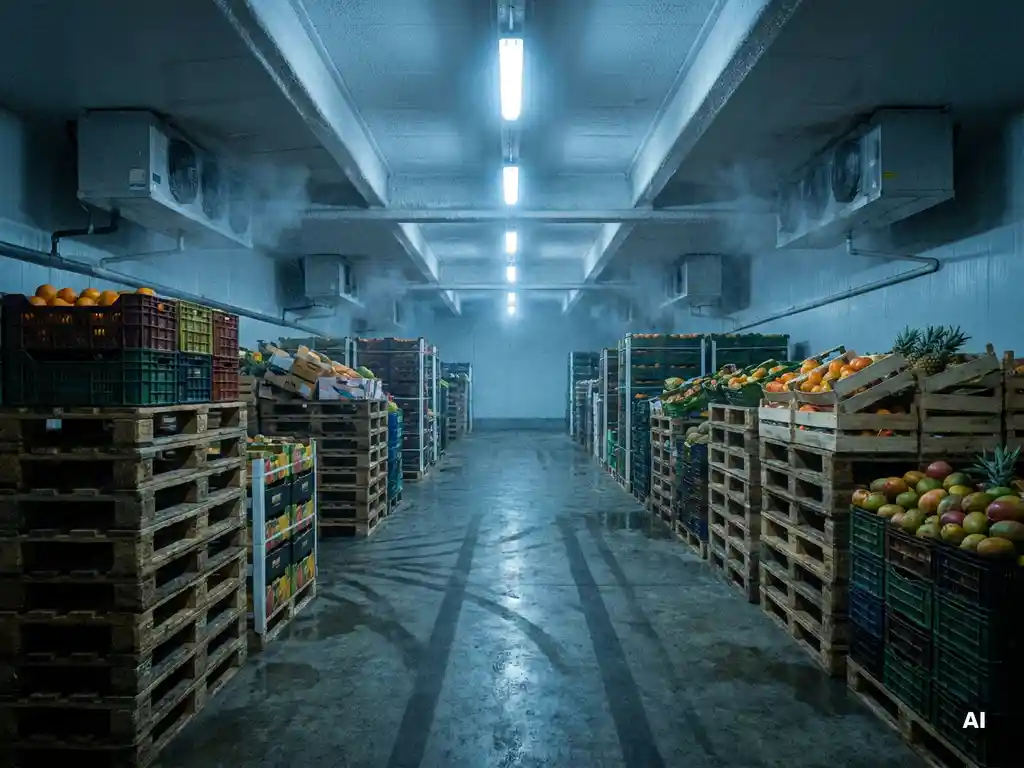
Food pallet storage works by placing goods on standardized pallets and storing them under controlled conditions in a warehouse designed to meet the specific requirements of the product. Storage conditions, such as temperature and humidity, are tailored to the type of food product. This article answers the most frequently asked questions about food pallet storage, from basic forms to choosing the right partner.
What types of pallet storage exist for food products?
For food products, there are two main forms of pallet storage: dry storage (also known as ambient or dry storage) and climate-controlled cold storage. Dry storage is suitable for products that remain stable at room temperature or a constant low temperature, such as nuts, peanuts, and seeds. Cold storage is intended for fresh, perishable products that require active temperature control.
Within these two main categories, there are further classifications based on the storage system:
- Block storage: pallets are stacked directly next to each other on the floor. Efficient in space utilization, but less accessible per individual pallet.
- Rack or shelving storage: pallets are placed in racks, making each pallet individually accessible. Ideal when multiple SKUs or batches need to be managed separately.
- Dynamic storage: pallets are moved via a roller conveyor or sliding system based on FIFO (first in, first out). This is particularly relevant for fresh products with a limited shelf life.
The choice of a storage system depends on the product type, the turnover rate, and the required level of traceability. For fresh food products such as exotic fruit, FIFO management is almost always a requirement.
What requirements apply to pallet storage of foodstuffs?
Pallet storage for food products must meet strict requirements regarding food safety, hygiene, and traceability. The most relevant standards are BRC (British Retail Consortium), SKAL (for organic products), and the requirements of the NVWA, including the KCB inspection for fresh fruit and vegetables. Without the proper certifications, products cannot be admitted to the European market.
Specifically, it concerns the following requirements:
- Temperature recording: temperatures must be continuously measured and documented so that deviations are immediately visible.
- Hygiene and pest control: the warehouse must be clean, dry, and free of pests. Regular inspections are mandatory.
- Traceability: every pallet must be traceable to the lot or batch from which it originates, including grower and LOT numbers.
- Separation of products: products that do not meet the quality standards must be immediately separated from the rest of the batch.
- Documentation: all incoming and outgoing flows must be recorded and available for audits.
For importers bringing in products from non-EU countries, additional requirements regarding customs clearance and phytosanitary inspections also apply.
How is the temperature controlled during pallet storage?
In professional pallet storage for food products, temperature is controlled via automated climate systems that operate 24 hours a day. Sensors continuously measure the temperature at multiple points in the warehouse, and the system automatically corrects for deviations. In addition to temperature, humidity and air circulation are also monitored, as all these factors influence the quality of food products.
The accuracy of temperature control depends on the type of product. Bananas, for example, require a different temperature zone than citrus fruits, and dry products such as nuts are typically stored at a fixed low temperature of around 11 degrees Celsius. Flexible settings per cell or zone are therefore essential in a warehouse that manages multiple product types.
Modern systems record all measurements in a digital logbook. This makes it possible to precisely reconstruct the temperatures a product was subjected to during the entire storage period in the event of a quality complaint or audit.
What is the difference between dry storage and cold storage for pallets?
The main difference between dry storage and cold storage is the degree of active temperature control. In dry storage, products are stored in a ventilated space at a fixed, stable temperature, without active cooling. In cold storage, the temperature is actively regulated and monitored, which is necessary for fresh and perishable products.
Dry storage
Dry storage, also known as ambient warehousing, is suitable for products that do not spoil at room temperature or in a lightly cooled environment. Examples include nuts, peanuts, seeds, and dried food products. The storage temperature is typically around 11 degrees Celsius. Ventilation and humidity control are important, but active cooling is not required. This makes dry storage more cost-effective than cold room storage.
Cold storage
Cold storage is intended for fresh products such as exotic fruit, vegetables, and other perishable goods. The temperature is actively controlled and can be set per product. Humidity and air circulation are also continuously monitored. This type of storage requires more technical infrastructure and energy, but is indispensable for products with a short shelf life that must maintain their quality until reaching the customer.
How many pallet spaces does a food company need?
The required number of pallet spaces depends on the product turnover rate, the seasonal pattern of demand, and the buffer space needed for unexpected peaks or delays in the supply chain. There is no universal answer, but a practical rule of thumb is to calculate with the maximum inventory you wish to hold at any given time, plus a buffer of 15 to 25 percent.
Factors influencing the calculation:
- Turnover rate: the faster products flow through, the fewer pallet spaces you structurally need.
- Seasonality: importers of fresh fruit require significantly more storage capacity during certain periods than during others.
- Product mix: if you manage multiple product types, each with its own storage conditions, you may need multiple zones or cells.
- Customs and inspection obligations: products awaiting release by the NVWA or KCB must be stored separately, which requires extra space.
A good storage partner can create a realistic capacity plan based on your inbound and outbound volumes.
How does the transfer of containers to pallet storage work?
The transfer of containers to pallet storage takes place via a series of steps: arrival of the container, unloading, quality control, palletizing, and placement in the warehouse. The speed at which this process takes place is crucial for fresh food products, as any delay compromises the quality and shelf life of the product.
An efficient transshipment procedure looks as follows:
- Arrival and registration: the container is notified and registered in the warehouse management system. Relevant documents are checked.
- Unloading: the container is emptied and the contents are sorted by batch or LOT number.
- Quality control: upon arrival, the shipment is inspected for damage, temperature deviations, packaging errors, and the overall condition of the product. Temperature, humidity, and Brix measurements are performed in accordance with the product specifications.
- Palletizing and labeling: products are placed on pallets and provided with barcodes, expiration dates, and customer-specific labels.
- Storage placement: pallets are moved to the correct storage zone and registered in the system, fully traceable via the barcode system.
When the cold storage facility is located directly next to the quay, as in the Port of Vlissingen, the time between unloading and cooling is minimal. This is a significant advantage for fresh products that need to be brought to temperature quickly.
What should you look out for when choosing a pallet storage partner?
When choosing a pallet storage partner for food products, certifications, technical capabilities, and logistical flexibility are the three most decisive factors. A partner without the right certifications can jeopardize your supply chain; a partner without flexibility will not adapt to your sailing schedules or seasonal peaks.
Specific points of attention during the selection:
- Certifications: check whether the partner holds BRC, SKAL, or other relevant certifications for your product category.
- Climate control: ask about the accuracy of the temperature control and the ability to set per cell or zone.
- Traceability: a barcode system that links grower and lot numbers to individual pallets is a basic requirement for modern food logistics.
- Location and accessibility: a partner close to the port or with its own quay significantly shortens the time between unloading and storage.
- Customs and inspection: can the partner fully handle the import inspection and customs clearance, or do you need to engage a third party for this?
- System integration: EDI connections for automated order processing, inbound notifications, and inventory updates ensure flawless communication between your systems and the warehouse.
- Flexibility: a good partner adapts to your sailing schedules and peaks, not the other way around.
How ZZColdstores helps with pallet storage for food products
ZZColdstores combines more than 30 years of experience in temperature-controlled storage with the infrastructure and certifications that B2B logistics partners require. The company offers both dry storage and climate-controlled cold storage for fresh and perishable products, with locations in Kruiningen and Vlissingen.
What ZZColdstores specifically offers:
- Climate-controlled storage with 24/7 monitoring of temperature, humidity, and air circulation, tailored to the specific requirements of your product
- Dry storage with a capacity of 12,000 pallet spaces for nuts, peanuts, seeds, and other dry food products
- Own quay in Vlissingen for minimal time between unloading and cooling
- Full traceability via a barcode system linked to grower and LOT numbers
- Quality control upon arrival, including temperature, humidity, and Brix measurements
- EDI connections for automatic order processing and inventory updates
- Certifications: BRC, SKAL and Demeter
- Arrangement of import inspection (KCB/NVWA) and customs clearance
Would you like to know which storage solution best suits your product and logistics process? Contact ZZColdstores for a no-obligation consultation.
Frequently Asked Questions
As a small importer, can I also use a professional pallet storage company, or is that only for large batches?
Professional pallet storage companies work with varying volumes and are often accessible to smaller importers as well. The key is to find a partner that offers flexible contract forms, so you only pay for the space you actually use. Always discuss your average and maximum volume during an initial meeting so that the partner can create a suitable capacity plan that can grow with your company.
What happens if the temperature in the warehouse falls outside the agreed range?
With a professional storage partner, automated alarm systems are in place that provide an immediate notification as soon as the temperature falls outside the set range, even outside office hours. In most cases, the system corrects automatically, and in the event of serious deviations, immediate action is taken by the operational team. All deviations are recorded in the digital logbook, ensuring that you, as the client, always have full insight into what has happened and what measures have been taken.
How far in advance should I reserve storage capacity, especially during seasonal peaks?
For regular volumes, signing in a few days to a week in advance is usually sufficient, but during seasonal peaks — such as the supply of summer fruit or the run-up to the holidays — it is wise to reserve capacity two to four weeks ahead. A good storage partner has insight into your sailing schedules and historical volumes, allowing capacity planning to proceed proactively rather than reactively. Always discuss seasonal patterns with your partner beforehand so there are no surprises at the busiest time of the year.
What is the difference between a regular warehouse and a BRC-certified food warehouse?
A BRC-certified warehouse complies with an international food safety standard that sets strict requirements for hygiene, traceability, temperature control, pest prevention, and documentation. A standard warehouse without this certification is unsuitable for storing food products intended for the European market, as retailers and buyers are increasingly using BRC as a minimum requirement. The certificate is audited annually by an independent party, which means that a BRC-certified partner demonstrably and consistently meets the highest food safety standards.
Can my own WMS or ERP system be linked to the storage partner's system?
Yes, modern warehousing partners offer EDI (Electronic Data Interchange) connections that allow your WMS or ERP system to automatically communicate with the warehouse management system. This makes it possible to automatically process inbound notifications, inventory updates, and outbound confirmations without manual intervention. When selecting a partner, always ask which EDI standards are supported and how much implementation time is required for the connection with your specific system.
How is it prevented that my products in the warehouse are swapped with those of another customer?
Professional food warehouses use a barcode system in which every individual pallet is provided with a unique label linked to the customer, the LOT number, and the grower. All movements in the warehouse—from inbound to outbound—are scanned and recorded in the warehouse management system, making mix-ups virtually impossible. Physical separation by customer or product category, combined with strict picking procedures, provides an additional safeguard.
What do I need to include or provide with the first shipment to a new storage partner?
For a first shipment, you typically need the following documents: the consignment note or Bill of Lading, the phytosanitary certificate (for products from outside the EU), the packing list with LOT numbers and grower information, and any customs documents for clearance. Some products also require pre-notification with the NVWA or KCB for import inspection. A storage partner that handles customs and import inspections themselves can guide you through this process and indicate which specific documents are required for your product category.
Related articles
- How does warehousing handle unexpected peaks in supply?
- When is external warehousing beneficial for food producers?
- What happens to goods between arrival and departure from a warehouse?
- How does packaging quality affect the shelf life of dried fruit?
- How does customs clearance for nuts from China or Vietnam work?