
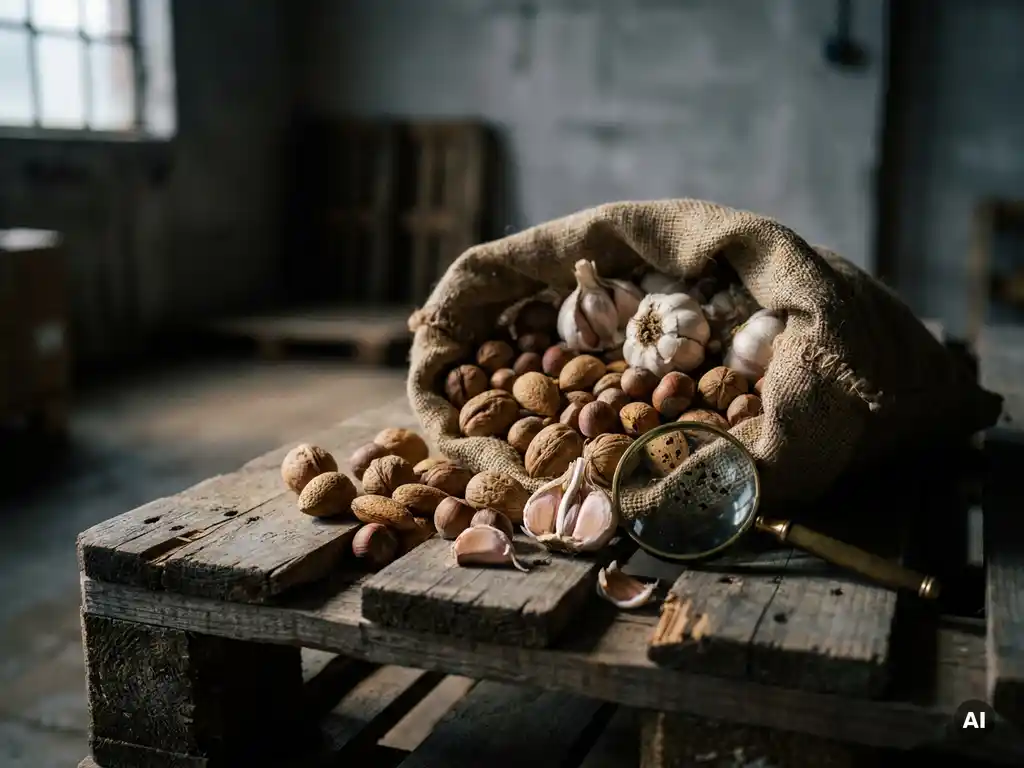
Insect infestation in stored nuts or garlic can be recognized by droppings, feeding damage, web-like threads, empty hulls, or an unusual odor. The earliest signs are often microscopic or hidden in the core of a batch, making a visual inspection of the outside insufficient. This article covers the most common pest insects, how to recognize early signs, and what you can do to prevent re-infestation.
Which insects are most commonly found in stored nuts and garlic?
The most common pest insects in stored nuts and garlic are the tobacco beetle (Lasioderma serricorne), the cereal weevil (Sitophilus granarius), the cocoa moth (Ephestia elutella), the meal moth (Plodia interpunctella), and the garlic mite (Aceria tulipae). Each of these species thrives in dry storage environments with insufficient air circulation.
In nuts, it is primarily the larvae of moths and beetles that cause damage. They bore into the nut itself, consume the fatty flesh, and leave behind excrement and skin flakes. In garlic, mites are a particularly persistent problem: they are barely visible to the naked eye but cause significant quality damage by drying out and discoloring the bulbs.
- Tobacco beetle: attacks both nuts and dried plant products; the larvae eat their way through packaging.
- Flour moth: lays eggs in cracks and seams of pallets or crates; recognizable by fine silk threads
- Cereal weevil: less frequent in nuts, but can occur in mixed storage alongside cereals
- Garlic mite: specific to garlic; causes a whitish haze on the outer skins
How do you recognize the early signs of insect infestation?
Early signs of insect infestation in stored nuts or garlic are small holes in packaging or products, fine dust or granular material (droppings or food debris) at the bottom of crates, a musty or sharply different odor, and visible cobwebs in moths. These signals are most reliable if you look for them systematically upon the arrival of a batch and during periodic storage checks.
A practical approach is to check the bottom layers of a pallet, as insects seek dark, sheltered spots. Open a sample of packages and inspect the inside for moving particles, damaged cores, or discoloration. In the case of garlic, a soft, spongy texture of the bulb is an additional warning sign indicating damage from the inside.
Glue traps and pheromone traps are an effective tool for the early detection of flying insects such as moths, even when a visual inspection yields no results. Regular reading of these traps provides an overview of the population build-up over time.
What is the difference between visible and hidden contamination?
Visible contamination is immediately observable on the outside of the product or packaging: moving insects, feeding damage, webs, or excrement. Hidden contamination is located in the core of the product, for example, larvae that have burrowed into a nut, and is not visible without destructive testing or laboratory analysis.
The distinction is crucial for quality control. A batch may appear completely flawless on the outside while a population is already active inside. In practice, hidden contamination only becomes visible when the insects have completed their larval phase and emerge from the product as adults, or when the nuts are cut into during processing or packaging.
For importers and logistics managers, this means that visual inspection alone is insufficient as a control method. Random sample laboratory inspection, in which products are opened or heated to activate larvae, provides a more reliable picture of the actual level of contamination.
Which conditions promote insect infestations in dry storage?
Insect infestations in dry storage are promoted by a combination of excessive temperature, high humidity, insufficient air circulation, and poor hygiene in the storage area. Most storage insects reproduce fastest at temperatures between 25 and 35 degrees Celsius and a relative humidity above 60 percent.
In addition to climatic factors, physical conditions play a major role. Old packaging material, remnants from previous batches, cracks in floors or walls, and insufficient stock rotation create ideal hiding places for insects to establish themselves and multiply. Mixed storage of different product types significantly increases the risk of cross-contamination.
proper dry storage of nuts and seeds requires not only the right temperature and humidity settings, but also strict hygiene protocols and a well-thought-out storage schedule in which older batches are delivered first (FIFO).
When is a batch of nuts or garlic no longer suitable for consumption?
A batch of nuts or garlic is no longer suitable for consumption if live insects or larvae are found in the product, if insect excrement or skin flakes are mixed with the product, or if contamination has led to mold formation as a result of feeding and moisture penetration. In all these cases, rejection by the NVWA or the import inspection authority is the most likely outcome.
The boundary is not always black and white. Regulations set maximum limits on the number of insect fragments per unit of weight, but in practice, buyers in the food industry often apply stricter standards than the legal minimums. A batch that technically just barely passes inspection may still be rejected by a supermarket purchasing organization based on its own specifications.
In addition to food safety aspects, economic damage also plays a role. Insect damage reduces the weight and quality class of a batch, which directly affects the selling price and processability.
How do you prevent reinfestation after an insect problem?
Re-infestation after an insect problem is prevented by a structured three-step approach: complete cleaning and disinfection of the storage area, strict control of new incoming batches, and continuous monitoring with traps and periodic inspections. Without all three steps, the risk of the pest returning is significant.
- Thorough cleaning: remove all residues of the contaminated batch, including dust and organic material in cracks, seams, and under pallets. Insect eggs survive in small amounts of organic material.
- Control of incoming batches: establish a mandatory inspection protocol for every new delivery, including random opening of packaging and checking for the aforementioned early warning signs.
- Climate control: structurally keep the storage temperature below 15 degrees Celsius and the humidity below 60 percent. Most storage insects stop reproducing at lower temperatures.
- Physical barriers: use insect-repellent packaging material and regularly check for tears or damage in packaging and the storage area itself.
- Continuous monitoring: place pheromone traps at strategic points and read them weekly. A sudden increase in catches is an early signal of a new wave of infection.
How ZZColdstores helps with the safe dry storage of nuts and garlic
ZZColdstores offers B2B logistics partners a professional environment for the dry storage of nuts, peanuts, seeds, and garlic, where conditions are structurally managed to prevent insect infestations. The new dry storage warehouse has a total capacity of 12,000 pallet spaces, with separate areas for each product type to prevent cross-contamination.
- Climate control tailored to the specific requirements of dry food products
- Separate storage areas per product category to minimize cross-contamination
- Import inspection via KCB (part of the NVWA) as part of the receiving process
- BRC-certified method for hygiene and quality assurance
- Flexible loading and unloading tailored to the client's sailing schedule and delivery plan
Would you like to know how ZZColdstores can store your batch of nuts or garlic safely and while preserving its quality? Contact us via the website for a no-obligation consultation with our specialists.
Author: Frans van der Maas, Operations Director ZZColdstores
Frequently Asked Questions
How often should I check my dry storage space for insect infestation?
For effective pest control, it is recommended to read the pheromone and glue traps at least weekly and to perform a full visual inspection of the storage area monthly, including the bottom pallet layers and hard-to-reach corners. For high-risk batches—such as products originating from regions with known pest problems or products that have been stored for an extended period—a higher inspection frequency is preferred. Document every inspection so that trends in catches or signs are recognized in a timely manner.
Can I still save a slightly contaminated batch of nuts, or do I have to dispose of the entire batch?
Whether a batch can still be salvaged depends on the nature and extent of the contamination. In cases of contamination visible only on the outside of the packaging — without the product itself being affected — sorting and re-inspection can sometimes offer a solution. In the event of proven hidden contamination, mold formation, or the presence of feces mixed with the product, disposal is in most cases the only safe and legally justifiable option. Always consult an inspection service such as the NVWA or KCB before making a decision regarding the fate of a suspect batch.
What is the biggest mistake importers make upon receiving a new batch of nuts or garlic?
The most common mistake is relying solely on a visual inspection of the outside of the packaging or the top layer of a pallet. As described in this article, hidden contamination can be completely invisible until insects have completed their larval phase. A robust receiving protocol always includes random opening of packages from different layers of the pallet, checking for odor and texture, and, in case of doubt, a laboratory inspection. Investing in this protocol upfront prevents significantly greater damage further down the chain.
Are there natural or chemical-free methods to control insects in dry storage?
Yes, there are several non-chemical methods that can be effective, particularly as part of an integrated pest management strategy. Lowering the storage temperature to below 10 degrees Celsius strongly inhibits the reproduction of virtually all storage insects. Diatomaceous earth can be applied as a physical barrier in crevices and edge areas of the storage space. Pheromone traps are a chemical-free monitoring and trapping method. For large-scale professional storage, these methods are most effective in combination with strict hygiene and climate control, not as a replacement for a complete storage protocol.
How do I know if my current storage conditions are good enough to prevent insect infestations?
A reliable way to assess this is to compare your current climate data—temperature and relative humidity—with the threshold values mentioned in this article: below 15°C and below 60% RH. If you do not have continuous climate monitoring, that in itself is a risk factor. Additionally, you can analyze the catch data from your pheromone traps over a longer period: a consistently low catch indicates that conditions are unfavorable for pest development. A professional storage partner with BRC certification and automated climate control offers the most reliable guarantee.
What should I do if a buyer refuses a batch due to suspected insect infestation, but I have not detected any infestation myself?
First and foremost, ask the purchaser for written substantiation of the refusal and, if possible, samples from the suspect batch for independent laboratory analysis. Have a certified inspection service re-inspect the batch to obtain an objective assessment. At the same time, check your own inspection documentation of the incoming batch and the storage conditions during the retention period. Good documentation is not only valuable for resolving the immediate dispute but is also essential for any potential liability questions regarding your supplier.
How long can insect eggs or larvae survive in an empty, cleaned storage space?
Insect eggs and larvae are remarkably resistant and can survive for months in small amounts of organic residue—such as dust, chaff, or nut remains in cracks and crevices—even in an otherwise empty space. This is why superficial cleaning after an infestation is insufficient. Effective disinfection requires the mechanical removal of all organic material from seams, cracks, floor penetrations, and pallet storage points, followed by an approved insecticide treatment or, where possible, a heat treatment of the space to above 55°C for at least several hours.
Related articles
- Which checks are important when storing imported food products?
- What are the certification requirements for a warehouse that stores food products?
- Why is humidity just as important as temperature in dry storage?
- Why do factories choose to outsource intermediate storage in Europe?
- What are the risks of larvae and insects when storing dried fruit?