
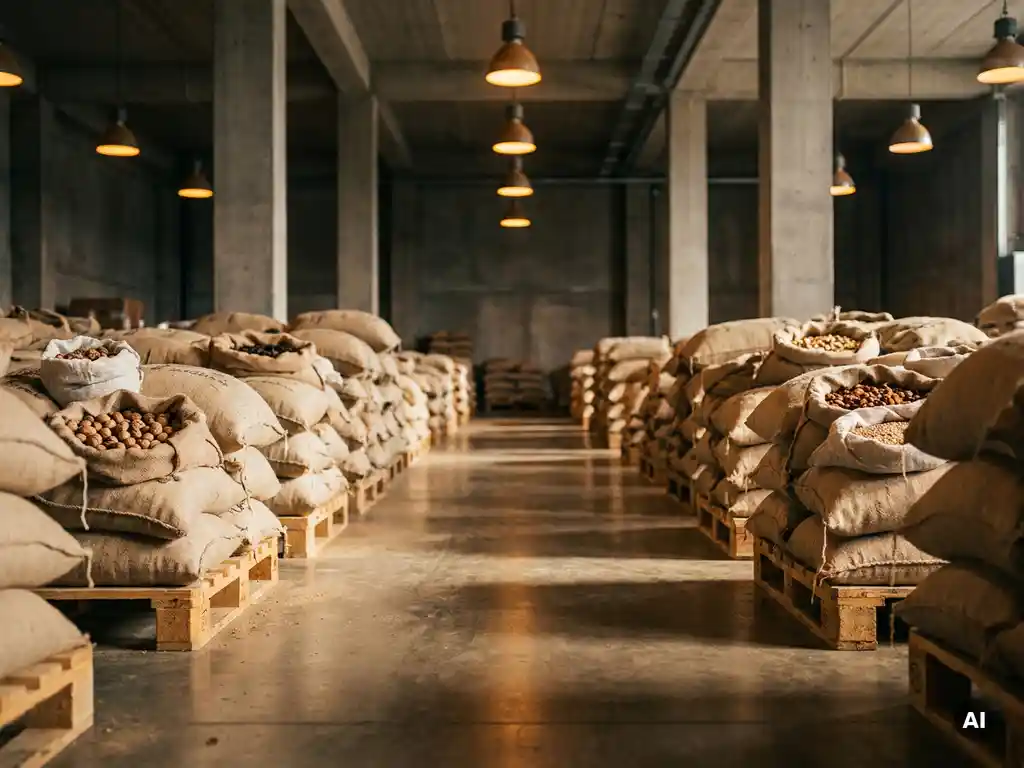
Dry storage is the storage of goods at ambient temperature, in a dry and stable environment without active cooling or freezing. It is the designated storage method for products that are not temperature-sensitive but must be protected against moisture, humidity fluctuations, and contamination. For logistics managers and importers, it is the most commonly used basic form of warehousing. In this article, we answer the most frequently asked questions about dry storage: which products are suitable for it, what a good warehouse requires, and when outsourcing is the smartest choice.
Which products are suitable for dry storage?
Dry storage is suitable for products that remain stable at ambient temperature and do not require active cooling, but do require a dry, clean, and controlled environment. Examples include unprocessed plant-based food products such as nuts, peanuts, seeds, and grains, but also packaged foods, canned goods, and certain non-food products.
Within the food industry, the rule of thumb is: if a product can be stored without refrigeration and does not require a specific temperature zone, dry storage is the logical choice. However, there are requirements regarding the environment. Products such as nuts and seeds are sensitive to moisture and cross-contamination, and therefore require separate storage areas with a stable climate.
- Nuts and peanuts – sensitive to humidity and oxidation, require dry and well-ventilated storage
- Seeds and cereals – stable at ambient temperature provided the moisture content remains low
- Dried fruits – shelf-stable without refrigeration, but sensitive to temperature fluctuations
- Packaged food products – cans, jars and dry packaging that do not require a refrigerated environment
- Non-food products – packaging material, paper and other non-perishable goods
Products that do require refrigeration, such as fresh fruit, dairy products, or frozen products, fall outside the scope of dry storage. Climate-controlled refrigeration is required for that category.
What are the requirements for a good dry storage warehouse?
A properly dry storage warehouse meets strict requirements regarding hygiene, climate control, and safety. The core requirements are stable humidity, good ventilation, pest prevention, and a logical layout that prevents cross-contamination between product groups.
Moreover, certification requirements apply to food products. Warehouses that store food products typically operate according to the BRC standard (British Retail Consortium), an international standard for food safety in the storage and distribution chain. Without this certification, access to most supermarket chains and major purchasing organizations is virtually impossible.
In addition to the certification, there are practical infrastructure requirements:
- Moisture control – humidity must be actively monitored and regulated, especially for moisture-sensitive products such as nuts and seeds.
- Ventilation and air circulation – stagnant air promotes mold formation and loss of quality
- Separation of product flows – separate areas for different product categories prevent odor and cross-contamination
- Hygienic floors and walls – easy to clean and resistant to heavy use
- Access control and security – unauthorized access increases the risk of contamination and theft
- Sufficient pallet capacity and logistical flexibility – the layout must align with the inflow and outflow of goods
For importers and wholesalers working with fluctuating volumes, the scalability of the warehouse is also a critical factor: storage capacity must adapt to seasonal peaks and changing volumes.
What is the difference between dry storage and cold storage?
The fundamental difference between dry storage and cold storage lies in temperature control. In dry storage, goods are stored at ambient temperature in a dry, stable environment. In cold storage, products are actively cooled or frozen to slow down or prevent spoilage. The choice depends entirely on the characteristics of the product.
Cold storage is necessary for fresh and perishable foods, such as fruit, vegetables, dairy, and other products with a short shelf life at room temperature. Dry storage suffices for products that are naturally stable at ambient temperature, provided that humidity remains under control.
In practice, both forms of storage often operate side by side within a single logistics chain. For example, an importer of tropical fruit can place the refrigerated cargo directly into a climate-controlled cold storage facility upon arrival, while the accompanying packaging materials or dry by-products are stored in a dry storage warehouse . The two forms of storage complement each other but are technically and operationally completely separate.
An important point to consider: some products do not require refrigeration but do require a controlled temperature range. Nuts and seeds, for example, must not be stored at too high a temperature, as heat accelerates oxidation. This still falls under dry storage, but requires a well-regulated indoor climate.
When is outsourcing dry storage the best choice?
Outsourcing dry storage is the best choice when the costs and complexity of in-house warehouse space outweigh the operational benefits, or when a company lacks the necessary certifications, infrastructure, or scale to meet quality requirements itself.
For importers, wholesalers, and processing companies, there are several situations in which outsourcing is clearly more attractive than on-site storage:
- Fluctuating volumes – those dealing with seasonal peaks or irregular supply pay only for what is actually used when outsourcing.
- Missing certifications – BRC, SKAL, or other quality certificates are time-consuming and costly to obtain and maintain in-house
- Lack of logistical scale – a specialized warehousing partner already has the infrastructure, personnel, and systems in-house.
- Geographic location – storage close to a port or distribution point shortens transport times and lowers costs
- Focus on core activities – those who want to concentrate on purchasing, sales, or processing gain time and capacity by outsourcing storage.
Outsourcing is less obvious when a company has very specific storage requirements that an external partner cannot meet, or when volumes are so consistent and large that in-house warehouse capacity proves to be structurally cheaper.
How is dry storage combined with logistics services?
Dry storage rarely stands alone. In a modern logistics chain, the warehouse is a link between supply, storage, inspection, and distribution. A comprehensive storage solution therefore also includes services such as container handling, customs clearance, import inspection, and transport to the next destination.
For importers of food products, this means in practice that goods are collected upon arrival in the port or unloaded directly at the quay, cleared through customs, undergo an import inspection by the competent authorities, and subsequently stored until they are reloaded for customers. Dry storage acts as the buffer space in this process that keeps the entire chain running smoothly.
The combination of warehousing and logistics services offers advantages in terms of speed, quality assurance, and administrative simplicity. Instead of coordinating multiple parties for transport, inspection, and storage, a logistics partner offering everything under one roof operates more efficiently and with greater error tolerance.
How ZZColdstores helps with dry storage
ZZColdstores offers a fully equipped dry storage warehouse with a capacity of 12,000 pallet spaces, featuring separate areas for nuts, peanuts, seeds, and other dry food products. The company is BRC, SKAL, and Demeter certified and works exclusively with B2B partners in food logistics.
- Dry pallet storage with separate areas per product category
- Certified for food safety (BRC, SKAL, Demeter)
- Combined with container handling, customs clearance, and import inspection via KCB
- Locations in Kruiningen and Vlissingen, with private quay in the port of Vlissingen
- Flexible capacity that matches fluctuating volumes and sailing schedules
Would you like to know if dry storage at ZZColdstores meets your logistical needs? Then contact us for a no-obligation consultation, or view the possibilities on the ambient warehousing.
Author: Frans van der Maas, Operations Director ZZColdstores
Frequently Asked Questions
How do I know if my product is suitable for dry storage or requires refrigeration?
First, check your product's shelf-life requirements: if it remains stable at ambient temperature (typically 15–25°C) and does not require active refrigeration to prevent spoilage, dry storage is the appropriate choice. Also consider sensitivity to moisture and oxidation — products such as nuts and seeds are perfectly suitable for dry storage, provided humidity is actively monitored. In doubt? Consult the manufacturer's product specifications or ask a storage specialist for advice based on your specific product category.
Which certifications should I check when choosing a dry storage warehouse for food products?
For food products, BRC (British Retail Consortium) certification is the minimum standard required by most supermarket chains and major purchasing organizations. If you work with organic products, also check whether the warehouse is SKAL-certified — without this certification, certified organic cargo may not be stored or traded as organic. Depending on your market and product type, additional certifications such as Demeter, IFS, or FSSC 22000 may also be relevant.
What are the most common mistakes made when setting up dry storage for food products yourself?
The most common mistake is underestimating humidity control: a warehouse that appears dry may still have excessive humidity at pallet level, leading to mold formation and loss of quality. A second common mistake is the lack of separation between product streams, resulting in odor and cross-contamination between, for example, nuts and strongly scented non-food products. Finally, the administrative burden of obtaining and maintaining food safety certifications is also systematically underestimated.
How flexible is outsourced dry storage with highly fluctuating volumes, for example around seasonal peaks?
A specialized storage partner can typically scale up or down quickly based on your current inventory volume, as capacity is shared across multiple customers. This means that during a peak season—such as the nut or seed harvest period—you can purchase extra pallet spaces without long-term commitments, and during quieter periods, you only pay for what you actually use. However, be sure to clearly discuss the terms regarding minimum purchase quantities, notice periods, and availability guarantees when signing a contract.
How does the transfer of goods work with outsourced dry storage — what do I, as an importer, need to arrange myself?
With a complete warehousing solution, the logistics partner typically handles container handling, customs clearance, and import inspection, after which the goods are immediately stored in the warehouse. As an importer, you are responsible for the timely submission of the necessary customs documents, phytosanitary certificates, and any import permits prior to the arrival of the shipment. Also ensure that you make clear agreements regarding who bears responsibility during the inspection phase to avoid any ambiguity in the event of rejections or additional inspections.
Can dry storage also be used as temporary buffer storage between two transport movements?
Yes, in practice, dry storage is regularly used as a short-term buffer—for example, between the arrival of a container in the port and further distribution to customers. This form of cross-docking or transit storage is efficient because it keeps the logistics chain running smoothly without you having to maintain warehouse capacity yourself. Do check, however, whether the storage partner also offers short storage terms and whether the location is conveniently situated in relation to the port and your distribution points.
What happens if my product shows a loss of quality during storage — who is responsible then?
The distribution of responsibility for quality loss depends on the cause and the contractual agreements with the storage partner. If the loss is the result of insufficient climate control, poor hygiene, or a storage error, liability generally rests with the warehouse operator. If the loss can be traced back to the condition of the product upon receipt—for example, excessive moisture content upon arrival—then responsibility lies with the importer. Always ensure a documented receipt inspection with photos and measurements, so that you have a clear case file in the event of any claims.
Related articles
- Which food products require cold storage?
- How can warehousing limit delays in the supply chain?
- How does the transfer of ownership work when storing goods in a third-party warehouse?
- What are the risks of improper storage of peanuts and cashews?
- How do you recognize insect infestation in stored nuts or garlic?