
Yes, you can rent storage space for pallets of fresh produce. Both refrigerated and dry storage facilities offer options for professional pallet storage of fresh food products. The right choice depends on the type of product, the required temperature, and the desired additional services. This article answers the most frequently asked questions about renting storage space for pallets of fresh produce.
Which type of storage space is suitable for pallets with fresh products?
For pallets of fresh products, there are two main types of storage space: climate-controlled cold storage and controlled dry storage (also known as ambient storage). Which type is suitable depends entirely on the specific product and the temperature requirements. Fresh products with a short shelf life generally require active cooling; dry products such as nuts or seeds suffice with a stable, controlled ambient temperature.
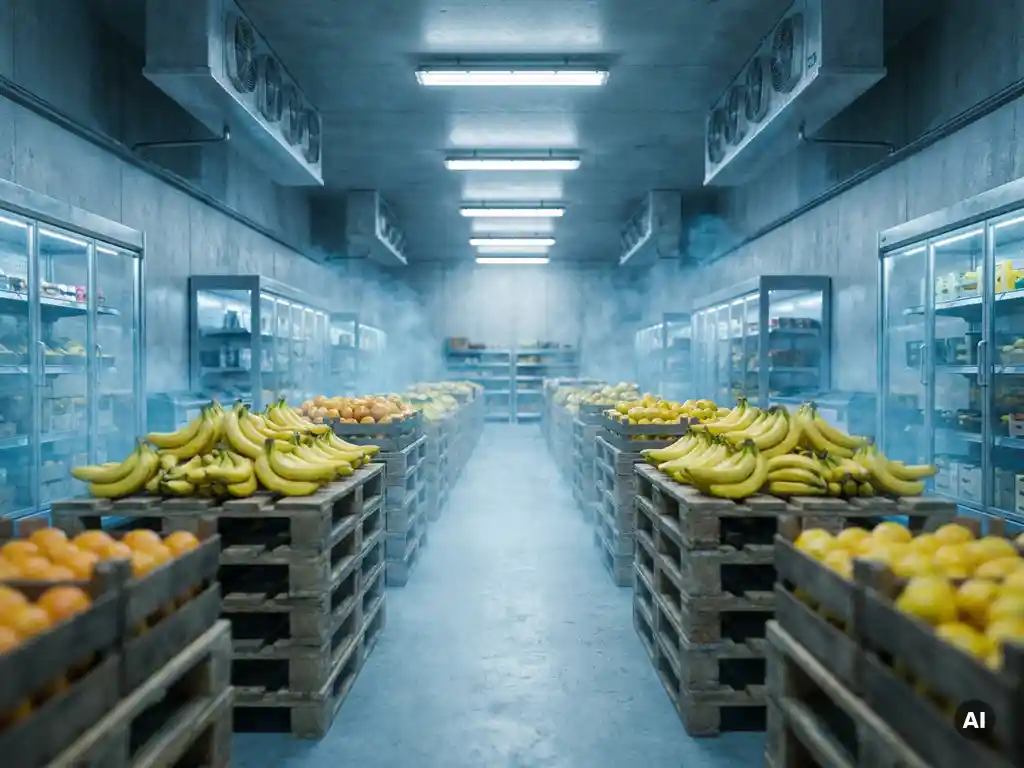
Climate-controlled cold storage is designed for products sensitive to temperature fluctuations, such as exotic fruits, citrus fruits, and other fresh, delicate products. In this form of storage, temperature, humidity, and air circulation are continuously monitored and adjusted. Dry storage at a fixed temperature of approximately 11 degrees is suitable for products that do not require active cooling but do require a stable climate, such as nuts, peanuts, and seeds.
What are the requirements for storing fresh products on pallets?
Storing fresh products on pallets places specific demands on both the storage location and the working methods. The most important requirements are a stable, product-specific temperature, sufficient air circulation, the correct humidity, and a certified storage environment that guarantees food safety. In addition, pallets must be traceable, and the storage partner must be able to respond quickly to quality deviations.
Additional requirements apply from the perspective of regulations and food safety. Storage locations for fresh food products ideally work with recognized certifications such as BRC, SKAL, or KCB/NVWA approval. These certifications provide assurance regarding hygiene, quality assurance, and traceability. For imported products from outside the EU, an import inspection via the NVWA or KCB is mandatory before products may be placed on the market.
At an operational level, it is important that every pallet is provided with clear identification, preferably via a barcode system. This makes it possible to link grower and LOT numbers to specific batches, which is essential for rapid recall procedures and quality control.
How does renting refrigerated or dry storage space by the pallet work?
Renting refrigerated or dry storage space by the pallet typically operates on the basis of a pallet space rate: you pay for the number of pallet spaces you are using at any given time. This model offers flexibility for companies with fluctuating inventory. The exact terms and conditions, such as the minimum rental period, inbound and outbound procedures, and additional services, are set out in a storage agreement.
Upon arrival of a shipment, the pallets are received, checked, and registered in the warehouse management system. Depending on the agreements, this also includes a quality control upon entry, during which the shipment is inspected for damage, temperature deviations, and packaging condition. Pallets that do not meet the quality standards are immediately separated from the batch.
Many storage partners offer additional services alongside pallet storage, such as labeling, barcode application, EDI connections for automated order processing and inventory updates, and shuttle services for regional distribution. This makes the storage location a fully-fledged part of the supply chain, rather than just a storage facility.
What should you look out for when choosing a storage partner for fresh products?
When choosing a storage partner for fresh products, certification, location, flexibility, and technical capacity are the four key factors. A certified partner with the right qualifications provides assurance regarding food safety and traceability. Geographic location determines how quickly products can be placed in storage upon arrival and how efficiently distribution proceeds.
- Certifications: Check whether the storage partner holds relevant certifications such as BRC, SKAL, or KCB/NVWA accreditation. These are not optional if you supply supermarket chains or processing plants.
- Location and port connectivity: A storage location close to the port of arrival significantly shortens the time between unloading and storage. This is particularly relevant for fresh products, where every unnecessary minute outside the correct temperature environment can mean a loss of quality.
- Flexibility: Choose a partner who adapts to fluctuating volumes and sailing schedules. Fixed contracts with little room for adjustment do not suit the dynamic nature of the fresh produce trade.
- Technical systems: Ask about the availability of barcode-driven traceability, EDI connections, and reporting capabilities. This determines how well the storage partner integrates into your own systems.
- Additional services: Consider quality control upon arrival, sorting, labeling, and customs clearance. A partner who can handle the entire process significantly reduces the coordination burden.
What is the difference between cold storage and dry storage for pallets?
The core difference between cold storage and dry storage lies in the temperature range and the degree of climate control. Cold storage actively maintains products at a low temperature, tailored to the specific product, and also precisely regulates humidity and air circulation. Dry storage, also known as ambient storage, stores products at a stable ambient temperature without active cooling, typically around 10 to 15 degrees.
Cold storage: for fresh and perishable products
Cold storage is suitable for products that spoil quickly at higher temperatures, such as exotic fruit, vegetables, and other fresh products. The temperature and humidity are continuously monitored and adjusted. This type of storage requires advanced facilities and a higher operational investment, which is reflected in the storage costs per pallet.
Dry storage: for stable products at ambient temperature
Dry storage is intended for products that do not require active cooling but do require a stable, controlled climate. Examples include nuts, peanuts, seeds, and other dry food products. A dry storage facility with a capacity of 12,000 pallet spaces accommodates large volumes, with separate areas for different product categories. This type of storage is generally more cost-effective than cold storage.
Can pallet storage also include customs clearance?
Yes, many professional warehousing partners in the logistics sector offer customs clearance as part of their services, in addition to pallet storage. This means that the storage location functions as a complete logistics hub: products arrive, are inspected, cleared for customs, and stored, all at one location. This is particularly relevant for importers of products from outside the EU.
For fresh products entering via the port, an import inspection by the KCB (part of the NVWA) is mandatory in many cases. A storage partner that can facilitate this inspection significantly shortens turnaround times and reduces the risk of quality loss due to unnecessary waiting times.
The combination of customs clearance, import inspection, and storage at a single location is particularly valuable for supply chain managers who want to reduce the number of links in the chain. Fewer transfers mean a lower risk of errors, fewer transport movements, and a faster flow from the quay to storage.
How ZZColdstores helps with storage space for pallets of fresh products
ZZColdstores offers a complete package for companies looking for reliable storage space for pallets of fresh products. From locations in Kruiningen and Vlissingen, with its own quay directly next to the cold storage facility in Vlissingen, ZZColdstores handles the entire process from arrival to customs clearance. These are the core components of the service:
- Climate-controlled cold storage for fresh and perishable products such as exotic fruit, with 24/7 monitoring of temperature, humidity, and air circulation.
- Dry storage with a capacity of 12,000 pallet spaces, suitable for nuts, peanuts, seeds, and other dry food products.
- Quality control upon entry, including temperature, humidity, and Brix measurements and a comprehensive QC report
- Barcode-driven traceability with linking grower and LOT numbers to each pallet
- EDI connections for automatic order processing, inbound notifications, and inventory updates
- Import inspection via KCB/NVWA and customs clearance as part of the logistics process
- Certifications: BRC, SKAL and Demeter
Would you like to know which storage solution best suits your products and logistics chain? View the climate-controlled storage options from ZZColdstores or contact us directly for a discussion about your specific situation.
Frequently Asked Questions
What are the minimum quantities for renting pallet storage space for fresh products?
Most professional storage partners do not have a strict minimum requirement regarding the number of pallets, but they do work with a minimum rental period or a minimum invoice amount per period. It is advisable to inquire about the exact rate structure in advance: some partners charge per pallet space per day, others per week or month. For companies with small or fluctuating volumes, a flexible pallet space rate without a long-term contract is often the most cost-effective choice.
How quickly can pallets of fresh products be loaded after arrival at the port?
With a storage partner located directly next to the quay, pallets can typically be received within a few hours of unloading. This is crucial for fresh products, where every minute outside the correct temperature environment can cause a loss of quality. Therefore, preferably choose a partner that offers the inbound procedure, quality control, and registration in the warehouse management system as a single integrated process, so that no unnecessary waiting times occur.
What happens if a batch does not meet the quality standards upon arrival?
A professional storage partner immediately separates non-conforming pallets from the rest of the batch following the quality control upon arrival. Subsequently, a detailed QC report is drawn up detailing findings regarding temperature deviations, damage, or packaging issues, which is immediately shared with the client. Based on this, the importer or supply chain manager can quickly decide on next steps, such as returns, processing, or rejection, which is essential for limiting financial losses.
As a small importer, can I also turn to a professional pallet storage partner, or is that only for large volumes?
Yes, even smaller importers can make use of professional pallet storage facilities. Thanks to the pay-per-pallet model, you only pay for the space you actually use, without having to rent an entire warehouse. This makes professional, certified storage accessible to companies at every growth stage, as long as you take into account any minimum invoice amounts or administrative fees charged by the storage partner.
Which certifications are required for storing organic fresh produce?
For the storage of organic fresh products, SKAL certification of the storage location is mandatory in the Netherlands. SKAL is the official certification body for organic production in the Netherlands and verifies whether the storage environment meets the strict requirements for organic products, including the separation of non-organic products and specific hygiene requirements. Additionally, check whether the storage partner holds supplementary certifications such as BRC or Demeter, depending on the requirements of your customers.
How do I ensure that my inventory data is always up to date with an external storage partner?
The most reliable way is to work with a warehousing partner that offers EDI connections, allowing inbound notifications, inventory movements, and outbound confirmations to be automatically forwarded to your own systems. When selecting a warehousing partner, specifically ask about the available integration options with your ERP or order management system. If a full EDI connection is not immediately possible, many partners also offer an online portal or periodic reports as an alternative.
What are the most common mistakes made when choosing a storage partner for fresh produce?
A common mistake is selecting primarily based on price per pallet space, without taking into account the total costs of the logistics process, such as additional costs for quality control, labeling, or customs clearance that are invoiced separately elsewhere. Additionally, many importers underestimate the importance of location: a cheaper storage location far from the port can ultimately turn out to be more expensive due to extra transport time and costs. Finally, certification status is too often viewed as a secondary matter, while supermarket chains and processing plants are checking this increasingly strictly.
Related articles
- How is the temperature controlled during cold storage?
- What is cross-docking and when is it an alternative to buffer storage?
- How does packaging quality affect the shelf life of dried fruit?
- What is dry storage and when do you need it?
- What is buffer storage and how does it help your factory run stably?