
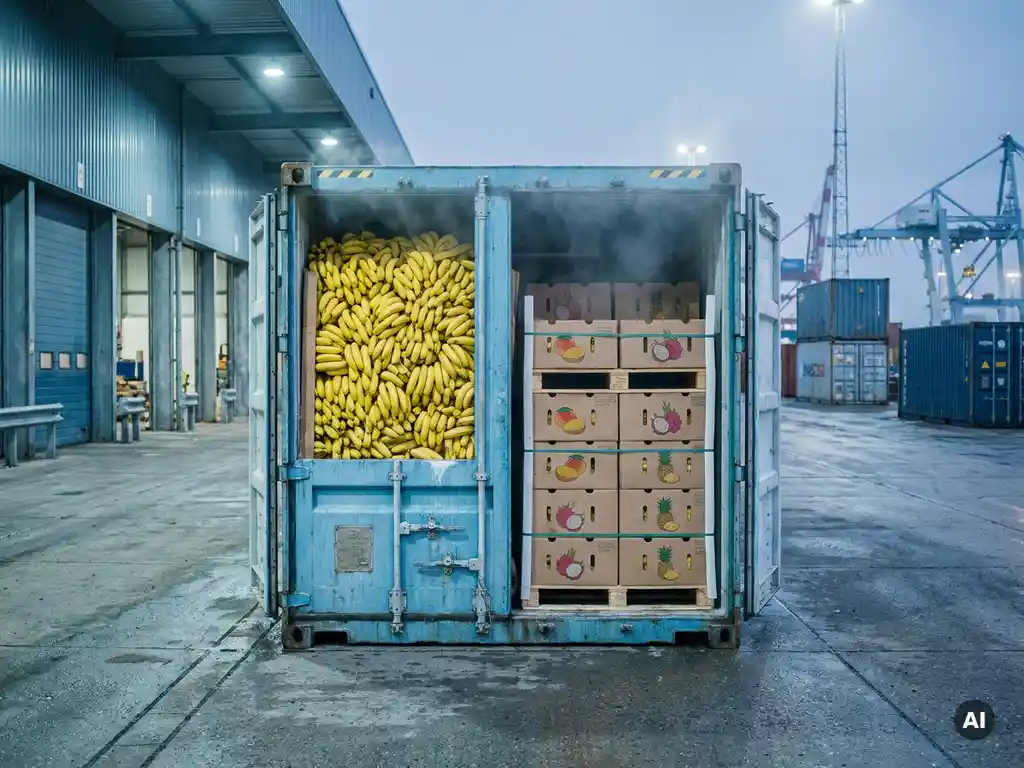
The difference between a floor-loaded container and a palletized container lies in the way goods are loaded and stacked. In a floor-loaded container, products are stacked directly on the container floor without the use of pallets. In a palletized container, goods rest on pallets that are driven or hoisted in as a single unit. Both methods have specific advantages and disadvantages that depend on the product, the supply chain, and the logistical context.
For importers and supply chain managers of fresh products such as exotic fruit, this choice is anything but trivial: it determines how quickly and safely a shipment can be unloaded, how the climate inside the container is utilized, and what costs are associated with handling. This article answers the most frequently asked questions about both methods.
How are goods stacked in a floor-loaded container?
In a floor-loaded container, boxes, bags, or other units are stacked manually and directly on the container floor, row by row and layer by layer. No pallets are used. The goods are placed as compactly as possible to utilize the maximum volume of the container. This requires manual labor during both loading and unloading.
The stacking method depends heavily on the product. Boxes of fruit are typically stacked in a staggered pattern to create stability. The height is determined by the load-bearing capacity of the bottom boxes and the internal height of the container. For fragile products, spacers or corner protectors are sometimes used to prevent damage.
An important feature of floor drawers is that space is utilized optimally: without the extra height occupied by pallets, more units fit into the same container. This can make the difference with large volumes and tight margins. The downside is that unloading is labor-intensive and takes more time than with palletized cargo.
How does palletizing differ from floor drawers in terms of handling?
With palletized containers, goods are loaded onto pallets, after which the pallets are driven into the container as a whole using a forklift or pallet truck. With floor loading, everything is done manually, box by box. The difference in handling is therefore fundamental: palletizing is mechanical and fast, while floor loading is labor-intensive but more volume-efficient.
When unloading a palletized container, a forklift can immediately pick up the pallets and drive them to the storage area. This is significantly faster than manually unloading a floor-loaded container, where each box is removed separately. For products where speed of unloading is crucial, such as chilled fruit that must undergo minimal temperature fluctuations, this is a relevant difference.
Palletization also simplifies further automation in the warehouse. Pallets are easy to scan, weigh, and register as a unit. With floor loading, counts and inspections must take place at the box level, which requires more time and personnel.
Which method is better for temperature-sensitive fruit?
For temperature-sensitive fruit such as bananas and citrus fruits, palletizing is generally preferred because unloading time is shorter and the load can be moved to a controlled cooling environment more quickly. Floor loading increases the risk of temperature fluctuations due to the longer unloading period, which can negatively affect shelf life.
However, it is not an absolute rule. Some fruit varieties are shipped floor-loaded as standard, simply because the packaging form or volume dictates it. In that case, an efficient unloading location with a short distance between the container and the cold storage is of great importance. The sooner the cargo reaches a climate-controlled space after opening the container, the better the quality is preserved.
Airflow within the container also plays a role. Pallets with ventilation openings ensure better circulation of cooled air around the products during transport. With floor drawers, airflow is more dependent on the stacking method, which can be less efficient with dense stacking.
When do shippers choose floor drawers instead of pallets?
Shippers opt for floor loading when they want to extract the maximum volume from a container and the additional handling costs during unloading are acceptable. This is particularly relevant for products with a low unit value, where the difference in container space utilization directly impacts transport costs per unit.
There are several situations where floor drawers are the logical choice:
- The product is packed in boxes or bags that cannot be stacked stably on pallets without additional aids.
- The receiver has sufficient manual unloading capacity, and the unloading speed is not a critical factor.
- The value per cubic meter is relatively low, meaning that volume optimization outweighs ease of handling.
- The container route is long and the unloading time is scheduled outside the most critical temperature windows.
- Pallets are not available at the source location or are too expensive to return.
For higher-value products or those with a stricter cold chain, such as bananas ripe for delivery, the benefits of fast pallet handling usually outweigh the volume gains of floor drawers.
What are the costs of floor loading versus palletized transport?
Floor loading generally results in lower transport costs per unit, because more product fits in the same container. Palletized transport entails higher handling costs at the loading end, but saves on unloading time and personnel at the receiving end. The total cost balance depends on the entire chain, not just on freight rates.
The following cost factors play a role in the comparison:
- Transport costs: Floor loading utilizes container volume better, which can lead to fewer containers for the same amount of product for large volumes.
- Unloading handling costs: Floor-loaded containers require more manpower and time during unloading, which increases labor costs.
- Pallet costs: Palletized cargo requires pallets that are either brought along, returned, or purchased locally. This entails additional costs or logistical complexity.
- Loss of quality: Longer unloading times for floor drawers can lead to a loss of quality in temperature-sensitive products, which indirectly causes costs through rejects or a shorter shelf life.
- Storage costs: Palletized cargo is easier and faster to store, which reduces time in the receiving zone and improves throughput.
An accurate cost calculation therefore requires insight into the entire chain: from loading at the producer to storage at the receiver.
How does the choice affect container handling in the port?
The choice between a floor-loaded container and a palletized container has direct consequences for handling in the port. Palletized containers can be unloaded faster using mechanical means, which reduces turnaround time at the terminal. Floor-loaded containers require more time and personnel, which affects the planning and capacity of the unloading location.
In ports where containers are transferred directly from ship to cold storage facilities, such as at terminals with their own quay, the unloading time per container is a critical variable. The longer a container remains open, the greater the risk of temperature fluctuations. For chilled fruit, this means that the logistical choice already affects product quality upon arrival during loading in the country of origin.
In addition, dry storage capacity plays a role in planning: if floor-loaded containers are scheduled for unloading later due to the higher labor load, this can lead to longer dwell times in the port and higher demurrage or detention costs.
For freight forwarders and terminal operators, it is therefore important to take the type of cargo into account during arrival planning: floor-loaded or palletized, refrigerated or ambient. This partly determines the required capacity on the unloading day.
How ZZColdstores helps with container handling and storage
ZZColdstores handles the complete processing of both floor-loaded and palletized containers, with particular expertise in temperature-sensitive fruit such as bananas and citrus fruits. Containers are unloaded directly from their own quay in Vlissingen and placed in the cold storage, minimizing exposure to temperature fluctuations.
What ZZColdstores offers for shippers and supply chain partners:
- Unloading of both floor-loaded and palletized refrigerated containers, tailored to the type of product and the desired speed.
- Climate-controlled storage with precise setting of temperature, humidity, and air circulation, monitored 24/7.
- Dry storage for ambient products such as nuts, peanuts, and seeds, with a capacity of 12,000 pallet spaces.
- Flexible scheduling that aligns with the sailing schedule of incoming vessels.
- Import inspection via KCB (part of the NVWA) and customs clearance as part of the service package.
Would you like to know which handling method best suits your cargo and logistics chain? Contact ZZColdstores for a consultation with one of our specialists.
Author: Frans van der Maas, Operations Director at ZZColdstores
Frequently Asked Questions
Can a container contain both floor-loaded and palletized cargo in a single shipment?
Yes, this is technically possible but is rarely applied in practice. Combining both methods in a single container makes stacking more complex and reduces the efficiency benefits of both methods. For clear handling and correct documentation, it is strongly recommended to choose one loading method per container.
Which pallet sizes are most commonly used for palletized refrigerated containers, and does the size matter?
In Europe, the Euro pallet size (80 x 120 cm) is the most common, but in the international fruit trade, pallets of 100 x 120 cm or 110 x 110 cm are also frequently used. The pallet size certainly matters: an incorrect size can lead to inefficient utilization of the container width, which directly reduces the number of pallets that fit. Always match the pallet size to the internal dimensions of the container type being used.
How do I prevent damage to boxes in floor drawers, especially with fragile fruit varieties?
The most important measures are the use of boxes with sufficient stacking strength, applying a staggered stacking pattern for stability, and placing corner protectors or spacers for fragile products. Also ensure that the boxes are dry and undamaged before loading, as damp boxes quickly lose stacking strength and increase the risk of collapse during transport.
What happens if a floor-loaded container is scheduled for unloading later than planned upon arrival?
Delays in the unloading schedule increase the risk of quality loss, particularly with chilled fruit. The container then remains at the terminal longer, during which time cooling depends on the terminal's power connection (reefer plug). Furthermore, demurrage and detention costs can increase if the container remains in use beyond the designated clearance period. It is therefore advisable to build in an extra buffer in the planning for floor-loaded refrigerated containers and to establish agreements regarding unloading priority in advance.
Are floor drawers also suitable for certified organic fruit, or are there additional requirements for that?
In principle, certified organic fruit may be shipped floor-loaded, but strict requirements apply regarding the separation of non-organic products and the cleanliness of the container. The container must be demonstrably free of plant protection product residues and must not have been previously used for unauthorized products. Always have the container status documented and check whether the certifying body imposes additional requirements regarding loading and unloading conditions.
How is airflow in floor-loaded refrigerated containers optimized to prevent loss of quality?
With floor drawers, good airflow depends on the stacking method and the packaging shape. Boxes with ventilation openings on the sides and top significantly improve the circulation of cooled air. Avoid completely sealing the space between the stack and the container walls, and take into account the T-bar floor of the reefer container, which directs air through the load from below. Consult the manufacturer's guidelines or your refrigeration specialist for the optimal stacking configuration per fruit type.
What do I need to arrange if I am having a floor-loaded refrigerated container unloaded at a new unloading location for the first time?
Inform the unloading location in advance about the type of cargo, the number of boxes, the required temperature, and the expected unloading time. Verify that the location has sufficient manual unloading capacity and direct access to a cold room to minimize exposure to outside temperatures. Also inquire about the availability of a reefer power connection in case the container arrives earlier than planned, ensuring uninterrupted cooling.
Related articles
- When is climate-controlled cold storage necessary?
- How much does it cost to rent a storage unit?
- How do you plan the inventory turnover of dry raw materials with a long lead time?
- What is a European hub and why do importers choose one?
- What is the difference between a warehouse and a distribution center?