
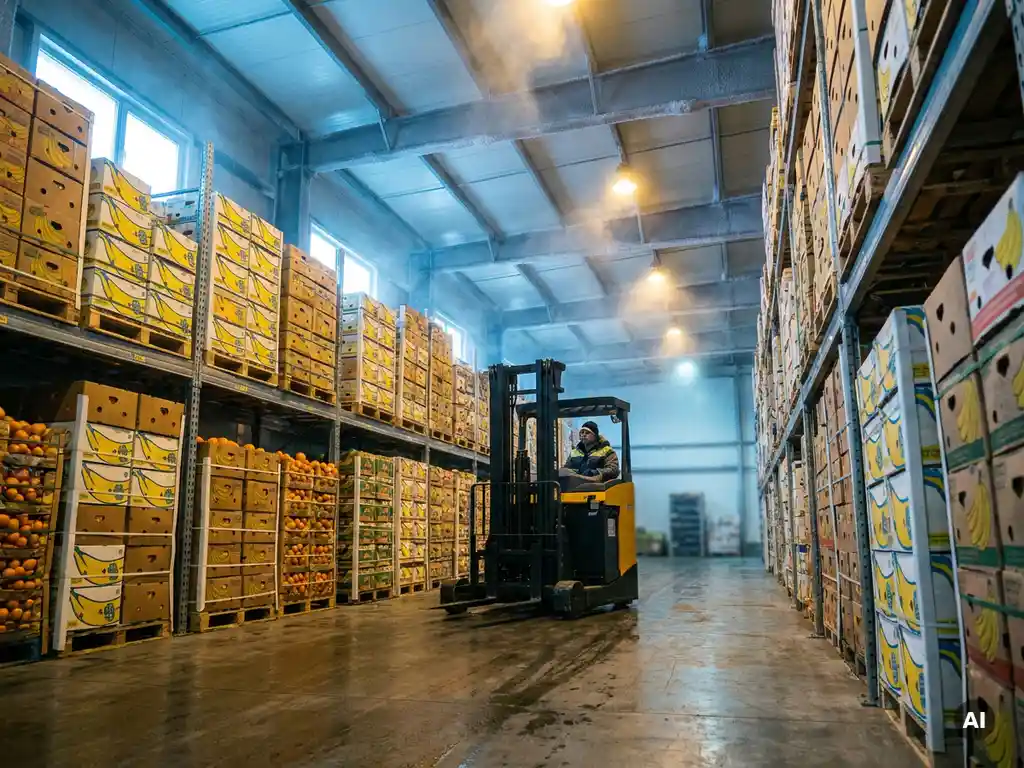
Warehousing encompasses all activities necessary to safely store, manage, and prepare goods for further distribution. This involves much more than simply placing pallets in a warehouse: from quality control upon arrival to container handling, from administrative processing to order fulfillment. For B2B players in food logistics, such as importers, wholesalers, and suppliers to supermarkets, a well-designed warehouse is a critical link in the supply chain. In this article, we answer the most frequently asked questions about warehousing, from basic activities to the question of when outsourcing makes sense.
Which activities fall under warehousing?
Warehousing encompasses the entirety of logistical activities surrounding the storage and processing of goods. Specifically, this involves the receipt and storage of goods, quality control, storage under the correct conditions, order picking, packaging and labeling, and ultimately dispatch and loading. Within a professional warehouse, administrative and digital processes also come together, such as inventory management and system integrations.
A complete warehouse package typically consists of the following core activities:
- Inbound processing: receipt of goods, checking quantities and quality, registration in the system
- Storage: placement in the correct location, under the correct temperature and humidity conditions
- Value Added Logistics (VAL): quality control, sorting, repalletizing and sampling
- Value Added Services (VAS): labeling, applying barcodes, activating EDI connections
- Order picking: assembling orders based on customer specifications, including box picking
- Outbound processing: dispatch, preparation for loading and loading
For food products, and especially for fresh or perishable goods, quality control upon arrival is an indispensable part of the process. Shipments are checked for damage, temperature deviations, and the condition of the packaging. Products that do not meet the set standards are immediately separated from the rest of the batch to ensure the quality of the remaining goods is maintained.
What is the difference between cold storage and dry storage?
The main difference between cold storage and dry storage lies in the storage conditions. Cold storage, also known as climate-controlled storage, keeps products at a precisely regulated temperature and humidity to prevent spoilage. Dry storage, also known as ambient storage, is intended for products that remain stable at room temperature or a fixed lower temperature, without active cooling.
In cold storage, temperature, humidity, and air circulation are continuously monitored, often 24 hours a day. This is essential for fresh products such as exotic fruit, which deteriorate rapidly if conditions deviate even slightly. Dry storage is less intensive in terms of climate control but does require stable conditions: a constant temperature of, for example, around 11 degrees Celsius is ideal for many dry food products to prevent loss of quality.
Both storage forms can be present in the same warehouse but require separate rooms with their own climate settings. The choice depends entirely on the product and the requirements of the customer or certifying body.
Which products are suitable for dry storage?
Dry storage is suitable for products that do not require active cooling but benefit from a stable, controlled environment. Examples include nuts, peanuts, seeds, grains, and dried food products. These products are sensitive to moisture and temperature fluctuations but do not require constant cooling.
Dry storage is explicitly not intended for fresh, perishable products. Products suitable for ambient warehousing typically have the following characteristics:
- Low moisture sensitivity or hermetic packaging
- No risk of spoilage at room temperature or slightly refrigerated conditions
- A longer shelf life that does not require active refrigeration
- No specific atmospheric requirements such as controlled atmosphere or ethylene management
Potato products, such as potato flakes produced by processing plants, are also well suited for dry storage, provided that the temperature and humidity remain within the correct limits. For each product group, it is important to take the specific storage requirements of the manufacturer or certifying body as a starting point.
How does container handling work within a warehouse?
Container handling within a warehouse involves unloading, inspecting, processing, and, if necessary, repalletizing goods delivered by container. The process begins upon the arrival of the container, after which the contents are unloaded, checked for quality and quantities, and subsequently stored or forwarded directly to the next link in the chain.
Unloading a container can take place in two ways: if the goods are loose, they are immediately palletized and stacked during unloading in accordance with applicable transport and storage requirements. For palletized shipments, the pallets are immediately checked for completeness and the condition of the packaging. If necessary, pallets can be reconfigured, extra layers of boxes added or removed, and re-wrapped for additional stability.
A favorable location relative to the port significantly shortens the time between unloading from the ship and storage. The shorter this time, the less quality loss, especially for temperature-sensitive products. Having a private quay directly next to the cold storage facility, as in Vlissingen, minimizes this time difference.
What are the certifications a warehouse must have?
A professional warehouse that stores food products must possess relevant food safety certifications. The most requested are BRC (British Retail Consortium) and SKAL for organic products. For fruit undergoing import inspection, the involvement of KCB (part of the NVWA) is required. Which certifications are necessary depends on the product, the customer, and the destination.
BRC certification
BRC is an international food safety standard required by most European retailers and supermarket chains. A BRC-certified warehouse meets strict requirements regarding hygiene, traceability, risk management, and process control. In practice, for suppliers to supermarkets, this certificate is a strict requirement.
SKAL and Demeter
SKAL certifies organic products and is required when a warehouse stores or processes organic food products. Demeter goes a step further and focuses on biodynamic products. For importers and wholesalers who process organic flows, SKAL certification of the warehouse is a prerequisite for maintaining the organic status of the product.
When is outsourcing warehousing worthwhile?
Outsourcing warehousing makes sense when storage needs fluctuate, when specific climate conditions are required that are not available internally, or when logistical complexity exceeds the in-house organization's capacity. For many importers and wholesalers, building and managing their own certified warehouse is costly and operationally intensive.
Outsourcing offers concrete benefits in the following situations:
- Volumes vary seasonally, and fixed storage capacity is not efficient
- The product requires climate-controlled storage, for which specific installations and certifications are necessary
- The company wants to focus on purchasing, sales, or production instead of logistics
- There is a need for a warehouse close to a port for fast container handling and import inspection
- The customer sets requirements for certifications such as BRC or SKAL that are not met internally
Outsourcing is less logical when volumes are stable and predictable, products have no special storage requirements, and the company already possesses certified own space that is utilized efficiently.
How ZZColdstores implements warehousing for food logistics
ZZColdstores offers a complete warehouse package for B2B players in food logistics, with locations in Kruiningen and Vlissingen. The services include:
- Climate-controlled storage for fresh and perishable products, with 24/7 monitoring of temperature, humidity, and air circulation
- Dry storage for nuts, peanuts, seeds, and other food products, with a capacity of 12,000 pallet spaces
- Container handling, including unloading, quality control, repalletizing and storage
- VAL and VAS services such as QC reporting, labeling, barcode traceability, and EDI connections
- Own shuttle transport within a radius of 40 kilometers around Kruiningen
- Certifications: BRC, SKAL and Demeter
Our own quay in Vlissingen enables direct transfer from ship to refrigerated storage, optimally protecting the quality of temperature-sensitive products such as bananas and citrus fruits. Would you like to know more about climate-controlled storage or discuss which warehouse services suit your logistics situation? Contact ZZColdstores for a no-obligation consultation.
Frequently Asked Questions
How quickly can goods be stored in a professional warehouse after arrival?
The lead time from arrival to storage depends on the type of product, the condition of the shipment, and the required checks. With an efficient warehouse layout featuring direct container access—such as a dedicated quay—goods can be unloaded, inspected, and stored within a few hours. For temperature-sensitive products, this speed is crucial to minimize quality loss.
What is the difference between VAL and VAS, and do I need both?
Value Added Logistics (VAL) focuses on physical operations that improve the logistics flow, such as repalletizing, sorting, and quality control. Value Added Services (VAS) encompass more commercially oriented services such as labeling, barcoding, and EDI connections. Whether you need both depends on the requirements of your customers: supermarket chains generally place higher demands on both VAL and VAS than smaller wholesalers.
What happens if part of my shipment does not meet the quality requirements upon arrival?
Rejected or questionable products are immediately separated from the approved batch to prevent cross-contamination or loss of quality in the rest of the shipment. A professional warehouse prepares a QC report on this, so that you, as an importer or wholesaler, have documented evidence to present to your supplier or insurer. Depending on the situation, the rejected goods are returned, destroyed, or placed in quarantine.
As an importer, can I view my inventory in real time via a connection with my own system?
Yes, most professional warehouses nowadays offer system integrations via EDI or API that allow you to receive inventory information directly into your own ERP or order management system. This gives you real-time insight into quantities, locations, and movements without manual reporting. When selecting a warehouse partner, always ask about the available integrations and whether they are compatible with your current systems.
How do I choose the right warehouse partner for my specific product group?
Start by mapping out the specific storage requirements of your product: does it require refrigeration, are there certification requirements from your customers, and how variable are your volumes throughout the year? Next, check whether the potential partner possesses the appropriate certifications (such as BRC or SKAL), the necessary climate control facilities, and experience with similar product groups. A no-obligation consultation with a warehouse specialist will help you quickly determine whether the collaboration is logistically and operationally feasible.
What are the most common mistakes made when setting up your own warehouse for food products?
A common mistake is underestimating the requirements surrounding climate control: temperature and humidity fluctuations that seem small can have major consequences for shelf life and product quality. Additionally, certifications such as BRC and SKAL are often included too late in the process, even though customers require them as strict conditions. Finally, many companies underestimate the operational complexity of inventory management, traceability, and system integration involved in professional food logistics.
Is outsourcing warehousing also interesting for smaller importers, or only for large volumes?
Outsourcing is particularly attractive for smaller importers, as it provides them with access to certified facilities and professional processes without the high fixed costs of their own warehouse. You only pay for the space and services you actually use, offering flexibility during growth or seasonal peaks. For smaller players, outsourcing is often the fastest way to meet the demands of large customers such as supermarket chains.
Related articles
- What storage space do you need for temperature-sensitive foods?
- How does warehousing handle unexpected peaks in supply?
- Can you rent storage space for pallets of fresh produce?
- How does the transit of dry goods to Germany or Ukraine work?
- How do you switch from on-premises storage to outsourced ambient storage?