Outsourcing warehousing to a logistics partner makes sense as soon as your own storage capacity is structurally insufficient, operational costs become too high, or the complexity of product management falls outside your organization's core competence. For B2B companies in the agri-food sector, such as importers of exotic fruit or wholesalers of dry food products, outsourcing is often not only more practical but also strategically smarter. This article answers the most frequently asked questions about when and how best to take that step.
What signals indicate that own storage is insufficient?
In-house storage falls short when you experience a structural lack of space, product quality deteriorates due to insufficient climate control, or when your logistics team spends more time on warehouse management than on the company's core activities. These are not temporary growing pains, but structural bottlenecks that require immediate action.
Concrete signals to look out for:
- Products are stored outside the ideal temperature zone due to a lack of refrigerated space
- Inventory management is manual and leads to errors in orders or traceability
- Seasonal peaks result in repeated space shortages or extra costs for temporary solutions
- Quality complaints are increasing due to insufficient control during intake or output
- Employees spend a disproportionate share of their time on logistical tasks instead of on core commercial or operational tasks
When multiple of these signals occur simultaneously, it is a clear indication that the proprietary infrastructure is no longer keeping up with the growth or product-specific requirements.
What are the benefits of outsourcing warehousing to a 3PL?
Outsourcing warehousing to a third-party logistics provider (3PL) gives you access to specialized infrastructure, certified storage environments, and scalable capacity, without having to invest in real estate, systems, or personnel yourself. You pay for what you use and benefit from the expertise of a partner whose core business is logistics.
The main benefits are:
- Scale flexibility: storage capacity adapts to seasonal peaks or product range growth
- Quality assurance: certified partners (such as BRC, SKAL, KCB/NVWA) guarantee food safety and traceability.
- Operational support: from quality control upon arrival to barcode-driven traceability and digital system connections (EDI)
- Value-added services: operations such as labeling, repalletizing, box picking, and sampling are performed by the partner.
- Faster lead times: a well-positioned 3PL, preferably in the vicinity of a port or production location, significantly shortens the supply chain.
Moreover, for companies supplying supermarket chains or processing plants, the added value of a 3PL with demonstrable certifications is a requirement, not a luxury.
When is outsourcing storage financially more attractive than having your own warehouse space?
Outsourcing storage is financially more attractive than owning your own warehouse space once the fixed costs of your own real estate, installations, maintenance, and personnel exceed the variable costs of an external partner. This point is reached sooner than many companies expect, especially when specialized climate control is required.
Owning your own cold storage warehouses requires significant investments in compressors, insulation, monitoring systems, and maintenance. On top of that come personnel costs, certification costs, and fixed real estate costs. With a 3PL, these costs are shared across multiple customers, resulting in a lower price per pallet space.
Outsourcing is particularly financially attractive when:
- The utilization rate of own storage fluctuates strongly due to seasonal demand
- Specific climate requirements (temperature, humidity) require expensive installations that you cannot fully utilize
- Growth or contraction of volume leads to overcapacity or a structural shortage
- Investment budget can be better utilized in the company's core activity
Which products are best suited for outsourced storage?
Products best suited for outsourced storage are goods with specific climate requirements, a short shelf life, or strict traceability requirements. This applies in particular to fresh food products such as exotic fruit and vegetables, and dry food products such as nuts, peanuts, and seeds.
Two categories stand out:
Fresh and temperature-sensitive products
Products such as bananas and citrus fruits require precise temperature and humidity control throughout the entire storage period. Even a slight deviation in climate conditions can lead to quality loss, rejection by the buyer, or food safety incidents. A specialized partner with climate-controlled cells that are monitored 24/7 offers the most reliable environment for this.
Dry food products with stable storage conditions
Nuts, peanuts, seeds, and similar dry products require a clean, stable environment at a constant temperature, typically around 11 degrees. Although less critical than cold storage, certifications and hygiene standards are also decisive for the suitability of a storage partner here, particularly when the final destination is supermarkets or processing plants.
How do you choose the right logistics partner for warehousing?
You choose the right logistics partner for warehousing based on product-specific expertise, relevant certifications, geographical location, and the extent to which the partner adds value to your supply chain. Price is a factor, but it should never be the sole selection criterion for goods that must meet strict quality standards.
Criteria for a targeted selection:
- Certifications: check whether the partner holds relevant certificates such as BRC (food safety), SKAL (organic products), and KCB/NVWA accreditation for import inspections.
- Product knowledge: a partner with demonstrable experience in your product category makes fewer mistakes and acts faster in the event of deviations.
- Location and port connection: proximity to the port or a private quay shortens the chain and limits quality loss during transshipment.
- System integration: possibility of EDI connections for automatic order processing, inventory updates, and status reporting
- Flexibility: the partner must be able to adapt to your sailing schedule, seasonal peaks, and product-specific requirements.
- Traceability: barcode-driven systems that link grower and LOT numbers to products are indispensable for suppliers to supermarkets.
What is the difference between outsourcing cold storage and dry storage?
The difference between outsourcing cold storage and dry storage lies in the infrastructure requirements, the eligible product categories, and the degree of climate control required. Cold storage requires active temperature and humidity control; dry storage requires a stable, controlled environment without active cooling.
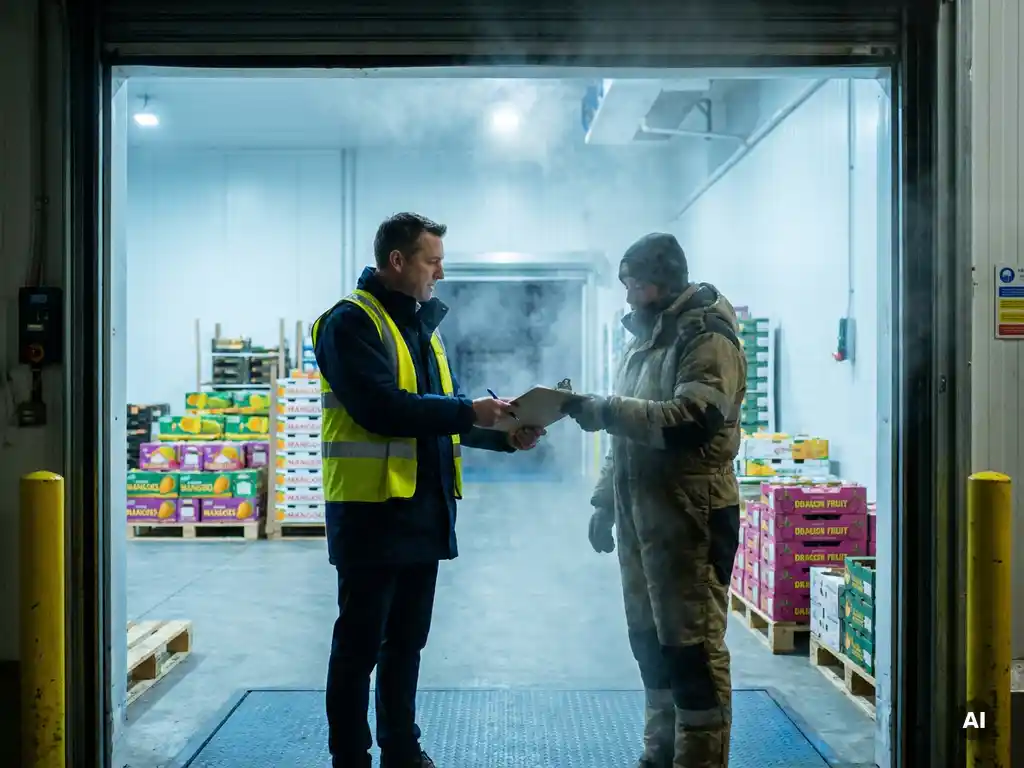
In cold storage , fresh and perishable products are stored in climate-controlled chambers that are continuously monitored for temperature, humidity, and air circulation. The settings vary by product type and are specifically tailored to the requirements of the goods. This type of storage is indispensable for products such as exotic fruit, where even minor deviations lead to a loss of quality.
Dry storage concerns products stored at a stable ambient temperature, typically around 10 to 12 degrees, without active cooling. Examples include nuts, peanuts, seeds, and other dry food products. The requirements for hygiene, traceability, and certification are comparable, but the technical installations are less intensive.
For companies trading both types of products, a partner with both climate-controlled and dry storage capacity at the same location is logistically the most efficient. It prevents unnecessary transport movements and enables combined quality control upon arrival.
How ZZColdstores helps with warehousing
ZZColdstores offers specialized warehousing solutions for B2B companies in the agri-food sector, with locations in Kruiningen and Vlissingen. Whether it concerns climate-controlled cold storage for fresh exotic fruit or dry storage for nuts and seeds, the company combines product-specific expertise with demonstrable certifications (BRC, SKAL, KCB/NVWA).
What ZZColdstores specifically offers:
- Climate-controlled cells with 24/7 monitoring of temperature, humidity, and air circulation
- Dry storage capacity of 12,000 pallet spaces for nuts, peanuts, seeds, and similar products
- Own quay in Vlissingen for direct transfer from ship to cooling
- Quality control, sampling, and barcode-driven traceability per pallet
- Value-added services such as labeling, repalletization, box picking, and EDI system integrations
- Shuttle transport within a radius of 40 km for direct connection with production locations
Would you like to know if outsourced warehousing is the right step for your product flow? View our range of climate-controlled storage or contact ZZColdstores for a discussion about your specific situation.
Frequently Asked Questions
How long does it take on average to switch to an external warehousing partner?
The lead time for a successful transition to an external warehousing partner typically varies between four and twelve weeks, depending on the complexity of your product portfolio and the required system integrations. Allow time for setting up EDI connections, transferring inventory information, and aligning operational procedures. A phased transfer, starting with one product category or one storage location, significantly reduces risk and gives both parties the opportunity to properly align processes.
What are the most common mistakes when selecting a 3PL partner for food products?
The most common mistake is selecting a partner based purely on the lowest price, without paying sufficient attention to product-specific expertise and certifications. Other common errors include underestimating the importance of location relative to the port, failing to verify whether the partner has experience with your specific product category, and the lack of clear agreements regarding traceability and reporting. Always ask for references from customers with similar products and do not rely on general logistics experience if your products require specific climate or hygiene standards.
How do I, as a client, keep track of my inventory if storage is outsourced?
A professional 3PL partner offers real-time insight into your inventory via a Warehouse Management System (WMS) that can be linked to your own ERP or order management system via EDI. You receive automatic updates upon receipt, dispatch, and inventory movements, ensuring you have an up-to-date picture of your goods flow at all times. When concluding the contract, ensure you make clear agreements regarding the frequency and format of reports, including LOT numbers and grower information for full traceability.
Can I outsource my warehousing if I also process organically certified products?
Yes, but then it is essential that your partner holds SKAL certification, which is specifically required for the storage and processing of certified organic products in the Netherlands. Without this certification, a 3PL is not permitted to store or handle your organic products as such, which affects the certification status of your goods. When selecting a partner, check not only whether the certification is present, but also whether the partner has separate storage capacity to prevent contamination with non-organic products.
What happens if my volume fluctuates heavily due to seasonal demand? Can a 3PL handle that well?
Seasonal flexibility is actually one of the biggest advantages of outsourced warehousing: a good 3PL has multiple customers and can redistribute capacity internally, meaning you only pay for the pallet spaces and services you need at that moment. When concluding the partnership, however, be sure to explicitly discuss the expected peaks and valleys in your volume so that the partner can take this into account in their planning. Also, make agreements regarding minimum purchases outside the season so that you are not faced with surprises during quieter periods.
Are there specific contractual agreements I need to make when outsourcing warehousing for food products?
For food products, a number of contractual agreements are particularly important: consider clear SLAs (Service Level Agreements) for quality control upon arrival, maximum response times for deviations in climate conditions, and liability arrangements for quality loss resulting from storage. Also specify how recall situations will be handled, who is responsible for communication with the NVWA or other authorities, and how traceability data is stored and shared. If necessary, have the contract reviewed by a specialist in logistics or food law to mitigate risks.
Can I also turn to a 3PL for distribution to my customers, or is warehousing a separate service?
Many specialized 3PL partners offer warehousing and distribution as an integrated service, which is logistically and administratively much simpler than working with multiple parties. Examples include shuttle transport to production locations, direct delivery to supermarkets or processing plants, and combined quality control at both inbound and outbound. When selecting a partner, explicitly ask about the geographical scope of the distribution services and whether they align with your customer locations, so that you can entrust the entire chain to a single partner.
Related articles
- What requirements must professional food storage meet?
- Which checks are important when storing imported food products?
- How does warehousing work after the arrival of a sea container?
- How does the logistics chain from port to factory for dry raw materials work?
- Why is conditioned storage better than a regular warehouse for nuts?