
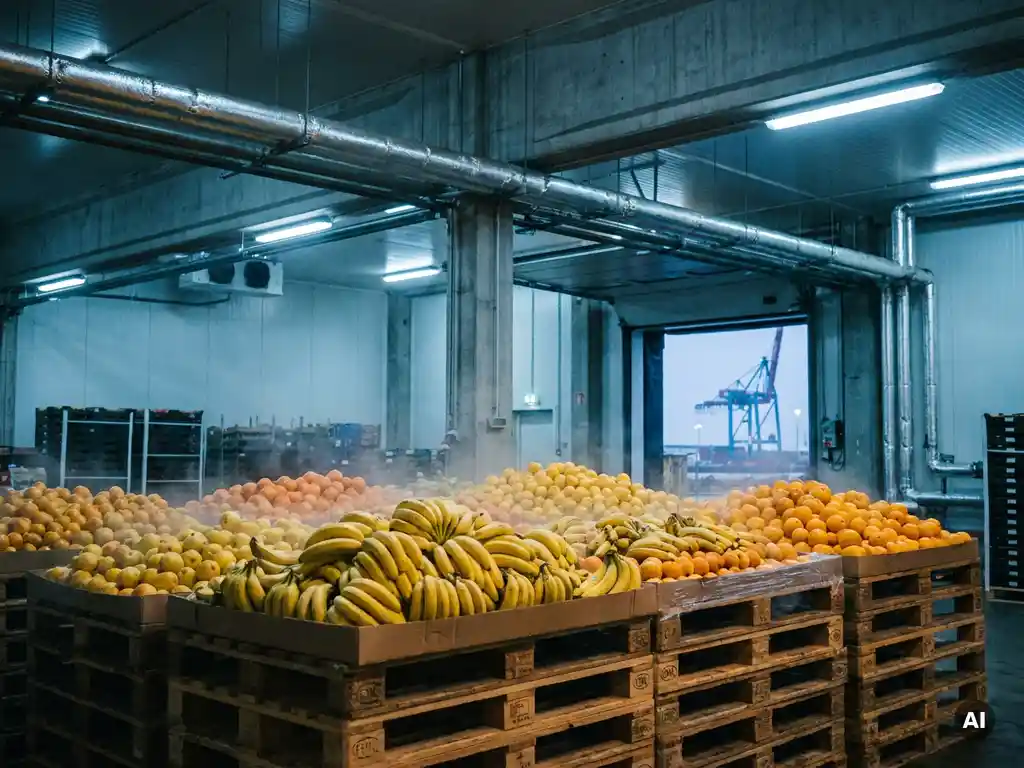
Warehousing acts as the link between unloading at the port and delivery to the end customer. Without a well-equipped storage facility, products lose quality, delivery schedules are delayed, and the supply chain loses its grip on traceability and compliance. This article answers the most frequently asked questions about warehousing in food logistics, from storage types and certifications to choosing the right partner.
What happens to goods between unloading and delivery?
Between the moment of unloading in the port and final delivery to the customer, goods go through a series of logistical steps: quality control, storage under the correct conditions, order picking, labeling, and preparation for transport. Each of these steps determines the final quality and the speed at which products reach the market.
An incoming inspection typically takes place immediately upon arrival. During this process, shipments are inspected for damage, temperature deviations, and packaging errors. Products that do not meet specifications are immediately separated from the approved batch to ensure the quality of the rest of the cargo remains guaranteed.
Subsequently, the goods are stored in an environment tailored to their specific requirements: refrigerated, ambient, or dry. Only when an order is ready for shipment are products picked, optionally provided with customer-specific labels and palletized, and handed over to transport. The shorter and more streamlined this process is, the lower the risk of quality loss or delay.
What types of storage are available for food products in the port?
For food products in the port, there are three main categories of warehousing: climate-controlled cold storage, dry storage at a constant ambient temperature, and freezer storage. Which type applies depends entirely on the nature and sensitivity of the product.
Climate-controlled cold storage is intended for fresh and perishable products such as exotic fruit, vegetables, and other perishable goods. Temperature, humidity, and air circulation are continuously monitored and adjusted.
Dry storage, also known as ambient warehousing, is suitable for products that do not need to be refrigerated but do require a stable, controlled environment. Examples include nuts, peanuts, seeds, and dried food products. These products are stored at a constant temperature of approximately 11 degrees, which prevents mold formation and loss of quality.
Cold storage is reserved for products that must be kept below freezing point. This type of storage places the strictest demands on insulation, equipment, and energy management.
Many logistics partners in the port region offer a combination of these storage types, so that importers with diverse product flows can turn to a single party for their entire warehousing needs.
How does warehousing affect the quality of exotic fruit?
Warehousing has a direct impact on the quality of exotic fruit. Bananas, citrus fruits, and other tropical products are extremely sensitive to temperature fluctuations, incorrect humidity, and insufficient air circulation. Even brief exposure to the wrong conditions can lead to accelerated ripening, mold formation, or irreversible quality loss.
The so-called cold chain is crucial: from the moment a ship docks until the moment of delivery, the temperature of the product must never deviate significantly from the optimal storage temperature. This means that the distance and time between unloading and storage in the cold room must be as short as possible. Having a dedicated quay directly next to the cold storage facility, such as in the Port of Vlissingen, eliminates most risks during this critical transition.
In addition to temperature, humidity plays an equally important role. Too little moisture leads to dehydration and weight loss; too much moisture promotes mold growth. A well-designed warehouse monitors both parameters per cell and adjusts them according to product type. Different settings apply to bananas than to citrus fruits, and a reliable warehousing partner has the flexibility to realize these distinctive conditions.
What are the differences between cold storage and dry storage?
The core difference between cold storage and dry storage lies in the temperature range and the type of product for which they are suitable. Cold storage uses active climate control for fresh and perishable products; dry storage offers a stable, controlled ambient temperature for non-perishable food products such as nuts, seeds, and peanuts.
Cold storage: for fresh and perishable products
In cold storage, temperature, humidity, and air circulation are actively and continuously regulated. The settings vary per product and can be adjusted per cell. This type of storage requires more robust technical installations, continuous monitoring, and strict protocols for maintaining the cold chain during inbound and outbound handling.
Dry storage: for stable food products
Dry storage, or ambient warehousing, is not synonymous with uncontrolled storage. Temperature and humidity standards apply here as well, but the margins are wider than for refrigerated products. Nuts and seeds, for example, are stored at approximately 11 degrees to prevent oxidation and mold formation. Dry storage warehouses are typically organized with separate areas for each product category to avoid cross-contamination and odor transfer.
For importers and wholesalers with a mixed assortment, it is important to know which type of storage each product requires. An error in the choice between cold storage and dry storage can have direct consequences for the shelf life and marketability of the goods.
Which certifications are required for food storage facilities?
For food storage facilities in the Netherlands and the broader European market, several certifications are relevant, of which BRC (British Retail Consortium) and SKAL are the most in demand. In addition, the KCB, part of the NVWA, plays a role in the import inspection of fresh fruit and vegetables.
The BRC Global Standard for Storage and Distribution is an internationally recognized standard that sets requirements for food safety, quality management, product hygiene, and traceability. Supermarket chains and major buyers in Europe almost always require a valid BRC certificate from their suppliers and logistics partners.
SKAL is the Dutch supervisory body for organic production. SKAL certification is mandatory for companies that store, process, or trade organic products. For importers handling organically certified flows, this is a strict requirement when selecting a warehousing partner.
Demeter goes a step further than SKAL and serves as a quality mark for biodynamic products. Not every warehousing partner holds this certification.
In addition to certifications, the KCB import inspection is important for fresh fruit and vegetables from outside the EU. A warehousing partner that can facilitate this inspection on-site saves importers significant time and logistical complexity.
How does an importer choose the right warehousing partner?
An importer selects the right warehousing partner based on five criteria: the appropriate storage conditions for the specific product, the location relative to the port and the end customers, existing certifications, the degree of system integration, and the flexibility of service. None of these factors stands alone.
Start with the storage conditions. Not every facility can handle every product. Check whether the partner has the right climate chambers, the right temperature ranges, and experience with your specific product group. A specialist in exotic fruit understands the ripening dynamics of bananas differently than a generalist.
Location is also a determining factor. A warehouse in the immediate vicinity of the port reduces transport time and the risk of quality loss. For distribution to Germany or other European markets, the distance to the motorway infrastructure and the availability of shuttle services within a radius of 40 kilometers also count.
Always inquire about the certifications held. For suppliers to supermarket chains, BRC certification is not optional. For organic supply chains, the same applies to SKAL. Also check whether the partner can facilitate customs clearance and import inspection, so that the entire process from arrival to delivery is handled by a single party.
Finally: system integration. A modern warehousing partner offers EDI connections for automated order processing, inventory updates, and inbound notifications. This prevents errors, accelerates throughput, and provides insight into inventory levels without manual consultation.
How ZZColdstores supports your warehousing
ZZColdstores combines more than 30 years of experience in temperature-controlled storage with a strategic location in Vlissingen and Kruiningen. For importers and wholesalers of exotic fruit, nuts, and other food products, ZZColdstores offers a fully integrated warehousing solution:
- Climate-controlled cold storage with 24/7 monitoring of temperature, humidity, and air circulation, tailored per product type
- Dry storage with a capacity of 12,000 pallet spaces, with separate areas for nuts, peanuts, and seeds
- Own quay in Vlissingen for direct loading from the ship's hold, without unnecessary transport time
- Quality control upon arrival, including temperature, humidity, and Brix measurements and full QC reporting
- Barcode-driven traceability per pallet, linked to grower and LOT numbers
- EDI connections for automatic order processing and inventory updates
- Certifications: BRC, SKAL and Demeter
- Facilitation of KCB import inspection and customs clearance
Would you like to know more about climate-controlled storage options , or would you like to discuss which warehousing solution best suits your product flows? Get in touch , and ZZColdstores will be happy to help you find the best solution.
Frequently Asked Questions
What is the maximum time food products can be stored in a cold room without loss of quality?
The maximum storage duration varies significantly by product type and depends on the initial quality upon arrival, the storage temperature, and the humidity. Exotic fruits such as bananas typically have a limited storage window of a few days to weeks, while nuts and dried products remain shelf-stable for months under the right conditions (approximately 11 degrees Celsius, low humidity). An experienced warehousing partner advises on the optimal storage duration for each product group and proactively identifies when products are approaching their expiration date.
What are the risks of a short interruption in the cold chain and how are they mitigated?
Even an interruption of a few hours in the cold chain can lead to irreversible quality damage, accelerated ripening, or mold formation in sensitive products. The moments of greatest risk are the transfer from the ship to the cold storage facility and the moment of order picking and loading. This risk is mitigated by using a dedicated quay directly adjacent to the cold storage facility, reducing internal transport times to a minimum, and using refrigerated docks during loading so that the product temperature never rises significantly.
As an importer, can I place my organic and conventional product flows with the same warehousing partner?
Yes, that is possible, provided the warehousing partner holds SKAL certification and has the physical infrastructure to keep biological and conventional flows strictly separate. Cross-contamination or mixing of certified and non-certified batches is a serious compliance risk that can jeopardize the SKAL status of your products. Always explicitly ask your partner about the separation of storage areas, traceability systems per LOT number, and audit procedures for biological flows.
How does EDI integration with a warehousing partner work in practice, and what do I need for it?
EDI (Electronic Data Interchange) enables the automatic exchange of order information, inbound notifications, and inventory updates between your own system and your partner's warehouse management system (WMS) without manual entry. In practice, commonly used message types such as DESADV (shipping message), RECADV (receipt confirmation), and INVRPT (inventory reporting) are exchanged via an agreed protocol. For this, you need an ERP or order management system that supports EDI; your warehousing partner typically handles the technical integration and mapping of the message formats.
What should I check if a shipment does not meet the expected quality upon arrival?
In the event of a non-standard shipment, it is crucial that the warehousing partner immediately performs a documented incoming inspection including measurements for temperature, humidity, and, for fruit, Brix values, as well as a visual inspection. This QC report forms the basis of evidence for any potential claim against the supplier, shipping company, or insurer. Ensure that your warehousing partner adheres to a clear escalation protocol and informs you immediately of any discrepancies, so that you can decide in a timely manner whether the shipment is accepted, partially released, or withheld.
Is warehousing in the port region always cheaper than storage closer to my customers?
Not necessarily. Warehousing in the port region saves on the critical leg between unloading and receiving, but the total logistics costs also depend on the distance to your end customers and the frequency of your distribution. For importers who deliver large volumes directly from the port to wholesalers or distribution centers, port storage is almost always more cost-efficient. For importers with a fragmented customer base spread across multiple regions, a combination of port storage and regional cross-docking may prove more advantageous; discuss this scenario explicitly with your warehousing partner.
How often are temperature and humidity recorded in a professional warehouse, and who has access to that data?
In a professional climate-controlled warehouse, temperature and humidity are continuously recorded, typically at measurement intervals of a few minutes per cell. In the event of deviations outside the set ranges, alarms are automatically generated for the operational team. As an importer or owner of the stored goods, you are in most cases entitled to access the log data for your batch, which is essential for quality documentation, audits, and potential claims. When selecting your partner, explicitly inquire about the availability and format of these reports.
Related articles
- How does warehousing handle unexpected peaks in supply?
- When is external warehousing beneficial for food producers?
- How does the transfer of ownership work when storing goods in a third-party warehouse?
- What is conditioned storage at a temperature of 11°C?
- What are the most common mistakes when importing nuts from third countries?