
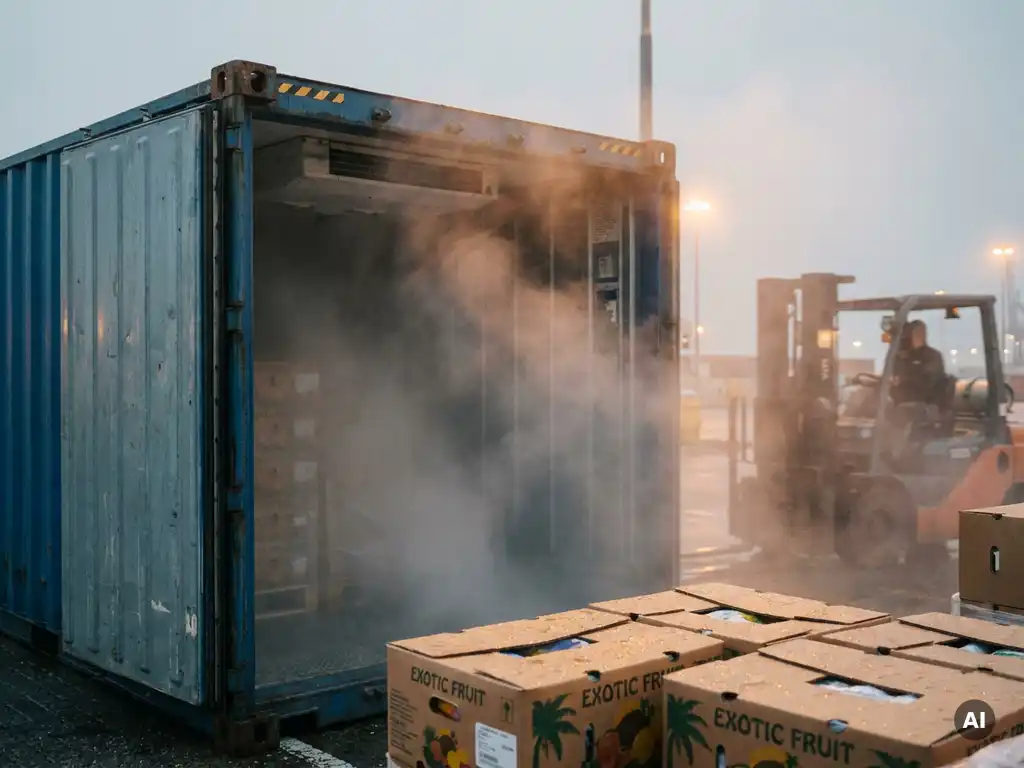
Condensation occurs during the unloading of refrigerated containers when cold products or cold container air comes into contact with warmer, humid outside air. This temperature difference causes water vapor to condense on packaging, pallets, and the product itself. For importers and logistics service providers working with exotic fruit, nuts, or other sensitive food products, this is a concrete quality risk that has direct consequences for shelf life and commercial value. The following questions address the causes, consequences, and preventive measures regarding condensation risk in the cold chain.
What causes condensation during unloading?
Condensation during the unloading of refrigerated containers is caused by the physical principle of the dew point: when cold air or a cold surface comes into contact with warmer, more humid air, that air cools rapidly to below the dew point and the moisture condenses as water droplets. This occurs on packaging, boxes, pallets, and sometimes on the product itself.
When opening a refrigerated container that has been transported at sea temperature, outside air immediately flows in. This outside air contains significantly more moisture than the dry, refrigerated air inside the container. The temperature difference does not have to be large to cause condensation. Even with a difference of five to ten degrees Celsius, visible precipitation can form on the product, especially on warm, humid summer days or in climates with high humidity.
In addition, the speed of unloading plays a role. The longer the container remains open in a warm environment without a climate-controlled unloading area, the more moisture penetrates and the greater the risk of condensation damage.
Which products are most vulnerable to condensation damage?
Products most vulnerable to condensation damage are fresh, refrigerated products with high surface sensitivity, such as exotic fruits, citrus fruits, and bananas. Dry products such as nuts, seeds, and peanuts are also vulnerable, as moisture directly affects their quality and shelf life, even if they are not stored refrigerated.
Vulnerability varies by product category:
- Exotic fruits and citrus fruits: Condensation promotes mold growth and accelerates ripening. Moisture on the peel of oranges or limes quickly leads to rot and loss of color.
- Bananas: Banana cultivation requires precise temperature control. Condensation can disrupt ripening and cause black spots on the peel, which reduces commercial value.
- Nuts, peanuts, and seeds: Moisture promotes mold formation and can lead to mycotoxin formation, causing serious quality problems and rejection upon import.
- Cardboard packaging: Even if the product itself is resistant, wet boxes and pallets weaken structurally, leading to unstable stacks and damage during storage or transport.
What are the consequences of condensation for product quality?
Condensation during the unloading of refrigerated containers leads directly to a loss of quality: packaging weakens, mold develops more rapidly, and fresh products lose their shelf life. In the worst case, an entire batch is no longer marketable or is rejected during the import inspection by the KCB or NVWA.
The consequences are not always immediately visible. Sometimes condensation damage only manifests after a few days in storage, when mold becomes visible or boxes collapse. This makes the risk particularly difficult to manage without the proper facilities and procedures during unloading.
Concrete consequences of condensation include:
- Accelerated spoilage: Moisture accelerates microbiological processes, significantly shortening the shelf life of fresh products.
- Packaging damage: Wet cardboard boxes lose load-bearing capacity, leading to unstable pallets and a higher risk of product loss.
- Rejection during import inspection: Products that do not meet quality standards are rejected by the KCB, resulting in financial loss.
- Reputational damage: Suppliers who systematically deliver products with condensation damage lose the trust of purchasing organizations at supermarkets and processing plants.
- Additional costs: Repalletizing, sorting out, or destroying damaged products significantly increases logistics costs.
How does a cold storage facility prevent condensation upon the arrival of containers?
A cold storage facility prevents condensation upon the arrival of containers by having unloading take place in a climate-controlled environment, where the temperature and humidity of the unloading area match the temperature of the container and the cargo as closely as possible. This minimizes the critical temperature difference that causes condensation.
In addition to the suitable unloading environment, speed and logistical connectivity are determining factors. The shorter the time between opening the container and placing the goods in the controlled storage area, the lower the risk. A direct connection between the unloading location and the cold storage, such as a quay directly adjacent to the cold storage facility, significantly reduces this exposure time.
Additionally, quality checks are carried out upon arrival, including temperature measurements and moisture inspections, to immediately detect any condensation damage. Products showing deviations are immediately separated from the rest of the batch so that the quality of the remaining goods is guaranteed.
What is the difference between cold storage and dry storage regarding condensation risk?
The difference regarding condensation risk is that cold storage actively regulates temperature and humidity to keep fresh, refrigerated products stable, whereas dry storage aims for a stable, dry environment without active cooling. In dry storage, the risk of condensation is present when products arrive from a cold container and are exposed to warmer warehouse air.
In cold storage, the risk is greatest at the moment of unloading, when the transition from the cold container air to the outside environment takes place. Once stabilized in the cold room, the risk of condensation is minimal.
Dry storage, also known as ambient storage, involves products such as nuts, peanuts, seeds, and flakes that are stored at a stable temperature, typically around eleven degrees Celsius. When a cold container with such dry products is unloaded into a warmer warehouse, condensation can occur on the packaging. Therefore, a controlled unloading environment and a stable warehouse temperature are essential in dry storage , to prevent loss of quality.
When is the risk of condensation greatest during transport and transshipment?
The risk of condensation is greatest when a refrigerated container is opened and unloaded in a warm, humid outdoor environment. This risk is highest during the summer months, at high outdoor temperatures and humidity, and during long waiting times between arrival and unloading.
During sea transport itself, the risk is relatively manageable because the container is closed and the internal climate is kept stable. The critical moments in the logistics chain are:
- Upon arrival at the port: Waiting times at the terminal increase the risk of the container warming up or the cooling failing, which causes condensation immediately upon opening.
- During unloading: Opening the container doors is the moment when warm outside air flows in and condensation forms on the cargo.
- During transfer between means of transport: Every time goods are transferred from container to truck or from quay to cold storage, there is a moment of risk if the ambient temperature deviates.
- For temporary storage outside climate-controlled areas: Even brief exposure to uncontrolled environments can be sufficient to cause condensation.
Which certifications guarantee the correct handling of condensation risks?
Certifications such as BRC (British Retail Consortium) and KCB/NVWA recognition guarantee that a storage partner has documented procedures for temperature control, quality control, and food safety, including handling condensation risks during unloading and storage. These certifications are a minimum requirement for purchasing organizations and supermarket chains when selecting logistics partners.
BRC sets strict requirements for climate control, hygiene, traceability, and quality assurance. A BRC-certified cold storage facility operates with established protocols for unloading refrigerated containers, including temperature recording and inspection procedures upon arrival.
KCB accreditation (part of the NVWA) is specifically relevant for the import inspection of fresh products such as exotic fruit. An accredited company is authorized to perform import inspections and is required to work in accordance with the guidelines of the Netherlands Food and Consumer Product Safety Authority, which offers direct quality assurance to importers and exporters.
SKAL certification is relevant for organic products and guarantees that organic standards are met during storage and unloading processes as well, including the prevention of cross-contamination and loss of quality due to environmental factors such as moisture.
How ZZColdstores helps manage condensation risk
ZZColdstores has climate-controlled storage facilities in Kruiningen and Vlissingen, with its own quay directly next to the cold storage facility in Vlissingen. This minimizes the exposure time of refrigerated products to the external environment, which significantly reduces the risk of condensation during unloading. For dry products such as nuts, peanuts, and seeds, ZZColdstores offers ambient storage in a stable, dry storage environment that also controls the temperature transition upon the arrival of cold containers.
What ZZColdstores offers to prevent and control condensation damage:
- Climate-controlled unloading areas that match the container temperature
- Direct quality control upon arrival, including temperature and humidity measurements
- Rapid transfer from quay to cold storage or ambient warehouse, with minimal exposure time
- BRC, SKAL, and KCB/NVWA certifications as a guarantee of quality
- Barcode-driven traceability per pallet for complete control over every shipment
Would you like to know how ZZColdstores can manage your unloading and storage with minimal condensation risk? Contact the team for a no-obligation discussion about the possibilities.
Frequently Asked Questions
How do I know if my consignment has sustained condensation damage during transport?
Condensation damage is not always immediately visible upon arrival. Upon receipt, look for water droplets on packaging, discolored or soft boxes, and a product surface temperature higher than expected. If in doubt, have a professional quality control performed including temperature and humidity measurements so that any damage is documented immediately and further spread within the batch is prevented.
What should I do if I do not have climate-controlled unloading space available?
If climate-controlled unloading space is not available, limit exposure time as much as possible by only opening containers when everything is ready for immediate transfer. Preferably unload early in the morning when the outside temperature is lowest, and avoid unloading on hot, humid summer days without additional measures. In the longer term, it is advisable to work with a certified logistics partner who does have the appropriate facilities, in order to avoid structural quality risks.
Can condensation damage be claimed from the insurer or the carrier?
That depends on the cause and when the damage occurred. If condensation is caused by a technical defect in the container's cooling system during transport, the carrier may be liable. If the damage is caused by incorrect unloading or insufficient facilities on the receiving end, the responsibility lies with the logistics service provider or the recipient themselves. Always ensure you have documented temperature records and a written inspection report upon arrival, as a claim is virtually hopeless without proof.
How does the risk of condensation vary by season, and do I need to adjust my unloading schedule accordingly?
Yes, the season has a direct influence on the risk of condensation. During the summer months, the temperature difference between the container contents and the outside air is greatest, and humidity is generally higher, which significantly increases the risk. In winter, the risk is lower but not absent, especially during rain or fog. Adjust your unloading schedule by using early unloading times in the summer, minimizing waiting times at the terminal, and paying extra attention to immediate quality control upon arrival.
What information do I need to provide to my logistics partner to properly manage the risk of condensation?
Provide your logistics partner with at least the following information: the product type and the required storage temperature, the container temperature set during transport, the origin and climate of the country of origin, and any previous quality issues with similar shipments. The more specific the information, the better the unloading environment and protocol can be tailored to the specific characteristics of your cargo.
Is condensation also a risk in ventilated containers, such as with bananas?
Yes, there is also a risk of condensation with ventilated containers, but the dynamics differ. With ventilated containers, fresh air is deliberately supplied during transport to remove ripening gases, which affects the humidity inside the container. When unloading in a warm environment, the difference between the internal container temperature and the outside air can still lead to condensation on the fruit and packaging. Precise temperature control throughout the entire unloading operation therefore remains essential, even for this type of container.
How can I, as an importer, verify whether my storage partner is taking sufficient measures against the risk of condensation?
Ask your storage partner about their certifications (BRC, KCB/NVWA accreditation, SKAL) and the documented procedures for unloading refrigerated containers. A reliable partner can demonstrate that they work with temperature recording upon arrival, climate-controlled unloading areas, and an established inspection protocol. Also inquire about the physical infrastructure, such as the distance between the unloading location and the cold storage cell, as this determines in practice how well the risk of condensation is actually managed.
Related articles
- Which food products require cold storage?
- What happens to nuts that are stored at too high a temperature during transport?
- When does it make sense to combine inventory management with customs clearance?
- How does the traceability of dry raw materials work in a European warehouse?
- What are the risks of larvae and insects when storing dried fruit?