
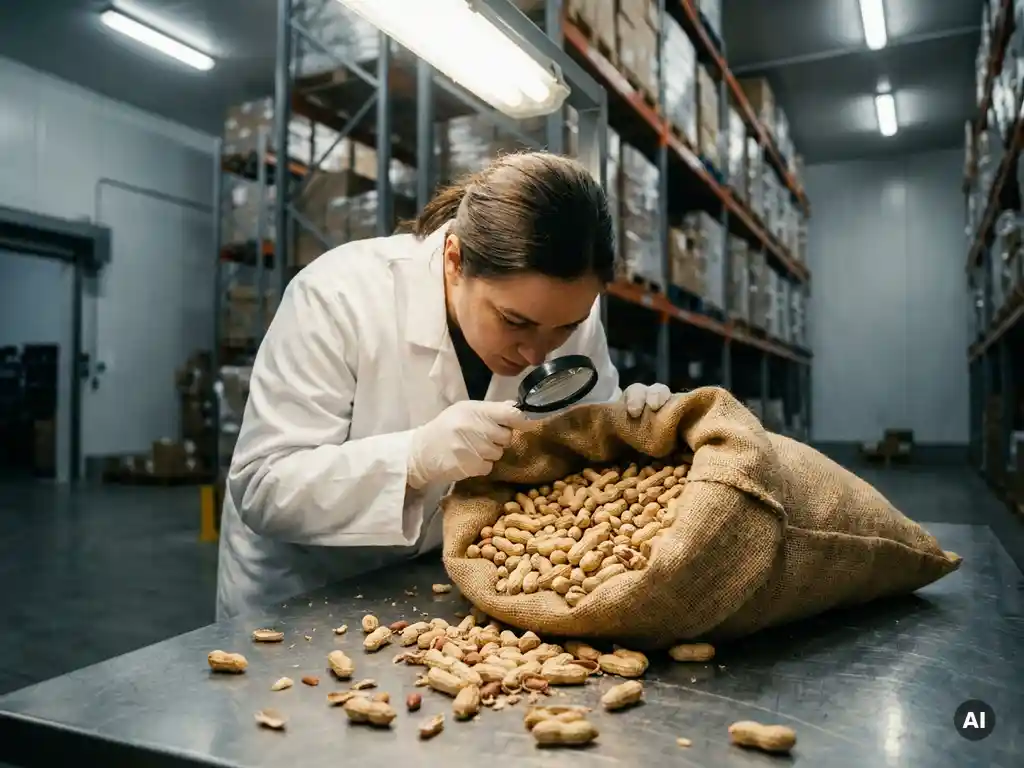
When importing peanuts from Brazil, an inspection is mandatory before the consignment may be placed into free circulation in the Netherlands. The inspection is carried out by the NVWA, specifically through its implementing organization KCB, and checks both the phytosanitary status and the food safety of the shipment. The questions below outline the entire inspection process step by step, from the authorities involved to the storage conditions during the waiting period.
Which authorities carry out the inspection of peanut imports?
Inspections for the import of peanuts from Brazil are carried out in the Netherlands by the NVWA, the Netherlands Food and Consumer Product Safety Authority. For fresh and unprocessed plant products such as peanuts, the NVWA collaborates with KCB, its specialized implementing organization for quality and phytosanitary inspections. KCB is the first point of contact for importers wishing to have a batch released.
In addition to the NVWA and KCB, Customs and European border control posts also play a role. Peanuts from Brazil are subject to EU regulations for food of non-animal origin and are declared via the TRACES system upon entry into the EU. Depending on the risk class assigned by the EU to the product and the country of origin, a consignment may be selected for a document check, an identity check, or a physical inspection.
The frequency of physical inspections for peanuts from Brazil is relatively high, as this product is on the European control list due to risks of mold formation and contamination. Importers are advised to contact their customs broker and the inspecting authority in advance to arrange the notification in a timely manner.
What exactly is checked during an inspection?
During an inspection of imported peanuts from Brazil, inspectors check three aspects: the documentation, the identity of the batch, and the physical condition of the product. The emphasis is on food safety and phytosanitary integrity, with a particular focus on assessing mold contamination and the presence of pests.
The audit focuses specifically on the following points:
- Document check: phytosanitary certificate from the country of origin, health certificate, freight documents and the pre-notification in TRACES
- Identity check: verification whether the physical batch matches the description in the documents (type, quantity, packaging, origin)
- Physical inspection: visual assessment of the cargo for damage, moisture, mold growth, and pests
- Sampling for laboratory analysis: samples are taken and analyzed for contaminants
- Packaging inspection: assessment of whether the packaging is intact and complies with EU requirements for food packaging.
The laboratory analysis usually takes the most time. Only when the results are available and fall within the permitted standards does the NVWA or KCB release the batch for further distribution.
How does the inspection process work step by step?
The inspection process for the import of peanuts from Brazil follows a fixed sequence that begins with the arrival of the ship and ends with the release of the consignment. Each step must be completed before the next can begin, which underscores the importance of proper preparation.
- Pre-notification via TRACES: the importer or freight forwarder notifies the consignment to the competent authority via the European TRACES system at least one working day before arrival.
- Arrival and unloading: the container or ship arrives in the port. The cargo is unloaded and taken to an approved inspection location or storage facility.
- Document check: the inspector assesses all accompanying documents for completeness and accuracy.
- Identity verification: the party is physically compared with the document description.
- Physical inspection and sampling: inspectors take samples from the batch for laboratory analysis.
- Laboratory analysis: the samples are analyzed. The batch remains under supervision until the results are known.
- Release or refusal: in the event of a satisfactory result, the NVWA or KCB issues an official release document. In the event of deviations, a decision follows regarding return, destruction, or re-inspection.
How long does an inspection take for peanuts from Brazil?
The total turnaround time for an inspection of peanuts from Brazil typically ranges from two to five working days, depending on the type of inspection and the laboratory's turnaround time. Release can be faster for a document check only, but waiting times increase as soon as sampling and laboratory analysis are required.
The variation in lead time is determined by factors such as the workload at the inspection authority, the complexity of the batch, and any deviations requiring further investigation. Importers wishing to align their logistics planning with this preferably allow for a waiting time of at least three working days as a buffer.
Timely and correct pre-notification via TRACES significantly shortens lead times, as inspectors can assess the documentation before the consignment physically arrives. Errors or missing documents almost always lead to delays.
What happens if peanuts do not pass the inspection?
When a batch of peanuts fails the inspection, the importer in principle has three options: return to the country of origin, destruction of the shipment, or special treatment to remedy the problem. The NVWA or KCB determines which options apply based on the nature of the defect.
In the event of a documentation error or a minor irregularity, additional information or a re-inspection may sometimes suffice. In the event of demonstrable contamination or exceeding of the permitted standards, destruction or return is mandatory. The costs of return, storage during the waiting period, and any destruction shall be borne by the importer.
It is important for importers to make clear agreements with their supplier in Brazil regarding quality standards and documentation requirements to minimize the risk of rejection. A rejection not only has financial consequences but can also lead to an increased inspection frequency for future batches from the same supplier.
What storage conditions apply during the waiting period for inspection?
During the inspection waiting period, peanuts must be stored under conditioned circumstances that prevent spoilage and loss of quality. Peanuts are sensitive to moisture and mold formation, making storage in a dry, ventilated room with stable temperature and humidity essential. The batch may not be moved or traded during this period.
EU regulations stipulate that products under inspection must be stored at an approved location and remain available to the inspecting authority. In practice, this means that the storage facility must meet the requirements for food storage and that the batch must be kept clearly identified and separated from released goods.
For dry products such as peanuts, the following recommended conditions apply during the waiting period:
- Temperature: between 10 and 18 degrees Celsius, depending on the condition of the cargo and the expected waiting time
- Relative humidity: maximum 65 percent to prevent mold growth
- Ventilation: sufficient air circulation to avoid moisture accumulation in the packaging
- Separation: the batch is stored physically separated from already released or other products
- Traceability: clear labeling with batch number, date of arrival and inspection status
How ZZColdstores helps with the storage of imported peanuts
ZZColdstores has a dry storage warehouse with a capacity of 12,000 pallet spaces, specifically designed for the storage of nuts, peanuts, seeds, and other dry food products. For importers of peanuts from Brazil, this means that the batch can be placed in a certified, temperature-controlled environment immediately after unloading, even during the inspection waiting period.
The benefits for importers and supply chain partners are concrete:
- Storage in a dry storage warehouse that meets the requirements for food storage, including BRC and SKAL certification.
- Ability to store batches separately and traceably during the inspection period
- Assistance with the import inspection via KCB as part of the logistical process
- Flexible deployment tailored to the ship's arrival time and the inspection schedule
- Locations in Vlissingen and Kruiningen, strategically located for parties entering via the Zeeland ports
Would you like to know how ZZColdstores can handle the storage and processing of your peanut imports? Please contact us for a no-obligation discussion about the possibilities.
This article was written by Frans van der Maas, Operations Director at ZZColdstores.
Frequently Asked Questions
As an importer, do I have to complete the pre-notification in TRACES myself, or can my freight forwarder arrange that on my behalf?
The pre-notification in TRACES can be submitted either by the importer themselves or by an authorized customs broker. In practice, brokers almost always handle this on behalf of the importer, as they are familiar with the system and the required documentation. However, ensure that all necessary documents — including the phytosanitary certificate and the health certificate — are provided by your supplier in Brazil in a timely manner, so that the notification can be submitted in full at least one working day before arrival.
Which documents must my supplier in Brazil send with the shipment?
Your supplier must submit at least a valid phytosanitary certificate, a health certificate, and the standard freight documents (such as the bill of lading and the commercial invoice). The phytosanitary certificate is issued by the competent authority in Brazil and must demonstrate that the consignment is free of quarantine pests and complies with EU import requirements. Missing or incorrect documents are one of the most common causes of inspection delays, so please check this carefully with your supplier in advance.
How high are the inspection costs and who pays them?
The costs for the inspection — including KCB inspection fees and laboratory analysis costs — are in principle borne by the importer. The exact amounts depend on the type of inspection, the size of the batch, and the number of samples to be analyzed. It is advisable to request an indication of the expected inspection costs from KCB or your freight forwarder in advance, so that you can include these in your cost calculation.
What is aflatoxin and why is this specifically a risk with peanuts from Brazil?
Aflatoxin is a toxic mold substance produced by molds of the genus Aspergillus, and which occurs particularly in nuts, peanuts, and cereals that have been stored or transported under humid or warm conditions. Peanuts from Brazil are on the European control list partly due to the increased risk of aflatoxin contamination, which can occur both during cultivation and transport. The EU applies strict maximum limits for aflatoxin in foodstuffs, and exceeding these limits leads to immediate rejection of the batch.
Can a rejected batch of peanuts still be approved after reprocessing?
This is possible in limited cases, depending on the nature of the deviation. In the event of a documentation error or a minor administrative irregularity, additional documentation or a re-inspection may sometimes lead to release. However, in the case of demonstrable contamination with aflatoxin or other hazardous substances, re-treatment is not permitted, and mandatory return or destruction follows. The NVWA or KCB decides on a case-by-case basis which options are available, and it is advisable to discuss this immediately with the inspecting authority as soon as a deviation is detected.
Does a rejection affect my future imports from the same supplier?
Yes, a rejection can have direct consequences for the inspection frequency of future shipments from the same supplier or country of origin. The European Commission periodically adjusts checklists and sampling frequencies based on recorded violations, which means that repeated rejections can lead to a structurally higher inspection pressure. It is therefore strongly recommended to establish concrete quality agreements with your Brazilian supplier and to periodically check whether they comply with the applicable EU standards.
What do I need to arrange if my consignment of peanuts enters via an EU port other than a Dutch port?
Peanuts entering via another EU port — such as Antwerp or Hamburg — are inspected there by the local competent authority at the designated Border Control Post. Registration still takes place via TRACES, but you are subject to the regulations and procedures of the country concerned. If the consignment is subsequently transported to the Netherlands, the inspection is in principle already completed and no new inspection is required in the Netherlands, provided the release documents have been issued correctly.
Related articles
- What happens to goods between arrival and departure from a warehouse?
- What happens in the event of a temperature deviation during cold storage?
- How do you know if your current storage location is suitable for nuts?
- What is conditioned storage at a temperature of 11°C?
- How does a logistics partner ensure continuous delivery to your factory?