
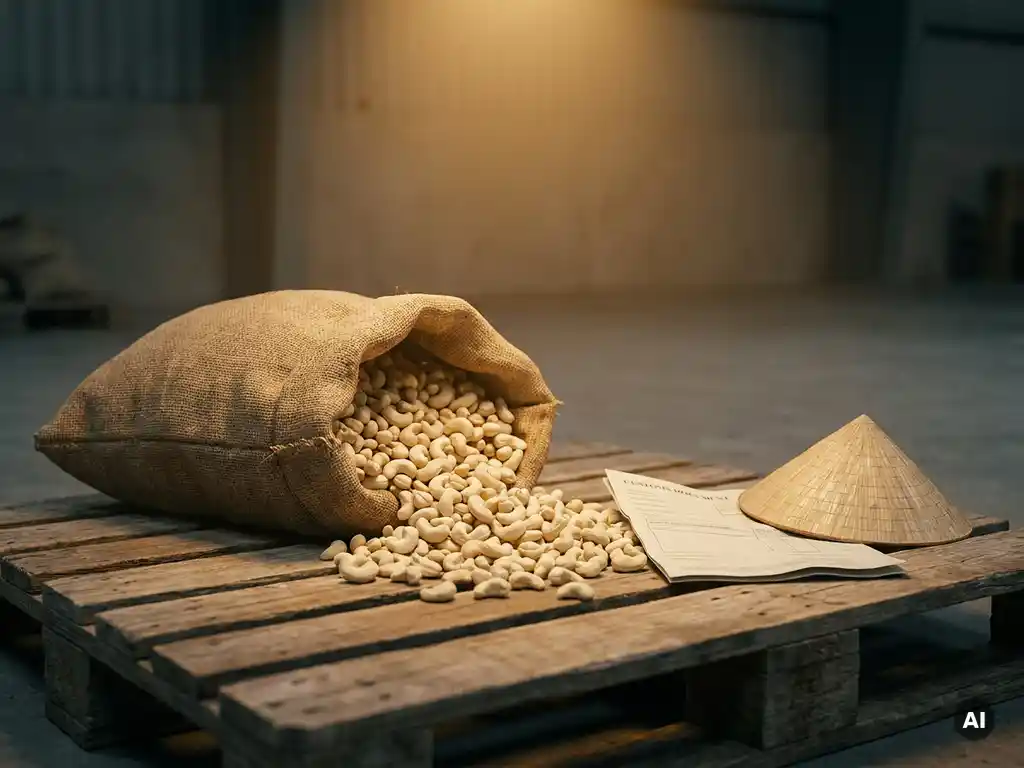
In 2026, reduced or zero tariffs will apply to most nut varieties from Vietnam under the EU-Vietnam Free Trade Agreement (EVFTA), provided that rules of origin are met and the correct documentation is submitted. Without the use of the EVFTA, the standard EU customs tariff applies, which can amount to several percent depending on the product category. This article answers the most frequently asked questions regarding import duties, additional charges, mandatory documentation, and smart storage strategies when importing nuts from Vietnam.
What customs tariffs apply to nuts from Vietnam in 2026?
For most dry nuts from Vietnam, a preferential customs tariff of 0% will apply under the EVFTA in 2026, provided the goods are demonstrably of Vietnamese origin and comply with the associated rules. Without preferential treatment, standard EU tariffs for nuts generally range between 0% and 3.2%, depending on the exact CN code.
The tariff classification depends on the specific nut variety and the state of processing. Cashews, macadamias, and Brazil nuts fall under different CN chapters than peanuts or coconuts. It is important to determine the correct commodity code via the EU tariff classification (TARIC) at the start of the import process, because the same nut in roasted or salted form may have a different code and sometimes a different tariff than in its raw state.
Importers who regularly import nuts from Vietnam would be wise to apply for a Binding Tariff Information (BTI) from Customs. This provides legal certainty regarding the applicable code and prevents unexpected additional assessments during inspections.
How does the EVFTA work and what does that mean for import duties?
The EVFTA is a free trade agreement between the European Union and Vietnam that entered into force in August 2020. The agreement is gradually phasing out import duties on most products to 0%. For dry nuts, this phase-out path has now been largely completed, meaning that in most cases, importers will benefit from a zero rate on customs duties in 2026.
To qualify for the preferential rate, two central conditions apply:
- Origin rule: The notes must be demonstrably of Vietnamese origin. This means that they were produced entirely in Vietnam or have undergone sufficient processing there according to the rules of the chord.
- Proof of origin: The importer submits a valid declaration of origin issued by a registered exporter in Vietnam, or a certificate of origin (Form EUR.1 or EUR-MED).
If proof of origin is missing, or if the party does not comply with the rules of origin, the right to the preferential tariff lapses and the regular MFN (Most Favoured Nation) tariff applies. It is therefore essential to have the documentation in order at the time of purchase in Vietnam, not only upon arrival at the EU port.
What are the additional levies besides customs duty?
In addition to the customs duty itself, there are several additional levies and costs that importers must take into account when importing nuts from Vietnam. Consequently, the customs duty is only one component of the total import burden.
The main additional levies are:
- VAT on imports: Dutch VAT is levied on the customs value plus customs duty (21% for food raw materials not intended for direct consumption, 9% for certain edible products). The VAT due can usually be reclaimed via the VAT return.
- Phytosanitary inspection costs: Nuts from Vietnam are subject to phytosanitary checks by the NVWA (KCB). The costs for this inspection are passed on to the importer and vary per shipment and product type.
- Port dues and terminal charges: Depending on the port of arrival (Rotterdam, Antwerp, or a smaller seaport), terminal handling charges and port dues are charged.
- Customs forwarding agent costs: The fee for the customs agent or forwarder who handles the declaration is a fixed cost per shipment.
- Potential anti-dumping duties: Check for each shipment whether temporary trade protection measures are in force for the specific product category. This can change rapidly based on EU trade policy.
An accurate calculation of the total import costs therefore requires more than just knowledge of the customs tariff. A thorough landed cost calculation in advance prevents unpleasant surprises.
Which documents are required when importing nuts from Vietnam?
When importing nuts from Vietnam into the EU, several documents are required. The core consists of a commercial invoice, a packing list, a bill of lading or air waybill, a phytosanitary certificate issued by the Vietnamese authorities, and a proof of origin for the application of the EVFTA.
Depending on the product type and use, additional documents may be required:
- Phytosanitary certificate: Mandatory for all nuts and seeds from third countries. The certificate is issued by the competent authority in Vietnam and must be presented to the NVWA or the KCB upon arrival for import inspection.
- Certificate of Origin (EUR.1 or Declaration of Origin): Required for the preferential rate under the EVFTA. Without this document, the importer pays the higher standard rate.
- CITES documentation: Not applicable to common nuts, but relevant if the consignment contains products covered by the Convention on International Trade in Endangered Species of Wild Animals and Plants.
- Food safety declaration or certificate of analysis: Some supermarket buyers or purchasing organizations require a certificate of analysis (aflatoxin, pesticides) as additional proof of quality.
It is advisable to check all documents for completeness and accuracy before departure from Vietnam. Missing or incorrect documents lead to delays at customs and can compromise the quality of the cargo, especially for products that require a stable storage environment.
How does storage temperature affect the customs classification of nuts?
Storage temperature in itself has no direct influence on the customs classification of nuts. The GN code is determined by the nature of the product, the state of processing (raw, roasted, salted), and the form of packaging, not by the way the product is stored after import.
Nevertheless, the relationship between storage and classification is indirectly relevant. Nuts imported as “unprocessed” or “raw” are subject to a different tariff heading than nuts that have already undergone further processing upon arrival. If an importer has nuts roasted or salted in the Netherlands prior to the customs declaration, this may alter the applicable CN code and, consequently, the tariff. The condition of the product at the time of the customs declaration is decisive.
Furthermore, for dry nuts, a stable storage environment of around 11 degrees Celsius and controlled humidity are essential to prevent loss of quality. The formation of aflatoxins, which can occur at excessively high temperatures or humidity, is not only a quality risk but can also lead to rejection by the NVWA, which has customs-related consequences for the release of the batch.
When is it smart to use a bonded warehouse for nut imports?
A bonded warehouse is a suitable solution when an importer wishes to defer the payment of customs duties and VAT until the goods are actually released into free circulation. For nut imports from Vietnam, this is particularly interesting for large consignments where the final destination or distribution to multiple customers is not yet determined upon arrival.
Specifically, a customs warehouse is smart in the following situations:
- The consignment is partially resold to countries outside the EU, meaning import duties are never payable on that part.
- The importer wants to optimize cash flow by spreading the VAT payment over multiple deliveries instead of paying it in a single lump sum upon arrival.
- There is uncertainty regarding the exact classification or origin of the consignment, and the importer wants to prepare the declaration without time pressure.
- The goods are stored awaiting a favorable market moment, while the customs debt has not yet arisen.
The use of a customs warehouse requires a license and imposes requirements regarding administration and the physical separation of goods. Not every storage location is designated as a warehouse. Importers considering using this arrangement would do well to discuss this with their customs broker in advance.
How ZZColdstores helps with the storage of imported nuts
Once customs formalities have been completed and the nuts released, the next critical phase begins: storage under the right conditions. For this purpose, ZZColdstores offers ambient storage for dry nuts in a stable, dry storage environment specifically designed for product categories such as nuts, peanuts, seeds, and dried fruit.
What ZZColdstores specifically offers for nut importers:
- Ambient storage at a stable temperature of approximately 11 degrees Celsius, without unnecessary cooling costs
- Quality control upon arrival, including inspection for damage, packaging deviations, and moisture levels
- Barcode-driven traceability linking LOT numbers to the correct parties
- Container unloading, repalletizing, and box picking according to your specifications
- EDI connections for automatic inventory updates and status reporting
- Locations in Kruiningen and Vlissingen, strategically located in the Rotterdam-Antwerp corridor
Would you like to know how ZZColdstores can support your nut import logistics after customs clearance? Then contact the team directly to discuss the possibilities.
Frequently Asked Questions
What happens if my supplier in Vietnam is not a registered exporter for the EVFTA?
If your Vietnamese supplier is not registered as an approved exporter under the EVFTA, they cannot issue a valid Declaration of Origin. In that case, you can still apply for a Certificate of Origin (Form EUR.1) through the competent Vietnamese authorities, but this requires extra time and coordination. It is highly recommended to verify in advance whether a new supplier in Vietnam is EVFTA-certified when selecting them, so that you can benefit from the 0% preferential rate without delays at customs.
How do I request a Binding Tariff Information (BTI) and how long does it take?
You can request a Binding Tariff Information via the EU Customs Decisions Portal (CDS), or have your customs broker arrange this for you. By law, Customs has 120 days to issue a BTI, but in practice, this is often faster. A BTI is valid for three years and provides you with legal certainty regarding the correct CN code, which prevents additional assessments and disputes during inspections — particularly useful if you import multiple types of nuts or different grades of processing.
What are the most common mistakes importers make during their first nut import from Vietnam?
The most common mistakes are: requesting the phytosanitary certificate or declaration of origin too late (causing the shipment to become stuck upon arrival), incorrectly classifying processed nuts (such as salted or roasted varieties) under the same GN code as raw nuts, and underestimating additional costs such as NVWA inspection fees and freight forwarder fees. A thorough pre-shipment checklist, drawn up together with your customs broker, prevents most of these pitfalls before departure from Vietnam.
Do I need to apply for a phytosanitary certificate again for each shipment, or is one certificate valid for multiple shipments?
A phytosanitary certificate is shipment-specific and must be applied for again for each individual consignment from the competent Vietnamese authority. The certificate describes the specific consignment, weight, and origin, and is therefore not transferable to subsequent consignments. Ensure that your Vietnamese supplier applies for the certificate in good time so that it is ready before shipment — a missing or expired certificate upon arrival in the EU will lead to an immediate inspection and possible rejection by the NVWA.
Can I have nuts from Vietnam processed in a bonded warehouse, such as roasted or packaged?
Yes, so-called 'usual treatments' are permitted within a bonded warehouse, such as repackaging, labelling, or sorting, but invasive processing such as roasting or salting generally does not fall under this. For further processing, you can make use of inward processing relief, a separate customs procedure that allows you to process nuts without first paying import duties, provided the finished products are exported or placed into free circulation under specific conditions. Always discuss the exact possibilities with your customs broker in advance, as choosing the right procedure has direct financial consequences.
How do I know if anti-dumping duties or other trade protection measures apply to my batch of nuts?
The most reliable method is to consult the European Commission's TARIC database, where you can check whether additional measures are in force based on the CN code and the country of origin. Anti-dumping duties are published in the Official Journal of the EU and can enter into force or be adjusted at any time. Ask your customs broker to perform an up-to-date tariff check for every new shipment so that you are not faced with any surprises when filing your customs declaration.
What do I need to arrange for the storage of nuts immediately after customs clearance has been completed?
As soon as the goods have been released, a rapid transfer to a suitable storage location is essential to prevent loss of quality. For dry nuts, this means a stable environment with a temperature of around 11 degrees Celsius and controlled humidity to prevent aflatoxin formation and oxidation. Ensure that your storage partner is informed in advance of the arrival date, volume, and packaging form so that unloading, repalletization, and lot registration can take place without delay — every day in an uncontrolled environment counts towards the shelf life of your batch.
Related articles
- How does pallet storage for food work?
- How does customs clearance for nuts from China or Vietnam work?
- How does repalletization work and when is it necessary for bulk import?
- How do you recognize insect infestation in stored nuts or garlic?
- Why do supermarket suppliers opt for external buffer storage in Europe?