
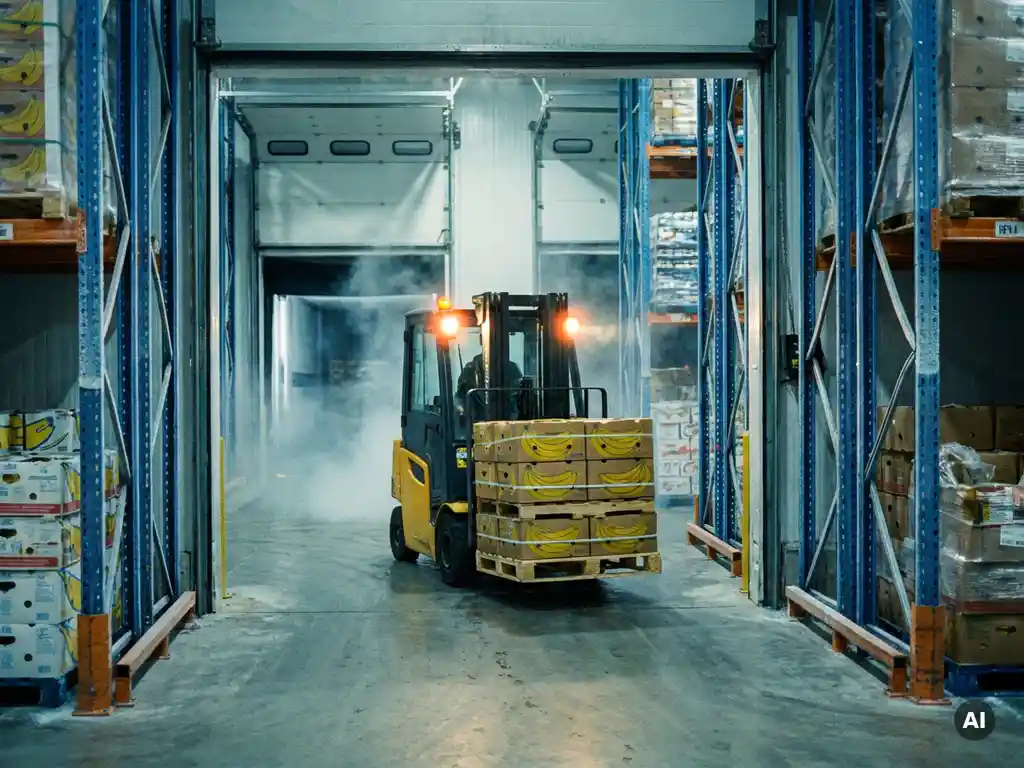
Inbound and outbound are the two main flows within any warehouse: inbound encompasses everything entering, from receiving and unloading to storage, while outbound encompasses everything leaving the warehouse, from order picking to loading and shipping. Together, these processes determine how efficiently a warehousing operation runs. In this article, we answer the most frequently asked questions about both logistics flows, including the role of temperature control and storage type.
What is the difference between inbound and outbound in a warehouse?
Inbound logistics encompasses all activities surrounding the arrival of goods in a warehouse: unloading, registering, checking, and storing. Outbound logistics encompasses all activities surrounding the departure of goods: order picking, packing, documenting, and loading. The difference lies in the direction of the flow of goods: inward versus outward.
In practice, both flows are highly interdependent. An error in the inbound process, such as incorrect registration or a missed quality check, has a direct impact on the outbound phase. Conversely, the speed of outbound determines how long products remain in storage and the demands this places on storage capacity.
For B2B parties in the food sector, such as importers of fresh fruit or suppliers to supermarkets, tight coordination between inbound and outbound is crucial. Products have a limited shelf life, and any delay in the flow of goods has direct consequences for product quality and delivery reliability.
Which steps are part of the inbound process?
The inbound process in a warehouse consists of the receipt of goods, unloading, quality control, registration in the warehouse management system, and final storage in the correct location. Each of these steps must be performed accurately to prevent errors further down the chain.
In concrete terms, an inbound process typically looks like this:
- Arrival notification and planning: the expected shipment is registered and capacity is cleared for receiving and unloading.
- Unloading: goods are removed from the means of transport, whether it is a truck, container, or seagoing vessel.
- Quality control: the shipment is inspected for damage, labeling, packaging deviations, and product condition. For temperature-sensitive products, temperature and humidity measurements are also performed.
- Registration and labeling: goods are booked into the system and provided with a traceable label or barcode.
- Inbound: the products are transported to the correct storage location, tailored to the type of product and the required storage conditions.
For fresh and perishable products, such as exotic fruit, the speed of the inbound process is particularly important. The shorter the time between unloading and storage under the right conditions, the better product quality is preserved.
Which steps are part of the outbound process?
The outbound process includes order picking, pre-shipment quality checks, packaging, documentation, and final loading onto the means of transport. This process is driven by customer orders and requires precise planning to meet delivery times.
The most important steps in the outbound process are:
- Order processing: a purchase order or delivery order is received and translated into a picking list.
- Picking: the correct products are retrieved from storage based on the order, taking into account shelf life and the FIFO principle (first in, first out).
- Inspection and packaging: the picked goods are checked for accuracy and, if necessary, packed or labeled for transport.
- Documentation: freight documents, packing slips, and any necessary customs papers are prepared.
- Loading: goods are loaded onto the correct means of transport, ready for delivery to the customer.
For international deliveries, such as shipments to Germany or Ukraine, customs clearance also plays a role in the outbound process. A well-organized outbound system ensures that these steps run in parallel and that lead times remain as short as possible.
How does temperature control affect inbound and outbound logistics?
Temperature control has a direct impact on both logistics flows: for inbound, the cold chain determines how quickly products are stored upon arrival; for outbound, it determines how products are prepared and loaded without breaking the temperature. An interruption of the cold chain at any point leads to a loss of quality.
In inbound logistics, the transition from transport vehicle to refrigerated storage is the critical moment. The longer fresh products remain outside controlled conditions, the greater the risk of quality deterioration. This applies particularly to products such as bananas and citrus fruits, which are sensitive to temperature fluctuations.
For outbound, the same principle applies in reverse. Products leaving cold storage for loading must be loaded onto refrigerated transport as quickly as possible. This requires tight coordination between warehouse planning and the sailing schedule or transport planning.
A well-designed warehousing operation takes loading and unloading times, external temperature conditions, and specific product characteristics into account for both processes. To this end, temperature, humidity, and air circulation are continuously monitored, even outside office hours.
What is the difference between dry storage and cold storage in a warehouse?
Dry storage, also known as ambient storage, stores goods at a stable ambient temperature without active cooling, typically around 10 to 15 degrees. Cold storage, or climate-controlled storage, actively regulates temperature, humidity, and air circulation to protect fresh and perishable products. The difference lies in the degree of climate control and the products for which they are suitable.
Dry storage is suitable for products that do not have strict temperature requirements but must be kept dry and stable. Examples include nuts, peanuts, seeds, and other non-perishable food products. The emphasis is on protection against moisture, pests, and temperature spikes.
Cold storage is necessary for fresh products that spoil quickly at higher temperatures. Storage conditions are set per product group and monitored 24/7. Any deviation is immediately detected and corrected, ensuring product quality is guaranteed from arrival to delivery.
The choice between dry and cold storage depends entirely on the product and the requirements of the buyer or processor. Some warehousing partners offer both storage types within a single location, which offers logistical advantages for parties with a mixed product range.
When does a company need an external warehousing partner?
A company needs an external warehousing partner when its own storage capacity is insufficient, when specific climate conditions are required that are not available internally, or when logistical complexity, such as customs clearance or port handling, falls outside its own expertise.
In practice, these are the most common situations in which external warehousing offers added value:
- Seasonal peaks: the demand for storage capacity varies significantly by season, and it is not cost-effective to maintain proprietary infrastructure for peak periods.
- Specialized products: fresh food products, exotic fruit, or temperature-sensitive goods require climate control that is not standard in a regular warehouse.
- Port logistics: importers receiving goods directly from a seagoing vessel benefit from a partner with its own quay and a direct connection to cold storage facilities.
- Customs and certification: for products requiring import inspection, a certified partner is necessary.
- International deliveries: companies that supply customers in multiple countries need a logistics hub with flexible delivery options.
An external warehousing partner offers not only capacity, but also knowledge, systems, and certifications that are difficult to build internally.
Which certifications are important when choosing a warehousing partner?
When choosing a warehousing partner for food products, BRC certification, SKAL certification, and KCB/NVWA inspections are the most relevant quality and safety standards. These certifications indicate that a partner meets strict requirements regarding food safety, biological integrity, and import inspection.
A brief explanation of the most important certifications:
- BRC (British Retail Consortium): an internationally recognized standard for food safety and quality management in the storage and distribution of food products. Supermarket chains and large purchasing organizations often require this certificate.
- SKAL: the certification body for organic production and processing in the Netherlands. For parties importing or storing organic products, SKAL certification of the storage partner is mandatory.
- Demeter: a supplementary certification for biodynamic products, relevant to a specific segment of the organic market.
- KCB/NVWA: The KCB is part of the NVWA and carries out import inspections for fresh fruit and vegetables entering the EU. A warehousing partner that facilitates these inspections significantly accelerates the import process.
When selecting a partner, always check which certifications are current and whether they meet your customers' requirements. Large supermarket chains and processing plants typically conduct strict supplier audits that include certifications of logistics partners.
How ZZColdstores supports your warehousing operation
ZZColdstores offers a complete warehousing solution for B2B parties working with fresh food products, nuts, seeds, and other food goods. The facilities in Kruiningen and Vlissingen are equipped for both dry storage and climate-controlled cold storage, with direct port access via its own quay in Vlissingen.
What ZZColdstores specifically offers:
- Climate-controlled storage with 24/7 monitoring of temperature, humidity, and air circulation, tailored to the specific requirements of your product
- Dry storage warehouse with a capacity of 12,000 pallet spaces, suitable for nuts, peanuts, seeds, and similar products
- Quality control upon arrival, including temperature and humidity measurements and reporting per shipment
- Full traceability of every pallet via a barcode system, from inbound to outbound
- Facilitating import inspections via KCB/NVWA and customs clearance
- Certifications: BRC, SKAL and Demeter
- Flexible scheduling tailored to sailing schedules and transport movements
Would you like to know if ZZColdstores meets your logistical requirements? Contact us for a no-obligation discussion about your specific situation.
Frequently Asked Questions
How long does an average inbound process take for a shipment of fresh fruit?
The turnaround time for an inbound process of fresh products such as exotic fruit typically varies between two and four hours, depending on the size of the shipment and the complexity of quality control. The tighter the arrival schedule and the better the documentation is in order, the faster unloading and receiving can take place. For time-critical products, it is therefore highly recommended to notify the warehousing partner of the arrival well in advance so that capacity is immediately available.
What is the FIFO principle and why is it so important in outbound logistics?
FIFO stands for 'First In, First Out' and means that products that arrived first are also shipped first. This principle is essential for food products with a limited shelf life, as it prevents older stock from being left behind while newer batches are already being shipped. A good warehouse management system (WMS) automatically applies FIFO when creating picking lists, but it also requires correct registration and positioning of goods upon receipt.
What are the most common errors in the inbound process and how do you prevent them?
The most common errors are incorrect entries in the warehouse management system, skipping quality checks under time pressure, and storing products in the wrong location or under incorrect climate conditions. These errors can almost always be traced back to a lack of standardized procedures or insufficient communication between the carrier and the warehousing partner. The use of barcode systems, fixed inspection intervals, and clear inbound protocols per product group significantly reduces the risk of errors.
As an importer, can I use external warehousing if I import both chilled and dry products?
Yes, that is certainly possible, provided the warehousing partner offers both storage types within a single location. This offers logistical advantages, as you work with one partner for the entire flow of goods, regardless of whether it concerns temperature-sensitive fresh fruit or non-perishable dry products such as nuts and seeds. Do check, however, whether the partner holds the correct certifications for both product categories and whether the traceability systems cover the entire inventory.
How does customs clearance work when importing fresh products via a seaport?
When importing fresh fruit and vegetables via a seaport, the goods must be notified to the NVWA for a phytosanitary import inspection, carried out by the KCB. This inspection verifies whether the products comply with EU standards for plant health and quality class. A warehousing partner with direct port access and a certified inspection area can significantly speed up this process, as inspection and unloading take place at the same location and no additional transport movement to an external inspection site is required.
How do I know if a warehousing partner is suitable for my specific product?
Ask the potential partner about their experience with similar product groups, available certifications, technical specifications of the storage facilities, and how temperature and humidity are monitored and reported. Also ask for references from similar customers and whether the partner is willing to accompany a trial shipment. A transparent partner shares their quality reports and audit results without hesitation and actively collaborates on aligning with your specific logistical requirements.
What are the risks if the cold chain is interrupted during the outbound process?
An interruption of the cold chain during the outbound process, for example due to products remaining on an uncooled loading dock for too long, can lead to accelerated spoilage, loss of quality, and rejection by the buyer. With sensitive products such as bananas or citrus fruits, even short temperature fluctuations affect color, texture, and shelf life. To minimize this risk, close coordination is required between warehouse planning and transport planning, keeping loading times as short as possible and ensuring refrigerated transport vehicles are available in a timely manner.
Related articles
- What data is recorded during the storage of foodstuffs?
- What is the difference between ambient storage and room temperature storage?
- How do you prevent mold formation when storing garlic?
- What is the difference between floor-loaded and palletized containers?
- Why is Zeeland a logical location for European food storage?