
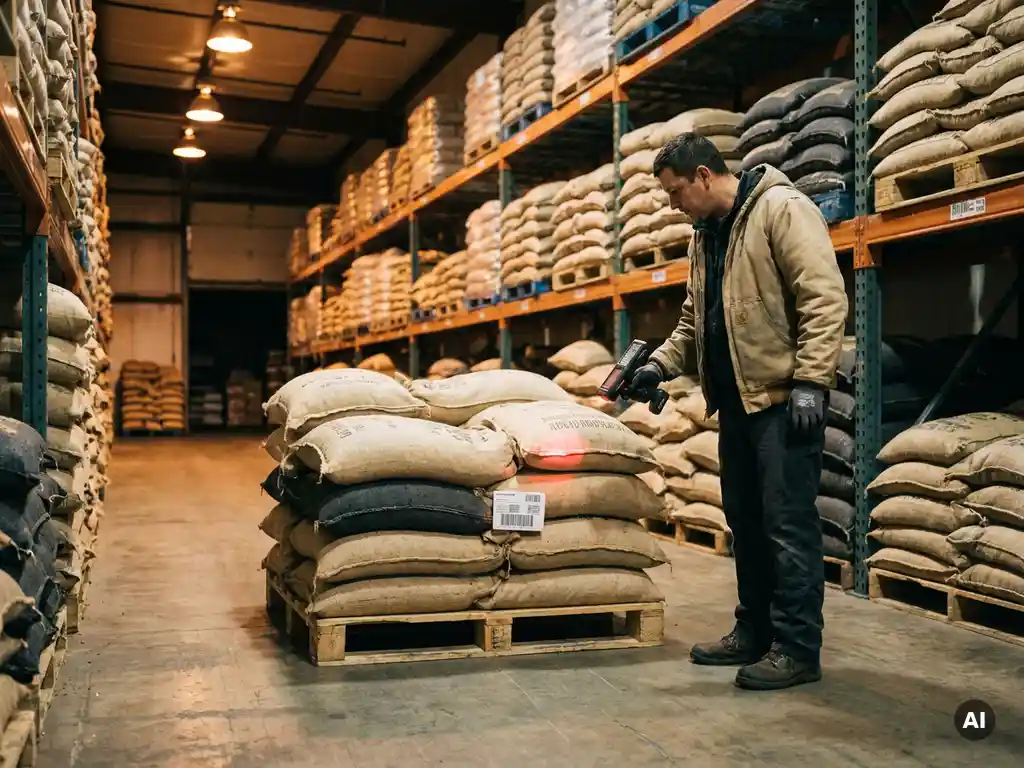
Traceability of dry raw materials in a European warehouse means that every batch of raw materials, from arrival to departure, is fully documented and traceable via a continuous chain of records. European legislation mandates this for all food companies in the chain, including warehouses that store nuts, seeds, grains, and other dry food products. The questions below elaborate concretely on each component of that traceability system.
Which laws and regulations mandate traceability in European warehouses?
Traceability in European warehouses is legally required under the General Food Regulation, better known as EU Regulation 178/2002. This regulation obliges all operators in the food chain, including warehouses storing dry raw materials, to be able to trace one step back and one step forward. This therefore also applies to the dry storage of nuts, peanuts, seeds, and grains.
In addition to this basic regulation, supplementary frameworks play a role. EU Regulation 852/2004 on food hygiene sets requirements for the registration of product flows and hygienic storage conditions. Warehouses with BRC certification (British Retail Consortium) meet an even stricter standard: they are audited annually on, among other things, traceability procedures, document management, and the speed with which a traceability report can be submitted.
Moreover, for warehouses storing organic products, the SKAL rules apply, which impose additional requirements on separation, registration, and documentation of origin. In short: the legal framework for warehouse traceability in Europe is layered and comprises both a statutory minimum and sector-specific certification standards that raise the bar.
How is a consignment of dry raw materials tracked from arrival to dispatch?
Upon arrival at the warehouse, a batch of dry raw materials goes through a fixed series of registration points that together form the traceability chain. Upon entry, the batch is linked to a unique batch number, the supplier documents are registered, and an initial quality control takes place. Subsequently, the location within the warehouse is recorded so that the batch can be physically located at any time.
During storage, relevant conditions such as temperature and humidity, which affect the quality of dry products like nuts and seeds, are monitored. Upon dispatch, the quantity of which batch number delivered to which customer is recorded, including the time and transport documents. This makes it possible to precisely reconstruct which sub-batches went where in the event of a quality notification or recall.
The strength of this system lies in the connection between the steps: every moment of transition, from container to storage location, from storage location to outbound, is documented without gaps in the chain.
What is the difference between batch and serial traceability for dry products?
Batch traceability tracks a group of products produced or delivered under the same conditions as a single entity, whereas serial traceability identifies and tracks each individual product or package separately. For dry raw materials such as nuts, peanuts, and seeds, batch traceability is the standard in practice.
With batch traceability, a delivered batch is assigned a batch number or lot number. All boxes, bags, or pallets within that batch share the same number. In the event of a recall, this makes it possible to recall the entire batch without having to identify each individual product. This is practical and scalable for bulk goods that are stored and processed in large quantities.
Serial traceability goes a step further: every product or package has a unique code, often via a barcode or RFID tag. This level of raw material tracking in the warehouse is more frequently applied to high-value or high-risk products, or when a retailer or processor requires it contractually. For standard dry storage of raw materials, batch traceability is generally sufficient to comply with European regulations.
Which systems and technologies do warehouses use for raw material tracking?
Warehouses typically use a combination of a Warehouse Management System (WMS), barcode registration, and additional technologies such as RFID or digital weighbridges for raw material tracking. The WMS forms the core: it links batch numbers to locations, records incoming and outgoing flows, and provides an overview of inventory per batch at any given moment.
The most used technologies per function are:
- Barcodes and QR codes: for scanning pallets and boxes upon receipt, movement, and dispatch
- RFID tags: for automatic identification without manual scanning, useful for large volumes
- Digital weighing registration: for recording weights per batch upon receipt and dispatch
- Temperature and humidity sensors: for monitoring storage conditions that affect the quality of dry products
- ERP integrations: for transferring traceability data to the systems of clients or customers
The choice of a specific combination depends on the volume, product categories, and traceability requirements of the client. Certifications such as BRC impose requirements on the reliability and completeness of the systems used.
How quickly must a warehouse be able to provide a traceability report?
According to the BRC standard, a warehouse must be able to provide a full traceability report within four hours. This is the most widely used benchmark in the sector for dry storage of food products. The European basic legislation does not set a specific time limit, but does require that information be “immediately available” to competent authorities.
In practice, this means that a warehouse must configure its records so that, in the event of a notification or audit, it is possible to immediately look up which batches have been received, where they are stored, which quantities have been dispatched, and to which customers the products have gone. The better the WMS is configured, the faster this report can be generated.
For clients supplying supermarket purchasing organizations or processing plants, the speed of traceability reporting is a competitive factor: a supplier who can report quickly and completely in the event of an incident limits damage and strengthens confidence in the supply chain.
Which documents are essential for demonstrable traceability in dry storage?
Demonstrable traceability in dry storage relies on a set of core documents that record the entire lifecycle of a batch. Without these documents, it is impossible to conclusively demonstrate the origin and destination of raw materials during an audit or recall.
The essential documents are:
- Bill of Lading: proof of origin and transport route from the supplier to the warehouse
- Packing list: specification of quantities, weights, lot numbers, and packaging units per shipment
- Receipt registration: internal recording of date, quantity, location, and batch number upon arrival at the warehouse
- Quality Control Report (QC Report): results of the inspection upon arrival, including any deviations
- Storage record: overview of the location(s) where the batch was stored during the storage period
- Outgoing documentation: record of which quantity, of which batch, to which customer was delivered and at what time
- Certificates of origin or organic certification: required for SKAL-certified products or specific import requirements
All these documents must remain available for a minimum retention period. Under European food regulations, a retention period of at least five years generally applies to traceability documents for dry food products.
How does certified dry storage strengthen traceability in the supply chain?
Certified dry storage strengthens traceability in the supply chain because certification standards, such as BRC and SKAL, set concrete and demonstrable requirements for registration systems, document management, and internal controls. A certified warehouse not only has its traceability procedures documented but also has them externally audited annually by independent auditors.
For importers, wholesalers, and suppliers to supermarkets, this means a significantly lower risk factor. When a customer or regulator requests proof of traceability of food products, a certified warehouse can substantiate this with audit reports, validated procedures, and up-to-date records. This significantly strengthens the client's position in the supply chain.
Certification also has a practical effect on daily operations: employees are trained in correct registration, deviations are systematically recorded, and corrective measures are documented. This increases the reliability of the data in the WMS and, consequently, the quality of every traceability report generated by that system.
How ZZColdstores helps with the traceability of dry raw materials
ZZColdstores offers dry storage for food products in a stable, controlled environment specifically designed for products such as nuts, peanuts, seeds, grains, and flakes. Traceability is not an afterthought, but an integral part of the service. Specifically, ZZColdstores offers:
- Quality control upon arrival, including QC reporting per shipment
- Accurate receipt and dispatch registration per batch
- Storage in a certified environment (BRC, SKAL, Demeter)
- Box picking and repalletization with accompanying documentation
- Shuttle transport between production locations and the warehouse in Kruiningen
For supply chain managers and buyers working with dry raw materials and requiring demonstrable traceability to their customers, ZZColdstores offers a reliable base in the Rotterdam-Antwerp corridor. Contact us to discuss how our dry storage solutions align with your specific traceability requirements.
Frequently Asked Questions
What should I do if a gap in the chain of traceability is discovered during an audit?
Identify the missing link as soon as possible by consulting additional sources, such as transport documents, supplier confirmations, or camera footage of the warehouse. Document the deviation and the corrective measure in a non-conformity report. Prevent recurrence by tightening the procedure at the time of registration and retraining employees. In BRC-certified warehouses, documenting corrective measures is a requirement, not an option.
How do I handle traceability when a batch is split or merged in the warehouse?
When splitting a batch, each sub-batch must be assigned a derived batch code traceable to the original batch number, ensuring the chain remains continuous. Merging different batches into a single new lot should, in principle, be avoided for dry food raw materials, as this complicates traceability per original batch. If merging is nevertheless necessary, all involved batch numbers must be documented and linked to the new lot number. A well-configured WMS offers standard functionality for this.
What common mistakes do warehouses make when setting up a traceability system?
One of the most common errors is working with paper records that are not maintained in real time, resulting in time discrepancies between the physical movement of a batch and the administrative recording. Another common mistake is the lack of consistent numbering: when suppliers, the warehouse, and customers each use their own batch codes without linkage, blind spots arise in the chain. Therefore, ensure a standardized coding structure and always link supplier numbers to internal batch numbers upon receipt.
How long do I need to retain traceability documents and in what format?
Under European food regulations, a minimum retention period of five years applies to traceability documents for dry food products, but sector-specific certifications or contractual agreements with customers may require a longer period. Documents may be stored either physically or digitally, provided they are legible, intact, and immediately retrievable during an audit or recall. Digital storage in a centralized system is preferred, as this enables faster searching and reporting and eliminates the risk of loss or damage to paper documents.
How can I, as an importer or wholesaler, verify whether my warehouse partner implements traceability correctly?
Ask your warehouse partner for a current audit report of their certification, such as BRC, and specifically review the findings regarding traceability procedures and document management. Additionally, conduct your own periodic traceability test: select a random batch and ask the warehouse to provide a complete traceability report from receipt to dispatch within the agreed timeframe. Specify the applicable reporting requirements in the logistics contract, including the maximum response time in the event of a recall. Transparency and testability are the best indicators of a reliable warehouse partner.
What are the consequences if a warehouse cannot comply with a traceability request from a regulator?
If a warehouse is unable to produce a conclusive traceability report during an inspection by the NVWA or another competent authority, this can lead to an official warning, a temporary ban on processing or releasing the affected batches, or, in serious cases, a fine. Furthermore, it can jeopardize the warehouse's certification status, which has direct consequences for all clients who use that certification as proof to their own customers. For supply chain managers, this is a real chain risk: the responsibility for traceability does not stop at the warehouse gate.
How does the traceability of the warehouse align with my own organization's system?
A good warehouse partner offers the ability to export traceability data in a format that aligns with your ERP or purchasing system, for example via EDI messages, standardized CSV exports, or direct API connections. Discuss during onboarding which data you require and in what format, so that batch numbers, delivery confirmations, and outgoing records are automatically integrated into your own administration. The better the systems align, the less manual intervention is required and the lower the risk of errors in the shared traceability chain.