
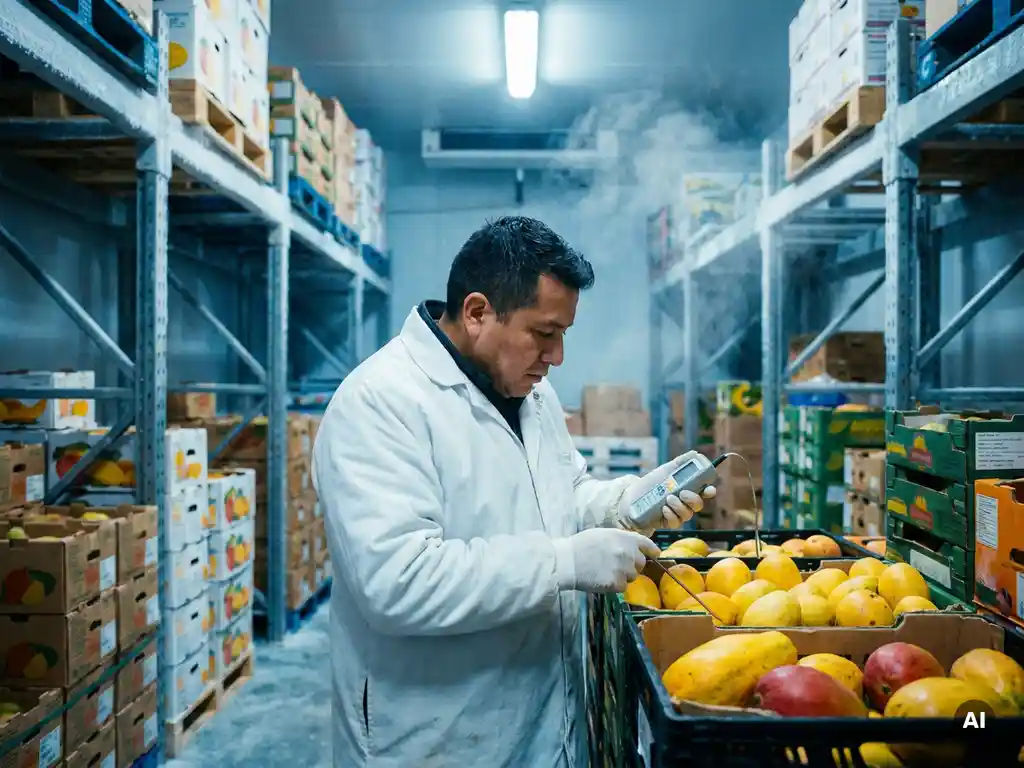
Upon receipt of refrigerated products, multiple checks are systematically performed: a visual inspection of the packaging and labeling, a temperature measurement of the shipment, and a document check. These checks are essential for every link in the cold chain, from importer to processing plant, because deviations upon arrival have direct consequences for shelf life, food safety, and liability. The questions below answer the most frequently asked questions about incoming quality control in a cold storage facility.
What checks are carried out upon arrival of refrigerated cargo?
Upon arrival of refrigerated cargo, three types of checks are performed as standard: a physical inspection of the shipment (packaging, labeling, product condition), a temperature measurement, and a document check. Together, these checks provide a complete picture of the quality and conformity of the cargo at the time of receipt.
The physical inspection focuses on visible deviations: damaged boxes, incorrect or missing labels, packaging defects, and the general condition of the product. Simultaneously, the temperature of the cargo is measured and checked against the agreed specifications. Finally, the accompanying documents are checked for completeness and conformity with the physical shipment.
For products subject to the supervision of the KCB (part of the NVWA), such as certain types of fresh fruit, an import inspection is part of the arrival process. This inspection is mandatory before the goods are placed into storage or transported further.
How is the temperature of refrigerated products measured upon arrival?
The temperature of refrigerated products is measured upon arrival using calibrated thermometers or temperature loggers, both on the outside of the packaging and, if required, inside the core of the product. The measurement is preferably performed immediately upon arrival, before the shipment enters the cold storage facility, to record the actual transport temperature.
In addition to direct measurement, transport loggers are read out when present. This logger records the temperature throughout the entire transport and makes deviations visible during the journey. This makes it possible to assess whether a temporary temperature overshoot has occurred, even if the cargo is at the correct temperature upon arrival.
The measured values are recorded in a receipt register and compared with the product specifications. For fragile products such as exotic fruit, narrow temperature margins often apply, where even a brief exceedance can have visible consequences for ripening and quality.
What happens if refrigerated products do not meet the temperature standards?
If refrigerated products do not meet the agreed temperature standards upon arrival, they are immediately separated from the rest of the batch. The non-standard goods are set aside and assessed before further processing or storage takes place. This prevents a potentially affected batch from influencing the quality of the rest of the shipment.
Subsequently, the client is immediately informed of the finding. Based on the nature and extent of the deviation, it is determined in consultation what happens to the batch: additional inspection, sampling, rejection, or accelerated processing. The appropriate action depends on the product, the degree of deviation, and the applicable specifications.
Proper recording of the deviation is crucial in this regard. A detailed QC report including the time, measured temperatures, and photographic documentation provides the client with the evidence required for a potential claim against the carrier or supplier.
Which documents are required upon receipt of refrigerated goods?
Upon receipt of refrigerated goods, the following documents are generally required: a consignment note (CMR or bill of lading), a packing list, a commercial invoice and, depending on the product and origin, a phytosanitary certificate or a certificate of origin. For products subject to NVWA supervision, an import notification or inspection report is also required.
The consignment note confirms the agreement between the sender and the carrier and contains information regarding the cargo, weight, and temperature instructions. The packing list makes it possible to compare the physical shipment with what was ordered and invoiced. Discrepancies between the packing list and the actual receipt are recorded in a receipt notification or reservation on the consignment note.
Additional requirements apply to imports from outside the European Union. Customs clearance requires a customs declaration and, depending on the product, phytosanitary documents demonstrating that the goods comply with EU import regulations. Missing or incorrect documents may lead to delays in the inspection or release of the consignment.
How does the inspection of exotic fruit differ from other refrigerated products?
The inspection of exotic fruit differs from other refrigerated products because, in addition to temperature, the ripening status and sugar content (Brix value) are also measured. Furthermore, fresh fruit from non-EU countries is subject to mandatory phytosanitary inspection by the KCB, which adds an extra step to the arrival process that does not apply to many other refrigerated products.
Products such as bananas and citrus fruits are particularly sensitive to temperature fluctuations. Temperatures that are too low can cause cold damage (chilling injury), while temperatures that are too high accelerate ripening. The permissible margin is narrow, which means that temperature measurement upon arrival must be more accurate and thorough than for less sensitive products.
In addition, ripening stages play a role in the assessment. A banana that is already too ripe upon arrival will no longer achieve the desired shelf life, regardless of how well further storage proceeds. The Brix measurement provides an objective indication of the ripening stage and thus forms a valuable part of the quality control upon arrival.
Who is responsible for quality control upon entry into a cold storage facility?
The primary responsibility for quality control upon arrival lies with the cold storage facility receiving the goods, acting on behalf of the owner or importer of the consignment. The importer remains ultimately responsible for the conformity of their product but typically delegates the execution of the inspection to the storage partner.
In practice, an experienced cold storage employee performs the incoming inspection. This person checks the physical condition of the shipment, measures the temperature, and records the findings. In the event of discrepancies, he informs the client and acts in accordance with the agreed procedures. The resulting report serves as formal proof of the condition of the goods at the time of receipt.
When a statutory inspection is required, such as the import inspection for fresh fruit by the KCB, an inspector from the competent authority carries out this inspection. The cold storage facility facilitates this process by making the goods available and providing the appropriate documents, but the inspection itself is a public law task.
How ZZColdstores handles incoming quality control
ZZColdstores handles the complete incoming quality control for refrigerated shipments, from initial inspection to final storage. This includes, among other things:
- Visual inspection for damage, labeling, and packaging discrepancies on every incoming shipment
- Temperature, humidity, and Brix measurements fully in accordance with the agreed product specifications
- Immediate separation of products that do not meet quality standards
- Comprehensive QC reporting with clear findings per shipment
- Barcode-driven traceability: every pallet is fully traceable via grower and LOT numbers
- Facilitating statutory import inspections via KCB/NVWA
climate -controlled cold storage is specially designed for fresh and delicate products such as exotic fruit, with 24/7 monitoring of temperature, humidity, and air circulation. Would you like to know how ZZColdstores can set up quality control for your shipments? Contact us for a no-obligation consultation.
Frequently Asked Questions
How long does a full incoming quality inspection of a refrigerated shipment take on average?
The duration of an incoming quality control depends on the size of the shipment, the product type, and the required inspections. For a standard shipment without statutory import inspection, a full inspection, including temperature measurement and document checks, can usually be completed within 30 to 60 minutes. When a KCB import inspection is required or when deviations are found that require additional assessment, the turnaround time increases. It is therefore advisable to discuss the expected processing time with your warehousing partner in advance so that your logistics planning can be aligned accordingly.
What should I do if, as an importer, I suspect a discrepancy but the carrier has already departed?
If a discrepancy is identified after the carrier has already departed, a detailed QC report with a timestamp, photos, and measured temperatures is the most important piece of evidence for any potential claim. Always ensure that discrepancies are also recorded in a reservation on the Consignment Note (CMR) at the time of receipt, even if the full inspection has not yet been completed — this is legally crucial. Contact the carrier and your insurer as soon as possible and retain all original documents. The sooner and more detailed the discrepancy is documented, the stronger your position in the event of a claim.
What common mistakes are made during incoming quality control in a cold storage facility?
A common mistake is measuring the temperature only after the cargo has already been unloaded or stored, making it impossible to accurately determine the actual transport temperature. Another common error is failing to read the transport logger, causing temporary temperature overshoots during transport to go unnoticed. Additionally, document checks are sometimes performed too superficially, which can lead to problems later during customs clearance or liability issues. A structured receiving protocol with fixed inspection points and recording obligations prevents these errors.
How can I, as an importer, remotely monitor my storage partner's quality controls myself?
More and more cold storage facilities offer digital portals or reporting systems that provide importers with real-time or per-shipment access to QC reports, temperature data, and photo documentation. Ask your storage partner about the availability of such systems and which data is shared by default after every incoming inspection. Furthermore, barcode-driven traceability, where each pallet is linked to grower and LOT numbers, makes it possible to remotely track the origin and quality status of individual pallets. Clear agreements regarding reporting frequency and format are essential for transparent cooperation.
Do different requirements apply to refrigerated organic products upon entry?
Yes, organic refrigerated products are subject to additional documentation requirements on top of standard incoming inspections. When importing organic products from non-EU countries, a Certificate of Inspection (COI) is required, issued by a recognized inspection body, demonstrating that the product complies with EU organic production regulations. Additionally, the storage location itself must be certified for the storage of organic products to prevent mixing or contamination with non-organic goods. Check in advance whether your storage partner holds the correct organic certification.
What is the difference between a phytosanitary certificate and a certificate of origin, and when do I need which one?
A phytosanitary certificate is an official document issued by the plant pathology service of the exporting country confirming that the plant product is free from harmful organisms and complies with EU import requirements regarding plant health. A certificate of origin indicates the country in which the product was produced or processed and is primarily relevant for customs purposes, such as determining the applicable import tariff. For fresh fruit and vegetables from non-EU countries, a phytosanitary certificate is generally mandatory; a certificate of origin depends on the country of origin and the applicable trade agreements. If in doubt, consult your customs broker or the NVWA for the specific requirements per product and country of origin.
How often must the thermometers and measuring equipment used in incoming quality control be calibrated?
The calibration requirement for measuring equipment depends on the applicable certifications of the cold storage facility, such as BRC, IFS, or HACCP; however, as a guideline, calibrated thermometers must be verified by a recognized body at least once a year. Equipment that is used intensively or exposed to extreme temperature fluctuations may require calibration more frequently. A valid calibration report is not only an internal quality requirement but also a requirement during audits and in potential liability cases where the accuracy of the measurement is in dispute. Ask your storage partner for the calibration schedule and associated certificates as part of your due diligence.
Related articles
- What activities can a warehouse perform for an importer?
- What are the certification requirements for a warehouse that stores food products?
- How does seasonal supply affect storage planning for importers?
- What is a European hub and why do importers choose one?
- How do you recognize insect infestation in stored nuts or garlic?