
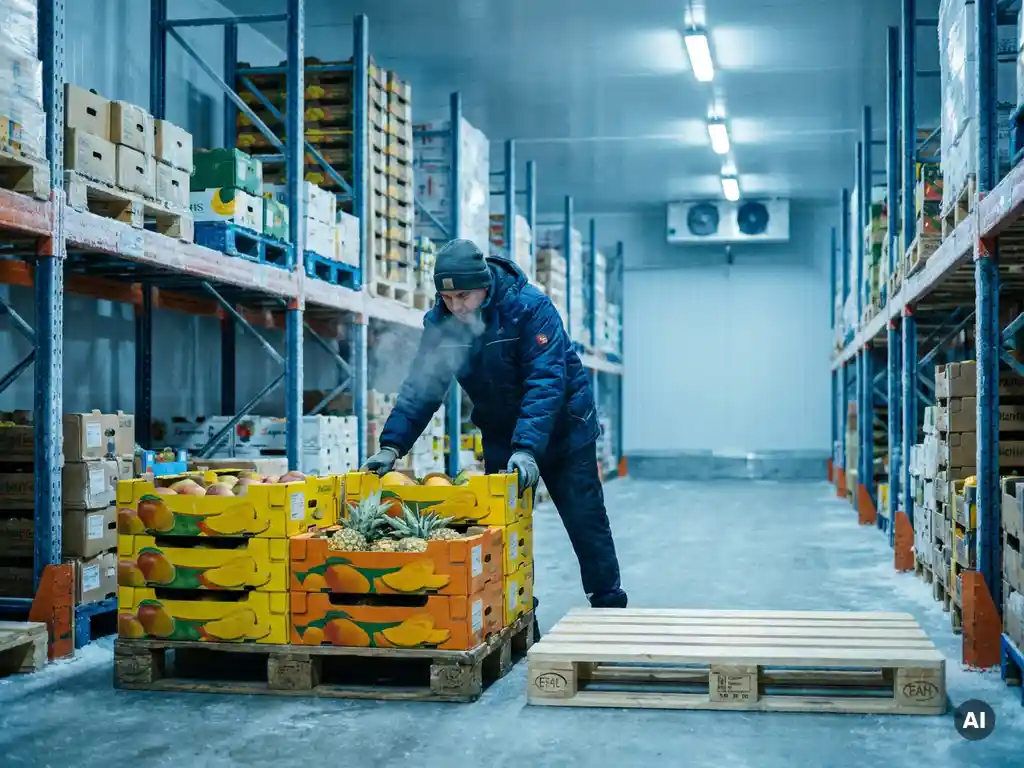
Repalletization is the process of removing goods from an existing pallet and restacking them onto a new or different pallet, in accordance with the requirements of the receiving party or the distribution channel. This is a standard operation in import logistics, particularly in the bulk import of fresh products such as exotic fruit, where shipments from non-European countries often do not meet the pallet standards or stacking methods required by European buyers. The sections below answer the most frequently asked questions about repalletization in practice.
What exactly happens during repalletization?
During repalletizing, packages, boxes, or packaging units are removed from an existing pallet and restacked onto another pallet. This is done manually or using mechanical aids, depending on the weight, the fragility of the products, and the desired stacking configuration. The goal is to create a pallet that meets the dimensions, weight, or layout required by the customer or the warehouse.
The processing of bulk imports often involves large numbers of pallets that need to be converted in a short time. The steps in the process are typically as follows:
- Receipt and registration of the incoming pallet or container
- Inspection of the condition of the goods and the existing stacking
- Dismantling the existing pallet, including removal of stretch film or straps
- Rearrangement of the packages on the new pallet, in accordance with the desired stacking configuration
- Re-securing the pallet with film or straps
- Labeling and registration of the new pallet identity in the warehouse system
For temperature-sensitive products such as fresh fruit, it is important that repalletization takes place as quickly as possible, preferably in a refrigerated environment, so as not to break the cold chain.
When is repalletization necessary for bulk import?
Repalletization is necessary in bulk import when incoming pallets do not meet the requirements of the receiving party, the warehouse, or the retail chain. This occurs regularly in bulk import because exporting countries use different pallet sizes, stacking heights, or weight limits than the European market requires.
Concrete situations where repalletization is unavoidable:
- The import pallet has dimensions that do not fit on European warehouse racking or transport equipment
- The stacking is not stable enough for further transport or storage
- A customer or retailer requires a specific pallet configuration (for example, a certain number of boxes per layer)
- Pallets are mixed loaded and must be unpacked by item or SKU
- Pallets were damaged during sea transport and need to be rebuilt
- Customs or inspection requirements require that packages be opened and repacked
In practice, therefore, repalletization in bulk imports of exotic fruit is not an exception, but rather a fixed link in the logistical process between arrival and distribution.
What is the difference between repalletizing and cross-docking?
Repalletization and cross-docking are two different logistical operations that can overlap but serve fundamentally different purposes. In repalletization, goods are physically transferred from one pallet to another and the stacking structure is adjusted. In cross-docking, goods are received, immediately sorted, and forwarded to the next shipment, without long-term storage.
The difference lies in the core of the operation: repalletizing is a processing method focused on the physical presentation and arrangement of the cargo, whereas cross-docking is a flow process aimed at speed and avoiding storage costs. In practice, repalletizing can be part of a cross-docking operation, namely when goods are immediately refitted and forwarded upon arrival without intermediate storage.
For importers of fresh products, the distinction is relevant: cross-docking is only feasible if the incoming pallets already meet the requirements of the receiving party. If this is not the case, repalletization is a necessary intermediate step, even if the lead time is short.
How does repalletizing affect the shelf life of fresh fruit?
Repalletization directly affects the shelf life of fresh fruit if it takes place outside a refrigerated environment or if it lasts too long. Any interruption of the cold chain, even a short one, can lead to temperature fluctuations that accelerate ripening, damage the fruit's cell structure, or increase the risk of mold formation.
The risks are greatest with tropical and subtropical fruit such as bananas and citrus fruits, which are sensitive to both excessively high and excessively low temperatures. Proper execution of the repalletization process minimizes these risks by:
- To perform the operation entirely in a refrigerated room
- To keep the processing time per pallet as short as possible
- Immediately identify damaged packages and separate them from the healthy product
- After repalletizing, immediately return the product to refrigerated storage
Good coordination between a shipment's arrival time and the availability of processing space is crucial in this regard. Delays between unloading and processing are one of the most common causes of quality loss in fresh fruit within import logistics.
Which pallet standards apply to European importers?
The most widely used pallet standard in Europe is the Euro pallet, also known as the EUR pallet or EPAL pallet, with dimensions of 1200 x 800 millimeters. In addition to the Euro pallet, the industrial pallet of 1200 x 1000 millimeters is common, particularly in sectors where larger volumes are handled per pallet. It is important for importers to know which standard their customers accept, as not all warehouses and transport equipment support both sizes.
Outside Europe, different pallet sizes are used. North America uses the GMA pallet of 1219 x 1016 millimeters, and in many Asian and South American export countries, local sizes are used that are not directly compatible with European racking or trucks. This is one of the main reasons why repalletization upon arrival in Europe is so frequent for bulk imports.
In addition to dimensions, weight limits, maximum stacking height, and the quality requirements of the pallet itself also play a role. Damaged or outdated pallets are rejected by many retailers, which means that the carrier itself sometimes has to be replaced as part of the repalletization process.
Who is responsible for repalletizing in the supply chain?
The responsibility for repalletization generally lies with the party receiving the goods upon arrival, in most cases the logistics service provider or the warehouse processing the import shipment. This can be the importer themselves, a specialized warehouse owner, or a third party appointed by the buyer or seller, depending on the agreed delivery terms.
In international trade contracts, Incoterms determine who is responsible for the cargo at any given moment. With DDP (Delivered Duty Paid), responsibility for the entire delivery, including any processing such as repalletization, lies with the seller or their logistics partner. With EXW (Ex Works) or FOB (Free On Board), responsibility transfers to the buyer sooner, who must then also organize the repalletization.
In practice, repalletizing is often outsourced to the warehouse operator, as they possess the right equipment, refrigerated space, and knowledge of customer requirements. Clear agreements regarding who bears the costs and who monitors quality are essential to prevent disputes afterwards.
How ZZColdstores helps with pallet processing and bulk import
ZZColdstores combines refrigerated and dry storage capacity with the operational infrastructure required for the efficient processing of bulk imports. With its own quay in the Port of Vlissingen, a direct connection to cold storage facilities, and years of experience processing exotic fruit, ZZColdstores is equipped to meet the specific requirements of importers who wish to work quickly and carefully. What ZZColdstores offers in the context of pallet handling and import logistics:
- Temperature-controlled storage in Kruiningen and Vlissingen, tailored to the requirements of the product
- Dry storage capacity for non-refrigerated products, available via the ambient warehouse with 12,000 pallet spaces.
- Direct unloading from the ship to the cold storage facility via our own quay, minimizing interruptions to the cold chain
- Flexible operational deployment, aligned with the sailing schedule of incoming vessels
- Certifications, including BRC, SKAL, and Demeter, that align with the quality requirements of retailers and processors
Would you like to know how ZZColdstores can support your import flow, from arrival to storage and pallet handling? Contact us via the contact page for a no-obligation consultation with one of our specialists.
Author: Frans van der Maas, Operations Director ZZColdstores
Frequently Asked Questions
How long does it take on average to repalletize a full container load of exotic fruit?
The lead time depends on the number of pallets, the complexity of the desired stacking configuration, and the available manpower and equipment. For a standard 40-foot container with approximately 20 to 24 pallets, you can generally expect two to four hours in a well-equipped warehouse. For time-critical shipments of fresh fruit, it is advisable to schedule a processing slot with your logistics service provider in advance so that processing can start immediately after unloading and delays in the cold chain are avoided.
What are the most common mistakes made when repalletizing fresh produce, and how do I avoid them?
The most common errors are performing the operation outside a refrigerated environment, allowing goods to wait too long between unloading and processing, and insufficiently checking damaged packages before restacking. Another common mistake is failing to correctly register the new pallet identity in the warehouse system, which causes tracing problems later on. Prevent this by agreeing on clear work instructions with your warehouse operator in advance and structurally integrating quality control into the process.
As an importer, can I determine which stack configuration is used during repalletizing?
Yes, as an importer, you can specify the desired stacking configuration, provided you communicate this in advance to your logistics service provider or warehouse operator. Consider the number of boxes per layer, the total stacking height, the use of intermediate layers or corner protectors, and any label positions required by the customer. The more specific you provide your requirements, the greater the chance that the final pallet will immediately meet the requirements of your customer or retailer, without additional rounds of corrections.
What happens to pallets or packaging material remaining after repalletizing?
Remaining pallet material, such as old pallets, stretch film, and straps, is typically processed or disposed of by the warehouse operator in accordance with applicable waste regulations. In some cases, used pallets are taken back by the supplier or incorporated into a pallet pool. It is advisable to specify in your contract with the logistics service provider who is responsible for the disposal of residual material and whether additional costs are associated with this, so that you are not faced with unexpected bills.
How is the quality of the fruit monitored during repalletization, and who is responsible for this?
During repalletization, the warehouse operator typically performs a visual inspection for damage, mold growth, or other quality deviations. Damaged packages are separated from the undamaged product and registered separately. The ultimate responsibility for quality control lies with the party contractually responsible for the goods at that time, which depends on the agreed Incoterms. As an importer, it is advisable to establish clear quality criteria and escalation procedures in writing with your logistics partner.
Is repalletization also necessary for certified organic or Demeter products, and are there additional requirements?
Yes, organic and Demeter-certified products must also be repalletized if the incoming pallets do not meet the customer's requirements. However, additional requirements apply to certified products: repalletization must take place in an environment approved by the relevant certification body, and there must be demonstrable separation from non-certified products to prevent cross-contamination or loss of certification. Therefore, always check whether your warehouse operator holds the correct certifications, such as SKAL for organic or Demeter recognition, before placing the order.
What are the costs of repalletization and how are they typically charged?
The costs of repalletizing are usually calculated per pallet, per hour, or per package, depending on the agreements with the warehouse operator and the complexity of the operation. Factors influencing the price include the weight and fragility of the products, the required stacking configuration, necessary materials such as new pallets and film, and whether the operation must take place in a refrigerated environment. Always request a detailed quotation from your logistics service provider so that you can transparently pass on the repalletizing costs in your import calculation.
Related articles
- When do you outsource warehousing to a logistics partner?
- How does warehousing work after the arrival of a sea container?
- What are the requirements for ambient storage of pistachios in Europe?
- What is a European hub and why do importers choose one?
- How do you choose a suitable storage partner for dry food products?