
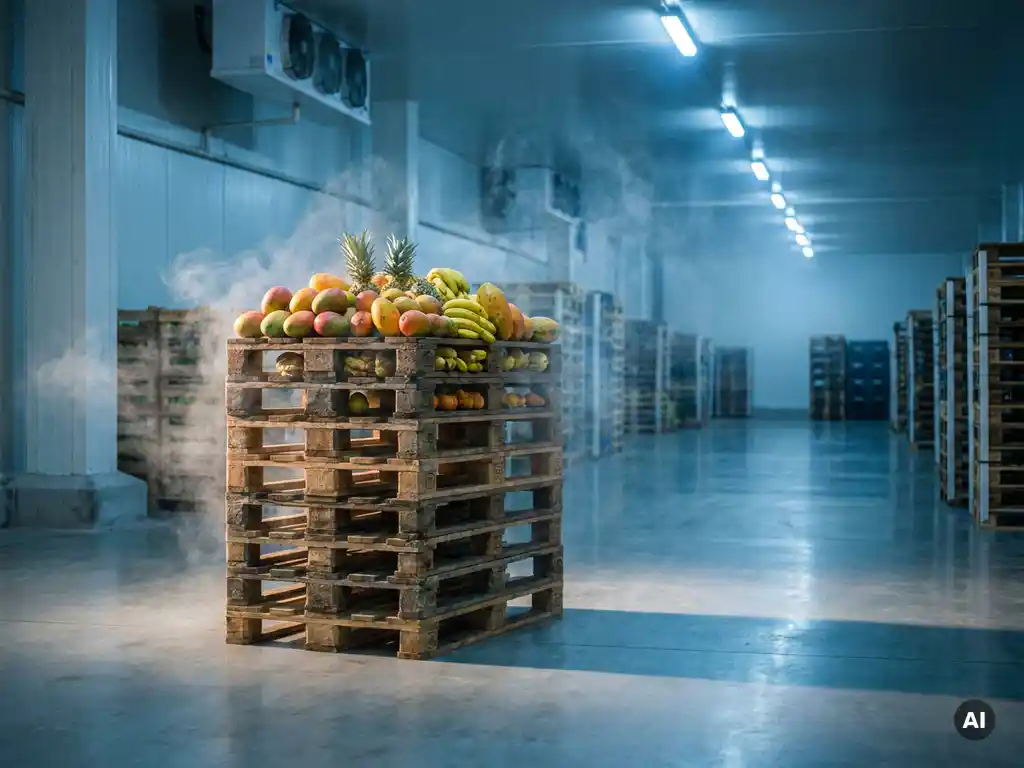
In B2B logistics, renting storage space costs on average between 5 and 20 euros per pallet space per month, depending on the type of storage, location, and additional services. Rates for climate-controlled storage are structurally higher than for dry storage at room temperature. In this article, we answer the most frequently asked questions about the costs of renting storage space, so that you, as a buyer or logistics manager, are well-prepared.
Which factors determine the price of storage space?
The price of renting storage space is determined by a combination of storage type, location, volume, and desired additional services. No two clients have exactly the same needs, and this is directly reflected in the pricing structure applied by a storage company.
The main cost drivers are:
- Type of storage: Dry storage (ambient or cooled to approximately 11 degrees) is cheaper than climate-controlled cold storage with strict temperature and humidity control.
- Location: Facilities in or near a seaport such as Vlissingen or Rotterdam are logistically favorably priced for importers, but land costs and infrastructure influence the rate.
- Volume and occupancy rate: The more pallet spaces you purchase on a regular basis, the more favorable the unit price generally is.
- Throughput speed: Products that rotate quickly require less storage capacity but more handling; products that sit for a long time occupy space longer and increase storage costs per unit.
- Additional services: Quality control, labeling, repalletizing, and EDI connections are charged separately and increase the total price.
- Certifications: Storage under BRC, SKAL, or KCB/NVWA certification entails higher operational costs, but is an absolute requirement for many B2B customers and supermarket suppliers.
In short: the price is always custom-made. A good quote starts with an accurate description of your product, your volume, and your logistical requirements.
How much does it cost to store a pallet per month?
The costs for pallet storage in the Netherlands typically range between 5 and 20 euros per pallet space per month. Dry storage at ambient temperature is at the lower end of this spectrum; refrigerated or climate-controlled storage is structurally higher due to energy costs and technical requirements.
In addition to the pure storage costs per pallet, most storage companies also charge inbound and outbound rates. These are costs per operation, such as booking a pallet in upon arrival or preparing it for transport. Depending on the company and the contract type, these are invoiced per movement, per hour, or as a fixed package.
Higher rates apply to fresh and perishable products such as exotic fruit, because storage conditions must be monitored more closely and turnaround times are shorter. Those who store a significant volume on an annual basis can usually negotiate a volume discount or a fixed contract price.
What is the difference between dry storage and cold storage?
Dry storage and cold storage differ fundamentally in the conditions under which goods are stored. Dry storage (also known as ambient storage or tempered storage) keeps products at a stable, non-refrigerated temperature, typically between 8 and 18 degrees. Cold storage actively and continuously regulates temperature, humidity, and air circulation, specifically tailored to the product.
Dry storage: stable and cost-efficient
Dry storage is suitable for products that do not require active cooling but do require a stable environment. Examples include nuts, peanuts, seeds, and other dry food products. A tempered dry storage facility with a capacity of 12,000 pallet spaces, such as that of ZZColdstores, offers sufficient volume for large-scale B2B flows to processing plants and wholesalers. Operational costs are lower than with cold storage, which translates into a lower pallet price.
Cold storage: precision for fresh products
Cold storage is indispensable for fresh, perishable products such as exotic fruit. Temperature, humidity, and air circulation are monitored and adjusted 24/7. Each climate chamber can be configured per product, ensuring that bananas, citrus fruits, and other sensitive goods are stored under exactly the right conditions. Energy costs and technical complexity make cold storage more expensive, but quality assurance is non-negotiable for many customers in the supermarket chain.
The choice between dry and cold storage depends entirely on the product and the customer's requirements. Some logistics partners offer both forms at a single location, which simplifies supply chain integration.
What additional costs should you expect when renting storage space?
In addition to the basic rental price per pallet space, there are several additional costs that determine the total bill when renting storage space. It is essential to map out these items in advance to compare quotes fairly.
Common additional costs are:
- Inbound and outbound rates: Costs per pallet or per handling operation upon arrival and departure.
- Handling and repalletizing: When containers are unloaded, products are sorted, or pallets are rebuilt, labor costs are passed on.
- Quality Control (QC): Inspections upon arrival for damage, labeling, and product condition, including temperature and humidity measurements, are charged separately.
- Labeling: The application of barcodes, expiration dates, or customer-specific labels falls under Value Added Services and has its own rate.
- EDI connections: System integrations for automated order processing and inventory updates are valuable services, but they entail implementation and maintenance costs.
- Transport and shuttle services: In-house transport between the production location and the warehouse (within a radius of approximately 40 km) is priced separately, usually per trip or per kilometer.
- Customs and import inspection: For imported goods, costs for customs clearance and KCB/NVWA inspections are added to the storage costs.
Explicitly request a complete overview of these items with every quotation. A low pallet price can be misleading if handling, QC, and administrative services are billed separately and at a high rate.
When is it more cost-effective to outsource storage?
Outsourcing storage is more cost-effective than maintaining your own warehouse capacity when volumes fluctuate, the investment costs for your own facilities are too high, or when specific certifications and technical requirements necessitate a specialized partner.
For importers and wholesalers of fresh food products, outsourcing is almost always the wisest choice. The investment in climate-controlled storage with BRC or SKAL certification, including 24/7 monitoring, is not profitable for most trading houses to set up in-house. Moreover, own warehouses tie up capital that could be better utilized in the trading activity itself.
Outsourcing is also attractive when you want access to port-related facilities. A storage location with its own quay, such as in Vlissingen, reduces the time between unloading and storage to a minimum, which directly benefits product quality. That type of infrastructure is virtually unattainable for an individual importer.
Keep in mind that outsourcing yields the best return when you enter into a long-term, stable relationship with a storage partner. Short-term contracts are more expensive per unit and offer less room for customization.
How do you compare quotes from storage companies?
You compare quotes for storage space by looking not only at the pallet price, but at the total cost per unit of product, including all handling, services, and additional costs. A fair comparison requires that all quotes cover the same scope.
Use the following checklist when evaluating quotations:
- Define your scope in advance: Accurately describe which product you store, the volume, the temperature requirements, and the additional services you need.
- Request an all-in cost overview: Have each provider give a complete overview of pallet storage, inbound/outbound, handling, QC, labeling, and any administrative costs.
- Check the certifications: Are the required certifications (BRC, SKAL, KCB/NVWA) present? Without the proper certification, a low price can end up costing you dearly during buyer inspections.
- Assess the location and infrastructure: Is the facility logistically well located in relation to the port, production site, and customers? Transport costs saved count towards the overall comparison.
- Demand for flexibility: Can the partner scale up during volume peaks or adapt to changing sailing schedules? Rigid contracts can cause operational bottlenecks.
- Inquire about traceability: Does the provider work with barcode-driven systems and are EDI connections possible? This is often a strict requirement for supermarket suppliers.
A good storage partner is transparent about its rates and proactively helps find the most efficient solution for your specific flow of goods.
How ZZColdstores helps with renting storage space
ZZColdstores offers B2B logistics partners a complete solution for both dry and climate-controlled storage, from strategically located facilities in Kruiningen and Vlissingen. Whether you are looking for tempered dry storage for nuts and seeds, or climate-controlled cold storage for exotic fruit and other fresh products, ZZColdstores precisely tailors the storage conditions to the requirements of your product.
What sets ZZColdstores apart as a storage partner:
- Climate chambers configurable per product, with 24/7 monitoring of temperature, humidity, and air circulation
- Dry storage warehouse with a capacity of 12,000 pallet spaces for ambient products
- Own quay in Vlissingen for direct transfer from ship to cooling
- Full traceability via barcode systems and optional EDI connections
- Certified under BRC, SKAL and KCB/NVWA for food-safe storage
- Additional services such as quality control, repalletizing, labeling, and shuttle transport
- Flexible contract forms tailored to sailing schedules and volume fluctuations
Would you like to know what renting storage space at ZZColdstores costs for your specific situation? Contact us for a customized, no-obligation quote.
Frequently Asked Questions
What is a realistic minimum quantity to rent storage space from a B2B storage company?
Most professional storage companies apply a minimum purchase requirement, often expressed as a minimum number of pallet spaces per month or a minimum contract value. In practice, a structural volume of 20 to 50 pallet spaces per month is a realistic starting point for a profitable partnership for many providers. Do you have a smaller volume? Then explicitly ask about flexible or shared storage options, where you only pay for what you actually use.
How far in advance should I reserve storage capacity, especially during seasonal peaks?
For regular volumes, signing in two to four weeks in advance is usually sufficient, but for expected seasonal peaks — such as a large import of exotic fruit for the summer months — it is advisable to reserve capacity three to six months ahead. Climate-controlled storage cells are scarce and fill up quickly. Proactively discuss your expected sailing schedules and volume peaks with your storage partner so that space can be reserved in a timely manner.
What happens if my products get damaged during storage or the temperature fails?
A professional storage partner works with 24/7 monitoring and alarm systems that intervene immediately in the event of temperature deviations, thereby preventing damage as much as possible. Nevertheless, it is essential to make clear agreements in advance regarding liability and damage procedures, and to check whether the storage partner has adequate goods insurance or liability insurance. Also ask about the emergency protocol: who is called when, and how quickly is action taken?
Can I track my inventory in real-time if I outsource storage space?
Yes, most modern warehousing companies offer access to a Warehouse Management System (WMS) or inventory management portal that allows you to view your current inventory status. EDI connections are available for seamless integration with your own ERP or order processing system, although these do entail implementation costs. When comparing providers, check what level of digital transparency is included as standard and what is optional or at an additional cost.
What are the most common mistakes buyers make when concluding a storage contract?
The most common mistake is comparing providers based purely on pallet price, without taking into account the total cost price, including inbound and outbound rates, handling, and ancillary services. A second common mistake is underestimating the importance of certifications: a storage partner without the proper BRC or SKAL certification can cause you significant problems during a customer audit. Finally, ensure that contract flexibility is explicitly stipulated so that you are not tied to unprofitable minimum obligations in the event of volume changes.
Is it possible to house both dry and cold storage with one and the same partner?
Yes, and that is often even the most efficient choice. When a single partner offers both forms of storage at the same location, you save on transport movements between facilities and keep the entire chain transparent. Moreover, this simplifies administration, quality control, and traceability, as all goods flows run through one system and a single point of contact. When dealing with combined contracts, always ask if a pricing advantage is possible.
How do I know if a storage company has the right certifications for my product?
Ask the supplier to provide current certificates and check the validity dates and the specific scope of each certificate — a BRC certificate, for example, does not automatically cover all product categories or storage activities. For fresh food products destined for the Dutch supermarket chain, BRC (food safety), SKAL (organic products), and KCB/NVWA (phytosanitary inspection) are the most relevant certifications. If in doubt, consult your buyer or retailer regarding which certifications they require before signing a contract.
Related articles
- What is the difference between refrigerated storage and dry storage?
- Why do factories choose to outsource intermediate storage in Europe?
- How does the transit of dry goods to Germany or Ukraine work?
- What are the NVWA rules for import inspection of dried fruit in 2026?
- Can poor storage of nuts lead to rejection during import inspection?