
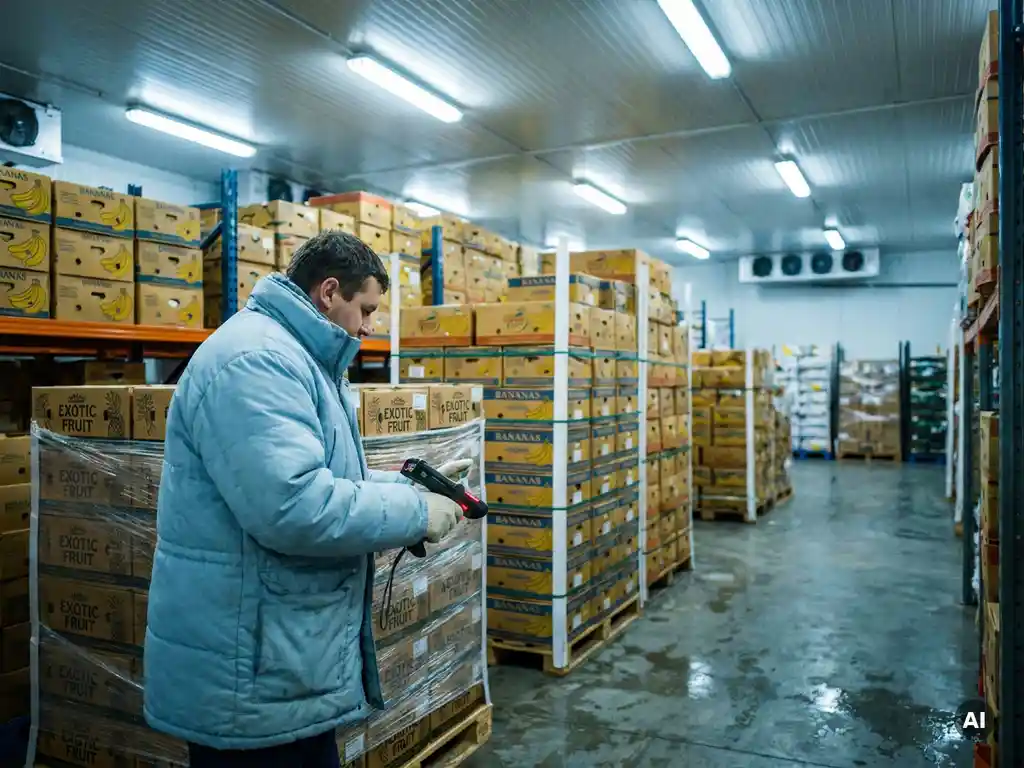
Inventory registration within a warehouse is the systematic tracking of all goods movements: which products have arrived, where they are stored, in what quantities, and when they leave the warehouse. Accurate registration forms the backbone of any efficient warehouse process and is indispensable for supply chain managers, buyers, and logistics partners who want insight into their inventory position at any time. The following sections address the most frequently asked questions about how inventory registration works in practice.
What methods are used for inventory tracking in a warehouse?
The most commonly used methods for inventory registration in a warehouse are barcode registration, RFID scanning, manual counting, and digital warehouse management systems. In most modern warehouses, these methods are combined: barcodes or RFID tags identify individual pallets or boxes, while a central system collects and processes all data.
Barcode registration is the most common approach in food logistics. Upon arrival, every pallet or shipment receives a unique barcode containing all relevant product information. Scanners read these codes with every movement: during inbound, transit, and outbound. RFID goes a step further and makes it possible to register multiple products simultaneously without a direct line of sight, which increases processing speed for large goods flows.
Manual counts, also known as cycle counting or inventory, are used as a supplement to automated registration. In this process, warehouse personnel periodically physically count a portion of the stock and compare the result with system data. This is an effective way to detect discrepancies early without shutting down the entire warehouse.
What is a warehouse management system (WMS) and how does it support inventory tracking?
A warehouse management system, abbreviated as WMS, is software that controls and records all logistical processes within a warehouse. The system links goods movements to locations, batches, quantities, and timestamps, ensuring that the entire inventory is always visible. A WMS forms the digital core of modern inventory registration in warehousing.
In practice, a WMS directs employees via picking lists or mobile scanners and automatically records every action. As soon as a pallet is booked in, the system knows where it is located, how many there are, and to which batch or order it is linked. This prevents searching, incorrect deliveries, and duplicate registration.
For companies working with multiple product types, temperature zones, or customer-specific requirements, a WMS is particularly valuable. The system can assign locations based on product type, expiration date, or desired storage temperature. This keeps inventory structured and ensures traceability per batch, which is essential for food safety and certifications such as BRC.
How does real-time inventory tracking work for incoming and outgoing goods?
Real-time inventory registration means that every movement of goods is recorded immediately and automatically the moment it occurs. For incoming goods, this begins at the moment of unloading: products are scanned, checked, and immediately booked into the system. For outgoing goods, the outbound shipment is also registered immediately, ensuring the inventory position is always up-to-date.
Upon receipt of a shipment, the warehouse typically first checks the physical condition of the goods. Damage, discrepancies in quantities, or incorrect labeling are recorded and linked to the incoming batch. Only after approval is the shipment definitively booked and assigned to a storage location.
Upon delivery, the process works in reverse order. A picking list or shipping instruction triggers the registration of the outgoing goods. As soon as the pallet or shipment leaves the warehouse and is scanned at the exit, the inventory is automatically updated. Discrepancies between what has been picked and what the order requires are immediately flagged so that errors are not carried through the chain.
What are the benefits of accurate inventory tracking for cold chain storage?
Accurate inventory recording is even more important in cold chain storage than in regular warehousing, because fresh and perishable products have a limited shelf life. An error in recording can mean that products remain in the wrong location for too long, resulting in loss of quality or food safety risks. Correct recording therefore protects not only the records but also the product itself.
The benefits of accurate record-keeping in a refrigerated warehouse include:
- Full traceability: every pallet can be traced back to the original batch, the time of arrival, and the storage location.
- FIFO management: the system automatically directs employees to the oldest stock, ensuring products are delivered on time.
- Rapid response to quality deviations: if a batch does not meet the standards, it can be immediately isolated without affecting the rest of the stock.
- Demonstrability for certification: certifications such as BRC require documented traceability, which an accurate WMS automatically provides.
For importers and wholesalers of exotic fruit, vegetables, or nuts, this means that they know at all times where their stock is located, in what condition, and when it is available for further distribution.
What data is recorded during inventory registration in a warehouse?
When registering inventory in a warehouse, at least the following data are recorded: product name and code, quantity (number of packages, boxes, or pallets), weight, arrival date, storage location, batch or lot number, and the name of the client. Depending on the product type and certification requirements, additional data are added.
For fresh food products, additional registrations are common:
- Expiration date or use-by date
- Country of origin and supplier
- Temperature upon arrival and during storage
- Results of quality controls, such as Brix or moisture measurements
- Any discrepancies or remarks upon receipt
All this data combined forms a batch file. This file is essential for any complaints, recalls, or inspections by supervisory authorities such as the NVWA. A complete and correctly filled-out file per batch is therefore not an administrative formality, but a practical necessity in food logistics.
How does inventory registration in dry storage differ from refrigerated storage?
The basic principles of inventory recording are the same in dry storage and refrigerated storage: every movement of goods is recorded, locations are tracked, and batches are traceable. The difference lies in the additional parameters that are monitored and recorded in refrigerated storage, such as temperature, humidity, and air circulation.
In dry storage, such as that for nuts, peanuts, and seeds, the focus is on quantity, location, and batch management. Storage conditions are more stable and require less continuous monitoring. As a result, registration is slightly simpler in design, although traceability per batch remains essential here as well, especially for products destined for the food industry or supermarket chains.
In the case of refrigerated storage, continuously logged climate data is added. Any deviation in temperature or humidity is recorded and linked to the parties involved. This makes it possible to demonstrate retrospectively that products were stored under the correct conditions throughout the entire storage period. For importers working with certifications or who must account to customers, this documented climate history is an important part of inventory records.
How does a warehouse ensure error-free inventory registration?
A warehouse minimizes errors in inventory registration by replacing manual operations with automated scanning as much as possible, employing fixed work procedures for every goods movement, and incorporating periodic checks that detect deviations early. No system is error-free, but a combination of technology, discipline, and control keeps deviations structurally low.
Concrete measures that contribute to error-free registration are:
- Mandatory scan confirmation: employees can only complete an action after the barcode has been scanned and the system approves it.
- Double check upon delivery: the picked goods are scanned again during loading and compared with the order.
- Cycle count: periodic physical counts per location or product group are compared with the system data.
- Direct quality control upon receipt: deviations are recorded upon arrival, so that errors do not surface later in the chain.
Education and work discipline are at least as important as technology. A good system only works if employees consistently follow the correct procedures. This requires clear instructions, regular training, and a culture where correct record-keeping is considered a matter of course.
How ZZColdstores supports inventory registration in climate-controlled storage
ZZColdstores combines advanced climate control with a streamlined registration process for fresh and fragile products. For importers, wholesalers, and supply chain partners working with exotic fruit, vegetables, or dry food products, this offers a number of concrete benefits:
- Every pallet is fully traceable via a barcode system, from arrival to departure
- Temperature, humidity, and air circulation are monitored and logged 24/7 per storage cell
- Upon arrival, shipments are immediately checked for damage, labeling, and product condition, with a report available upon request
- Both refrigerated storage and dry storage (for nuts, peanuts, and seeds) fall under the same structured registration process
- The locations in Kruiningen and Vlissingen are certified (BRC, SKAL), which aligns with the traceability requirements of supermarket chains and processing plants
Would you like to know how climate-controlled storage works at ZZColdstores and how inventory registration aligns with your supply chain? Contact us for a no-obligation discussion about the possibilities.
Frequently Asked Questions
How long does it take to implement a WMS in an existing warehouse?
The implementation time for a WMS depends on the complexity of the warehouse and the integrations with existing systems, but on average, allow two to six months. A phased approach works best: start with core functions such as inbound and outbound logistics, and then add advanced features such as automatic location assignment or integration with ERP systems. Ensure adequate training for employees during the implementation, as a system only works optimally if the team knows how to use it.
What happens if there is a discrepancy between the physical inventory and the system record?
In the event of a discrepancy between the physical count and the system data, the cause is investigated first: examples include a missed scan, an incorrectly booked location, or an administrative error upon receipt or delivery. Subsequently, the system registration is corrected and documented to ensure the file remains complete and traceable. Structural discrepancies signal the need to critically review work procedures or scanning times.
Is inventory registration via barcodes sufficient, or is RFID necessary for my situation?
For most food logistics warehouses, barcode registration is a solid and cost-effective solution. RFID becomes interesting when you work with very high goods flows, where scanning individual barcodes acts as a bottleneck, or when products are difficult to reach with a handheld scanner. Discuss with your logistics partner which method suits your product volume, packaging type, and desired processing speed.
How can I, as an importer or wholesaler, gain access to my inventory data at an external logistics service provider?
Professional warehouses typically offer a customer portal or a direct connection via EDI or API, providing you with real-time insight into your inventory position, including locations, quantities, and batch information. Explicitly ask your logistics partner about reporting capabilities and how data is shared so that you can integrate this into your own ERP or purchasing system. Transparent data sharing is a fundamental requirement for reliable collaboration in the supply chain.
Which certifications are relevant for inventory registration in food logistics, and what do they specifically require?
The most relevant certification for food logistics is BRC Storage & Distribution, which sets requirements for, among other things, batch traceability, documented receiving inspections, and demonstrable FIFO management. For organic products, SKAL certification is required, where strict separation and registration per batch are mandatory. A well-configured WMS provides the necessary documentation largely automatically, but the underlying work procedures and the audit process also require organizational preparation.
How is inventory registration used during a recall or quality incident?
In the event of a recall, a complete batch file is key: using the lot or batch number, the warehouse can immediately determine which locations are involved, how much is still in stock, and which shipments have already been delivered and to whom. This enables targeted and rapid action without unnecessarily affecting other parties or customers. The more detailed the registration upon receipt, the smaller the impact of an incident on the rest of the chain.
What are the most common errors in inventory registration and how do I avoid them?
The most common errors are skipping a scan step, booking to the wrong location, and failing to record discrepancies upon receipt. These errors can largely be prevented by implementing mandatory scan confirmation in the WMS, ensuring that an action is only completed after a successful scan, and by regularly training employees on the applicable procedures. Periodic cycle counts act as a safety net and help correct creeping discrepancies early on, before they have major consequences.