
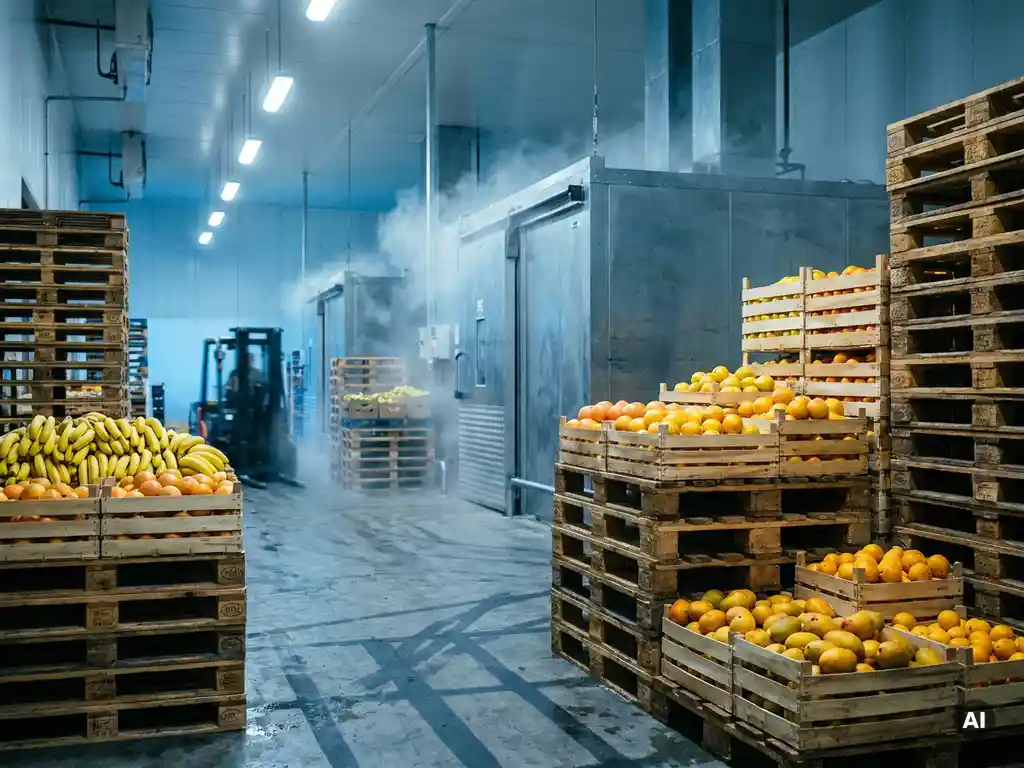
When warehousing imported food products, you focus on three key factors: the correct storage conditions per product, applicable certifications and customs requirements, and the logistical location of the warehouse. For B2B parties such as importers, wholesalers, and suppliers to supermarkets, these are not minor details but prerequisites that directly determine product quality and compliance with laws and regulations. The questions below address every aspect that plays a role in choosing a warehousing partner for food products.
What storage conditions apply to imported foodstuffs?
The required storage conditions for imported food products depend entirely on the product. Fresh and perishable products such as exotic fruit require precise climate control: a stable temperature, controlled humidity, and sufficient air circulation. Dry products such as nuts, peanuts, and seeds require a dry, cool environment without moisture spikes.
Each product stream imposes different requirements. Bananas, for example, ripen at a specific temperature and ethylene concentration, while citrus fruits are susceptible to cold damage at temperatures that are too low. Nuts and seeds, on the other hand, are vulnerable to mold formation at high humidity. A warehouse handling imported food products must be able to implement separate climate settings for each cell or room and monitor them continuously.
It is also important that the conditions begin at the moment of arrival. Any interruption of the cold chain, even a brief one, can lead to a loss of quality that cannot be restored later in the chain. The shorter the time between unloading and placement in the conditioned room, the better product quality is guaranteed.
Which certifications are required for food storage in the Netherlands?
There are no universally mandatory certifications for the storage of imported food products in the Netherlands, but in practice, BRC, SKAL, and accreditation by the NVWA (via KCB) are the standards that purchasing organizations of supermarkets and processing plants require from their logistics partners.
BRC (British Retail Consortium) is an international food safety standard required by virtually all major European retailers and processing companies. A BRC-certified warehouse meets strict requirements regarding hygiene, traceability, temperature control, and internal processes.
SKAL is relevant for parties that import and store organic products. SKAL certification guarantees that organic products are stored separately from conventional products and that the organic status is demonstrably maintained throughout the entire logistics chain. For organically certified importers, this is a strict requirement.
KCB/NVWA accreditation is required for the import inspection of fresh products from outside the EU. The KCB, part of the NVWA, performs phytosanitary inspections on fresh fruit and vegetables. A warehouse wishing to serve importers must be registered as an accredited inspection location in order to have these inspections carried out on-site.
Always ask a potential warehousing partner for current certificates and check whether the certification applies to the specific areas where your products are stored, not just to the company as a whole.
What are the customs and import requirements for the storage of imported food?
Imported foodstuffs from outside the EU must be declared to customs upon entry into the Netherlands and, depending on the product, undergo a phytosanitary or veterinary inspection. As long as goods have not been released, they remain in a customs warehouse and may not be placed in free circulation.
For fresh products such as exotic fruit, additional import requirements apply under EU phytosanitary regulations. A phytosanitary certificate from the country of origin is mandatory, and upon arrival, the KCB (part of the NVWA) conducts a physical inspection. The consignment may only be released for further distribution after approval.
A warehouse that processes imported foodstuffs must be able to temporarily store goods under customs supervision and coordinate the administrative handling. This requires a customs license or close cooperation with a recognized customs broker. For importers, it is a major advantage when the warehousing partner can facilitate on-site customs clearance and inspection, so that the supply chain remains as short as possible.
How does the location of a warehouse affect the quality of food products?
The location of a warehouse has a direct impact on product quality because every additional transport movement between unloading and temperature-controlled storage poses a risk to temperature-sensitive goods. The shorter the distance between the ship or container and the storage area, the lower the risk of quality loss.
Warehouses located directly on a quay have a structural advantage when processing sea freight. Transfer from the hold to the cold storage can take place within minutes, whereas a warehouse on a remote industrial estate always requires an extra transport link. For products sensitive to temperature fluctuations, such as ripening bananas or citrus fruits, this makes a demonstrable difference.
In addition to proximity to the port, the location relative to the final destination also plays a role. Warehouses in the Rotterdam-Antwerp corridor are strategically located for distribution to Germany, Eastern Europe, and other European markets. A shorter distance to the end customer means less transport time and a longer remaining shelf life upon arrival.
What is the difference between cold storage and dry storage for food?
Cold storage and dry storage differ primarily in temperature and the products for which they are suitable. Cold storage, also known as climate-controlled storage, keeps products at a specific temperature and humidity to slow down spoilage. Dry storage, also known as ambient storage, stores products at a stable room temperature without active cooling.
Cold storage: for fresh and perishable products
Climate-controlled cold storage is intended for products that spoil quickly at ambient temperature, such as fresh fruit, vegetables, and other fresh foods. The temperature, humidity, and air circulation are continuously monitored and adjusted. The settings vary by product: what applies to bananas is different from what applies to citrus fruits or leafy vegetables.
Dry storage: for non-perishable products
Dry storage is suitable for products with a longer shelf life that do not require active refrigeration but must be protected against moisture, temperature fluctuations, and pests. Examples include nuts, peanuts, seeds, and dried food products. A good dry storage facility stores products at a constant, cool temperature, typically around 11 degrees Celsius, and is set up with separate areas for each product category to prevent cross-contamination and odor transfer.
The choice between cold and dry storage is therefore not a preference but a product requirement. A warehouse offering both facilities gives importers and wholesalers the flexibility to house multiple product streams with a single partner.
What questions should you ask a food warehousing partner?
When selecting a warehousing partner for imported food products, asking the right questions is decisive. The following questions help you quickly and concretely assess a partner's suitability:
- Which certifications are active and for which spaces do they apply? Ask about BRC, SKAL, and KCB/NVWA accreditation and check if they apply to the specific storage areas for your products.
- Can climate settings be adjusted per product? Not every product requires the same conditions. A flexible partner sets separate parameters per cell or zone.
- How is the cold chain secured from the moment of unloading? Ask about the time and procedure between the arrival of the shipment and placement in the temperature-controlled room.
- Can the partner facilitate customs clearance and import inspection? This avoids extra links in the chain and significantly shortens the lead time.
- How is the traceability of goods arranged? Barcode-driven traceability per pallet, including the linking of grower and LOT numbers, is the norm among serious partners.
- Which Value Added Services are offered? Think of quality control upon arrival, repalletizing, labeling, and EDI connections with your own systems.
- What is the location in relation to the port and the end market? Direct quay access and location in the Rotterdam-Antwerp corridor are relevant factors for speed and maintaining quality.
A reliable warehousing partner answers these questions concretely and demonstrably, not only in brochures but also in certificates, contracts, and references.
How ZZColdstores helps with the warehousing of imported food products
ZZColdstores combines climate-controlled cold storage with dry storage at locations in Kruiningen and Vlissingen, thereby equipping itself to handle the full range of imported food product flows. Its own quay in Vlissingen enables direct transfer from ship to cold storage, keeping the cold chain as short as possible. Relevant features at a glance:
- Climate-controlled storage with 24/7 monitoring of temperature, humidity, and air circulation, adjustable per product
- Dry storage with a capacity of 12,000 pallet spaces, with separate areas for nuts, peanuts, seeds, and other food products
- Certifications: BRC, SKAL, and Demeter, with KCB/NVWA accreditation for on-site import inspections
- Barcode-driven traceability per pallet, including linking of grower and LOT numbers
- Value Added Services such as quality control upon arrival, repalletizing, labeling, and EDI connections
- Customs clearance and import inspection are facilitated on-site
Would you like to know if ZZColdstores' climate-controlled storage aligns with your product requirements and logistics chain? Contact us and discuss the possibilities directly with the specialists.
Frequently Asked Questions
How far in advance do I need to engage a warehousing partner when importing food products?
It is highly recommended to engage a warehousing partner before the first shipment leaves the country of origin. This gives the partner time to prepare the correct climate settings, coordinate customs documentation, and schedule a KCB inspection. For new product flows or new partnerships, a preparation time of two to four weeks is realistic to ensure everything runs smoothly.
What happens if a shipment does not meet the quality requirements upon arrival?
A professional warehousing partner performs a quality control upon arrival and documents any deviations immediately. This is crucial for reclaim procedures with the supplier or insurer. Ensure that you agree with your partner in advance on the protocol for non-conforming shipments: who is informed, how the batch is stored separately, and what documentation is provided? Clear agreements on this prevent disputes afterwards and protect your commercial position.
As an importer, can I house multiple product categories with different storage requirements in a single warehouse?
Yes, provided the warehouse has both climate-controlled and dry storage facilities with the ability to set separate parameters per cell or zone. The advantage of having a single partner for multiple product streams is that your administration, traceability, and communication are centralized. However, ensure that the warehouse is demonstrably capable of preventing cross-contamination and odor transfer between different product categories, for example, through physically separated spaces per product type.
What is the difference between a customs bonded warehouse and a regular food storage location?
A bonded warehouse is a recognized location where goods from outside the EU are temporarily stored without import duties or VAT being payable, as long as the goods have not been released into free circulation. A regular storage location does not have this status and therefore cannot receive uncleared goods. For importers of food products from outside the EU, it is a major practical advantage if their warehousing partner holds a customs license or works closely with a recognized freight forwarder, so that customs clearance and storage take place at the same location.
How do I check if a BRC certification actually applies to the space where my products are stored?
Ask the warehousing partner for the current BRC certificate and the accompanying scope description. This states exactly which activities, areas, and product categories fall under the certification. A company may be BRC-certified for only a part of its facilities, while your products are stored in an area that falls outside the scope. Do not be reassured by a logo on a website; always ask for the original certificate with a valid date and check the scope.
What common mistakes do importers make when choosing a warehousing partner for food products?
A common mistake is selecting a partner based purely on price per pallet space, without taking total chain costs into account. A cheaper warehouse located far from the port can ultimately turn out to be more expensive due to extra transport, longer lead times, and higher quality losses. Other common mistakes include: failing to verify whether certifications actually apply to the correct spaces, not making clear agreements regarding cold chain assurance during unloading, and forgetting to inquire about capacity and experience with your specific product category.
Is EDI integration with my own systems a standard service or a custom solution from a warehousing partner?
This varies by partner. For specialized food warehouses working with professional B2B clients, EDI integration is increasingly becoming a standard part of the service package, but the technical implementation always requires coordination between the systems of both parties. Discuss this early in the selection process: which message standards are supported, how does the implementation proceed, and what are the lead times? A good EDI integration significantly reduces manual administration and minimizes the risk of errors in orders and inventory management.