
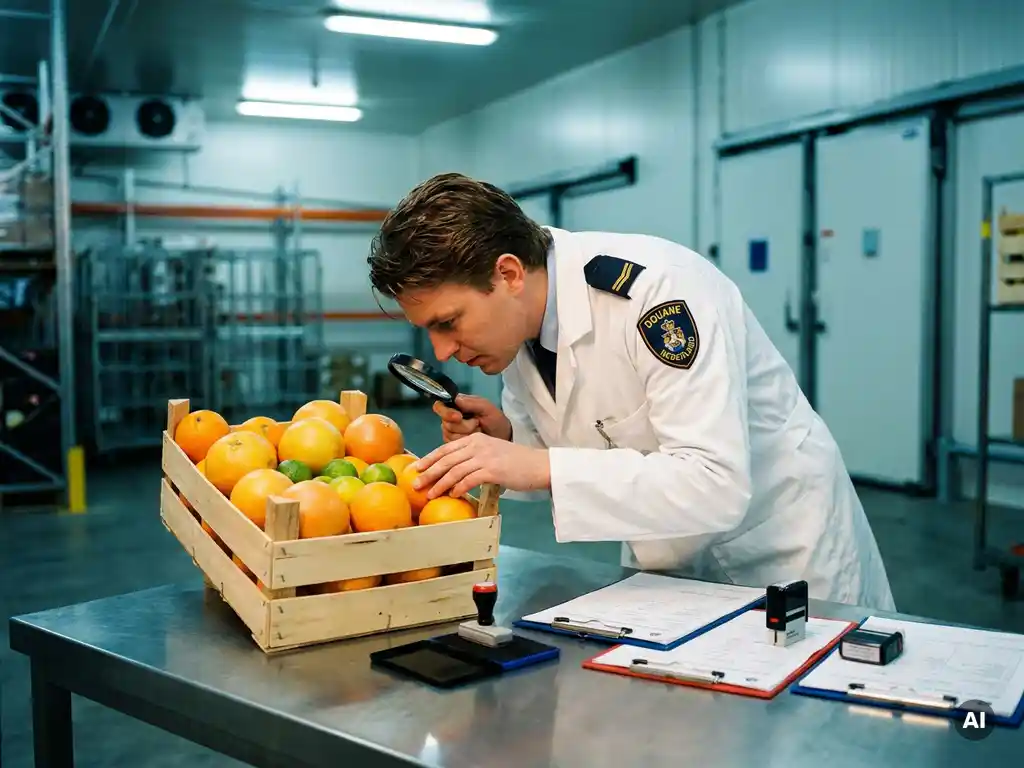
Import inspections of fresh fruit in the Netherlands are carried out by two agencies: the KCB (Quality Control Bureau) and the NVWA (Netherlands Food and Consumer Product Safety Authority). As an independent administrative body under the supervision of the NVWA, the KCB performs quality inspections on fresh vegetables and fruit, while the NVWA is responsible for phytosanitary and food safety checks. Together, they act as the gatekeepers for every shipment of fresh fruit entering the Netherlands.
For importers, logistics managers, and supply chain partners, it is essential to understand how this system works, which documents are required, and what happens if a shipment is rejected. This article answers the most frequently asked questions about the import inspection process step by step.
Which products are subject to the KCB import inspection?
The KCB import inspection applies to fresh fruit and vegetables imported from countries outside the European Union. Specifically, this concerns products for which the EU has established trade standards, such as bananas, citrus fruits, apples, pears, tomatoes, cucumbers, and various other fresh products. Exotic fruit imported outside the EU growing season is almost always subject to this inspection requirement.
EU trade standards prescribe minimum requirements regarding quality, sorting, packaging, and labelling. Products that do not meet these standards may not enter the European market. On behalf of the EU, the KCB checks whether imported batches meet these requirements. A simplified standard applies to some product categories, but for most common import products, such as bananas and citrus, full inspection applies.
It is important to note that the inspection requirement does not depend on the quantity or value of the shipment. Every commercial consignment of fresh fruit entering the EU via a Dutch port or airport must be registered with the KCB for an import inspection of fruit in the Netherlands.
What does the NVWA check during the import of fresh fruit?
The NVWA focuses primarily on phytosanitary inspection and food safety for the import of fresh fruit. Phytosanitary means checking whether the shipment is free from plant diseases, harmful insects, and other organisms that pose a risk to Dutch and European agriculture and horticulture. In addition, the NVWA assesses whether products comply with the standards for plant protection product residues.
The NVWA operates on the basis of risk analysis. Not every shipment is inspected with the same intensity; the frequency and depth of the inspection depend on the country of origin, the type of product, and the historical results of previous shipments. Countries or products with an increased risk are inspected more frequently and thoroughly.
During a phytosanitary inspection, the NVWA may take samples for laboratory analysis. This may mean that a shipment is temporarily held until the results are available. For fresh, fragile products such as exotic fruit, this is a critical moment, where temperature-controlled storage during the waiting period is essential to maintain product quality.
What is the difference between a KCB inspection and an NVWA inspection?
The main difference between a KCB inspection and an NVWA inspection lies in the purpose of the inspection. The KCB inspection is a quality inspection: it assesses whether the product complies with EU trade standards for appearance, ripeness, sorting, and packaging. The NVWA inspection is a safety and health inspection: it checks for plant diseases, pests, and residues that pose a risk to humans, plants, or the environment.
In practice, both inspections are complementary and often run in parallel or shortly after one another. The KCB is an independent administrative body that operates under the responsibility of the NVWA, but the two organizations each apply their own legal framework and procedures.
- KCB inspection: control of EU trade standards (quality, sorting, packaging, labelling)
- NVWA inspection: phytosanitary control (plant diseases, pests, residues of plant protection products)
- Authority: KCB is executive, NVWA is supervisory and enforcement.
- Consequences upon rejection: KCB rejection leads to refusal on quality grounds; NVWA rejection may lead to destruction or return due to health risks.
It is important for importers to initiate both processes in a timely manner, as a delay at either inspection can hold up the entire shipment.
How does the import inspection process work step by step?
The import inspection process for fresh fruit in the Netherlands follows a fixed sequence of actions, from arrival of the shipment to release for the market. Below is an overview of the steps:
- Customs notification: The importer or freight forwarder submits a declaration to Dutch Customs via the electronic system. The required documents are submitted at this stage.
- Phytosanitary notification to the NVWA: Simultaneously with or immediately after the customs declaration, the importer notifies the consignment to the NVWA for phytosanitary control. This is done via the EU's TRACES NT system.
- Document check: The NVWA first checks the papers: phytosanitary certificate, invoice, packing list, and any certificates of origin.
- Physical inspection: A physical inspection follows a selection of shipments, during which samples are taken from the product.
- KCB registration and quality inspection: The importer registers the batch with the KCB. A KCB inspector assesses the batch for quality, sorting, and packaging in accordance with EU trade standards.
- Release: If both inspections are successfully concluded and customs clearance is completed, the consignment is released for the European market.
The turnaround time for this process varies depending on the type of product, the country of origin, and the workload at the relevant authorities. For fresh products, speed is crucial; proper preparation of the documentation significantly shortens the turnaround time.
What happens if a shipment fails the inspection?
If a shipment fails the KCB or NVWA inspection, there are several possible outcomes depending on the nature and severity of the rejection. A rejected shipment does not automatically have to be destroyed; in many cases, the importer has the option to take action.
In the event of a KCB rejection based on quality, the importer can choose:
- Re-sorting: the removal of products that do not meet the standard, so that the rest of the batch is still approved.
- Conversion to a lower standard: the batch is designated for processing instead of sale as fresh product.
- Return: the shipment is being returned to the country of origin
- Destruction: if none of the above options are feasible
In the event of an NVWA rejection on phytosanitary grounds, the options are more limited. If a quarantine organism or serious contamination is involved, the NVWA may impose mandatory destruction or return without re-sorting being an option. The importer is responsible for the costs of storage, return, or destruction during this period.
Preventing rejections starts with a reliable supplier, correct documentation, and proper conditioning of the products during transport and storage.
Which documents are required for an import inspection in the Netherlands?
A fixed set of documents is required for the import inspection of fresh fruit in the Netherlands. Missing or incorrect documents are one of the most common causes of delays during import control. The mandatory documents are:
- Phytosanitary certificate: issued by the official plant pathology service of the exporting country; this is mandatory for virtually all fresh plant products from outside the EU.
- Commercial invoice: stating the value, quantity, product description, and batches
- Packing list: detailed overview of the contents of the shipment
- Certificate of origin: depending on the country of origin and the applicable trade agreement
- Transport documents: bill of lading or air waybill, depending on the mode of transport
- TRACES NT notification: the electronic notification to the NVWA via the EU system for cross-border shipments
For specific products or countries of origin, additional documents may be required, such as a Certificate of Conformity or additional declarations from the exporter. It is advisable to verify the current documentation requirements prior to any import, as EU regulations are updated periodically.
How ZZColdstores helps with import inspection and storage of fresh fruit
For importers and logistics partners importing fresh and exotic fruit via Dutch ports, the combination of smooth import inspection and immediate temperature-controlled storage is crucial for the quality of the final product. ZZColdstores supports this process as an operational partner on the following points:
- Guidance of the KCB inspection and NVWA phytosanitary control as part of the logistical process
- Direct storage in climate-controlled cold rooms after unloading, with minimal exposure to uncontrolled temperatures
- Own quay in the port of Vlissingen, whereby the time between unloading and cooling is kept to a minimum
- Flexible climate settings per cell, tailored to the specific requirements of the product (temperature, humidity, air circulation)
- Dry storage capacity for nuts, peanuts, and seeds via the ambient warehouse in Kruiningen
Would you like to know how ZZColdstores can support your import flow, from arrival at the quay to release after inspection? Contact Frans van der Maas, Operations Director, for a no-obligation discussion about your specific situation.
Frequently Asked Questions
How long does the import inspection process take on average for fresh fruit in the Netherlands?
The turnaround time varies significantly depending on the product, the country of origin, and the availability of inspection services. With complete documentation and a low risk profile, the process can be completed within one working day. When the NVWA conducts additional laboratory testing, this can extend to several days — a critical period for fragile fresh products where temperature-controlled storage is indispensable.
As an importer, can I submit the inspection application myself, or do I need a freight forwarder?
Technically, as an importer, you can handle the registration with both the KCB and the NVWA yourself via TRACES NT, provided you have the necessary access to the systems and knowledge of the procedures. In practice, however, most importers engage a specialized customs broker or logistics partner, as errors in the registration or documentation immediately lead to delays and additional costs. Professional guidance is highly recommended, especially for the first imports.
What are the most common reasons why a shipment of fresh fruit is rejected?
The most common causes of rejection are incomplete or incorrect documentation (particularly an invalid or missing phytosanitary certificate), quality defects such as overripeness, rot, or damage that do not meet EU trade standards, and the detection of quarantine organisms or excessively high residue levels of plant protection products. Many of these problems can be prevented through strict quality controls at the exporter and thorough documentation preparation prior to shipment.
Do the same inspection rules apply to fruit entering the Netherlands via other EU countries?
No, the import inspection applies at the first point of entry into the EU, also known as the Border Inspection Post (BIP) or Designated Entry Point (DPE). For example, if a consignment of fresh fruit first enters the EU via the Port of Antwerp or Hamburg, the inspection is carried out there. Once the consignment has entered the EU and has been released, it can circulate freely within the internal market without repeated import inspection in the Netherlands.
Are there any products or situations where KCB certification is not mandatory?
Yes, simplified EU trade standards apply to a limited number of product categories, where the inspection intensity may be lower. In addition, shipments intended for industrial processing—provided this is demonstrably documented—are in some cases exempt from full quality inspection. However, it is always advisable to verify the current exemption regulations with the KCB prior to import, as regulations may vary by product category and country of origin.
What are the costs associated with the KCB and NVWA import inspection?
Both the KCB and the NVWA charge inspection fees that depend on the type of inspection, the size of the consignment, and the number of samples to be taken. The KCB uses a tariff structure based on the number of packages to be inspected or the batch size, while the NVWA charges for phytosanitary inspections and any laboratory testing. The current rates can be consulted on the websites of the KCB and the NVWA; please note that additional costs may arise for a re-inspection or supplementary testing.
How can I minimize the risk of delays during the import inspection?
The most important step is complete and correct documentation preparation before the shipment leaves the country of origin: verify that the phytosanitary certificate corresponds to the actual cargo and that all required documents are present. Work with a reliable exporter familiar with EU requirements and ensure timely notification via TRACES NT so that the NVWA can schedule the shipment before arrival. Furthermore, immediate cooling after unloading at a logistics partner with its own quay — such as ZZColdstores in Vlissingen — minimizes quality risks during the waiting period.
Related articles
- Can you rent storage space for pallets of fresh produce?
- When does a wholesaler need extra refrigerated storage space?
- What are the certification requirements for a warehouse that stores food products?
- What are the customs tariffs for importing nuts from Vietnam in 2026?
- How does the traceability of dry raw materials work in a European warehouse?