
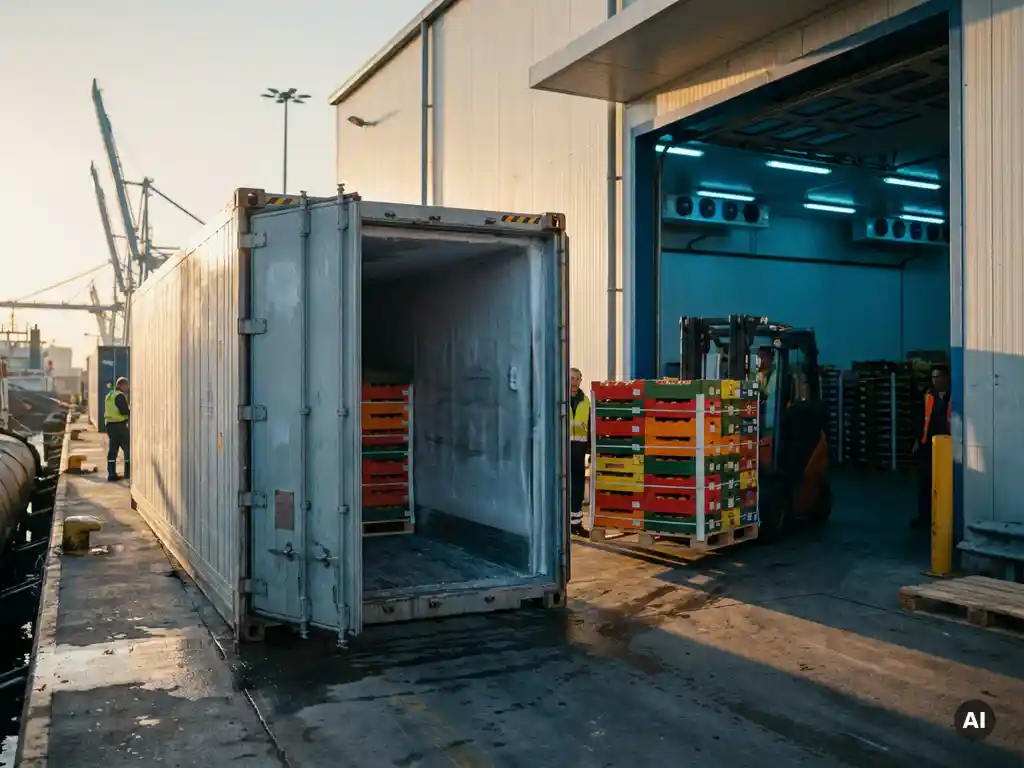
Upon the arrival of a sea container in the port, a shipment goes through a fixed sequence of steps: unloading, customs clearance, quality control, and storage under the correct conditions. For importers and logistics managers, it is crucial that every link in that chain aligns seamlessly, as unnecessary delays or temperature fluctuations can directly affect the quality of fresh products. The questions below provide a clear answer for each phase regarding exactly what happens and where the critical decision points lie.
What happens to a shipping container immediately after arrival in the port?
Immediately upon arrival, a sea container is unloaded from the ship by the terminal and temporarily placed on the container yard. Subsequently, the container is released for customs clearance, after which a logistics service provider or freight forwarder collects it and transports it to a warehouse. For temperature-sensitive cargo such as fresh fruit, every minute outside a controlled environment counts.
The speed of transshipment determines the final product quality. With a private quay, such as in the Port of Vlissingen, the distance between the ship and the cooling unit is minimal. This significantly reduces exposure to outside temperatures and prevents loss of quality in vulnerable products such as bananas and citrus fruits.
Upon arrival at the warehouse, these steps typically follow:
- Visual inspection and registration of the shipment
- Temperature measurement at unloading
- Palletize or repalletize if necessary
- Storage under the right climate conditions
- Linking the shipment to the warehouse management system
How does the customs clearance process work for imports by sea?
The customs clearance process for import by sea includes customs declaration, any phytosanitary inspection, and the release of the goods. For food products from countries outside the European Union, an import inspection by the NVWA or the KCB (Quality Control Bureau) is mandatory before the goods are freely available on the market.
The customs declaration is submitted by a recognized customs broker. In it, the goods code, origin, value, and quantity are specified. Based on this, Customs calculates any import duties and VAT. For fresh products such as fruit, a phytosanitary inspection also applies: inspectors from the KCB check whether the shipment complies with EU standards for plant health and quality.
The goods may only be stored and delivered on after release by both Customs and the inspection service. A specialized storage partner that handles customs clearance in-house significantly shortens lead times and prevents cargo from waiting unnecessarily long at the container yard.
What is the difference between cold storage and dry storage for food products?
Cold storage keeps products at a controlled low temperature, typically between 2 and 15 degrees Celsius depending on the product, whereas dry storage is aimed at products that can be kept stably at a constant ambient temperature without active cooling. The difference lies not only in the temperature, but also in the requirements for humidity and air circulation.
Cold storage: for fresh and perishable products
Fresh products such as bananas, citrus fruits, and other exotic fruits require precise climate control. Temperature, humidity, and air circulation are continuously monitored. Small deviations can accelerate ripening, cause mold formation, or shorten shelf life. Climate chambers are configured per product type so that the conditions exactly match the product specifications.
Dry storage: for stable products at a constant temperature
Nuts, peanuts, seeds, and other dry food products are stored in a dry storage warehouse, typically at around 11 degrees Celsius. These products do not require active refrigeration but are sensitive to moisture and temperature fluctuations. A stable, dry climate prevents spoilage and loss of quality over extended storage periods. Dry storage requires separate areas for each product category to prevent cross-contamination and odor transfer.
Which certifications are required for food-safe storage after sea import?
In practice, three certifications are most relevant for the food-safe storage of imported products: BRC (British Retail Consortium), SKAL for organic products, and the KCB/NVWA inspection for phytosanitary control. Which certification is required depends on the product, the destination, and the requirements of the buyer.
BRC Global Standard for Storage and Distribution is the most sought-after certification in the food sector. Supermarket chains and processing plants require this certificate from their storage partners as a standard practice. It covers hygiene, traceability, temperature control, and risk management.
SKAL certification is mandatory for the storage of organic products. Without a valid SKAL registration, a storage company may not store or resell organically certified products as such. Demeter certification goes a step further and applies to biodynamic products.
KCB/NVWA inspection is not a certification of the warehouse itself, but a statutory inspection of the import shipment. The KCB carries out these inspections on behalf of the NVWA and verifies whether fresh fruit and vegetables comply with European quality and plant health standards. A warehouse that works closely with the KCB can have the inspection performed directly on-site, which shortens turnaround time.
How long can imported fruit or dry goods remain in storage?
The maximum storage duration of imported fruit or dry goods depends on the product, the storage conditions, and the desired quality upon delivery. Fresh products such as bananas have a limited shelf life of a few weeks, while dry products such as nuts and peanuts can remain in storage for months under the right conditions without loss of quality.
For fresh fruit, the storage duration depends heavily on the condition upon arrival, the temperature history during transport, and the accuracy of the climate control in the warehouse. A batch of citrus fruit that has experienced temperature fluctuations during transport will have a shorter shelf life than a batch that has gone through the entire chain under refrigeration.
Dry products have more leeway, but humidity and temperature are determining factors here as well. Nuts exposed to excessive humidity can mold or become rancid. Regular sampling and quality control during the storage period help to intervene in a timely manner if quality deteriorates.
When is an integrated storage partner better than separate service providers?
An integrated warehousing partner is better than separate service providers as the complexity of the flow of goods increases: multiple product types with different storage conditions, time-sensitive unloading, combined customs and inspection processes, or customers with strict certification requirements. The more links in the chain, the greater the risk of delays, communication errors, and loss of quality.
With separate service providers, the coordination between unloading, inspection, storage, and delivery is the responsibility of the client themselves. This requires active coordination, multiple contracts, and a clear overview of who is responsible for what. If something goes wrong, the cause is often difficult to trace.
An integrated partner takes over the entire chain: from the quay to delivery. This means a single point of contact, a direct link between inbound processes and warehousing, and continuous quality control without transfer risk. For importers working with fixed delivery schedules to supermarkets or processing plants, this reliability is not a luxury but a requirement.
How ZZColdstores handles your warehousing after sea import
ZZColdstores offers a fully integrated solution for warehousing after the arrival of a sea container, with locations in Kruiningen and Vlissingen and its own quay in the Port of Vlissingen. The approach focuses on minimal lead time, maximum quality assurance, and complete unburdening of the logistics chain. Specifically, this includes:
- Direct unloading and transshipment via our own quay in Vlissingen
- Climate-controlled cold storage for fresh fruit, adjustable per product type
- Dry storage at approximately 11 degrees for nuts, peanuts, seeds, and other dry food products
- Quality control including temperature, humidity, and Brix measurements upon arrival
- Barcode-driven traceability per pallet, including grower and LOT numbers
- Customs clearance and KCB inspection on site
- Certifications: BRC, SKAL and Demeter
- EDI connections for automatic order processing and inventory updates
Would you like to know how climate-controlled storage at ZZColdstores works for your specific product type? Or would you like to discuss immediately how the supply chain can be set up after the arrival of your containers? Contact ZZColdstores for a concrete introduction.
Frequently Asked Questions
How quickly can a sea container with fresh fruit be cleared and stored after arrival at the port?
With an integrated approach — where customs clearance, inspection by the Quality Control Board, and cold storage take place at the same location — a container can typically be released and stored within a few hours of arrival. The exact turnaround time depends on the completeness of the import documentation and the availability of the inspection service. A prepared customs declaration and a fixed partnership with a freight forwarder and inspection body are the key factors to prevent delays.
What are the most common mistakes when importing fresh produce by sea, and how do you avoid them?
The most common mistakes are incomplete import documentation, late customs declarations, and insufficient attention to the temperature chain between the ship and the warehouse. This leads to unnecessary waiting times at the container yard, during which the product is stored outside controlled conditions. The solution lies in early preparation: ensure the customs declaration is ready before the ship arrives, work with a freight forwarder familiar with phytosanitary inspections, and choose a storage location as close as possible to the unloading quay.
As an importer, can I track my inventory in real-time during storage?
Yes, modern warehouse management systems (WMS) offer real-time insight into inventory movements, pallet locations, and LOT numbers via barcode-driven traceability. Through EDI connections, inventory status and order updates can be automatically transferred to your own systems without manual intervention. This is particularly valuable for importers working with fixed delivery schedules to supermarkets or processing plants, where timely and accurate inventory information is essential.
What happens if a batch does not meet the KCB quality standards upon arrival?
If the KCB determines during inspection that a batch does not meet European quality or plant health standards, the shipment may be rejected or released under certain conditions, such as re-sorting or destruction of the rejected portion. In that case, rapid communication between the inspection service, the storage partner, and the importer is crucial to limit the damage. A warehouse that facilitates on-site inspection can take immediate action—such as separating rejected pallets—without additional transport movements.
Is BRC certification mandatory, or is it only a requirement of certain customers?
BRC certification is not legally mandatory, but in practice, it is a strict requirement of virtually all major supermarket chains and processing plants in Europe. Without a valid BRC certificate at your storage partner, many customers will refuse cooperation or demand additional audits. It is therefore advisable to always check whether the BRC certification is up-to-date and what scope (product categories and activities) it covers when choosing a storage partner.
Can I store both organic and conventional products with the same storage partner?
Yes, that is possible, provided the storage partner holds both a SKAL registration and the proper physical separation between organic and conventional products. SKAL sets strict requirements regarding the separation of storage areas, documentation, and traceability to prevent mixing and cross-contamination. Always ask your storage partner about the specific SKAL scope and how the separation is organized in practice so that your organic certification is not jeopardized.
How do I determine which storage temperature is most suitable for my specific product?
The optimal storage temperature depends on the product type, the desired shelf life, and the condition of the product upon arrival. Suppliers and manufacturers typically provide technical specifications with recommended temperature and humidity ranges. Based on these specifications, a specialized storage partner can precisely configure and monitor the climate chamber and also advises on the interplay between temperature, humidity, and air circulation for your specific product type.
Related articles
- When is climate-controlled cold storage necessary?
- Which checks are important when storing imported food products?
- What is the difference between ambient storage and room temperature storage?
- How does import inspection via the KCB and NVWA work in the Netherlands?
- Why is conditioned storage better than a regular warehouse for nuts?