
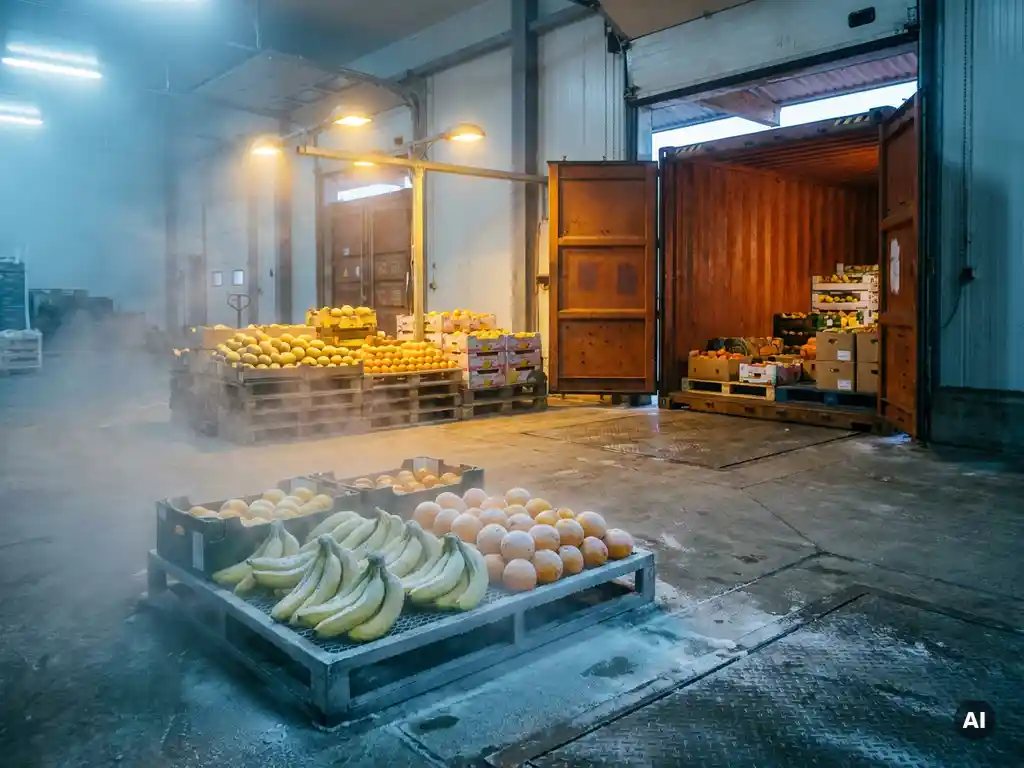
The correct storage method for food depends on the product itself: temperature sensitivity, moisture content, and shelf life determine whether refrigerated, dry, or climate-controlled storage is the best choice. Different requirements apply to fresh products such as exotic fruit compared to dry goods such as nuts or seeds. In this article, we answer the most frequently asked questions about food storage so that you, as a logistics or supply chain professional, can make the right decision.
Which temperature is suitable for which food product?
The correct storage temperature varies by product category and determines the shelf life and quality of food products. Fresh products such as bananas are generally stored between 12 and 14 degrees Celsius, citrus fruits between 5 and 10 degrees, while dry products such as nuts and seeds can be stored well at approximately 11 degrees in a dry, ventilated room.
A temperature that is too low can be just as harmful as one that is too high. Bananas are sensitive to cold and can sustain damage at temperatures below 12 degrees, an effect known in the industry as cold damage or chilling injury. Citrus fruits tolerate slightly lower temperatures, but also require carefully controlled humidity to prevent dehydration.
For dry products such as nuts, peanuts, and seeds, it is not the temperature itself that is central, but rather the combination of temperature and relative humidity. Excessive humidity promotes mold growth and spoilage, even in products that are not fresh in the traditional sense of the word. A stable environment of approximately 11 degrees with controlled ventilation is generally the starting point for this category.
What is the difference between cold storage and dry storage?
Cold storage focuses on storing fresh, temperature-sensitive products at low temperatures, with active control of both temperature and humidity. Dry storage, also known as ambient storage, is intended for products that do not require active cooling but do require a stable, dry environment without extreme temperature fluctuations.
The distinction lies not only in the temperature, but also in the infrastructure and the requirements for the space. A cold room is equipped with active cooling systems and humidity controllers. A dry storage warehouse focuses on good ventilation, insulation, and a constant ambient temperature, but does not require active cooling.
For logistics partners, the difference is also operationally relevant. Cold storage requires rapid transfer to avoid interrupting the cold chain, while dry storage offers more flexibility in timing and handling. Both forms of storage impose specific requirements regarding certification, food safety, and traceability, but the operational workflows differ significantly.
Which food products require climate-controlled storage?
Climate-controlled storage is necessary for fresh, delicate products where not only the temperature but also the humidity and air circulation must be precisely controlled. Think of exotic fruits such as bananas and citrus fruits, but also other fresh vegetables and products that are sensitive to dehydration, condensation, or ripening processes.
The difference compared to standard cooling is the degree of control. With climate-controlled storage, multiple parameters are monitored and adjusted simultaneously, often 24 hours a day, 7 days a week. This is essential for products that continue to ripen after harvest, such as bananas, or for products where even a slight deviation in humidity leads to a loss of quality.
For importers and wholesalers who process fresh products in large volumes, climate-controlled storage is not a luxury, but a basic logistical requirement. Products that do not meet the quality standards of supermarkets or processing plants are rejected, which has direct financial consequences. A stable climate-controlled environment significantly reduces that risk.
How does the storage of nuts differ from that of fresh fruit?
The storage of nuts differs fundamentally from that of fresh fruit, because nuts do not require active refrigeration but are sensitive to humidity and oxidation. Fresh fruit requires precise temperature control and sometimes gas regulation, whereas nuts benefit from a dry, stable environment with good ventilation and protection against moisture and pests.
Fresh fruit is biologically active: it breathes, ripens, and reacts immediately to temperature changes. This means that the storage environment must be continuously adjusted to the state of the product. Nuts are less active but more sensitive to external factors such as humidity and light, which can accelerate oxidation and rancidity.
Another important difference is the turnover rate. Fresh fruit has a limited shelf life and requires tight logistical planning. Nuts can be stored longer but place higher demands on quality assurance over extended periods, including periodic checks for moisture content and potential mold formation. For a storage partner, this means that both product categories require separate spaces, separate systems, and separate quality protocols.
When is refrigerated container storage the right choice?
Refrigerated container storage is the right choice when fresh products are transshipped directly from sea freight and the cold chain must remain uninterrupted. This is particularly relevant for importers receiving goods via seaports, where the time between unloading from the ship and placement in controlled storage must be as short as possible.
The location of the storage facility relative to the berth plays a crucial role in this. The shorter the distance between the ship and the cold storage, the lower the risk of temperature deviations during transshipment. In port cities like Vlissingen, where storage facilities are directly adjacent to the quay, this logistical advantage is immediately felt in product quality.
Refrigerated container storage is also relevant when the final destination is not yet definitive or when a shipment is awaiting customs clearance or import inspection. In those cases, refrigerated storage offers the possibility to safeguard quality while administrative processing takes its course, without compromising the shelf life of the product.
Which certifications apply to professional food storage?
For professional food storage, the most relevant certifications are BRC (British Retail Consortium), SKAL, and KCB/NVWA. BRC is an internationally recognized standard for food safety and quality management in the storage and distribution of food products. SKAL focuses specifically on organic products, while KCB (part of the NVWA) handles the import inspection of fresh fruit and vegetables.
For importers and wholesalers supplying supermarkets or processing plants, these certifications are not a minor matter. Retailers and large purchasing organizations require certification as a strict condition for supplier acceptance. A storage partner without the proper certifications can be a link that jeopardizes the entire chain.
In addition to the aforementioned certifications, traceability plays an increasingly important role. Systems that track, on a pallet basis, where a product originates, the route via which it was stored, and when it was shipped have become a basic requirement in professional food storage. Grower and LOT numbers, linked to individual pallets, make it possible to act quickly and decisively in the event of a quality incident, which limits both food safety and reputational damage.
Demeter certification, specifically for biodynamic products, is an additional standard relevant to a growing segment of the organic food market. For storage partners combining multiple certifications, this signals comprehensive quality assurance and professional quality management.
How ZZColdstores helps with proper food storage
As a specialized storage partner, ZZColdstores offers concrete solutions to the challenges discussed in this article. With locations in Kruiningen and Vlissingen, its own quay in Vlissingen, and more than 25 years of experience in temperature-controlled storage, ZZColdstores serves importers, wholesalers, and logistics service providers who demand high standards of quality and reliability.
What ZZColdstores specifically offers:
- Climate-controlled cold storage for fresh products such as bananas and citrus fruits, with 24/7 monitoring of temperature, humidity, and air circulation.
- Dry storage with a capacity of 12,000 pallet spaces, suitable for nuts, peanuts, seeds, and other dry food products at approximately 11 degrees.
- Direct quay connection in Vlissingen for minimal transshipment time and optimal supply chain assurance
- Certifications including BRC, SKAL, and Demeter, supplemented with import inspection via KCB/NVWA
- Full traceability via barcode systems linked to grower and LOT numbers
- Quality control upon arrival, including temperature, humidity, and Brix measurements and comprehensive QC reporting
Would you like to know which storage solution best suits your products and logistics process? View the climate-controlled storage solutions from ZZColdstores or contact us directly for a no-obligation consultation.
Frequently Asked Questions
How do I know which storage method best suits my specific product?
Start by mapping out three key parameters: the optimal storage temperature of your product, the moisture content, and the desired shelf life. Next, consult a specialized storage partner with experience in your product category, as they can quickly assess, based on practical experience, whether cold storage, dry storage, or climate-controlled storage is most suitable. An initial consultation with a party like ZZColdstores can provide a great deal of clarity without immediately committing to anything.
What are the consequences if the cold chain is temporarily interrupted during transport or transshipment?
An interruption of the cold chain, even a short one, can lead to accelerated ripening, loss of quality, or even complete rejection of a batch by the buyer. For sensitive products such as bananas, a temperature deviation of just a few degrees can cause visible damage in the form of browning or undesirable ripening. It is therefore essential to work with a storage partner that has a direct dock connection and efficient transshipment procedures, so that time outside controlled conditions is kept to an absolute minimum.
Can I store different product categories, such as fresh fruit and nuts, with the same storage partner?
Yes, that is possible, but only if the storage partner has physically separated spaces with separate climate control systems for each product category. Fresh fruit and dry products such as nuts have such varying requirements regarding temperature and humidity that they should never be stored in the same room. A specialized partner with both climate-controlled cold storage and dry storage capacity offers the advantage of a single point of contact and streamlined logistics for multiple product flows.
What common mistakes do companies make when choosing a food storage partner?
A common mistake is choosing a storage partner based purely on price, without checking whether the necessary certifications are in place. Retailers and large purchasing organizations enforce strict certification requirements such as BRC, and a partner without the proper credentials can jeopardize the entire supply chain. A second common mistake is underestimating the importance of location: a storage facility situated far from the port significantly increases the risk of temperature fluctuations during transport and transshipment.
How does traceability work in practice and why is it so important for food storage?
Traceability means that every pallet in the warehouse is linked to a unique grower or LOT number, allowing you to determine at any time where a product comes from, how it is stored, and when it was shipped. In practice, this works via barcode systems that are scanned upon arrival and tracked throughout the entire storage period. In the event of a quality incident or product recall, this enables you to act quickly and decisively, which not only guarantees food safety but also limits reputational damage and financial losses.
Is climate-controlled storage also suitable for smaller importers, or is it only reserved for large volumes?
Climate-controlled storage is certainly not exclusive to large importers; smaller parties can also benefit from it, especially when supplying quality-conscious customers such as supermarkets or specialty stores. Many specialized storage partners offer flexible storage capacity where you only pay for the pallet spaces you actually use. However, it is advisable to discuss minimum volumes and operational requirements in advance to ensure the collaboration is efficient and profitable for both parties.
How often are temperature and humidity checked in a professional storage facility?
In a professional climate-controlled storage facility, temperature and humidity are continuously monitored 24 hours a day, 7 days a week, via automated measurement systems that trigger an immediate alarm in the event of deviations. In addition to this automatic monitoring, periodic manual checks are also performed, during which employees physically inspect the condition of the products. The measurement data is logged and recorded in reports, which not only supports quality assurance but can also be demonstrated during certification audits.
Related articles
- How does the temperature remain stable during long-term cold storage?
- What are the certification requirements for a warehouse that stores food products?
- How does the transfer of ownership work when storing goods in a third-party warehouse?
- How does seasonal supply affect storage planning for importers?
- How do you prevent mold formation when storing garlic?