
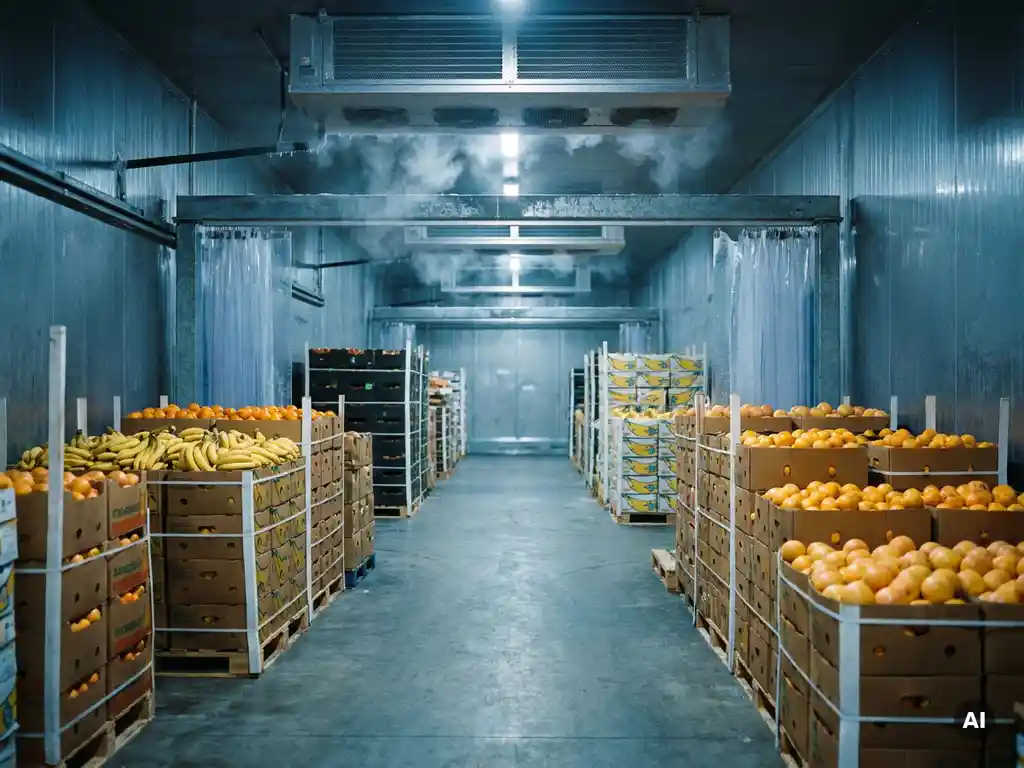
The temperature in a cold storage room remains stable thanks to a combination of continuous air circulation, precise humidity control, and automated monitoring that immediately detects and corrects deviations. For fresh and delicate products such as exotic fruit, this is not a luxury but a basic requirement: even small fluctuations can lead to loss of quality, shortened shelf life, or rejection upon arrival. The questions below cover every aspect of temperature stability during long-term cold storage, from the greatest risks to the role of a cold storage facility's location.
What are the biggest risks of temperature fluctuations in a cold room?
The greatest risks for temperature fluctuations in a cold room are the frequent opening of doors, insufficient insulation, excessive heat load from goods that have not yet been pre-cooled, and malfunctions in the refrigeration system. Each of these factors disrupts the thermal balance in the room, exposing products to undesirable temperature peaks or dips.
Opening cold storage doors is unavoidable during the unloading and loading of containers. Every time a door opens, warm outside air flows in. The longer the door remains open, the greater the impact on the cell temperature. Professional cold storage limits this risk through efficient work processes and proper sealing at loading bays.
A second risk is the introduction of products that have not yet reached the desired temperature. Warm goods release heat into the surroundings and raise the temperature in the immediate vicinity of the pallet. This effect is strongest with large batches received simultaneously. Pre-cooling or staggered inbound logistics helps to control this.
Finally, a defective refrigeration system or power outage poses an acute risk. Modern cold storage facilities therefore operate with redundant systems and alarms, so that immediate action can be taken in the event of a malfunction before the temperature falls outside the required range.
How does air circulation work in a cold room to keep the temperature even?
Air circulation in a cold room ensures that cooled air is evenly distributed throughout the entire storage space. Fans blow cold air past the evaporator and then distribute it throughout the room, removing warm air and keeping cold air constantly in motion. Without circulation, warmer zones develop, particularly around pallets and in the corners of the room.
The placement of pallets plays an important role in this. When pallets are placed too close together or block the airflow channels, cold air cannot properly penetrate to the core of the load. This applies particularly to dense packaging such as boxes of bananas, where air must be able to flow through the stack.
In well-designed cold rooms, the air speed is adjusted to the type of product. Too much air movement can cause dehydration in sensitive products; too little leads to uneven cooling. The right balance depends on the type of load and the desired storage temperature.
What role does humidity play in storing fresh fruit at the right temperature?
Humidity is at least as important as the temperature itself when storing fresh fruit. Relative humidity that is too low causes moisture loss in the product, leading to weight loss, wrinkling, and a decline in quality. Humidity that is too high promotes mold growth and condensation on the packaging, which also impairs shelf life.
For most types of exotic fruit, including bananas and citrus fruits, the optimal relative humidity is between 85 and 95 percent. This is a narrow range that requires constant monitoring. Small deviations, especially over longer storage periods, have a measurable effect on product quality upon delivery.
Moreover, the combination of temperature and humidity determines the ripening process. Bananas are a good example of this: they are sensitive to both temperatures that are too low (cold damage) and to humidity that is too high in combination with heat, which causes accelerated ripening. Climate-controlled storage keeps both parameters under control simultaneously.
How are temperature deviations in a cold storage facility monitored and corrected?
Temperature deviations in a cold storage facility are monitored via a network of sensors that continuously measure at multiple points within the cell. As soon as a sensor registers a deviation from the set target temperature, the management system sends a signal to the refrigeration unit to make adjustments. In the event of larger deviations, an alarm is automatically generated.
The sensors are strategically placed: at the air intake, at the return air, and at various heights in the cell. This creates a complete picture of the temperature distribution, not just an average. This is relevant because the temperature at pallet floor level can differ from the temperature higher up in the stack.
In addition to automatic adjustments, human supervision is essential. Loggers continuously record temperature data so that deviations can be traced retrospectively. For products destined for supermarket chains or processing plants, this data is also important for quality reporting and certification requirements such as BRC.
What is the difference between cold storage and climate-controlled storage?
Cold storage keeps products at a low temperature but typically regulates only the temperature. Climate-controlled storage goes further: in addition to temperature, humidity, air circulation, and sometimes the composition of the air are actively managed. This makes climate-controlled storage suitable for fresh and perishable products that require more than just cooling.
Standard cold storage suffices for products where temperature is the only critical factor. As soon as a product is sensitive to dehydration, condensation, or a specific ripening process, ordinary refrigeration falls short. Exotic fruit almost always falls into this latter category.
When is climate-controlled storage necessary?
Climate-controlled storage is necessary when a product places specific demands on humidity or air composition, when the storage period is long enough for cumulative quality loss, or when the recipient applies strict quality standards upon arrival. For importers and suppliers to supermarkets, this is almost always the case.
What are the benefits for the supply chain?
Climate-controlled storage extends product shelf life, reduces the risk of rejection upon delivery, and makes it possible to maintain larger inventories without loss of quality. This gives supply chain managers more flexibility in planning and less dependence on just-in-time supply.
How does the location of a cold storage facility affect temperature stability?
The location of a cold storage facility influences temperature stability in two ways: the distance to the goods' point of arrival and the environmental conditions surrounding the building. The shorter the time between unloading and entry into cold storage, the less temperature stress the product experiences. A cold storage facility directly on the quay eliminates the uncontrolled period during transport to a more distant location.
ZZColdstores has its own quay in Vlissingen, directly next to the cold storage facility. This means that containers can be placed in the climate-controlled environment from the ship's hold within minutes. For sensitive exotic fruit, this is a concrete advantage: the cold chain is not interrupted by road transport.
In addition, the structural quality of the cold storage facility plays a role. Good insulation of the walls, roof, and floor reduces the influence of outside temperatures on the cell temperature. In the summer, when outside temperatures are high, this difference is greatest. A poorly insulated cold storage facility requires more energy and struggles more to maintain the set temperature.
Cold storage at ZZColdstores: climate control for fresh exotic fruit
ZZColdstores offers climate-controlled cold storage specifically designed for fresh and perishable products such as bananas and citrus fruits. The facilities in Kruiningen and Vlissingen are equipped with flexible climate settings, allowing temperature and humidity to be precisely tailored to the requirements of the specific product and the desired storage duration.
What the approach entails in concrete terms:
- 24/7 monitoring of temperature, humidity, and air circulation via automated systems
- Own quay in Vlissingen for direct loading from the ship, without interruption of the cold chain
- Quality control upon arrival, including temperature and humidity measurements in accordance with product specifications
- Full traceability per pallet via barcode system, from arrival to departure
- BRC, SKAL, and Demeter certifications for demonstrable quality assurance
For importers, wholesalers, and suppliers who want certainty regarding the quality of their product upon arrival at the customer, stable cold storage is not a side issue, but a core requirement. View the options on the climate-controlled storage or contact us to discuss which storage conditions best suit your product and logistics chain.
Frequently Asked Questions
How long can exotic fruits such as bananas or citrus fruits be stored stably in climate-controlled cold storage?
The maximum shelf life varies per product and depends on the condition upon arrival, the set temperature, and the humidity. Under the right conditions (approximately 13–14°C and 85–95% RH), bananas can be stored for several weeks without noticeable loss of quality, provided the cold chain has not been broken. Citrus fruits generally tolerate longer storage periods. An exact shelf life is always determined in consultation, based on the product specifications and the recipient's wishes.
What is cold damage and how do I prevent my product from sustaining it during storage?
Cold damage (also known as 'chilling injury') occurs when cold-sensitive fruit is exposed to temperatures that are too low for that specific product. For bananas, this occurs below approximately 12°C: the peel turns dark and the texture of the flesh is affected. You can prevent this by precisely matching the storage temperature to the product specifications and by checking upon arrival whether the goods have previously been exposed to temperatures that are too low. A professional cold storage facility with per-cell adjustable climate parameters offers the necessary flexibility for this.
What should I check when choosing a cold storage partner for sensitive fresh products?
When making your choice, pay attention to at least the following points: does the cold storage facility feature climate-controlled cells (not just cold storage), are temperature and humidity adjustable per cell, is there 24/7 monitoring with automatic alarms, and does the location hold relevant certifications such as BRC? Also inquire about the location relative to the arrival point of your goods, as a short distance between unloading and storage significantly reduces the risk of temperature stress. Traceability per pallet and transparent reporting are also important indicators of a professional approach.
Can I also store part of my products and deliver the rest directly from the cold storage?
Yes, this is a widely used method for importers and wholesalers who wish to distribute part of their shipment directly to customers and temporarily buffer the remainder. A cold storage facility with full pallet traceability and flexible issuance makes this possible without disturbing the rest of the inventory. Discuss your logistics needs with the cold storage partner in advance so that inbound and outbound shipments can be planned efficiently and the cold chain remains safeguarded at all times.
How do I know for sure that my product was kept at the correct temperature throughout the entire storage period?
Professional cold storage facilities continuously record temperature and humidity data via data loggers and sensor networks, and make this data available as reports per storage period. For products destined for supermarkets or certified customers, these reports are often a mandatory part of quality assurance. Ask your cold storage partner about the availability of temperature logs per pallet or batch, and verify whether the reporting meets the requirements of your customer or the applicable certification scheme, such as BRC.
What happens if a malfunction occurs in the refrigeration system during storage?
Professional cold storage facilities operate with redundant cooling systems, which means that a second installation automatically takes over in the event of a failure of the primary unit. In addition, a 24/7 alarm system ensures that technical personnel are immediately dispatched in the event of a deviation. Explicitly ask your cold storage partner about the failure protocol: how quickly is action taken, what are the maximum permitted deviation times, and are you, as a customer, informed in the event of an incident affecting your party?
Is climate-controlled cold storage also suitable for organic or certified products such as Demeter or SKAL?
Yes, provided the cold storage facility itself holds the relevant certifications. For organic products, strict requirements apply regarding the separation of non-organic batches, traceability, and hygiene. A cold storage facility with SKAL and Demeter certification has demonstrably met these requirements and is permitted to store certified products without losing their organic status. Always check whether the certification is up-to-date and whether the specific storage cell used for your product falls within the certified scope.