
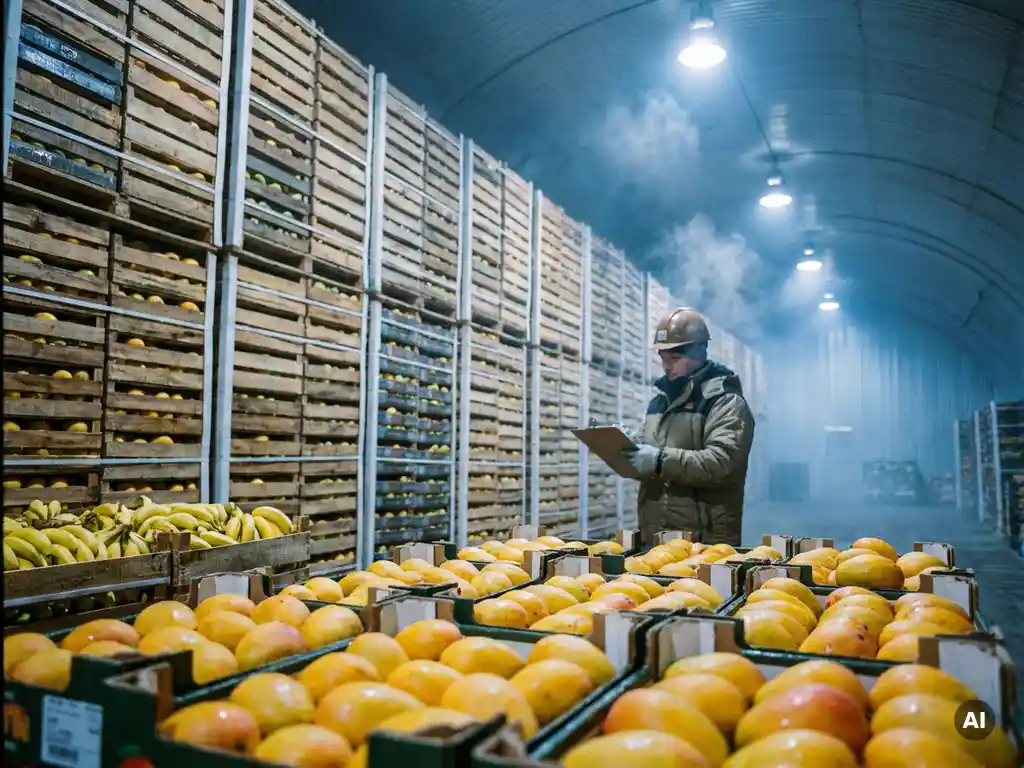
Seasonal supply directly and profoundly impacts storage planning for importers: during supply peaks, the supply of products increases sharply, while available storage capacity falls short in the event of poor planning. This leads to a loss of quality, disruptions in the supply chain, and higher costs. Importers who systematically align their storage needs with the seasonal cycle of their products avoid these problems and maintain a reliable supply position towards customers such as supermarket chains and processing plants. This article answers the most frequently asked questions about seasonal supply and storage planning.
Which seasonal patterns determine the peak supply of exotic fruit?
The supply of exotic fruit follows fixed seasonal patterns determined by the harvest cycles in the countries of origin. Bananas have a relatively constant supply throughout the year, but citrus fruits such as oranges, clementines, and grapefruits peak sharply in the autumn and winter. Mangoes, pineapples, and other tropical fruits follow their own rhythms, which depend on the production area.
For importers in the Rotterdam-Antwerp corridor, this means that supply volumes per product category can vary significantly from quarter to quarter. During the period from October through February, large quantities of citrus fruit arrive from countries such as Spain, Morocco, and South Africa. At the same time, the supply of some other products is actually quieter during the same period.
In addition to the harvest cycle, shipping company sailing schedules also play a role. Ships do not arrive every day, and the timing of unloadings partly determines when storage capacity must be available. Importers who do not take this into account run the risk of multiple shipments arriving simultaneously while storage space is already full.
How does a supply peak affect the available storage capacity?
A supply peak places direct pressure on available storage capacity: a large quantity of product must be stored, checked, and forwarded within a short period of time. If the storage location is not prepared for this influx, waiting times, undesirable temperature fluctuations, and logistical bottlenecks arise that compromise product quality.
In temperature-controlled storage, this effect is felt even more strongly. Fresh products such as exotic fruit cannot tolerate delays during the transition from transport to refrigerated storage. Every extra minute outside the proper climate conditions counts. Storage locations that do not have sufficient flexible capacity may be forced during peak periods to refuse batches or move them to less suitable conditions.
For dry products such as nuts, peanuts, and seeds, time pressure is less acute, but here too, an unexpected influx can quickly fill available pallet spaces. Importers working with multiple product streams notice that supply peaks in one category can disrupt the planning of another.
What are the risks of poor storage planning during seasonal peaks?
Poor storage planning during seasonal peaks leads to a range of concrete risks: loss of quality due to improper storage conditions, delays in delivery to customers, higher costs due to emergency solutions, and reputational damage to purchasing organizations of supermarkets or processing plants. These are not theoretical risks, but recognizable bottlenecks for importers that recur every season.
The main risks at a glance:
- Loss of quality: products left outside the correct temperature or humidity conditions for too long lose quality faster than is acceptable to customers.
- Delivery delays: if no storage space is available, further distribution may stagnate, leading to missed delivery times.
- Higher costs: last-minute storage solutions are more expensive and less reliable than pre-reserved capacity.
- Certification issues: storage with non-certified parties can conflict with BRC, SKAL, or KCB/NVWA requirements, causing problems during import inspections.
- Loss of customer trust: suppliers who are structurally unable to deliver at the agreed time lose their position with purchasing organizations.
Reliability is a critical factor, especially for importers supplying supermarket chains or processing plants. One failed season can have long-lasting consequences for the trade relationship.
How do importers plan their storage needs around seasonal fluctuations?
Importers plan their storage needs around seasonal fluctuations by mapping out expected quarterly supply volumes and linking them to concrete agreements with their storage partner. Good planning does not start with the ship's arrival, but months beforehand, when contracts with producers and shipping companies are concluded.
An effective approach typically proceeds in these steps:
- Map out the harvest cycles of all products you import, including the countries of origin and the expected supply periods.
- Link supply volumes to sailing schedules so you know how many pallets arrive each week and when.
- Reserve storage capacity in advance with a storage partner who can flexibly switch between peak and off-peak periods.
- Align lead times with your customers' requirements: how long can a product be stored before it exceeds the quality standard?
- Make arrangements for quality control upon arrival, so that products that do not meet the standard are immediately separated and do not endanger the rest of the batch.
Importers working with EDI connections between their own systems and the warehouse have a clear advantage: they automatically receive inbound notifications and inventory updates, allowing planning to be adjusted in real time without manual intervention.
What type of storage is suitable for seasonal dry products?
For seasonal dry products such as nuts, peanuts, seeds, and dried fruit, ambient storage is the most suitable form of storage. This type of storage offers a stable, dry, and clean storage environment without active cooling, which limits costs while simultaneously safeguarding the quality of the product throughout the entire storage period.
Ambient storage is specifically suitable for products that do not require temperature-controlled storage but are sensitive to humidity, temperature fluctuations, or contaminants. A controlled environment prevents products from spoiling, molding, or absorbing unwanted odors. This is particularly relevant for seasonal supply, where large batches are stored for a short period and must then be delivered quickly.
For fresh products such as exotic fruit, the opposite applies: climate-controlled dry storage insufficient, and active cold storage with precise temperature and humidity control is required. The choice of the right type of storage therefore depends entirely on the product category and the applicable storage requirements.
When does an importer need to reserve storage capacity for the season?
An importer should preferably reserve storage capacity two to four months before the expected supply peak. This gives the storage partner sufficient time to keep capacity free and align operational planning accordingly. Those who reserve too late risk the desired capacity already being allocated to other clients.
The exact timing varies by product category. For citrus fruits arriving in the autumn, this means that importers must make concrete arrangements as early as the summer. For products with a more staggered supply pattern, such as bananas, a continuous framework agreement with the storage partner is a more efficient approach than seasonal reservations.
A good rule of thumb is to link the reservation to the moment contracts with producers or shipping companies are signed. As soon as supply volumes and sailing schedules are known, storage requirements can also be determined. Importers who do this systematically avoid the pressure of last-minute solutions and can negotiate better agreements regarding price, flexibility, and additional services such as quality control and repalletization.
How ZZColdstores helps with seasonal storage planning
ZZColdstores offers importers a concrete solution to the challenges posed by seasonal supply. From locations in Kruiningen and Vlissingen, ZZColdstores provides both climate-controlled cold storage and ambient storage for dry products, fully tailored to the specific requirements of the goods and the client's schedule.
What ZZColdstores offers for importers dealing with seasonal peaks:
- Flexible storage capacity for both dry and refrigerated products, tailored to peak and off-peak periods in supply
- Ambient storage for nuts, peanuts, seeds, and dried fruit in a stable, controlled environment
- Quality control upon arrival, including temperature and humidity measurements and immediate separation of defective products
- Barcode-driven traceability per pallet, including linking of grower and LOT numbers
- EDI connections for automatic order processing, inbound notifications, and inventory updates
- Own quay in Vlissingen for direct transfer from ship to cold storage, without loss of quality
- Certifications: BRC, SKAL, and Demeter, ensuring products meet the requirements of purchasing organizations and import inspections
Would you like to know how ZZColdstores can support your storage planning around seasonal peaks? Contact us or view our ambient warehousing to see which solutions align with your product category and supply pattern.
Frequently Asked Questions
What happens if my storage partner runs out of capacity during a supply peak?
If your storage partner runs out of capacity during a peak period, you are forced to rely on last-minute alternatives that are typically more expensive, less reliable, and often uncertified. This poses direct risks to product quality and compliance with certification requirements such as BRC or SKAL. The best protection against this is securing capacity guarantees in a framework agreement, ensuring your storage space is contractually guaranteed before the season begins.
How do I know how much storage capacity I need during a supply peak?
Start by combining the expected supply volumes per sailing schedule and link them to the average turnaround time of your products in the warehouse. If a batch is in storage for an average of two weeks and you expect to receive 200 pallets weekly, you will have up to 400 pallets in storage at any given time. By performing this calculation per product category and adding a margin of 10 to 15 percent for unforeseen delays, you arrive at a realistic capacity plan that you can present to your storage partner.
Can I work with one warehousing partner for different product categories?
Yes, and that offers clear advantages: a single point of contact, integrated planning, and reduced coordination pressure during simultaneous supply peaks of multiple product streams. However, it is important to verify whether the storage partner offers both climate-controlled cold storage and ambient storage, and whether the certifications align with the requirements of your products and customers. Furthermore, a partner that combines both storage methods at one location shortens internal transport time and reduces the risk of quality loss during transshipment.
Which certifications must my storage partner have if I supply supermarket chains?
For deliveries to supermarket chains, BRC (British Retail Consortium) certification is in most cases a strict requirement of the purchasing organization. If you supply organic products, SKAL certification is also required to monitor the organic status of your goods during storage. Also check whether the storage location has been approved by the NVWA and, if relevant, by the KCB, so that import inspections can take place without delay.
What is the difference between a framework agreement and a seasonal reservation, and which suits me best?
A framework agreement establishes a continuous capacity agreement for an extended period, ideal for importers with a regular but fluctuating supply pattern, such as bananas or nuts. A seasonal reservation is more suitable for products with a distinct peak period, such as citrus fruits in the autumn, where extra capacity is required for a defined period. Importers with multiple product categories often combine both forms: a framework agreement for the base flow and additional seasonal reservations for peak periods.
How do I prevent quality loss during the transition from transport to storage during a busy supply period?
The critical factor is the time between unloading the transport and entry into the temperature-controlled storage: the shorter, the better. Preferably choose a storage location with its own quay or a direct connection to the port, so that products go from ship to cold storage without intermediate steps. Additionally, make prior arrangements regarding arrival notifications and inbound procedures, so that the storage location is already ready for receipt and immediate quality control upon the ship's arrival.
What do I need to arrange if I want to start with seasonal storage planning for the first time?
Start by drawing up a simple supply schedule per product category: note the expected supply months, the volumes per shipment, and the desired lead time in the warehouse. Take this schedule with you to a meeting with a potential storage partner and specifically ask about available capacity during your peak periods, applicable certifications, and the possibilities for EDI integration with your own systems. The more concrete you are when entering this first meeting, the faster you will reach workable agreements that structurally strengthen your supply chain.
Related articles
- Can you use warehousing for temporary storage?
- How does inventory tracking work within a warehouse?
- When does it make sense to combine inventory management with customs clearance?
- How does the transit of dry goods to Germany or Ukraine work?
- How do you recognize insect infestation in stored nuts or garlic?