
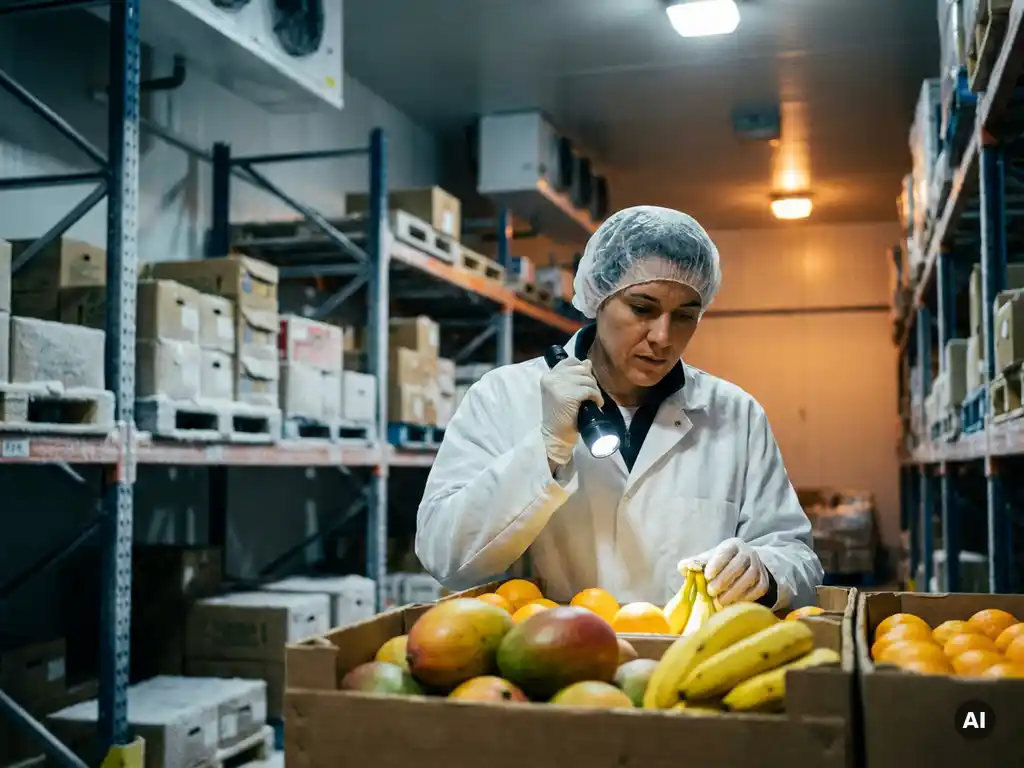
When storing imported food products, multiple checks are mandatory and necessary: statutory import inspections by government agencies, internal quality checks by the storage partner upon arrival, and continuous monitoring of temperature and humidity during storage. Exactly which checks apply depends on the product type, origin, and storage conditions. This article answers the most frequently asked questions about checks, certifications, and risks associated with the storage of imported food products.
Which statutory inspections apply to the import of food products?
When importing food products into the EU, statutory inspections are mandatory through official supervisory authorities. For fresh fruit and vegetables from third countries, the KCB (Quality Control Bureau for Fruit and Vegetables), part of the NVWA, carries out the phytosanitary and quality controls. Products may only be released for further distribution after this inspection has been completed and approved.
The import inspection focuses on trade standards, phytosanitary requirements, and any residue controls. Depending on the country of origin and the product type, additional documentation requirements apply, such as a phytosanitary certificate or a certificate of conformity. For organic products, SKAL certification is added to this, which verifies whether the organic origin is verifiable and correctly documented.
Importers and their logistics partners ensure that the goods are available for inspection at the time the inspection takes place. A storage location that can facilitate on-site import inspections significantly shortens lead times and limits the risk of quality loss due to unnecessary waiting times.
What do warehousing companies check themselves upon the arrival of goods?
A professional warehousing company performs its own quality control (QC) upon the arrival of goods, separate from the statutory inspection. This internal control focuses on the physical condition of the shipment: damage, packaging discrepancies, incorrect labeling, and the general condition of the product are assessed and recorded upon arrival.
In addition to visual inspection, measurable parameters are also checked. Examples include temperature measurements to verify that the cold chain remained intact during transport, moisture measurements, and in some cases Brix measurements to determine the ripeness of fresh fruit. Products that do not meet the agreed specifications are immediately separated from the rest of the batch so that the quality of the remaining goods is not compromised.
Good QC reporting provides importers and buyers with immediate insight into the quality status of every shipment. This enables rapid decision-making, for example regarding further processing, returns, or re-evaluation of the batch.
How does temperature monitoring work during the storage of fresh products?
Temperature monitoring during the storage of fresh products works via automated measuring systems that continuously record the temperature and humidity in the storage area. In climate-controlled storage, temperature, humidity, and air circulation are monitored 24 hours a day, seven days a week, so that deviations are immediately detected and corrected.
The settings are tailored to the specific product. Exotic fruits such as bananas and citrus fruits require different temperature and humidity conditions than dry products such as nuts or seeds. Flexible climate settings per storage cell or room are therefore essential for a storage partner managing multiple product categories.
Logbooks of the monitoring data are not only operationally valuable but also necessary for traceability and audits. Certification requirements such as BRC demand demonstrable temperature recording over the entire storage period. Without reliable monitoring data, compliance with these standards is not possible.
Which certifications must a storage partner have for food products?
A storage partner for food products must possess at least BRC (British Retail Consortium) certification as proof of a controlled food safety system. In addition, SKAL certification is relevant for parties storing organic products, and KCB/NVWA accreditation is necessary to facilitate import inspections of fresh fruit and vegetables from third countries.
In practice, BRC is a basic requirement for suppliers to supermarkets and processing plants. The certificate demonstrates that the storage location meets strict requirements regarding food safety, hygiene, temperature control, and traceability. Buyers and supply chain managers of retail chains typically only accept suppliers whose entire chain is BRC-certified.
SKAL certification is specifically required when organic products are stored and the organic status must be maintained. Demeter certification adds an extra layer to this for biodynamic products. Always check whether the certifications are up-to-date and exactly which product categories they cover.
What are the risks of insufficient control during dry storage?
Insufficient control during dry storage of food products leads to loss of quality, contamination risks, and financial damage. Dry products such as nuts, peanuts, and seeds are susceptible to moisture problems, pests, and cross-contamination if storage conditions are not monitored and incoming batches are not inspected.
A common risk is storing a damaged or damp batch without detecting this upon arrival. Moisture in a batch of nuts can cause mold to form, which spreads to adjacent pallets. Without adequate QC upon arrival and without continuous monitoring of the storage temperature (typically around 11 degrees Celsius for dry storage), this remains undetected until significant quality loss occurs.
In addition, the lack of traceability poses risks during product recalls. If it cannot be demonstrated which batch was stored when and which customers received the goods, a targeted recall is not possible. This can lead to broader recalls and reputational damage to supermarket chains and processing plants.
How does customs clearance work when storing imported goods?
When storing imported goods from countries outside the EU, customs clearance must be completed before the goods are freely available for distribution on the European market. This process involves submitting a customs declaration, paying import duties and VAT, and complying with any additional import conditions per product category.
Goods that have not yet been cleared can be temporarily stored in a bonded warehouse or under another customs procedure. This gives importers the option to store goods without paying import duties immediately, which can be relevant for large volumes or when the final destination has not yet been determined.
A storage partner that can facilitate customs clearance itself or works closely with a recognized customs broker significantly shortens lead times. Particularly when arriving via one's own quay, such as in Vlissingen, where the time between unloading and storage is minimal, an integrated approach to unloading, inspection, and customs makes a substantial difference to the quality of fragile products.
When is a specialized storage partner needed for food import?
A specialized storage partner is needed as soon as products have specific climate requirements, require statutory inspections, or serve the supply chain of supermarkets and processing plants. Generic storage locations typically do not possess the certifications, climate control, or knowledge of import procedures required for food products.
For importers of fresh exotic fruit, nuts, or other sensitive food products, a specialized partner is in practice not a choice but a necessity. The combination of statutory inspections, buyer BRC requirements, traceability requirements, and the vulnerability of the products themselves means that every link in the chain must meet high standards.
Even when the logistics flow is complex, involving sea transport, container handling, warehousing, and further distribution to Germany or other European markets, a specialized partner offers a clear advantage. Bundling unloading, QC, warehousing, and customs clearance with a single party reduces the number of transfer points and thereby the risk of errors or quality loss.
How ZZColdstores helps with the storage of imported food products
ZZColdstores combines all controls and services required for the responsible storage of imported food products under one roof. Specifically, ZZColdstores offers:
- Internal quality control upon arrival, including temperature, humidity, and Brix measurements and full QC reporting
- Climate-controlled storage with 24/7 monitoring of temperature, humidity, and air circulation, tailored to the specific requirements of the product.
- Dry storage (approx. 11 degrees) for nuts, peanuts, seeds, and other ambient products, with separate rooms for each product category
- Facilitating import inspections via KCB/NVWA and supporting customs clearance
- Full traceability via a barcode system, linked to grower and LOT numbers
- BRC, SKAL, and Demeter certification as the basis for suppliers to supermarkets and processing plants
- Own quay in Vlissingen for minimal transfer time between unloading and climate-controlled storage
Would you like to know if ZZColdstores is the right partner for your specific product and logistics flow? Contact us and discuss your requirements directly with a specialist.
Frequently Asked Questions
How long does an import inspection take upon arrival of a shipment of fresh fruit or vegetables?
The turnaround time for an import inspection via KCB/NVWA varies depending on the product type, origin, and the completeness of the accompanying documentation. In practice, this can range from a few hours to a full working day. By facilitating the inspection at the storage location itself—instead of first transporting the goods to an inspection point—the waiting time is significantly reduced and the cold chain remains better intact.
What happens if a batch does not meet the quality specifications upon arrival?
If a batch fails to meet the agreed specifications during internal QC control, it is immediately separated from the approved goods to prevent cross-contamination or quality transfer. The importer receives a detailed QC report with findings, based on which a quick decision can be made: return, re-evaluation, further processing, or write-off. Transparent reporting is essential in this regard, also for the handling of any claims with the supplier or insurer.
Can I store products from different categories — such as fresh fruit and nuts — with the same storage partner?
Yes, provided the storage partner has separate, climate-controlled rooms for each product category. Fresh exotic fruit requires different temperature and humidity conditions than dry products such as nuts or seeds, and both must not be stored in the same room due to cross-contamination risks and differing climate requirements. Always check with a potential storage partner whether the facilities are physically separated and whether the certifications cover all desired product categories.
How do I know if my storage partner's certifications are still current and valid?
BRC, SKAL, and Demeter certifications are audited periodically and have a validity period. Always ask your storage partner for the most recent certificates, including the validity date, and verify these directly with the issuing authorities if necessary. For BRC, you can check this via the official BRCGS directory; for SKAL, via the public register on the SKAL Biocontrole website. Retailers and processing plants typically check this themselves as part of their supplier qualification process.
What is the difference between a customs bonded warehouse and regular storage, and when is a bonded warehouse useful?
With regular storage, goods are already cleared for customs and import duties and VAT are paid at the time of entry into the EU. A bonded warehouse makes it possible to temporarily store uncleared goods without paying import duties immediately — this is only done at the moment of release for the European market. This is particularly interesting for importers who supply large volumes, do not yet know the final destination, or wish to partially forward goods to countries outside the EU.
What documentation do I need to provide as an importer to ensure smooth storage and inspection?
The required documentation varies by product type and country of origin, but a commercial invoice, packing list, bill of lading or airway bill, and a phytosanitary certificate are required as standard. For organic products, an inspection certificate in accordance with EU organic regulations is additionally required. Preferably, submit these documents digitally before the arrival of the shipment so that the storage partner and customs broker can prepare and the turnaround time after unloading remains as short as possible.
How can I, as an importer, track the traceability of my products throughout the entire storage period?
A professional storage partner links every incoming batch to unique identifiers such as grower numbers, LOT numbers, and barcode labels, which are tracked in a warehouse management system throughout the entire storage period. This makes it possible to see at any time which batch is stored where, when it arrived, and to which customers the goods have been delivered. In the event of a product recall, this information is indispensable for a targeted and rapid recall without causing unnecessary damage to the rest of the inventory.