
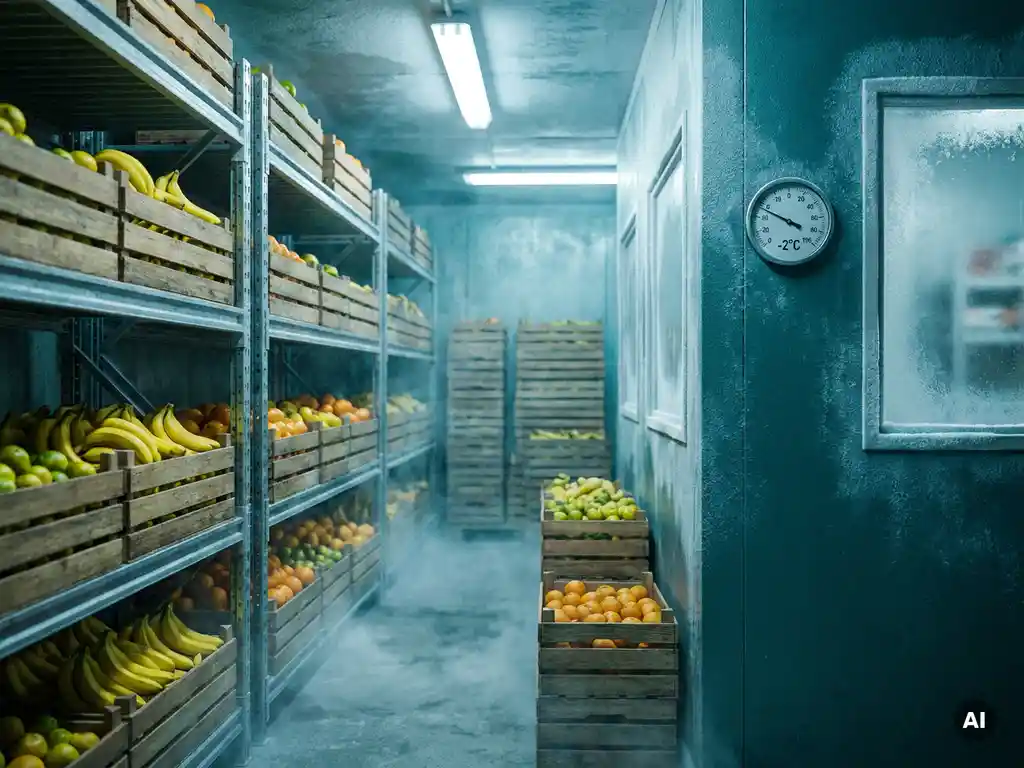
You prevent a break in the cold chain by continuously monitoring temperature and humidity throughout the entire logistics process, organizing rapid transshipment, and collaborating with certified storage partners equipped with automated climate control. For companies working with fresh food products such as exotic fruit or nuts, every link in the chain determines the final quality. The following questions delve deeper into the most critical aspects of cold chain management in storage and transport.
What are the most common causes of a cold chain break?
The most common causes of a cold chain break are temperature fluctuations during transshipment, slow turnaround times when unloading containers, insufficient climate control in the warehouse, and the lack of continuous monitoring. Each of these factors can lead to loss of quality, increased spoilage, and food safety risks.
In practice, there are a number of critical moments when the cold chain is most vulnerable:
- Transshipment and transport: When products are moved from a container to the warehouse, the temperature rises temporarily. The longer this lasts, the greater the risk.
- Insufficient preconditioning: Products that have not been brought to the correct temperature before storage disrupt the climate in the cold storage warehouse.
- Human error: Doors left open for too long, incorrect temperature settings, or mixing products with different climate requirements are common practical problems.
- Technical failure: A defective cooling unit or sensor that is not detected in time can cause major damage to an entire batch.
For importers and wholesalers of fresh products, it is essential to map out these risk moments and assess where the greatest vulnerability lies at each link in the chain.
How does continuous temperature monitoring work in a cold storage warehouse?
Continuous temperature monitoring in a cold storage warehouse works via a network of sensors placed at fixed measuring points throughout the warehouse that transmit real-time data to a central monitoring system. Deviations outside the set bandwidth immediately trigger an alarm, allowing operators to intervene immediately.
A good monitoring system monitors not only the temperature, but also humidity and air circulation. For delicate products such as bananas or citrus fruits, these are three interdependent parameters: humidity that is too high at the wrong temperature can accelerate mold formation, while humidity that is too low causes the product to dry out.
The registered data is recorded in logbooks available for quality checks, audits, and customer reports. This makes the system not only an operational tool but also an instrument for demonstrable quality assurance towards customers and certifying bodies.
Which temperature zones are critical for exotic fruits and nuts?
Widely varying optimal temperature zones apply to exotic fruits and nuts. Bananas are generally stored between 13 and 14 degrees Celsius, citrus fruits require a range of 5 to 10 degrees depending on the type, and nuts and peanuts are best stored at a stable ambient temperature of around 11 degrees Celsius.
Mixing products with different temperature requirements in a single room is one of the most common mistakes made in practice. Bananas are susceptible to cold damage at temperatures below 12 degrees, while other products spoil faster at higher temperatures. A good storage facility therefore features multiple climate zones that can be adjusted independently of each other.
Moreover, for nuts and seeds, not only temperature but also humidity is critical. Excessive humidity promotes mold growth and contamination by mycotoxins, which has direct consequences for food safety and acceptance by buyers such as processing plants or supermarket purchasers.
How do you prevent temperature loss during transshipment and container handling?
Temperature loss during transshipment and container handling is prevented by keeping the time between opening the container and placing the goods in the refrigerated storage area as short as possible. This requires an efficient logistics layout where the cold warehouse is directly adjacent to the unloading area.
A short physical distance between the quay or unloading point and the cold storage is an underestimated factor in this regard. The fewer meters a product spends outside the controlled environment, the smaller the temperature rise. Upon arrival, products are immediately checked for temperature, condition, and packaging, so that deviations are immediately detected and separated from the rest of the batch.
During unloading, products can also be repalletized or sorted. It is important that this process takes place in a climate-controlled area and not on an uncooled loading dock. Pallets that are being rewrapped or reconfigured must be returned to the appropriate temperature zone as soon as possible to limit heat absorption.
Which certifications guarantee a reliable cold chain process?
The most relevant certifications for a reliable cold chain process in food logistics are BRC (British Retail Consortium), SKAL for organic products, and KCB/NVWA for import inspections of fresh fruit and vegetables. These certifications set concrete requirements for temperature management, traceability, and quality control.
In practice, BRC is the most requested certification by supermarket purchasing organizations and processing plants. It sets requirements regarding, among other things, warehouse hygiene, the reliability of climate control, and the documentation of all processes. Consequently, a storage partner with valid BRC certification offers demonstrably higher guarantees than a non-certified party.
SKAL is relevant for importers and traders of organically certified products. Demeter certification goes a step further and is specific to biodynamic products. KCB, as part of the NVWA, carries out the official import inspection upon the arrival of fresh fruit and vegetables and is a legal requirement for the release of shipments onto the European market.
When is dry storage an alternative to refrigerated storage?
Dry storage is a suitable alternative to refrigerated storage when products are stable at ambient temperatures and do not require active cooling to maintain quality and safety. For nuts, peanuts, seeds, and other dry food products, controlled dry storage at around 11 degrees Celsius is often the right choice.
The distinction between dry and refrigerated storage is not always black and white. Products that are sensitive to humidity but do not require low temperatures benefit from a stable, dry climate with adequate ventilation. This prevents mold growth and loss of quality without the higher costs of active cooling.
For supply chain managers, it is relevant to know that dry storage can also be suitable as intermediate storage for products that will be further processed or shipped later. Moreover, the combination of dry and refrigerated storage capacity at a single location offers logistical advantages: less transport between locations and a shorter lead time from arrival to shipment.
How do you choose a reliable cold storage partner in the Rotterdam-Antwerp corridor?
You choose a reliable cold storage partner in the Rotterdam-Antwerp corridor based on four criteria: the presence of relevant certifications (BRC, SKAL, KCB/NVWA), the technical capacity for continuous climate monitoring, the geographical location relative to the port and customers, and the flexibility to adapt to fluctuating volumes and sailing schedules.
Location is a strategic factor in this corridor. A storage facility with its own quay or direct port access significantly shortens transshipment times and reduces the risk of cold chain breakage. Additionally, it is important that the partner possesses systems for barcode-driven traceability, ensuring that every pallet is fully traceable from arrival to departure.
During the selection process, also inquire about the possibility of EDI connections with your own systems. Automatic stock updates and inbound notifications reduce administrative errors and provide real-time insight into the status of your shipment. Finally, experience with specific product groups is a determining factor: a partner with demonstrable knowledge of the requirements for exotic fruit, nuts, or other fresh products offers more certainty than a generalist.
How ZZColdstores contributes to an uninterrupted cold chain
ZZColdstores offers a fully integrated solution for companies that want to secure the cold chain, from arrival at the quay to delivery to the next link in the supply chain. Specifically, this includes:
- 24/7 climate monitoring of temperature, humidity, and air circulation in the cold storage warehouses in Kruiningen and Vlissingen
- Own quay in Vlissingen for minimal transfer time between ship and cold storage
- Flexible climate zones tailored to the specific requirements of products such as bananas, citrus fruits, and nuts
- Quality control upon arrival, including temperature, humidity, and Brix measurements and full QC reporting
- Barcode-driven traceability per pallet, linked to grower and LOT numbers
- Certifications: BRC, SKAL, and Demeter, supplemented with import inspection via KCB/NVWA
- Dry storage capacity of 12,000 pallet spaces for nuts, peanuts, seeds, and other dry food products
Would you like to know how climate-controlled storage at ZZColdstores works for your specific product group or logistical situation? Contact us and discuss your requirements directly with our specialists.
Frequently Asked Questions
What is the maximum time a product may remain outside the cold chain during transshipment before quality loss occurs?
This varies significantly by product group. Bananas can experience a noticeable temperature increase that accelerates ripening after just 15 to 30 minutes outside the controlled environment, while nuts have slightly more tolerance. As a rule of thumb: the shorter the exposure to ambient temperature, the better. For delicate fresh products, always aim for a turnover time of less than 15 minutes.
What is the difference between passive and active cooling during sea transport, and which is better for my product?
Passive cooling utilizes pre-cooled products and insulated containers without active temperature control, whereas active cooling (via reefer containers) continuously regulates the temperature during transport. For fresh products such as exotic fruit, active cooling is almost always the better choice, especially on longer shipping routes. Nuts and dry products can sometimes be transported using passive cooling, depending on the duration of the voyage and ambient temperature, provided that humidity is properly controlled.
How do I know if my current cold storage partner meets the requirements of my supermarket customer or processing plant?
Ask your storage partner for current certification documents, particularly the BRC certification, including the associated audit report and grading (AA, A, or B). Supermarket purchasing organizations and processing plants typically require a minimum BRC rating of B. Also, verify whether the partner possesses verifiable temperature logs and QC reports that you can include as part of your product dossier for your customer.
What should I do if I suspect that the cold chain has been broken upon arrival of a shipment?
Have the shipment inspected immediately upon arrival by a certified quality controller and measure the core temperature of multiple products from different pallet positions. Document all findings, including photos and temperature measurements, and notify the carrier and any insurer immediately. Separate the suspect batch from other products until the quality has been assessed to prevent further contamination or mixing.
As an importer with fluctuating volumes, can I make use of climate-controlled storage, or is that only beneficial for large, fixed volumes?
Climate-controlled storage is also easily accessible for importers with fluctuating or seasonal volumes, provided you choose a partner that offers flexible storage capacity based on actual usage. Many specialized cold storage facilities work with variable pallet prices without fixed minimum volumes, meaning you only pay for the space and period you actually need. When selecting a partner, explicitly discuss your seasonal volume profile to ensure sufficient capacity is available during peak periods.
What minimum information must I, as an importer, be able to provide to meet the NVWA's traceability requirements?
The NVWA requires, at a minimum, that you can demonstrate for each shipment where the product originates (country of origin, grower or supplier code), what the product is (product description, LOT number), the quantity supplied, and where it went. In practice, this means that your storage partner must be able to link inbound documents, LOT numbers, and outbound deliveries per pallet. A barcode-driven warehouse management system makes this significantly easier and faster to demonstrate during an inspection.
Is it possible to combine both refrigerated and dry storage with a single logistics partner, and what are the benefits of doing so?
Yes, and this offers significant logistical advantages, particularly for importers handling multiple product groups with varying storage requirements. By combining refrigerated and dry storage at a single location, you avoid additional transport movements between sites, shorten total lead times, and maintain a single point of contact for quality control, reporting, and administration. Especially in the Rotterdam-Antwerp corridor, where speed and efficiency determine competitive position, this integration is a practical and cost-saving advantage.
Related articles
- How does the transfer of ownership work when storing goods in a third-party warehouse?
- Why is humidity just as important as temperature in dry storage?
- When does it make sense to combine inventory management with customs clearance?
- What are the NVWA rules for import inspection of dried fruit in 2026?
- How do you choose a suitable storage partner for dry food products?