
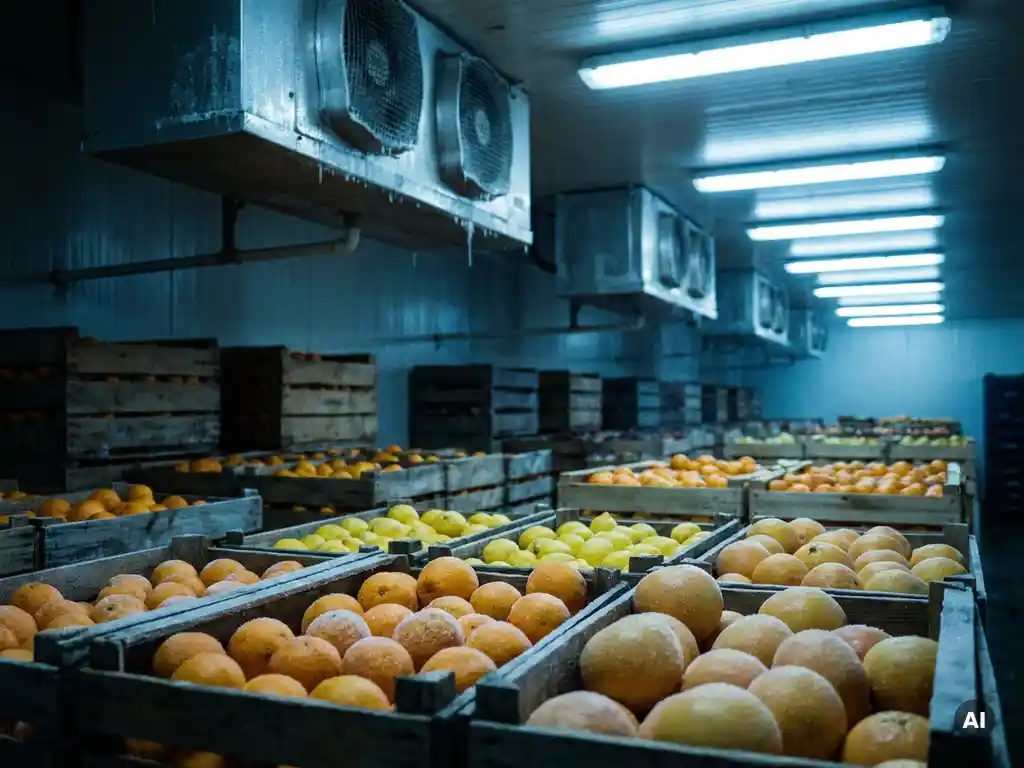
Temperature and humidity are the two most critical factors in the cold storage of citrus fruit. Citrus fruits such as oranges, lemons, and grapefruits are susceptible to mold, dehydration, and cold damage, making a precisely controlled storage climate a direct determinant of shelf life and quality. The questions below cover the most relevant aspects of professional citrus storage, from optimal settings to certifications.
What temperature is ideal for storing citrus fruit?
The ideal storage temperature for citrus fruit is generally between 5 and 10 degrees Celsius, depending on the variety. Oranges and grapefruits store best at around 7 to 9 degrees, while lemons and limes tolerate slightly higher temperatures, preferably between 10 and 13 degrees. Temperatures that are too low cause cold damage, while temperatures that are too high accelerate the ripening process.
Cold damage in citrus manifests as brown spots on the peel, a soft texture, and an altered taste. This occurs when products are exposed to temperatures below their specific threshold for too long. Therefore, each citrus variety has its own optimal storage window, and a uniform setting for all citrus fruits is rarely the best approach.
For logistics partners and importers, it is important that the cold storage facility not only maintains the correct temperature but is also capable of responding quickly to varying loads and incoming batches with different temperatures. Fluctuations during unloading and storage can temporarily affect product temperature, making a stable and rapidly recoverable climate system essential.
How important is humidity for the cold storage of citrus?
Humidity is at least as important as temperature for the cold storage of citrus. The optimal relative humidity for most citrus varieties is between 85 and 95 percent. Humidity that is too low leads to moisture loss, resulting in wrinkled skin, weight loss, and a shorter shelf life. Humidity that is too high promotes mold growth.
Citrus fruits lose moisture through their skin, a process that is accelerated by low humidity or insufficient air circulation. This moisture loss is not only visible on the outside but also affects the internal quality. For importers and wholesalers who store products for extended periods, even a limited difference in moisture content can mean a difference in yield at delivery.
Air circulation plays a supporting role in this. An even distribution of cooled, humid air throughout the cold room prevents warm or dry zones that can affect the quality of individual pallets. This requires a storage facility with a well-designed ventilation system that performs consistently, even with fluctuating occupancy rates.
What are the most common causes of quality loss in citrus storage?
The most common causes of quality loss during the cold storage of citrus are temperature fluctuations, incorrect humidity, insufficient air circulation, mold infection, and damage during unloading or stacking. Each of these factors, individually or in combination, can lead to reduced shelf life and rejection upon delivery.
The most important risk factors listed:
- Temperature fluctuations: Fluctuations in the cold room, for example due to the frequent opening of doors or the presence of warm batches, disrupt the optimal storage climate.
- Humidity too low: Leads to drying out of the peel and weight loss, which directly reduces the market value of the product.
- Mold growth: Penicillium molds are the most common culprits in citrus and spread rapidly from fruit to fruit with insufficient ventilation or damaged peels.
- Mechanical damage: Damage during unloading, stacking, or repalletizing creates entry points for mold and bacteria.
- Insufficient quality control upon arrival: Batches arriving already damaged or infected can contaminate the rest of the stock if not separated in a timely manner.
For supply chain managers, it is essential to inquire about the protocol for the arrival of a batch when selecting a storage partner. A thorough inspection upon receipt, including temperature measurement and visual checks, is the first line of defense against quality loss.
How long can citrus fruit be stored in a cold room?
The maximum shelf life of citrus fruit in a cold room varies by variety. Oranges and grapefruits can be stored for four to eight weeks under optimal conditions. Lemons last up to four weeks, while mandarins are more delicate and typically keep for two to four weeks. The exact shelf life depends heavily on the ripeness upon arrival and the quality of the climate control.
Origin and harvest time also play a role. Citrus that is cooled immediately after harvest and transported quickly has a longer potential shelf life than fruit that has already been in transit for some time under less ideal conditions. Importers working with long transport routes would do well to measure the internal temperature of the shipments upon arrival and assess their condition before determining the expected shelf life.
In addition, the shelf life is shorter in practice when products are moved regularly, the cold room door is opened frequently, or when batches of different qualities are combined. Stable, undisturbed storage is the best guarantee for maximum shelf life.
What is the difference between refrigerated storage and CA storage for citrus fruits?
Refrigerated storage, also known as cold storage, regulates only the temperature and humidity in the storage area. CA storage, or Controlled Atmosphere storage, goes a step further by also regulating the composition of the air, specifically the concentrations of oxygen and carbon dioxide. This slows down the ripening process and significantly extends shelf life.
Refrigerated storage: suitable for most citrus varieties
Standard cold storage is sufficient for most citrus varieties, especially when the shelf life is limited to a few weeks. It is the most common form of storage in trade logistics and offers a good balance between costs and quality preservation. Importers and wholesalers working with regular trade flows typically choose cold storage as the first option.
CA storage: for longer storage and specific applications
CA storage is used when citrus needs to be stored for extended periods, or when market conditions call for a more flexible sales timing. By lowering the oxygen level and increasing the carbon dioxide level, the fruit's metabolism is slowed down. This is particularly relevant for exporters who wish to bridge seasonal peaks or who serve distant markets with longer transport times. CA storage requires specialized infrastructure and is not available at every storage location.
Which certifications are important for the cold storage of citrus fruit?
For professional cold storage of citrus fruit, the most relevant certifications are BRC (British Retail Consortium), SKAL, and KCB/NVWA recognition. These certifications provide buyers and logistics partners with assurance regarding food safety, biological integrity, and compliance with phytosanitary requirements when importing from third countries.
An overview of the most requested certifications:
- BRC Global Standard for Storage and Distribution: An internationally recognized standard for food safety in storage and distribution. Supermarket chains and large processing plants often require this certificate as a basic requirement from their logistics partners.
- SKAL certification: Mandatory for the storage of organically certified products. Importers of organic citrus can only work with SKAL-certified storage locations to maintain the organic status of their products.
- KCB/NVWA accreditation: The Quality Control Bureau, part of the NVWA, carries out import inspections for fresh fruit and vegetables entering the EU from third countries. An accredited storage location can facilitate this inspection, which significantly shortens turnaround time during import.
- Demeter certification: Relevant for the storage of biodynamically grown products, a specific niche within the organic market.
For supply chain managers and buyers, when selecting a storage partner, it is wise not only to ask which certifications are present, but also how recently the audits were conducted and whether the certifications apply to the specific storage location and the type of product.
How ZZColdstores helps with the cold storage of citrus fruit
ZZColdstores offers climate-controlled cold storage specifically designed for fresh and perishable products such as citrus fruits. With locations in Kruiningen and Vlissingen, a private quay in the Port of Vlissingen, and 24/7 monitoring of temperature, humidity, and air circulation, ZZColdstores is able to safeguard the quality of citrus batches from arrival to delivery.
What ZZColdstores offers for the cold storage of citrus:
- Flexible climate settings per room, tailored to the specific requirements of each citrus variety
- Quality control upon arrival, including temperature measurements and visual inspection
- Full traceability per pallet via a barcode system, from inbound to outbound
- KCB/NVWA-approved on-site import inspection, without unnecessary delay in the cold chain
- BRC, SKAL, and Demeter certification for customers working with certified flows
- Private quay in Vlissingen for direct transfer from ship to cooling, with minimal exposure to outside temperatures
Would you like to know if ZZColdstores' storage capacity and certifications align with your specific citrus flows? Contact us for a no-obligation consultation.
Frequently Asked Questions
How do I check if a storage partner actually maintains the correct temperature and humidity?
When asking a potential storage partner for continuous temperature and humidity recording via a certified monitoring system, preferably with external data loggers and automatic alarms in case of deviations. Reliable partners can provide historical climate data per cold room and demonstrate how quickly the system recovers after opening doors or entering new batches. Do not be convinced by certifications alone; also ask for concrete reports and audit results.
What should I do if my batch of citrus arrives damaged or partially damaged at the cold storage?
Ensure that the storage partner performs a thorough inspection procedure upon arrival, including visual inspection and temperature measurement of the cargo. Affected fruit or pallets must be immediately separated from healthy batches to prevent the spread of fungi such as Penicillium. Accurately document the condition of the batch upon arrival, including photos and temperature logs, so that you can use this in any potential claims against the carrier or supplier.
Is it possible to store different citrus varieties together in one cold room?
This is possible in principle, but not always optimal, as different citrus varieties have varying temperature requirements. Lemons and limes require higher temperatures (10–13°C) than oranges and grapefruits (7–9°C), meaning that combined storage entails a compromise that can shorten the shelf life of one or both varieties. When volumes permit, storage in separate climate zones for each variety is the best approach for maximum quality assurance.
How does the transport route prior to storage affect the final shelf life of citrus?
The condition upon arrival depends heavily on the cold chain during transport: the longer and less stable the transport, the shorter the remaining shelf life in the cold room. Citrus that has been exposed to temperature spikes or high humidity during transport has often already developed increased mold pressure or moisture loss. It is therefore advisable to measure not only the air temperature upon arrival, but also the internal product temperature of multiple pallets to obtain a realistic picture of the expected storage duration.
When is CA storage financially sensible for citrus, and when is standard cold storage sufficient?
CA storage makes financial sense when you want to store citrus for more than six to eight weeks, bridge seasonal peaks, or serve distant markets with longer supply lines. The higher costs of CA storage are justified by a significantly longer shelf life and less quality loss, which increases the yield per kilo. For regular trade flows with a shelf life of two to six weeks, standard cold storage offers a better cost-benefit ratio.
How can I, as a buyer or supply chain manager, monitor the interim quality of stored citrus?
Ask your storage partner for interim quality reports and the option to access climate data remotely via an online portal or dashboard. Some facilities offer full traceability per pallet via barcode systems, allowing you to check the status of a specific batch at any time. Combine this with periodic physical inspections at the storage location, especially for long-term storage or for batches destined for demanding customers such as supermarket chains.
What questions should I ask when selecting a new storage partner for citrus?
In any case, ask questions about the available climate zones and whether temperature settings can be adjusted individually per room, which certifications are in place and how recently the audits were conducted, and what the protocol is upon arrival of a batch, including quality control and quarantine procedures. Also ask about the possibility of on-site KCB/NVWA import inspection, the availability of traceability systems, and the partner's experience with your specific citrus varieties and countries of origin.