
When renting storage space for food products, you pay attention to temperature zones, certifications, humidity, location, customs clearance, and the flexibility of the storage partner. For B2B parties in the food chain, such as importers, wholesalers, and suppliers to supermarkets, these are not minor details but critical factors that directly determine product quality and delivery reliability. The questions below provide a concrete answer for each theme.
What temperature zones are there for food storage?
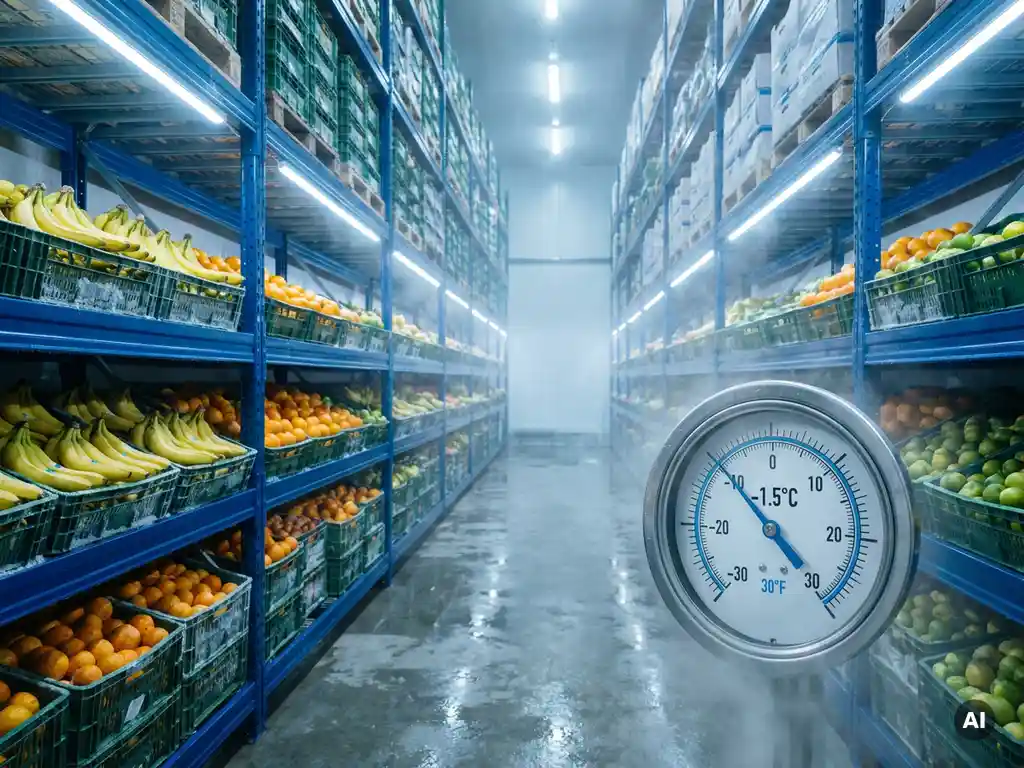
For food storage, three temperature zones are generally distinguished: freezer storage (below -18°C), cold storage (0°C to approximately 8°C), and dry or ambient storage (approximately 10°C to 15°C). Which zone is appropriate depends on the product. Bananas and citrus fruits require a precisely controlled cooling temperature, while nuts, peanuts, and seeds can be stored well in dry storage at approximately 11°C.
Specific requirements regarding temperature stability apply within each zone. Fluctuations, even small ones, can lead to loss of quality, condensation, or premature ripening. This is particularly critical for exotic fruit: temperatures that are too low can cause cold damage, while temperatures that are too high irreversibly accelerate the ripening process. A reliable storage location continuously monitors the temperature, preferably with automated monitoring and alarm systems that intervene immediately in the event of deviations.
For products that pass through multiple links in the chain, it is also important that the cold chain is continuous. Interruptions during transshipment or transport, even if brief, count. Therefore, choose a storage partner that manages the entire process from arrival to shipment.
Which certifications must a food storage location have?
A food storage location must hold at least a BRC (British Retail Consortium) certification for food safety. Depending on the product type, SKAL (for organic products) and KCB/NVWA accreditation (for import inspections of fresh products) are also relevant certifications to check for.
In practice, BRC is the standard for storage locations supplying supermarket chains and processing plants. The certificate demonstrates that the location operates according to demonstrable food safety standards, including hygiene protocols, traceability, and risk management. Without BRC certification, you simply cannot pass the gatekeeper requirements at many supermarket purchasing organizations.
SKAL is mandatory if you want to store organically certified products without losing the organic label. Demeter is a supplementary certification for biodynamic products. For fresh fruit and vegetables entering via the port, KCB accreditation (part of the NVWA) is required to carry out on-site import inspections. This prevents unnecessary transport movements and loss of time during the inspection.
Always ask for current certificates and check their validity. Certifications are audited annually or every two years; an expired certificate is a risk to your own delivery obligations.
What are the requirements for humidity and ventilation in food storage?
Humidity and ventilation are at least as important as temperature in food storage. Too little moisture leads to dehydration and weight loss of products; too much moisture promotes mold formation and bacterial growth. For most fresh products, a relative humidity between 85% and 95% is considered optimal, depending on the product.
Ventilation ensures an even temperature distribution in the room and prevents the accumulation of ethylene gas, which accelerates ripening in fruit. For sensitive products such as bananas, ethylene control is an active part of the storage process. A good storage facility features systems that continuously measure and adjust humidity and air circulation, not only upon arrival of a shipment but throughout the entire storage period.
For dry storage, such as for nuts and seeds, the requirements are different but no less strict. Excessive humidity in a dry warehouse can cause mold or oxidation, which has direct consequences for shelf life and the customer's quality standards.
How does customs clearance work for the storage of imported foodstuffs?
When storing imported foodstuffs, the consignment must first be cleared by customs before the goods are released into free circulation. This process involves a customs declaration, document verification, and in many cases, a phytosanitary inspection by the NVWA or KCB. A storage location with customs approval and KCB affiliation can handle this process on-site.
The advantage of a storage location that coordinates customs clearance itself is that goods can be placed directly into storage after unloading, without intermediate transport to an external inspection site. This limits exposure to temperature fluctuations and significantly shortens turnaround time. For importers of fresh fruit, where every hour counts for product quality, this is a concrete operational benefit.
When selecting a storage partner, check whether they hold AEO (Authorised Economic Operator) status or a similar customs clearance, and whether they are connected to systems such as AGS or SAGITTA for electronic declarations. This partly determines how quickly your shipment is released.
What is the difference between dry storage and cold storage for food?
Dry storage, also known as ambient storage, is intended for products that do not require active cooling but do require a stable, controlled environment. Cold storage is intended for fresh, perishable products that must be stored at low temperatures to prevent loss of quality. The difference lies not only in temperature, but also in the requirements for humidity, ventilation, and hygiene.
Dry storage
Dry storage is typically used for products such as nuts, peanuts, seeds, and other non-perishable food products. In professional facilities, the storage temperature is around 10 to 12°C, which prevents mold formation and oxidation without active cooling. The space must be free from moisture, pests, and odor contamination. Separate areas for each product category are recommended to prevent cross-contamination.
Cold room
Cold storage space is necessary for fresh products such as exotic fruit, vegetables, and other perishable goods. The required temperature varies by product and must be maintained precisely. Cold storage facilities require more advanced technical installations, stricter hygiene standards, and continuous monitoring. The investment in energy and maintenance is higher, which is typically reflected in the storage costs per pallet space.
What should you look out for regarding the location of a storage facility?
The location of a storage facility partly determines the speed, costs, and quality of your logistics chain. Important factors include proximity to ports or transport hubs, the availability of on-site customs facilities, and accessibility for trucks and containers.
For importers operating via seaports, a location in the Rotterdam-Antwerp corridor is strategically attractive. Having a private quay next to the cold storage facility, as in Vlissingen, eliminates intermediate transport and reduces the time between unloading and cooling to a minimum. For fresh products, this is not a luxury but a quality requirement.
In addition to port location, the distance to final destinations is relevant. If your customers are located in Germany or other European countries, a location in Zeeland or South Holland is well-positioned for efficient distribution. Also check whether the facility has sufficient capacity and flexible expansion options, so that you do not have to resort to a second location during seasonal peaks.
What flexibility can you expect from a food storage partner?
A professional food storage partner adapts to your supply rhythm, product specifications, and logistical planning, not the other way around. In practice, flexibility means being able to handle fluctuating volumes, aligning with ship schedules, and reacting quickly to unexpected deliveries or order changes.
Specifically, you can expect a good storage partner to have variable climate settings per cell or room, so that different products can be stored simultaneously under the right conditions. Additionally, value-added services such as quality control upon arrival, repalletization, labeling, and barcode-driven traceability are signs of a partner offering more than just square meters.
Digital integration is an increasing expectation in the sector. EDI connections for automated order processing, inbound notifications, and inventory updates reduce manual errors and accelerate communication between your systems and the warehouse. Always inquire about system integration options during the initial consultation.
How ZZColdstores helps with renting storage space for food
ZZColdstores offers a complete package for B2B parties seeking reliable food storage space in the Rotterdam-Antwerp corridor. Active since 1994, with locations in Kruiningen and Vlissingen, ZZColdstores combines dry storage and climate-controlled cooling with a wide range of logistics services.
What ZZColdstores specifically offers:
- Climate-controlled cold storage with 24/7 monitoring of temperature, humidity, and air circulation
- Dry storage warehouse with 12,000 pallet spaces, suitable for nuts, peanuts, seeds, and other non-perishable food products
- BRC, SKAL, and Demeter certification for demonstrable food safety
- KCB/NVWA accreditation for on-site import inspections
- Own quay in Vlissingen for direct transfer from ship to cooling
- Value-added services: quality control, repalletization, labeling, barcode traceability, and EDI connections
- Flexible adaptation to sailing schedules and fluctuating volumes
Would you like to know if ZZColdstores aligns with your specific products and logistical requirements? Contact us for a no-obligation consultation.
Frequently Asked Questions
How far in advance do I need to reserve storage capacity at a cold storage facility?
For structural storage needs, it is advisable to contact us at least four to eight weeks in advance so that the right climate-controlled room and capacity can be reserved for your product. During seasonal peaks — such as the supply of exotic fruit during busy periods — it is recommended to plan even earlier. A good storage partner proactively considers your supply schedule and signals in a timely manner when capacity is running low.
What happens if my product does not meet the expected quality standards upon arrival?
A professional storage partner performs an inbound quality check upon arrival and documents the condition of the cargo with photos and reports. If discrepancies are found, you are informed immediately so that you can liaise with the supplier or insurer in a timely manner. This is also why traceability and detailed receipt records are so important: they constitute your evidentiary position in the event of claims or disputes.
Can I store products with different temperature requirements simultaneously at a single storage partner?
Yes, provided the storage facility has multiple climate chambers that can be set independently of each other. This allows you, for example, to store bananas at 13°C while nuts are kept in a dry chamber at 11°C, without the conditions influencing each other. During the consultation, explicitly ask about the number of available chambers, the adjustable temperature ranges per chamber, and the ability to keep products from different customers or categories separate.
Which documents do I need for the customs clearance of imported food products?
For the import of foodstuffs, you generally require at least: a commercial invoice, packing list, bill of lading or airway bill, a phytosanitary certificate from the country of origin, and — depending on the product — a certificate of origin. Additional SKAL documents are required for organic products. A storage partner with their own customs expertise can assist you with the document check before the shipment arrives, thus preventing delays during inspection.
What are common mistakes when choosing a storage location for food?
A common mistake is choosing based on price per pallet space without taking into account hidden costs such as handling, inbound and outbound logistics, and administrative services. Additionally, companies frequently underestimate the importance of certifications: a location without BRC or SKAL can immediately jeopardize supply relationships with supermarkets or organic buyers. Finally, the location relative to the port or transport hubs is given insufficient weight, even though extra transport movements for fresh products entail direct quality risks.
How do I know if the temperature monitoring of a cold storage facility is reliable?
Ask the storage partner about the monitoring system used and whether it includes calibrated sensors that log continuously — not just at fixed measurement intervals. Reliable facilities use automated alarm systems that send an immediate notification to an on-duty employee in the event of deviations, even outside office hours. Also ask if you, as a customer, have access to temperature reports per batch or per storage period, as this data is essential for your own quality documentation and audits.
Is it possible to flexibly scale storage capacity up and down for fluctuating volumes?
With a professional storage partner, this is certainly possible, but the terms vary by provider. Some parties work with fixed contracts based on minimum pallet quantities, while others use a variable model that adapts to your actual usage. For importers with seasonal supply—think of campaign peaks for nuts or fruit—a flexible model is financially more advantageous. During the intake interview, explicitly discuss how the partner handles volume peaks and what the notice periods are for structural purchases.
Related articles
- How does pallet handling work in warehousing?
- Can you store food products between the port and the final destination?
- Can you combine warehousing with container handling?
- How does an inspection work for the import of peanuts from Brazil?
- Can poor storage of nuts lead to rejection during import inspection?