
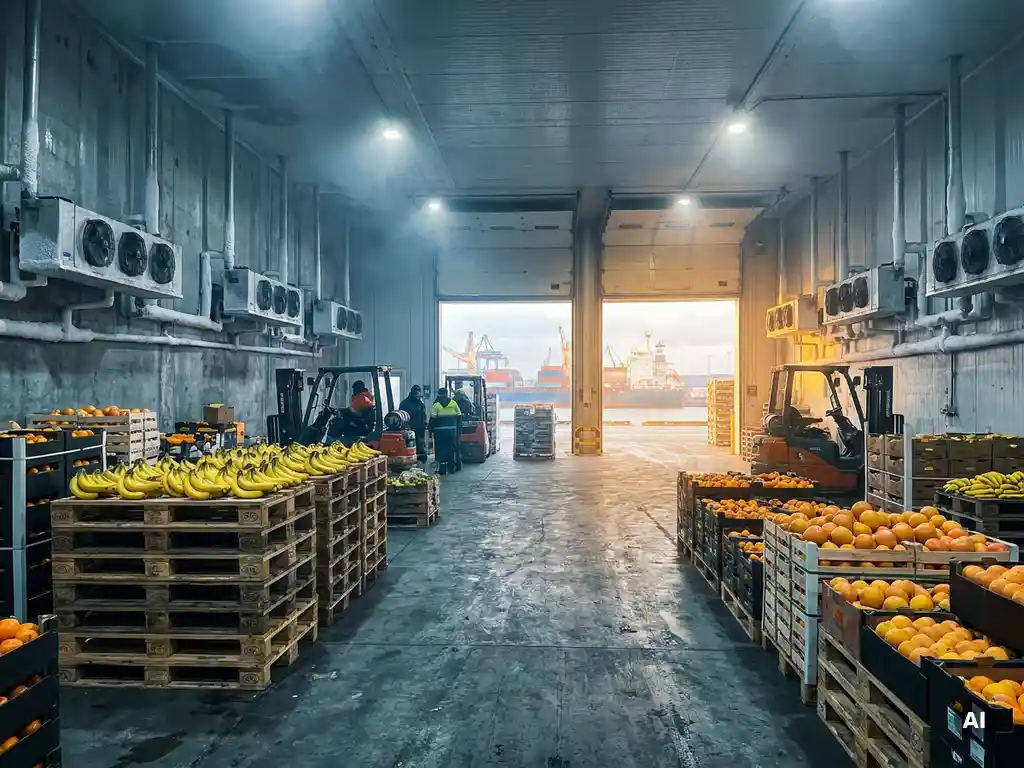
Yes, storing food products between the port and the final destination is not only possible, but for many importers and traders, it is also the most practical choice. Intermediate storage at the port offers the possibility to combine unloading, quality control, customs clearance, and further distribution at one location, without unnecessary transport movements. The questions below answer the most frequently asked questions about food storage in port and transit zone logistics.
What storage options are available between the port and the final destination?
Between the port and the final destination, there are two main forms of food storage: climate-controlled cold storage for fresh and perishable products, and dry storage (also known as ambient storage) for products that are stored stably at a constant temperature, such as nuts, peanuts, and seeds. Both forms of storage can be combined with additional logistics services at the same location.
The choice between these options depends on the product and the required storage conditions. Exotic fruits such as bananas and citrus fruits require precise temperature and humidity control. Dry food products such as nuts and seeds are less sensitive to temperature fluctuations, but do require a stable, controlled environment to prevent loss of quality.
In addition to pure storage, value-added services are also available in the transit zone, such as:
- Quality control upon arrival, including temperature and humidity measurements
- Repalletizing and resorting shipments
- Custom labeling and packaging
- Customs clearance and import inspection
- Container handling and transshipment
This makes intermediate storage at the port more than just a waiting area: it is a link in the supply chain where products are actively prepared for their onward journey.
How long can you store food in a cold storage facility at the port?
The maximum storage duration for foodstuffs in a cold storage facility at the port varies depending on the product type and the storage conditions set. Fresh products such as exotic fruit can be stored for several weeks at the correct temperature and humidity without loss of quality. Dry products such as nuts and seeds can be stored for months under stable conditions.
Determining factors for the storage duration are:
- The degree of ripeness of the product upon arrival
- The set temperature and humidity in the storage cell
- The packaging and pallet stability of the shipment
- The specific product requirements, such as ethylene sensitivity in certain fruit varieties
In practice, logistical and commercial considerations often determine storage duration more than technical limits. Many importers and wholesalers use intermediate storage to align inventories with customer demand without compromising the quality of the goods. Product-specific climate chambers make it possible to precisely optimize storage conditions for the specific characteristics of each shipment.
What is the difference between cold storage and dry storage for food?
Cold storage and dry storage are two fundamentally different forms of food storage. Cold storage keeps products actively cooled at a specific temperature and humidity, and is intended for fresh or perishable products. Dry storage, also known as ambient storage, stores products at a stable ambient temperature without active cooling, and is suitable for non-perishable food products.
Cold storage: for fresh and perishable products
Climate-controlled cold storage is designed for products sensitive to temperature fluctuations. Examples include exotic fruits, vegetables, and other fresh food products. Temperature, humidity, and air circulation are continuously monitored and adjusted. This prevents ripening, drying out, or spoilage during the storage period. Each climate chamber can be configured to the specific requirements of the product, allowing storage conditions to be tailored per shipment.
Dry storage: for stable food products
Dry storage is suitable for products that do not require active cooling but do require a constant and controlled environment. Nuts, peanuts, seeds, and similar dry food products are stored at a fixed temperature, typically around 11 degrees Celsius. This prevents moisture, mold formation, and loss of quality without the energy costs of full refrigeration. Dry storage warehouses often offer greater capacity and are more flexible for bulk and pallet storage.
How does the transfer of foodstuffs directly from the ship's hold work?
Direct transfer from the ship's hold means that goods are unloaded from the ship and transferred almost immediately to an adjacent storage facility, without intermediate road transport steps. This minimizes the time that temperature-sensitive products spend outside a controlled environment, which directly benefits their quality.
The proximity of the storage facility to the quay is decisive in this regard. When a cold storage facility is located directly next to the berth, the exposure time to external conditions is only a few minutes. This is particularly relevant for exotic fruit, which can absorb even short temperature fluctuations as a quality risk.
During unloading, additional operations may take place simultaneously, such as:
- Visual inspection and quality control upon arrival
- Temperature measurement of the cargo
- Sorting and separation of defective products
- Repalletizing or modifying the pallet structure for further storage or transport
This integrated approach makes direct transshipment more efficient than a classic route where goods are first transported to an external terminal and only then inspected or stored.
Which certifications are required for the intermediate storage of foodstuffs?
For the intermediate storage of foodstuffs in the Netherlands, several certifications and inspections are relevant, depending on the product type and destination. The most important are BRC (British Retail Consortium) for food safety, SKAL for organic products, and KCB/NVWA inspection for imported fresh products from outside the EU. Which certification is mandatory depends on the nature of the goods and the requirements of the buyer.
An overview of the most common certifications and inspections:
- BRC Global Standard for Storage and Distribution: An internationally recognized standard for food safety in storage and distribution. Many supermarket chains and processing plants set this as a strict requirement for their logistics partners.
- SKAL: Required for the storage of organically certified products. Without SKAL certification, organic products may lose their certification if stored in a non-certified facility.
- Demeter: Supplementary certification for biodynamic products, comparable to SKAL but with stricter requirements.
- KCB/NVWA inspection: The import inspection for fresh fruit and vegetables entering the EU from third countries. The KCB is part of the NVWA and checks whether products meet the EU phytosanitary requirements.
For logistics managers and buyers, it is essential to verify in advance which certifications the warehousing partner holds, and whether these align with the requirements of the end customer, such as a supermarket purchasing organization or processing plant.
When is intermediate storage at the port cheaper than direct delivery?
Intermediate storage at the port is financially more attractive than direct delivery when the logistics costs of multiple small deliveries, express transport, or storage capacity at the end customer exceed the costs of consolidated storage in the port zone. This is particularly the case with large volumes, irregular supply from overseas sources, or when the end customer does not have its own storage capacity.
Situations in which intermediate storage at the port yields cost advantages:
- Shipment consolidation: Multiple smaller deliveries can be bundled and forwarded as one larger shipment, which reduces transport costs.
- Flexible call-off: Customers can call off goods from the storage location at their own pace, without the importer having to maintain large stocks at the final destination.
- Seasonal supply: In the case of large-scale supply within a short time window, such as during harvest peaks, intermediate storage prevents goods from being distributed under time pressure at higher transport rates.
- Pre-shipment quality control: By separating defective products already in port storage, unnecessary transport costs to the final destination are avoided.
- Customs and import inspection: Handling formalities at one central location is more efficient than organizing this per delivery address.
Direct delivery remains more cost-effective for small volumes, short distances, or when the customer has its own storage capacity and supply is highly predictable. The decision depends heavily on the specific logistics structure and the requirements of the supply chain.
How ZZColdstores helps with food storage between port and final destination
ZZColdstores offers a fully integrated storage solution for food products in the transit zone between the port and the final destination. With locations in Kruiningen and Vlissingen, including a dedicated quay in Vlissingen, goods can be transferred directly from the ship's hold to a climate-controlled or dry storage facility. This minimizes transport time and quality risks.
What ZZColdstores specifically offers:
- Climate-controlled storage for fresh products such as exotic fruit, with 24/7 monitoring of temperature, humidity, and air circulation
- Dry storage for nuts, peanuts, seeds, and other ambient products, with a capacity of 12,000 pallet spaces
- Quality control, repalletizing, labeling, and barcode-driven traceability as part of the services
- Import inspection via KCB/NVWA and customs clearance on location
- Certifications: BRC, SKAL and Demeter
- Own shuttle transport within a 40 km radius of Kruiningen
Would you like to know what climate-controlled storage at ZZColdstores can mean for your supply chain? Contact us for a no-obligation discussion about the possibilities.
Frequently Asked Questions
As an importer, can I decide myself when my goods are delivered from the port warehouse?
Yes, one of the biggest advantages of intermediate storage at the port is flexible call-off. As an importer or trader, you can have goods delivered at your own pace based on the demand of your customers. This gives you full control over distribution planning without being dependent on a tight supply schedule or your own storage capacity at the final destination.
What happens if my products do not meet the quality requirements upon arrival?
Upon arrival at port storage, products are routinely subjected to a quality control check, including visual inspection, temperature measurement, and humidity checks. Deviating products are immediately separated from the rest of the shipment to ensure that good quality goods are not compromised. This prevents rejected products from incurring unnecessary transport costs to the final destination and allows you to take timely action with the supplier.
How do I ensure that my certified organic products retain their certification during intermediate storage?
To maintain the organic certification of your products, it is essential that the storage facility itself is SKAL-certified. Organic products may only be stored in a SKAL-recognized environment; storage in a non-certified facility automatically leads to the loss of organic status. Therefore, always check in advance whether your storage partner holds the correct certifications that meet your customer's requirements.
What are the most common mistakes importers make when choosing a storage location near the port?
A common mistake is comparing storage rates exclusively without taking into account total logistics costs, such as extra transport movements, loss of quality due to poor storage conditions, or delays caused by missing certifications. Additionally, importers often underestimate the importance of the physical proximity of the storage location to the quay, especially for temperature-sensitive products such as exotic fruit. Choose a partner who not only offers storage but also has the additional services in-house that your supply chain requires.
Is intermediate storage at the port also suitable for smaller volumes, or is it only beneficial for large shipments?
Intermediate storage at the port is primarily cost-efficient for larger volumes and irregular supply, but can also be of interest to smaller importers who wish to consolidate multiple shipments into one larger delivery. Bundling shipments significantly reduces transport costs per unit. Discuss the possibilities for shared storage or consolidation services with your storage partner if you work with smaller volumes.
How is the traceability of my products ensured during storage and transshipment?
Professional port storage locations work with barcode-driven traceability systems, where every pallet or shipment is registered upon arrival, during storage, and upon delivery. This makes it possible to see at any time where your products are located, which quality checks have been performed, and when goods have been delivered. Moreover, for customers such as supermarket chains or processing plants, this traceability is often a strict requirement stemming from BRC certification.
How do I start setting up an intermediate storage solution at the port for my supply chain?
The first step is to map out your product type, the required storage conditions, the expected volume, and the desired delivery frequency. Based on this, you can specifically select a storage partner that possesses the right facilities and certifications for your specific products. Next, contact the storage location for an introductory meeting so that they can propose a tailor-made solution that aligns with the structure of your supply chain.
Related articles
- Can you rent temporary storage space for a large food shipment?
- How many pallet spaces do you need for temporary food storage?
- What happens in the event of a temperature deviation during cold storage?
- What are the certification requirements for a warehouse that stores food products?
- How do you plan the inventory turnover of dry raw materials with a long lead time?