
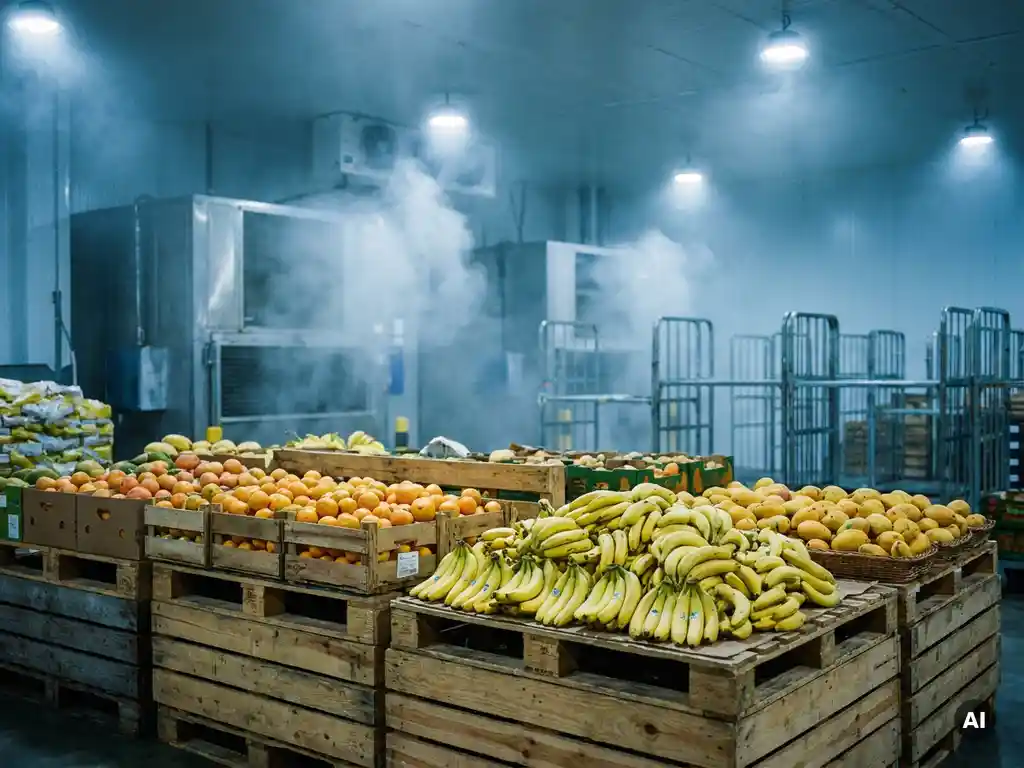
Yes, you can rent temporary storage space for a large food shipment. Most professional food warehouses offer flexible rental periods, from a few weeks to several months, depending on your product flow and the type of goods. For B2B parties in food logistics, short-term storage is a common and well-organized service.
The requirements vary by storage location and product type. Fresh, perishable products such as exotic fruit require climate-controlled spaces with specific temperature and humidity settings, while dry food products such as nuts or seeds are stored under different conditions. The questions below will help you determine what type of storage you need, how much space to plan, and what requirements a reliable storage partner must meet.
What are the minimum rental periods for food storage?
The minimum rental period for renting storage space for food varies by provider, but in practice, it often ranges from a few days to a month. For large food shipments with a clear turnaround time, such as a shipload of fruit or a bulk consignment of nuts, flexible agreements are typically used that align with the shipping schedule or the customer's processing capacity.
Many logistics partners in the food sector do not apply a strict minimum term, but work based on the actual storage duration. This is advantageous for importers and wholesalers dealing with fluctuating supply volumes. A shipment that flows quickly to a processing plant or supermarket distribution center has different storage requirements than a batch that is delivered on demand for weeks.
From a practical perspective, it is advisable to provide clarity immediately upon submission regarding the expected duration of stay, volume, and desired delivery schedule. This allows a storage partner to properly plan capacity and prioritize your goods upon arrival.
How many pallet spaces do you need for a large food shipment?
The number of pallet spaces required for a large food shipment depends on the volume of the shipment, the packaging format, and the stackability of the product. A standard 40-foot shipping container typically holds between 20 and 25 pallets, depending on the weight and height of the load. For larger shipments consisting of multiple containers, this quickly rises to hundreds of pallet spaces.
In addition to the direct volume, you must also take into account the lead time in the warehouse. If goods are delivered in phases, you occupy pallet spaces longer than with a single bulk delivery. A batch to be delivered in four weeks therefore requires more planning capacity than a batch that is processed within 48 hours.
For dry food products such as nuts, peanuts, or seeds, it is also relevant whether the goods arrive loose or palletized. For loose goods, repalletization upon arrival is an extra step that affects the required space and processing time.
What is the difference between cold storage and dry storage for food?
The difference between cold storage and dry storage for food lies in the storage temperature and climate control. Cold storage, also known as climate-controlled storage, is intended for fresh and perishable products that require a specific temperature and humidity. Dry storage, also known as ambient warehousing, is suitable for products that remain stable at room temperature or a slightly cooled environment of approximately 11 degrees.
Cold storage: for fresh and perishable products
Climate-controlled cold storage is indispensable for products such as bananas, citrus fruits, and other exotic fruits. Temperature, humidity, and air circulation are continuously monitored and adjusted per product type. Small deviations in storage conditions can lead to loss of quality, accelerated ripening, or spoilage. The settings per climate chamber can be configured per product.
Dry storage: for stable food products
Dry storage is suitable for products such as nuts, peanuts, seeds, and dried food raw materials. These products are less sensitive to temperature fluctuations but do require a dry, controlled environment to prevent moisture absorption, mold formation, or loss of quality. A dry storage warehouse with separate areas for each product category provides the right infrastructure for this.
Which certifications must a food warehouse have?
A food warehouse handling food products destined for the European market must hold at least BRC certification (British Retail Consortium). This is an internationally recognized standard for food safety and quality management that is a requirement of most supermarket chains and processing plants. Additional certifications depend on the product type and the sales market.
SKAL certification is required for organic products. SKAL is the Dutch supervisory body for organic production and verifies whether the entire chain, including storage and transport, meets the organic standard. Parties storing organically certified products without using a SKAL-certified warehouse risk losing the organic status of their goods.
In addition, an inspection by the KCB (part of the NVWA) is mandatory for the import of fresh fruit and vegetables from third countries. This is the import inspection for plant products, which checks for phytosanitary requirements. A storage partner that can facilitate this inspection on-site saves significantly on transport and waiting time.
For specific markets or product categories, Demeter certification may also be relevant, particularly for biodynamic products. When selecting a storage partner, it is advisable to check which certifications are current and whether they meet the requirements of your customers.
How does container handling work upon arrival at the port?
Upon the arrival of a container in the port, the cargo is transferred to the storage facility as quickly as possible. The speed of this process is crucial for the quality of fresh products. At a location with its own quay directly adjacent to the cold storage facility, the transport time from the hold to the refrigerated storage is minimal, which directly benefits the quality of perishable products such as fruit.
Upon arrival, the container is unloaded, during which the goods are immediately checked for damage, packaging discrepancies, and temperature history. Depending on the agreements, products are sorted, repalletized, and provided with barcodes or customer-specific labels. Quality measurements such as temperature, humidity, and Brix measurements can be performed immediately upon entry as part of the quality control.
After processing, pallets are stored in the climate-controlled chamber or dry warehouse, fully traceable via a barcode system. Grower and LOT numbers are linked to the correct products, ensuring full traceability from arrival to delivery. EDI connections make it possible to automatically provide your own systems with inbound notifications, inventory updates, and status reports.
When is a storage location in the Rotterdam-Antwerp corridor the best choice?
A storage location in the Rotterdam-Antwerp Corridor is the best choice when your goods enter Europe via sea freight and need to proceed quickly to customers in Germany, the Benelux, or Eastern Europe. This corridor is Europe's main logistical artery and offers direct connections to the continent's largest container ports, with excellent links to the European hinterland via road, rail, and inland waterways.
For importers and wholesalers who regularly receive large food shipments, a location in this corridor offers several practical advantages. Customs clearance can be arranged on-site, import inspections via the KCB can take place immediately upon arrival, and goods can be stored and delivered without unnecessary intermediate transport. This shortens lead times and reduces the risk of quality loss, particularly for fresh products.
Locations such as Vlissingen and Kruiningen are strategically situated in this corridor and are easily accessible from both Rotterdam and Antwerp. For shipments destined for the German market, the largest sales market for many European food importers, a storage location in Zeeland offers an efficient base with short transport times to the south and east of Germany.
How ZZColdstores helps with renting temporary storage space for large food shipments
ZZColdstores offers flexible storage solutions for B2B parties requiring temporary storage space for large food shipments. Whether it concerns a one-off shipment of exotic fruit or a continuous flow of dry food products, ZZColdstores adapts to your schedule and the arrival of ships at the quay.
- Climate-controlled storage for fresh and perishable products, with 24/7 monitoring of temperature, humidity, and air circulation
- Dry storage with a capacity of 12,000 pallet spaces for nuts, peanuts, seeds, and other dry food products
- Own quay in Vlissingen for minimal transport time from ship to cooling
- Container handling including unloading, sorting, repalletizing, and quality control upon arrival
- Certifications: BRC, SKAL, and Demeter, with on-site import inspection via KCB/NVWA
- Fully traceable storage via barcode systems and EDI connections with your systems
Would you like to know which type of storage best suits your product flow? View the climate-controlled storage options from ZZColdstores or contact us directly for a no-obligation consultation about your specific storage needs.
Frequently Asked Questions
Can I rent storage space if I don't know exactly when my shipment will arrive yet?
Yes, that is very common in food logistics. Sailing schedules can shift due to weather conditions, port delays, or changes in the loading plan. A good warehousing partner takes these uncertainties into account and works with flexible scheduling systems that can adjust to the actual arrival time of your shipment. Please specify an expected arrival window with your request and communicate updates as soon as you receive them from your shipping company or freight forwarder.
What happens if my goods do not meet the quality requirements upon arrival?
During a quality check upon arrival—such as temperature measurement, visual inspection, or Brix measurement—deviations can be immediately identified and documented. This enables you to take swift action towards your supplier or insurer. A storage partner with certified quality control procedures and traceability systems provides valuable documentation that you can use for complaints or claim handling.
How do I combine climate-controlled storage and dry storage for a mixed shipment?
If your shipment consists of both fresh and dry food products, most professional food warehouses allow you to use both storage types within a single location. This is logistically more efficient than working with multiple providers, as your administration, container handling, and delivery remain centralized. Please clearly indicate the product categories you expect in your request so that the storage partner can reserve the appropriate capacity and climate-controlled chambers for you.
Which documents do I need to store my food shipment in a certified food warehouse?
Generally, you require at least the freight documents (Bill of Lading or CMR), a packing list, and a commercial invoice, and for imports from outside the EU, customs documents such as a T1 or EX document. For fresh plant products, a phytosanitary certificate and import inspection via the KCB/NVWA are mandatory. For organic products, you must also provide your supplier's organic certification to ensure the batch's SKAL status.
Can a warehousing partner also handle further distribution to my customers?
Many specialized food warehouses offer value-added logistics services in addition to storage, such as order picking, repalletizing, labeling, and delivery to multiple customers. This makes it possible to operate as a European distribution center for your product flow from a single storage location. Ask your storage partner specifically about the possibilities for cross-docking, partial loads, and fixed delivery schedules if this aligns with your distribution needs.
How do I ensure that my stored food products remain fully traceable during the storage period?
Full traceability begins with linking grower and LOT numbers to every pallet upon receipt, followed by barcoding and registration in the storage partner's Warehouse Management System (WMS). Via EDI connections, you can automatically forward this information to your own ERP or purchasing system, ensuring you always have real-time insight into inventory status. When selecting a storage partner, verify whether their systems are compatible with your own software environment.
What are the most common mistakes when planning temporary food storage?
A common mistake is reserving storage capacity too late, resulting in no suitable space being available upon arrival of the shipment — particularly during busy seasons such as the summer or end-of-year period. Other common errors include underestimating the required number of pallet spaces (forget to factor in lead time), failing to submit the correct import documents on time, and choosing a storage partner without the proper certifications for your product type or market. Plan well in advance and communicate proactively with your storage partner regarding expected volumes and arrival times.
Related articles
- How does temporary storage work for a large import shipment?
- What storage space do you need for temperature-sensitive foods?
- Can you rent storage space for pallets of fresh produce?
- How does the transit of dry goods to Germany or Ukraine work?
- What is the difference between ambient storage and cold room storage for food?