
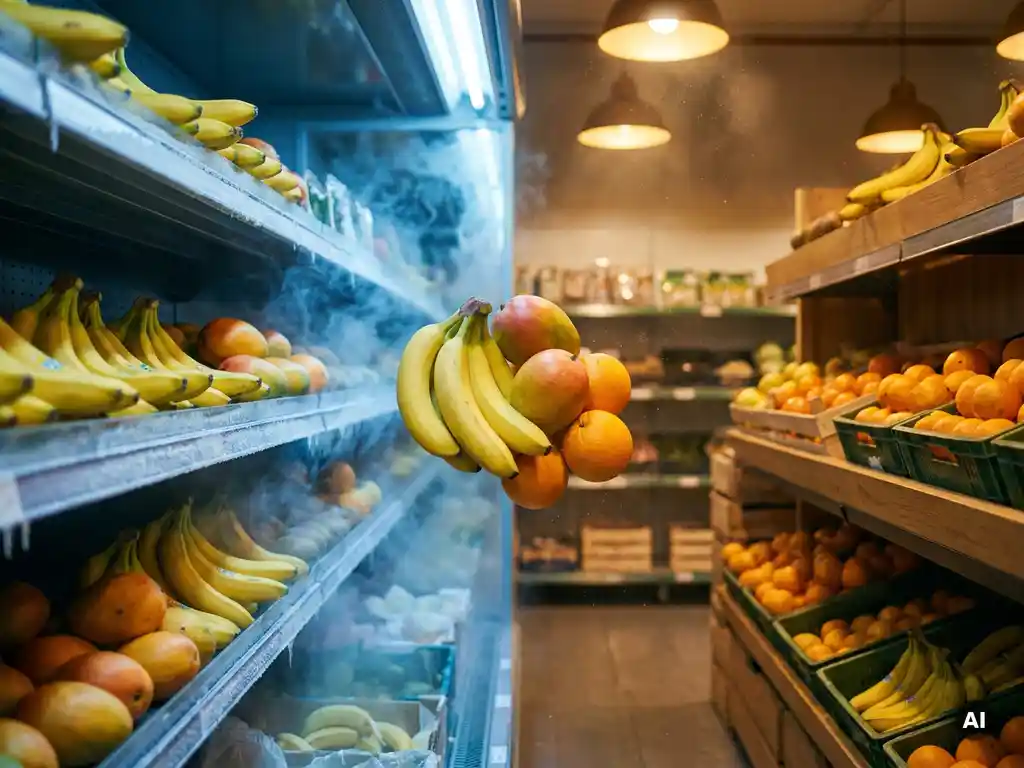
The difference between ambient storage and cold room storage lies in the temperature and the degree of climate control. Ambient storage takes place at room temperature, without active cooling, whereas cold room storage stores products in a controlled environment with specific temperature and humidity settings. Which form of storage is suitable depends entirely on the nature and shelf life of the food product. The questions below will help you determine which storage conditions your product requires.
Which products are suitable for ambient storage?
Products that remain stable at room temperature and do not spoil quickly are suitable for ambient storage. Examples include dry, non-perishable food products such as nuts, peanuts, seeds, grains, dried fruit, legumes, and packaged foods with a long shelf life. These products do not require active refrigeration, but they do require a dry, well-ventilated environment.
The core of dry storage is preventing moisture, pests, and temperature fluctuations that can affect product quality. A stable ambient temperature, typically between 15 and 25 degrees Celsius, is sufficient for this. Products sensitive to odors or contamination are preferably stored in separate rooms.
- Nuts and peanuts
- Seeds and grains
- Dried fruit
- Legumes
- Packaged non-perishable food products
For this type of product, dry storage in an ambient warehouse a cost-effective and practical solution, provided the space meets the appropriate hygiene and climate standards.
What are the optimal temperature zones for cold storage of food?
The optimal temperature zone for cold storage varies by product category. Fresh vegetables and fruit are typically stored between 0 and 8 degrees Celsius, while exotic fruits such as bananas require a higher minimum temperature, usually between 12 and 14 degrees Celsius, to prevent cold damage. Citrus fruits thrive at temperatures around 5 to 10 degrees Celsius.
Cold storage is not a uniform solution. Each product has its own temperature window within which quality preservation is optimal. Too cold can be just as harmful as too warm: bananas stored below 12 degrees for too long do not color properly and can become unsaleable. Precise temperature control is therefore essential, especially for delicate or exotic products.
The temperature zones are also determined by the phase in the logistics chain. Products that still need to ripen require different settings than products that are already ripe and are distributed quickly. A well-designed cold room offers flexible settings per cell or compartment.
How does humidity control differ in ambient and cold room storage?
In ambient storage, humidity control is aimed at preventing excessive moisture, which can cause mold growth and spoilage. In cold storage, humidity control is much more precise: air that is too dry extracts moisture from the product and causes dehydration, while excessive moisture promotes condensation and rotting. The balance differs per product.
In an ambient warehouse, good ventilation and a relative humidity below 65 to 70 percent are sufficient in most cases. For dry products such as nuts and seeds, this is enough to guarantee product quality.
In a cold room for fresh fruit, the situation is more complex. Here, the relative humidity is actively regulated, often between 85 and 95 percent, depending on the product. This prevents dehydration without the formation of free water. Modern cold rooms combine temperature sensors with humidity controllers and air circulation systems to continuously monitor this balance.
When is cold storage mandatory for food products?
Cold storage is mandatory when food products pose a microbiological risk at room temperature or when legislation and regulations prescribe specific storage temperatures. For fresh, unprocessed plant-based products such as vegetables and fruit, guidelines apply from European food legislation and national authorities such as the NVWA, which determine under which conditions products may be safely stored and traded.
In practice, importers of fresh fruit are required to store products under refrigeration almost immediately after unloading to comply with quality standards and import inspections. The shorter the time between unloading and refrigeration, the better product quality is preserved. This is particularly relevant for imports via seaports, where the transfer from ship's hold to cold storage must take place as quickly as possible.
In addition, private quality certifications such as BRC may impose additional requirements regarding storage temperatures and the recording of climate data. Companies supplying supermarket chains are regularly audited on this.
What are the cost differences between ambient and cold room storage?
Cold storage is structurally more expensive than ambient storage because active climate control entails higher energy and investment costs. The exact cost differences depend on the volume, the required temperature zone, the storage duration, and the location. As a rule of thumb, refrigerated storage costs two to four times more than dry storage per pallet space per week.
The higher costs of cold storage are justifiable when the product rapidly depreciates in value or becomes unsaleable without refrigeration. For fresh fruit, refrigeration is not a luxury but a necessity. The costs of rejected or spoiled product quickly outweigh the investment in proper storage conditions.
Factors influencing the cost ratio:
- Energy consumption: cold rooms consume significantly more energy than ambient warehouses.
- Technical installations: cold rooms require specialized equipment for temperature and humidity control.
- Certification and monitoring: refrigerated storage requires continuous recording and compliance with strict standards.
- Flexibility: cold rooms with variable temperature zones are more expensive to purchase but offer more application possibilities.
- Location: storage directly at a port reduces transport costs and quality loss, which can lower the total cost per unit.
How do you choose the right storage form for your food product?
The choice between ambient storage and cold room storage depends on three key questions: how perishable is the product, what temperature and humidity conditions are required to maintain quality, and what legal or certification requirements apply? Always start with the manufacturer's product specifications or applicable food legislation before choosing a storage method.
Products with a long shelf life and low moisture sensitivity are in most cases suitable for ambient storage. Fresh, fragile, or perishable products require temperature-controlled storage. In doubt? Consult the product technical specifications or a specialized logistics partner with experience in your product category.
Also take the logistics chain as a whole into account. A product that arrives refrigerated must remain refrigerated until the point of delivery. An interruption in the cold chain, even a brief one, can significantly impair shelf life and quality. The choice of the right storage method is therefore not only a product question, but also a supply chain question.
How ZZColdstores helps with the choice between ambient and cold room storage
ZZColdstores offers B2B logistics partners a complete range of solutions for both temperature-controlled and dry ambient storage, from locations in Kruiningen and Vlissingen. With over 30 years of experience in the storage of exotic fruit and dry food products, ZZColdstores actively collaborates to determine the right storage conditions for your product and logistics chain.
- Cold storage with flexible temperature and humidity settings, suitable for fresh and exotic fruits such as bananas and citrus.
- Dry ambient storage with a capacity of 12,000 pallet spaces, with separate areas for nuts, peanuts, seeds, and other dry food products.
- Direct connection to the port via a private quay in Vlissingen, minimizing the transition from ship's hold to cooling.
- Certifications including BRC, SKAL, and Demeter, which meet the requirements of supermarket chains and the processing industry.
- Import inspection and customs clearance as part of a complete logistics package.
Do you want to know which storage solution best suits your product and supply chain? Contact ZZColdstores for a no-obligation consultation with our specialists.
Author: Frans van der Maas, Operations Director at ZZColdstores
Frequently Asked Questions
Can a single product be stored both ambiently and refrigerated, depending on the situation?
Yes, that is sometimes possible, but it depends heavily on the processing status and packaging of the product. Dried nuts, for example, can be stored ambiently without any problems, but as soon as they are processed into a paste or combined with other ingredients, different storage requirements may apply. Always consult the product specifications and applicable food legislation for your specific situation.
How soon must fresh fruit be placed in the cold room after unloading?
The rule of thumb in the industry is: the faster, the better. For most fresh fruit varieties, the transfer from ship's hold to cold storage preferably takes place within a few hours. Any delay at room temperature accelerates the ripening process and significantly shortens the remaining shelf life. Locations with a direct port connection, such as the ZZColdstores quay in Vlissingen, offer a concrete advantage in this regard.
What are the most common mistakes in ambient storage of dry food products?
The most common mistakes are insufficient ventilation, excessive humidity, and mixing strongly scented products with odor-absorbing products such as nuts. Insufficient protection against pests is also a common problem in ambient warehouses. A well-designed ambient warehouse with separate compartments per product category and active humidity monitoring prevents most of these problems.
Which certifications are relevant if I want to store food products for supermarket chains?
For deliveries to supermarket chains, BRC (British Retail Consortium) certification is virtually standard practice for both refrigerated and dry storage. Additionally, organic products may require supplementary certifications such as SKAL or Demeter. It is advisable to verify with your logistics partner which certifications are in place before signing a storage contract to avoid unpleasant surprises during audits.
How is the temperature in a cold room continuously monitored and documented?
Modern cold rooms are equipped with automated temperature and humidity sensors that measure continuously and record the data digitally. These logbooks are essential for quality assurance and are requested during audits by certification bodies such as the BRC Standard. In the event of deviations from the set parameters, operators are automatically alerted, allowing for rapid intervention to prevent product loss.
Is it possible to flexibly scale up storage capacity during seasonal peaks?
Yes, many professional logistics service providers offer flexible storage contracts that allow you to scale capacity up and down based on seasonal demand. This is particularly relevant for products such as nuts and dried fruit, which are highly seasonal in terms of supply and demand. Discuss your expected peaks and troughs with your logistics partner in advance so that sufficient capacity can be reserved without paying for unused space all year round.
What happens if the cold chain is temporarily interrupted during transport or transshipment?
An interruption in the cold chain, even a brief one, can significantly shorten the shelf life of fresh products and, in some cases, lead to rejection during import inspections. It is therefore essential to keep the entire logistics chain—from ship's hold to final destination—continuously refrigerated. Document every stage of the cold chain accurately so that, in the event of any quality disputes with customers or inspection bodies, you can demonstrate that the conditions are continuously guaranteed.
Related articles
- What role does warehousing play between the port and the customer?
- When do you outsource warehousing to a logistics partner?
- What data is recorded during the storage of foodstuffs?
- How long can you safely store garlic in a temperature-controlled warehouse?
- How does the logistics chain from port to factory for dry raw materials work?