
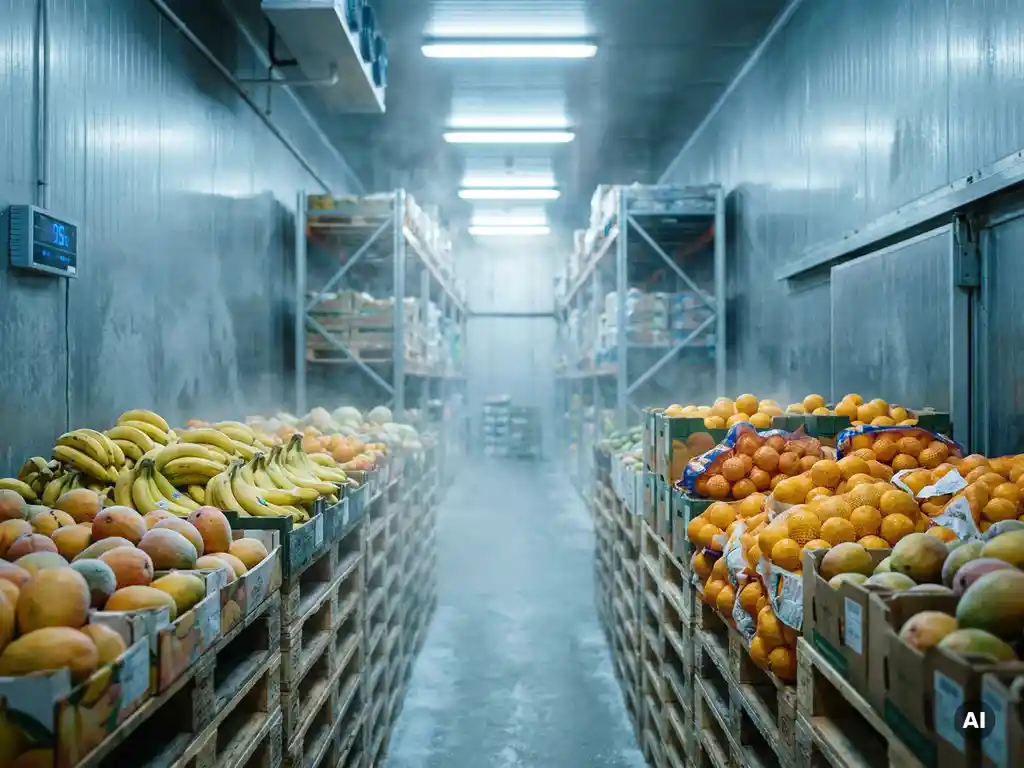
Cold storage for fresh food works by precisely controlling temperature, humidity, and air circulation in a refrigerated space so that perishable products remain fresh and of optimal quality for as long as possible. The exact settings vary by product: bananas require different conditions than citrus fruits or leafy greens. This article answers the most frequently asked questions about cold storage, from ideal temperatures to required certifications.
What temperature is ideal for storing fresh fruit?
The ideal storage temperature for fresh fruit is generally between 8 and 13 degrees Celsius, but varies significantly by variety. Tropical and exotic fruits such as bananas and citrus fruits are sensitive to cold and are damaged at temperatures below 8 degrees. Temperate fruits such as apples and pears tolerate lower temperatures, sometimes down to just above freezing.
For exotic fruit, the concept of cold damage (also known as “chilling injury”) is essential. When tropical fruit is stored at temperatures that are too cold, internal discoloration, soft spots, and flavor defects occur that only become visible later in the supply chain. This makes precise temperature control not only a matter of shelf life but also of quality assurance for the end customer.
For B2B parties in the food chain, such as importers and wholesalers supplying supermarket purchasing organizations, it is crucial that cold storage is individually adjustable for each product stream. In practice, a uniform setting for all products is insufficient.
How is the temperature in a cold room regulated?
The temperature in a cold room is regulated via a combination of refrigeration units, air circulation systems, and digital control systems that continuously measure and adjust. Modern cold rooms use sensors that register the temperature at multiple points in the room and automatically intervene as soon as deviations occur. This ensures a stable and homogeneous climate throughout the entire storage space.
In addition to the refrigeration units, air circulation plays a key role. Without even air distribution, hot or cold spots develop in the cell, which unevenly affects the quality of the stored products. Advanced systems monitor temperature and circulation 24 hours a day, seven days a week, and store measurement data for traceability and quality reporting.
For professional cold storage, continuous monitoring is not a luxury but a requirement, especially when customers such as supermarket chains or processing plants impose strict quality requirements on the delivered products.
What is the difference between cold storage and freezer storage?
The primary difference between cold storage and freezer storage lies in the temperature range. Cold storage stores products above freezing point, typically between 0 and 15 degrees Celsius depending on the product. Freezer storage operates at temperatures of minus 18 degrees Celsius or lower, intended for products that are completely frozen to enable long-term preservation.
Cold storage is suitable for fresh products that must retain their structure, taste, and nutritional value: fresh fruit, vegetables, and other perishable foods. Freezer storage is intended for products where shelf life outweighs fresh quality, such as frozen vegetables or ready-made meals.
For logistics partners and importers, the distinction is practically relevant: fresh exotic products arriving via the port typically go directly to cold storage. Freezer storage requires different infrastructure, different processing times, and different certifications. A cold storage facility with both refrigerated and temperature-controlled areas offers the most flexibility for a broad product portfolio.
Why is humidity so important in cold storage?
Humidity largely determines whether fresh produce dries out, condenses, or molds during storage. Humidity that is too low draws moisture out of the product, leading to weight loss, wrinkling, and loss of quality. Humidity that is too high promotes mold growth and bacterial contamination, resulting in spoilage and food safety issues.
For fresh fruit, a relative humidity of generally 85 to 95 percent is considered optimal, but here too, it varies by product. Citrus fruits tolerate slightly lower moisture levels than tropical fruits such as bananas. The combination of temperature and humidity together determines the climate that influences the shelf life and quality of the product.
Professional cold storage therefore regulates humidity and temperature as an integrated system, not as two separate variables. For B2B customers supplying products to supermarket chains with strict quality standards, this distinction is immediately visible in the product quality upon arrival at the end customer.
How long can fresh food be kept in cold storage?
The maximum shelf life of fresh food in cold storage varies greatly by product, but for most fresh fruits it is between two and eight weeks under optimal conditions. Bananas have a relatively short shelf life (a few weeks), while citrus fruits can be stored longer without loss of quality at the right temperature and humidity.
The storage period is determined by several factors:
- Ripeness on arrival: products arriving riper have a shorter remaining shelf life.
- Quality of the cold chain: any interruption in the cold chain, even a short one, accelerates the ripening process.
- Accuracy of climate control: fluctuations in temperature or humidity shorten shelf life
- Product characteristics: the biological ripening rate varies by fruit type and origin
For logistics partners, shelf life is a critical planning parameter. Products arriving via the port and immediately transferred to a cold storage facility with stable conditions retain their maximum remaining shelf life. Any delay or temperature fluctuation during the journey from ship to cooling directly reduces the saleable shelf life.
What certifications must a cold storage facility have?
A professional cold storage facility for fresh food products must hold at least BRC certification (British Retail Consortium), the international standard for food safety in storage and logistics. In addition, supplementary certifications are required for specific product flows, such as SKAL for organic products and KCB/NVWA accreditation for import inspections of fresh fruit and vegetables from outside the EU.
The most relevant certifications for cold storage of fresh food in the Netherlands are:
- BRC Storage & Distribution: required by virtually all major supermarket chains and processing plants as a basic requirement for their suppliers
- SKAL: mandatory for the storage of organically certified products; without SKAL certification, organic products may not be stored or distributed as such.
- KCB/NVWA accreditation: necessary for the official import inspection of fresh fruit and vegetables imported from outside the EU
- Demeter: for the storage of biodynamically certified products, a stricter variant of organic certification
For B2B parties supplying supermarket purchasing organizations or processing plants, these certifications are not a formality, but a strict purchasing requirement. A warehousing partner without the proper certifications closes the door to major customers and international trade flows.
How ZZColdstores provides cold storage for fresh food
ZZColdstores offers climate-controlled cold storage in Kruiningen and Vlissingen, specially designed for fresh and perishable products such as exotic fruit. The facilities are equipped with systems that monitor and adjust temperature, humidity, and air circulation 24/7. Every pallet is fully traceable via a barcode system, from arrival to departure.
What sets ZZColdstores apart for B2B partners:
- Private quay in Vlissingen for direct transfer from ship to cooling, with minimal exposure to outside temperatures
- Flexible climate settings per product type, tailored to the specific requirements of the product
- BRC, SKAL, and Demeter certification, plus KCB/NVWA accreditation for import inspections
- Quality control upon arrival, including temperature and humidity measurements and QC reports
- Additional services such as repalletizing, labeling, and EDI connections for seamless system integration
Would you like to know if ZZColdstores' cold storage aligns with your product flows and logistical requirements? Contact us for a no-obligation consultation.
Frequently Asked Questions
How soon must fresh fruit be placed in the cold room after arrival?
Fresh fruit must be placed in the cold storage as soon as possible upon arrival, preferably within one to two hours of unloading. Every minute the product remains at room temperature accelerates the ripening process and shortens the remaining shelf life. For exotic fruit arriving via the port, direct transfer from ship to refrigerated space is therefore highly recommended. Facilities with their own quay offer a clear logistical advantage in this regard compared to locations where road transport is necessary.
Can cold storage also be used for the controlled ripening of fruit?
Yes, in addition to slowing down the ripening process, cold storage can also be used for controlled ripening. By specifically increasing the temperature and ethylene levels in the cell, the ripening process of, for example, bananas or avocados can be precisely controlled. This enables importers and wholesalers to deliver products to the customer at the correct stage of ripeness. Not all cold storage facilities have this capability; it requires special ripening cells with additional climate control.
What happens if the cooling system fails? How is the quality of my products protected?
A professional cold storage facility features redundant systems and emergency procedures to handle the failure of the cooling system. This typically includes backup chillers, alarm systems active 24/7, and immediate notifications of temperature deviations. Additionally, all temperature data is continuously logged, ensuring that in the event of an incident, the exact conditions to which your products were exposed can be demonstrated. When selecting a storage partner, it is advisable to explicitly ask about the disaster recovery plan and the maximum response time in the event of a malfunction.
Am I allowed to store different types of products together in one cold room?
In practice, this is often undesirable and sometimes downright inadvisable. Some types of fruit, such as apples and pears, produce ethylene gas, which can significantly accelerate the ripening process of ethylene-sensitive products such as bananas or avocados. Additionally, different product types require different temperature and humidity settings, meaning that combined storage always represents a compromise. A professional storage facility offers individually adjustable cells for each product type, ensuring that every product is stored under optimal conditions.
How can I, as an importer or wholesaler, monitor and demonstrate the quality of my products during storage?
Modern cold storage utilizes digital monitoring systems that continuously record and store temperature, humidity, and air circulation. This data forms the basis for quality reports that you can present to customers such as supermarket chains or processing plants. Additionally, some storage partners offer QC reports upon the arrival and departure of your products, including visual inspections and measurements. This ensures full traceability of your product flows and strengthens your position vis-à-vis demanding purchasing organizations.
What are the most common mistakes when choosing cold storage for fresh fruit?
A common mistake is choosing based on price alone, without verifying whether the facility holds the correct certifications for your specific product flows. Additionally, many parties underestimate the importance of flexible climate settings per product type: a cold room with only a single fixed temperature setting is unsuitable for a varied product portfolio. The location relative to the port or distribution point is also an underestimated factor that directly influences cold chain quality and, consequently, the remaining shelf life of your products.
Is cold storage also suitable for small volumes or seasonal peaks?
Yes, many professional cold storage facilities offer flexible storage capacity that is scalable based on your current volumes. This is particularly relevant for importers dealing with seasonal supply or fluctuating market demand. It is advisable to make clear agreements in advance regarding minimum purchase obligations, flexible inbound and outbound movements, and the ability to reserve additional capacity at short notice. This allows you to handle seasonal peaks without compromising storage quality.
Related articles
- Can you have food products stored and logistically processed?
- What should you pay attention to when cold storing citrus fruit?
- What should you look for when renting storage space for food?
- How do you prevent a break in the cold chain during storage?
- What are the consequences of aflatoxin in poorly stored peanuts?