
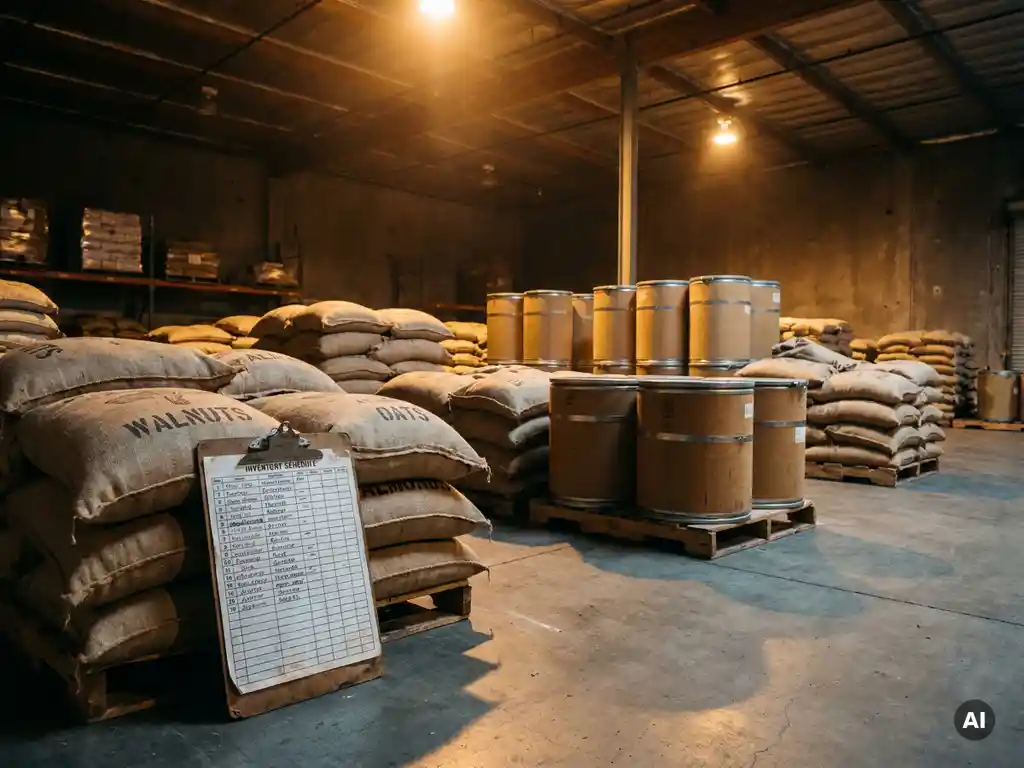
You plan the inventory turnover of dry raw materials with long lead times by linking safety stocks to realistic lead times, employing a strict FIFO method, and systematically monitoring demand patterns. The longer the lead time, the more buffer you need and the greater the risk of obsolescence or quality loss associated with stagnant inventory. The questions below elaborate step-by-step on the key aspects of effective inventory planning for dry raw materials.
What makes stock rotation so complex with long lead times?
Long lead times make inventory rotation complex because the gap between ordering and receipt is large, causing you to make decisions based on future demand that you do not yet know precisely. The longer that gap, the greater the chance of a mismatch between what is in the warehouse and what the market demands at that moment.
For dry raw materials such as nuts, peanuts, seeds, and grains, multiple factors come into play simultaneously. Seasonal harvests limit supply times. Shipping delays, port congestion, or customs procedures can further extend delivery times. At the same time, dry products also have an expiration date, and slow-moving batches run the risk of falling outside their optimal quality window.
An additional problem is that importers and wholesalers often order large batches to reduce freight costs, but as a result also maintain larger stock buffers than strictly necessary. This combination of bulk purchasing and uncertain supply times calls for a well-thought-out rotation approach.
Which rotation methods are suitable for dry raw materials?
For dry raw materials, FIFO (First In, First Out) is the most suitable rotation method. FIFO means that the oldest batch is delivered first, ensuring optimal utilization of the total stock's shelf life and minimizing the risk of expired batches.
In addition to FIFO, there is FEFO (First Expired, First Out), where the batch with the earliest expiration date leaves first, regardless of when it arrived. FEFO is particularly relevant when suppliers use varying expiration dates or when batches from different countries of origin are mixed.
Which method you choose depends on the product category:
- Nuts and peanuts with a fixed best-before date benefit from FEFO, because the expiration date determines the execution order.
- Cereals and flakes with a longer shelf life can be effectively managed via FIFO, where the date of receipt is the determining factor.
- Mixed inventories with changing suppliers require a combination of both methods and clear lot registration per batch.
Crucial to both methods is consistent LOT numbering and a physical storage layout that actually enables the desired rotation. A method that is correct on paper but unfeasible in practice does not work.
How do you calculate the correct safety stock for long lead times?
The safety stock for long lead times is calculated by multiplying the average daily demand by the variation in lead time, supplemented with a buffer for demand fluctuations. The greater the uncertainty in supply or sales, the higher the required safety stock.
A commonly used basic formula is: safety stock = Z-factor x standard deviation of demand x square root of lead time. The Z-factor determines the desired service level. At a service level of 95%, the Z-factor is 1.65; at 99%, it increases to 2.33.
In practice, you translate this into a concrete step-by-step plan as follows:
- Determine the average daily sales based on historical orders, preferably over at least 12 months.
- Calculate the standard deviation of those daily sales to map demand variation.
- Determine the average delivery time and document the historical upward outliers.
- Choose a service level that matches the criticality of the raw material for your production process.
- Apply the formula and translate the result into a minimum stock level in pallets or by weight.
Please note that safety stock is not a static figure. Seasonal patterns, new suppliers, or changing shipping routes can affect lead time variation and require periodic recalculation.
When is a pull strategy better than a push strategy for dry storage?
A pull strategy is better than a push strategy for dry storage when demand is reasonably predictable, lead times are manageable, and you do not need to build up large seasonal inventories. With a pull approach, you only order when inventory reaches a predetermined minimum level, which prevents overstorage and obsolescence.
A push strategy is particularly useful when harvest periods are limited, price advantages on bulk purchasing are significant, or the supply route is uncertain. Consider raw materials that are harvested once a year and where you need to purchase a year's supply at once to guarantee continuity.
For most dry raw materials in an international supply chain, a hybrid approach is the most practical: push when purchasing seasonal or scarce raw materials, pull when delivering to production or customers. This combines purchasing certainty with a controlled outflow rate.
How does a WMS help monitor inventory turnover?
A Warehouse Management System (WMS) helps monitor inventory turnover by automatically linking each pallet to the receipt date, lot number, and expiration date, and by automatically enforcing the correct rotation method (FIFO or FEFO) upon issuance. This structurally prevents manual errors in the rotation sequence.
Concrete functions that a WMS utilizes for effective rotation include:
- Automatic location assignment based on receipt date or expiration date
- Identification of parties exceeding a threshold age without issuance
- LOT traceability from receipt to delivery, including linking to supplier numbers
- Inventory reports by batch, location, and product category for planning purposes
- EDI connections for automatic inventory updates to customers or production planning
A WMS does not replace good rotation discipline, but makes that discipline more scalable and controllable. Without a system, FIFO or FEFO is hardly consistently implemented for larger inventories.
What are the most common mistakes when planning dry raw material stocks?
The most common errors in planning dry raw material inventories are underestimating lead time variation, working with overly static safety stocks, and the lack of consistent lot registration. Each of these errors can lead to stockouts, obsolete lots, or unnecessary storage costs.
Other common planning mistakes are:
- Failing to differentiate between product categories when determining buffer stocks, even though nuts and grains have a very different risk profile.
- Demand forecasts are based on historical periods that are too short, meaning seasonal peaks are not taken into account.
- Do not adjust reorder points following changes in suppliers, shipping routes, or customer contracts.
- Ignoring physical storage layout in rotation policy: if older batches lag behind newer ones, FIFO is impractical in practice.
- Failure to conduct a periodic inventory audit to detect discrepancies between the system and reality in a timely manner.
What role does the storage location play in an effective rotation approach?
The storage location plays a decisive role in effective inventory rotation, because the physical layout of a warehouse determines whether a rotation method is feasible in practice. A FIFO policy not supported by the correct location structure inevitably leads to errors in the execution sequence.
For dry storage of raw materials such as nuts, peanuts, and seeds, the following location principles are relevant:
- Drive-through racks or push-through systems automatically enforce FIFO because loading and unloading take place on opposite sides.
- Fixed locations per LOT number prevent parties from getting mixed up and make audits easier.
- Clear walking routes for inbound and outbound reduce the chance that order pickers take the wrong pallet.
- Zone climate stability is relevant for products that are sensitive to temperature fluctuations or humidity, even if they do not require active cooling.
The location of the warehouse itself also counts. A storage facility close to the port shortens the time between unloading and receiving, which better safeguards the quality of the raw material upon arrival and makes the rotation cycle more reliable.
How ZZColdstores helps with the storage of dry raw materials
ZZColdstores offers ambient warehousing for dry and shelf-stable food products such as nuts, peanuts, seeds, grains, and flakes. The storage facilities in Kruiningen and Vlissingen are specifically designed for these product categories, with a stable, dry, and clean storage environment that prevents quality loss due to humidity or temperature fluctuations.
For supply chain managers and buyers working with long lead times, ZZColdstores offers the following, among other things:
- Dry storage with a capacity of 12,000 pallet spaces, with separate areas per product category
- Full lot traceability via barcode systems, linked to grower and lot numbers
- Quality control upon arrival, including inspection for damage, labeling, and product condition
- EDI connections for automatic inventory updates and inbound notifications to your systems
- Own shuttle transport within a 40 km radius for direct connection with production locations
Would you like to know how ZZColdstores practically supports your stock rotation for dry raw materials? Contact us for a no-obligation consultation.
Frequently Asked Questions
How often should I review my reorder points and safety stocks?
Ideally, reorder points and safety stocks should be reviewed at least quarterly, and immediately after significant changes such as a new supplier, a changed shipping route, or a new customer contract. Use current sales data from the past 12 months as a basis for this, ensuring that seasonal patterns are fully taken into account. A thorough annual recalculation based on the Z-factor and current lead time variation is an absolute minimum requirement for raw materials with long lead times.
What do I do if a batch of dry raw material is at risk of expiring before I can deliver it?
Detection of approaching expiration dates as early as possible via your WMS or inventory reporting so that you can still take action. Concrete options include: prioritizing the batch in the production schedule, proactively approaching customers with a price advantage for early purchase, or repurposing the batch for an alternative application or market. The sooner you detect the deviation, the more room you have to limit losses.
Can I apply FIFO and FEFO simultaneously within one warehouse?
Yes, that is possible and, in practice, even advisable if you store multiple product categories with different risk profiles. The key is clear zoning per product category, where each zone has its own rotation method and this is consistently recorded in your WMS or location map. Ensure that warehouse staff know which method applies to each zone, supported by clear labels or system-driven picking instructions.
How do I handle significant variations in delivery times due to, for example, port congestion or customs delays?
Systematically document historical lead time outliers by supplier and supply route, and include the maximum deviation in your safety stock calculation instead of just the average. For critical raw materials, consider a second supplier or alternative supply route as a buffer against structural delays. Also build in an escalation protocol: in the event of a reported delay above a certain threshold, immediately initiate an alternative procurement process or adjust the production schedule.
What are the minimum registration requirements for functioning LOT traceability for dry raw materials?
Functional LOT traceability requires at least the recording of the LOT number, the receipt date, the supplier, the weight or number of units per batch, and the expiration date. Link this LOT number to every physical pallet via a barcode or label and ensure that this number is included in all outgoing documents to customers or production. Without this basic registration, retrieval is practically impossible in the event of a quality incident or supplier complaint.
Is a WMS always necessary, or can I manage inventory turnover well with a spreadsheet as well?
For small inventories with one or two product categories and a limited number of batches, a well-structured spreadsheet may suffice temporarily, provided it is updated daily and all employees work with it consistently. However, as soon as you manage more than five active LOT numbers simultaneously, use multiple storage locations, or work with changing suppliers, a spreadsheet falls short due to the risk of human error and the lack of automatic alerts. At that point, a WMS becomes not a luxury but an operational necessity.
How do I choose the right service level for my safety stock calculation?
You choose the appropriate service level based on the criticality of the raw material to your production process and the commercial consequences of a stockout. For raw materials that cause immediate production downtime in the event of failure, a service level of 98-99% is justified; for less critical ingredients with alternative substitutes, 90-95% suffices. Always weigh the additional storage costs of a higher buffer against the actual costs of a stockout, including production loss, rush freight, and customer loss.