
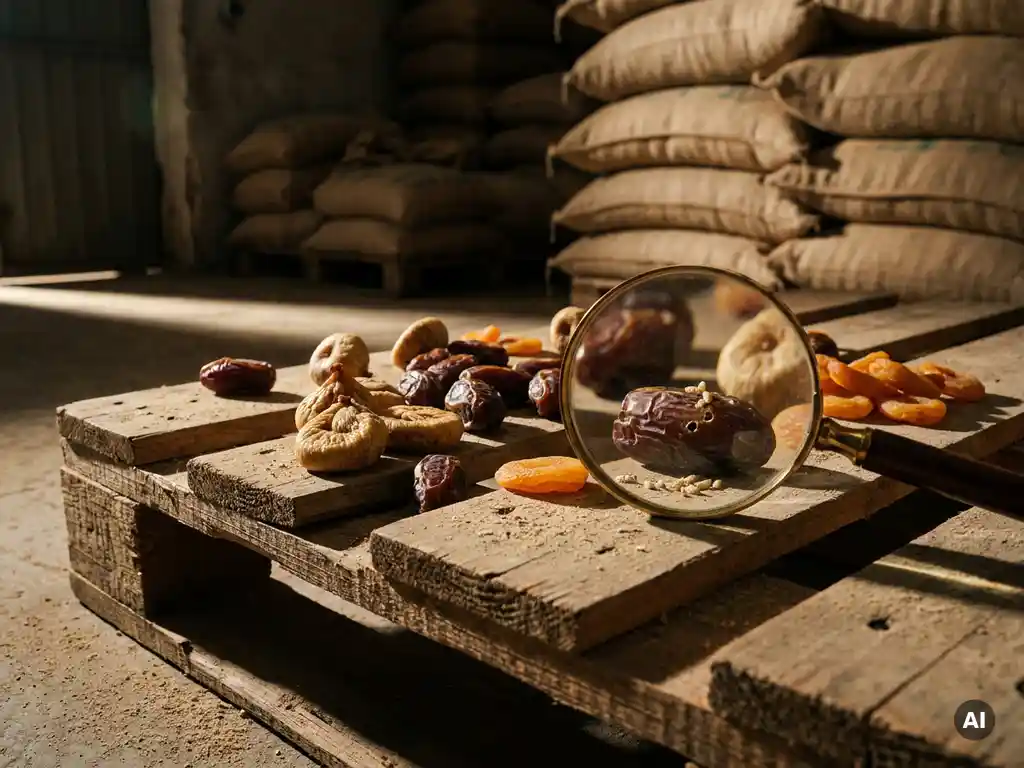
During the storage of dried fruit, larvae and insects pose a serious risk to product quality and food safety. Contamination can lead to direct product damage, rejection during inspection, and legal consequences for importers and wholesalers. This article answers the most frequently asked questions about insect contamination in dried fruit and explains how to manage this risk in a professional storage environment.
Which insects and larvae are most commonly found on dried fruit?
The most common pests of dried fruit are the raisin beetle (Carpophilus hemipterus), the mealworm moth (Ephestia kuehniella), the tobacco beetle (Lasioderma serricorne), and various species of grain beetles. Their larvae are particularly harmful because they feed directly on the product, grow invisibly in stored batches, and are difficult to detect at an early stage.
Dried fruit attracts insects due to its high sugar content and soft texture. Products such as dried figs, dates, apricots, and raisins are particularly vulnerable. Butterflies lay their eggs in small cracks or folds in packaging, after which the larvae burrow inside. Beetles are able to bite through thin plastic packaging, which further spreads the infestation.
- Raisin beetles: small, winged beetles that multiply rapidly in warm, dry environments.
- Flour moths: their larvae spin web-like threads causing clumps to cluster together.
- Tobacco beetles: versatile pests that also survive in well-sealed spaces.
- Granule beetles: thrive in storage areas with fluctuating temperatures
How do storage sites become contaminated with larvae and insects?
Contamination of a storage location with insects during fruit storage almost always occurs via one of three routes: via the product itself upon arrival, via the packaging, or via the storage area when hygiene and sealing are insufficient. Even a small quantity of eggs in an incoming batch is enough to contaminate an entire storage environment.
Insects and their eggs survive transport from countries of origin and are not always visible upon visual inspection. Insufficient sealing of doors, windows, or ventilation openings provides flying insects with free access. Pallets, crates, and reused packaging can also carry eggs or larvae. In addition, temperature fluctuations play a role: when a room is alternately warm and cool, this accelerates the development rate of larvae.
Another underestimated risk of contamination is the proximity of other product groups. When dried fruit is stored next to other dry food products such as nuts or seeds without adequate separation, contamination can spread quickly.
What are the consequences of an insect infestation for product quality?
Insect infestation directly and irreversibly affects the product quality of dried fruit. Larvae bore tunnels through the product, leading to weight loss, changes in taste, and visual abnormalities. In most cases, affected batches are no longer suitable for human consumption and must be disposed of or destroyed.
The damage is rarely limited to the directly affected products. Feces, shed skins, and larval webs contaminate surrounding packaging and pallets. Transfer of odor and flavor to neighboring batches is also a real risk. In an advanced stage of contamination, the entire stock in a storage cell can become unsaleable, resulting in significant financial loss.
What legal and food safety risks does contamination entail?
Insect infestation during the storage of dried fruit entails direct legal risks. Under European food legislation, in particular the General Food Regulation (EC) No 178/2002, importers and storage operators are required to remove unsafe products from the supply chain and notify the competent authorities. Non-compliance can result in fines, withdrawal of certifications, and liability for damages to customers.
In the Netherlands, the NVWA (Netherlands Food and Consumer Product Safety Authority) conducts inspections at storage locations and can impose a temporary delivery ban in the event of contamination. Furthermore, for importers working with BRC- or IFS-certified storage partners, contamination can trigger a re-audit of that certification. In many cases, the reputational damage to supermarket buyers or processing plants exceeds the direct financial loss.
How do you prevent larvae and insects when storing dried fruit?
Effective prevention of larvae in dried fruit requires a combination of physical measures, temperature control, and strict hygiene protocols. There is no single solution: a sustainable approach requires structural attention at multiple levels simultaneously.
The most important preventive steps are:
- Thoroughly inspect incoming batches upon receipt, including the packaging and the underside of pallets.
- Maintain a constant, low storage temperature; insects and larvae develop significantly more slowly under cool conditions.
- Ensure proper sealing of doors, ventilation openings, and connections to keep flying insects out.
- Apply a strict FIFO (First In, First Out) principle so that older batches are not forgotten and contamination does not develop unnoticed.
- Clean the storage area regularly, including floors, walls, and shelves, to remove food product residues that attract insects.
- Work with integrated pest management (IPM), where monitoring via traps and visual inspection is structurally embedded in the storage process.
What is the difference between cold storage and dry storage in pest control?
In pest control, the difference between cold storage and dry storage determines which insects are active and how quickly an infestation develops. In cold storage, temperatures are low enough to significantly slow down or interrupt the life cycle of most insects. In dry storage, also known as ambient storage, temperatures are higher, offering insects and larvae more opportunities to multiply.
Dried fruit is typically stored in dry storage areas at controlled temperature and humidity. This makes the environment less extreme than a freezer, but also less protective than active cold storage. Humidity is an additional point of attention in dry storage: excessive humidity promotes mold growth and attracts certain insect species, while excessive humidity can damage the product itself.
Different risks apply to cold storage for fresh fruit: the cold conditions effectively inhibit insect growth, but larvae already present in packaging can still survive due to temperature fluctuations during loading and unloading. Regardless of the type of storage, prevention and monitoring cannot be separated from the broader hygiene and quality protocols of the storage location.
How ZZColdstores helps with the safe storage of dried fruit
ZZColdstores offers professional dry storage for dried fruit and related food products from locations in Kruiningen and Vlissingen. The focus is on a controlled storage environment that guarantees food safety and product quality for B2B partners in the supply chain.
- Certified storage in accordance with BRC and SKAL standards, with attention to hygiene and pest control
- Dry storage warehouse with a capacity of 12,000 pallet spaces, with separate areas for nuts, peanuts, seeds, and other dry food products
- Constant monitoring of temperature and humidity to maintain storage conditions
- Support with import inspections via KCB (part of the NVWA) and customs clearance
Would you like to know how ZZColdstores stores your batch of dried fruit safely and in compliance with regulations? View the options on the dry storage or contact us directly for a no-obligation consultation.
Frequently Asked Questions
How quickly can an insect infestation spread in a storage room?
Under warm and dry conditions, a small infestation can expand into a fully affected batch within a few weeks. Flour moths, for example, complete their entire life cycle in 4 to 6 weeks, during which a single female can lay dozens of eggs. Early detection via pheromone traps and weekly visual inspections is therefore essential to stop the spread before the damage becomes unmanageable.
Are there specific certifications I should look out for when choosing a storage partner for dried fruit?
Yes, for the storage of dried fruit, BRC (British Retail Consortium) and IFS (International Featured Standards) are the most relevant certifications. These standards set explicit requirements for pest control, hygiene protocols, and monitoring. For organically certified products, SKAL certification of the storage location is also required. Always check whether the certifications are up to date and ask for the most recent audit results.
What should I do if I discover signs of contamination upon receiving a batch of dried fruit?
Immediately isolate the batch from other stored products and document the findings with photos and a written inspection report. Contact your supplier to file an official complaint and inform your storage partner so that the area can be inspected and potentially treated. Depending on the severity of the contamination, as an importer, you may be required under European law to report this to the NVWA.
Can I still save a affected batch of dried fruit, or must it always be destroyed?
In most cases, a contaminated batch is no longer suitable for human consumption and must be disposed of or destroyed in accordance with applicable food legislation. Partial salvage is only conceivable if the contamination is discovered at a very early stage, the affected products are completely isolated, and a certified food expert has approved the remaining batch. Never attempt to process contaminated products yourself or mix them with uncontaminated batches; this increases the damage and legal risk.
How often must a storage location be inspected for pests?
For professional dried fruit storage locations, it is considered a best practice that pheromone and glue traps are checked and recorded at least weekly. A full visual inspection of the storage area, including corners, racks, and ventilation openings, should take place monthly. Additionally, a periodic audit by a certified pest control specialist, typically quarterly, is required to comply with BRC and IFS standards.
What role does humidity play in the risk of insect infestation?
Humidity has a direct influence on both the attractiveness of the storage space to insects and the quality of the product itself. A relative humidity above 65% promotes mold growth and attracts moisture-seeking insect species, while humidity that is too low can dry out and damage the dried fruit. The optimal relative humidity for storing dried fruit is generally between 55% and 65%, depending on the specific product.
What are the most common mistakes made when managing pest prevention yourself in a dry warehouse?
The most common mistake is acting reactively: only intervening when visible damage has already occurred, whereas prevention and early monitoring are most effective. Other common errors include insufficient cleaning of racks and pallet spaces between batches, reusing packaging without inspection, and the lack of a written pest control file. Furthermore, without documented monitoring, you run the risk of losing your BRC or IFS certification during an unannounced audit.
Related articles
- When does a wholesaler need extra refrigerated storage space?
- What happens to goods between arrival and departure from a warehouse?
- How does the traceability of dry raw materials work in a European warehouse?
- What is the difference between refrigerated storage and dry storage?
- Why is conditioned storage better than a regular warehouse for nuts?