
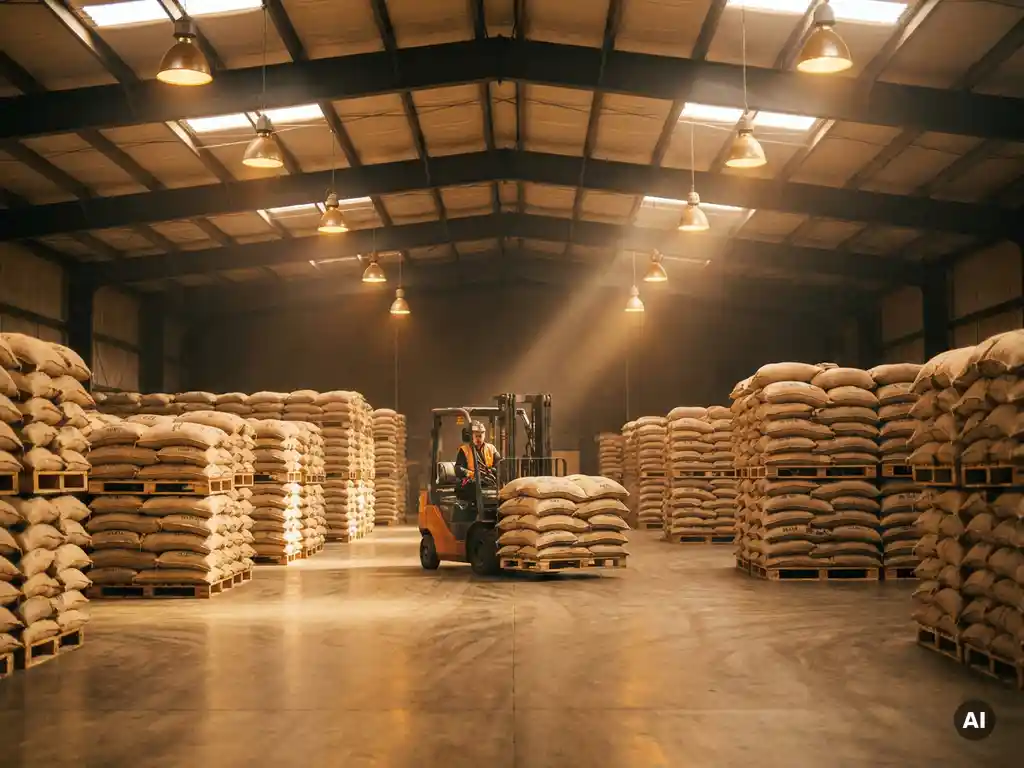
You select a suitable storage partner for dry food products based on four criteria: the right storage conditions, demonstrable certifications, sufficient capacity, and a logistically favorable location. For companies in the food industry, making the wrong choice is costly, as loss of quality or non-compliance can have direct consequences for food safety and supply chain continuity. The questions below will help you make the right assessment step by step.
Which storage conditions are essential for dry food products?
The essential storage conditions for dry food products are a stable temperature (typically between 10 and 18 degrees Celsius), a relative humidity below 65%, good ventilation, and protection against pests and foreign odors. These conditions prevent mold formation, moisture damage, and loss of quality in products such as nuts, peanuts, seeds, and dried fruits.
In addition to the basic parameters, the layout of the warehouse and working methods also play a role. Pallets must never be placed directly on the floor to allow for air circulation under the load. Products must be separated from non-food goods and materials that emit odors. Good lighting and hygienic maintenance of the floor and walls are also part of the storage conditions that serious partners guarantee as standard.
For products such as nuts and peanuts, the CO2 concentration in the storage area is also relevant, because an increased concentration slows down oxidation and extends shelf life. This requires a warehouse with actively managed ventilation, not simply a dry shed.
What is the difference between dry storage and refrigerated storage?
Dry storage, also known as ambient storage, is intended for products that do not require active cooling but do require a controlled ambient temperature. Refrigerated storage actively keeps products at a lower temperature, often between 2 and 8 degrees Celsius, and is suitable for fresh, perishable goods. The fundamental difference lies in energy consumption, infrastructure, and the types of products for which they are designed.
For dry food products such as nuts, seeds, and dried fruits, refrigerated storage is in most cases not only unnecessary but can even be harmful. Condensation upon leaving a cold storage room damages packaging and can promote mold growth. A well-designed dry warehouse offers the right environmental conditions without the disadvantages of active cooling.
Some storage partners offer both facilities at a single location. This can be logistically advantageous if your assortment includes both fresh and dry products, as you then work with one partner for the entire flow of goods.
What should you look out for when certifying a storage partner?
When certifying a storage partner for food products, BRC (British Retail Consortium) and SKAL are the most relevant labels. BRC is the international standard for food safety and is required by virtually all European retailers and major buyers. SKAL is relevant if you store organic products and wish to maintain their organic status during storage and handling.
Pay attention to the following when assessing certifications:
- Validity: Is the certificate current and issued by a recognized body?
- Scope: Does the certificate also cover the specific activities you outsource, such as pallet storage, handling, and forwarding?
- Audit frequency: How often is the partner audited and are the reports transparent?
- Additional requirements: Some customers or supermarket chains impose additional requirements on top of the standard certification. Check whether the partner can meet these.
Certifications are not a guarantee in themselves, but they demonstrate that a partner invests structurally in quality assurance and is willing to allow external audits. In most cases, a partner without relevant certification is not a serious option for food companies.
How much storage capacity does a reliable dry warehouse need?
A reliable dry warehouse for the food industry has sufficient capacity to handle peak volumes without compromising storage conditions or lead times. As a rule of thumb, a partner should be able to offer at least 20 to 30 percent reserve capacity above the average expected volume, so that seasonal peaks or unexpected supply do not cause operational problems.
In addition to the total number of pallet spaces, the layout and flexibility of the warehouse are also important. Separate areas for different product categories, such as nuts versus seeds, prevent cross-contamination of odors and enable more efficient traceability. A warehouse that mixes everything on a single floor offers less control and higher risks.
Always ask a potential partner about the average utilization rate. A warehouse that is structurally occupied at 95 percent or more has little flexibility and cannot react quickly to unexpected deliveries. This poses a risk to the continuity of your supply chain.
How does the location of a warehouse affect logistics costs?
The location of a dry warehouse influences logistics costs through two factors: the distance to supply points (ports, distribution centers) and the distance to the final destination (processing plants or distributors). The shorter both distances, the lower the transport costs and the smaller the risk of quality loss during transport.
Warehouses in the immediate vicinity of seaports offer an additional advantage for import flows: transshipment from container to storage can take place without intermediate road transport, saving both costs and handling. This is particularly relevant for dry food products imported in large volumes by container from non-European countries.
In addition to transport costs, the availability of customs facilities also plays a role. A warehouse that facilitates customs clearance at or near the location significantly shortens lead times and prevents unnecessary storage costs in the port itself.
What questions should you ask a potential storage partner?
Before signing a contract with a logistics partner for pallet storage of food products, it is wise to have a structured conversation. The answers will give you immediate insight into the professionalism and suitability of the partner.
- Which certifications are active and when was the last audit conducted? This demonstrates whether the partner takes food safety seriously.
- How are temperature and humidity monitored and recorded? Continuous monitoring and demonstrable logging are a basic requirement.
- How is the traceability of my goods handled? You need to know where a specific batch is located at all times.
- What is the average occupancy rate and how is peak capacity handled? This provides insight into operational flexibility.
- What procedures apply in the event of deviations in storage conditions? A serious partner has an established protocol for these types of situations.
- How is the separation between different product categories ensured? Relevant for cross-contamination and traceability.
A partner who can provide clear and documented answers to these questions demonstrates that the operation is professionally organized. Vague or evasive answers are a warning sign.
How ZZColdstores helps with the storage of dry food products
ZZColdstores offers B2B storage solutions for dry food products from locations in Kruiningen and Vlissingen. The company has been active since 1994 and has certified facilities for products such as nuts, peanuts, and seeds. What distinguishes ZZColdstores as a logistics partner for the food industry:
- A dry storage warehouse with a capacity of 12,000 pallet spaces, with separate areas per product category
- Certifications including BRC, SKAL, and Demeter, relevant for both conventional and organic products
- Located directly on the port of Vlissingen, with its own quay for fast transshipment and minimal transport time
- Flexible approach that adapts to ship sailing schedules and client wishes
- Possibility of combined refrigerated and dry storage at one location
Would you like to know if ZZColdstores is the right partner for your storage needs? View the ambient warehousingfacilities or contact us directly to discuss the possibilities.
Author: Frans van der Maas, Operations Director ZZColdstores
Frequently Asked Questions
How long does it take on average to select a storage partner and be operational?
The selection process for a suitable storage partner takes an average of two to six weeks, depending on the complexity of your product requirements and the number of parties you compare. After signing the contract and setting up the administrative processes—such as traceability systems and EDI connections—you can usually be operational within one to two weeks. Plan this process well in advance of a seasonal peak or a new import flow to avoid making a suboptimal choice under time pressure.
What are the most common mistakes companies make when choosing a dry storage partner?
The most common mistake is selecting a partner based purely on the lowest price per pallet space, without taking total logistics costs and risks into account. Other common errors include failing to verify the actual scope of certifications, ignoring warehouse occupancy rates, and not sufficiently questioning protocols regarding deviations. A cheap storage location that does not meet your quality requirements can ultimately lead to product loss, rejected batches, or problems with customers — costs that are many times the savings on storage rates.
How do I know if a storage partner is also suitable for my organic products?
For the storage of organic products, SKAL certification of the storage partner is a strict requirement; without this certificate, your product officially loses its organic status as soon as it enters the location. Additionally, verify whether the partner can guarantee physical separation between organic and conventional products, and whether this is demonstrably documented in the records. Explicitly ask about the procedures regarding cross-contamination and how the partner handles the combined storage of organic and non-organic streams.
As an importer, can I also expect customs-related services from a dry storage partner?
Not all warehousing partners offer customs services, but locations situated directly at or adjacent to a seaport often facilitate this through partnerships with recognized customs brokers or possess their own Customs Warehouse status. This makes it possible to store goods without paying immediate import duties until the consignment is actually released into free circulation — a financial advantage for large import volumes. When considering a partner, explicitly ask about the location's customs status and the procedures that apply to clearance and release.
How is the quality of my products monitored during storage?
A professional storage partner utilizes continuous monitoring of temperature and relative humidity via automated sensors, the data of which is logged and reported periodically. In addition to climate monitoring, regular visual inspections of the stored batches and a pest control program are also part of standard procedures. Ask a potential partner about the frequency of reports and whether you, as the client, receive real-time or periodic access to the measurement data — transparency in this regard is a strong indicator of a professional operation.
What happens if my storage needs fluctuate significantly due to seasonal peaks?
Seasonal fluctuations are very common in the dry food industry, for example during the harvest of nuts or seeds. A reliable storage partner takes this into account structurally by keeping reserve capacity available and offering flexible contract forms, such as rates based on actual pallet spaces used rather than fixed volumes. During contract negotiations, explicitly discuss how peak demand is handled, what lead times apply to additional deliveries, and whether there is a maximum limit on the volume that can be stored at short notice.
Is it wise to use multiple storage partners simultaneously, or is one partner preferred?
For smaller volumes or a limited assortment, one specialized partner is generally more efficient and easier to manage. For larger volumes or geographically dispersed distribution, spreading across two locations can mitigate risk, for example, to avoid a complete shutdown in the event of emergencies or capacity problems at a single partner. Weigh the operational simplification of a single partner against the continuity benefits of diversification, and in both cases, establish clear SLAs (Service Level Agreements) regarding capacity, lead times, and quality management.
Related articles
- What activities can a warehouse perform for an importer?
- What role does warehousing play between the port and the customer?
- How does the transit of dry goods to Germany or Ukraine work?
- How does customs clearance for nuts from China or Vietnam work?
- How do you recognize insect infestation in stored nuts or garlic?