
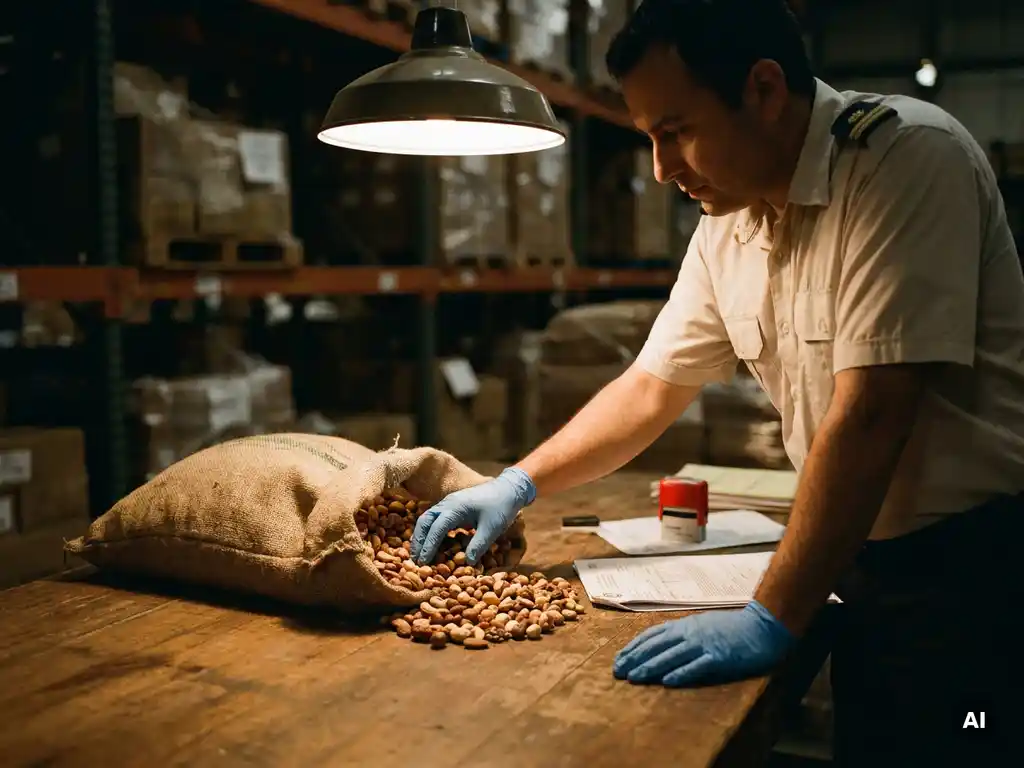
The most common errors when importing nuts from third countries are incomplete or incorrect documentation, inadequate storage during transport, and failure to comply with European Union phytosanitary and customs requirements. These errors regularly lead to rejection at the border, delays in the supply chain, and financial losses for importers and logistics partners. This article answers the most frequently asked questions regarding nut imports, from import regulations to choosing the right storage facility.
What import rules apply to nuts from third countries?
Strict import rules regarding food safety, phytosanitary requirements, and customs procedures apply to the import of nuts from third countries into the European Union. Every consignment must be accompanied by a phytosanitary certificate, comply with the maximum residue limits for plant protection products, and be notified to the competent authorities for an official import inspection.
In the Netherlands, the NVWA (Netherlands Food and Consumer Product Safety Authority) is the supervisory body. For the import inspection of nuts, it collaborates with the KCB (Quality Control Bureau), which carries out inspections regarding quality and phytosanitary requirements. Nuts originating from countries with an increased risk of certain pests or contaminants may be subject to additional checks or increased inspection frequencies. The EU Regulation on Official Controls (Regulation 2017/625) forms the legal basis for these border controls.
Importers must also comply with EU rules regarding mycotoxins, particularly aflatoxins, which can occur in certain nuts such as peanuts and pistachios. Exceeding the permitted standards almost always leads to the refusal of the shipment.
Why are nuts from third countries so often rejected at the border?
Nuts from third countries are rejected at the EU border due to exceeding mycotoxin limits, the lack of valid phytosanitary certificates, or the presence of quarantine pests. Aflatoxin contamination is the most common reason for rejection and particularly affects shipments from tropical and subtropical regions.
Other common grounds for rejection are:
- Insufficient dryness upon arrival, resulting in mold formation during transport
- Presence of insects or insect remains indicating inadequate handling before shipment
- Exceeding pesticide residue limits
- Incorrect or missing labeling and documentation of origin
- Temperature fluctuations during transport that affected product quality
The European Commission regularly publishes RASFF (Rapid Alert System for Food and Feed) notifications regarding refused consignments. Nuts consistently rank among the top product categories with the most notifications, indicating how critical correct handling and documentation are.
What are the dangers of improper storage during transport and transit?
Improper storage during transport and transit of nuts leads to loss of quality, mold formation, and mycotoxin development. Nuts are hygroscopic: they absorb moisture from the environment. As soon as humidity rises too high or temperature fluctuates, the risk of spoilage and contamination increases significantly.
The risks associated with inadequate storage are concrete and costly. Mold formation due to excessive humidity can render an entire container unfit for consumption. Condensation caused by temperature fluctuations, for example when a refrigerated container is suddenly placed in a warm environment, causes moisture to accumulate inside the packaging. This accelerates the growth of Aspergillus molds, the producers of aflatoxins.
During transit via intermediate ports, the risk is particularly high if containers remain at a terminal for an extended period without climate control. The longer nuts are exposed to fluctuating conditions, the greater the chance that the shipment will no longer meet standards upon arrival in the EU. Rapid transshipment and immediate placement in a controlled storage facility upon arrival are therefore not a luxury, but a necessity.
How does the choice of storage facility affect the quality of imported nuts?
The choice of storage facility has a direct impact on the quality of imported nuts. Nuts require dry storage with stable temperature and humidity. A facility without adequate climate control increases the risk of mycotoxin contamination, weight loss, and flavor deterioration, which directly affects the sales value of the shipment.
A suitable storage facility for nuts is characterized by constant, low relative humidity, good ventilation, and a stable temperature. Nuts such as peanuts, cashews, and walnuts each have their own optimal storage conditions, but they all share the commonality that moisture is their greatest enemy. Facilities designed for dry storage of food products provide the right infrastructure to keep nuts in optimal condition.
In addition to the technical specifications, the location of the facility also plays a role. Storage close to the port of arrival shortens the time between unloading and controlled storage, which reduces the risk of quality deterioration. Every additional link in the logistics chain that exposes nuts to uncontrolled conditions is a potential risk moment.
Which documentation errors cause the most delays in nut import?
Most delays in the import of nuts are caused by missing or incorrect phytosanitary certificates, errors in customs declarations, and discrepancies between the paperwork and the physical shipment. Even minor administrative errors can lead to detained containers and significant costs.
Listed the most common documentation errors:
- Invalid or expired phytosanitary certificate that does not correspond to the actual consignment or was issued by a non-recognized authority
- Incorrect HS code in the customs declaration, resulting in the shipment being cleared under an incorrect tariff heading.
- Missing certificate of origin, which is required for preferential tariff treatment or specific import arrangements
- Discrepancy in weight or quantity between the bill of lading, the packing list, and the actual cargo
- Missing certificates of analysis for mycotoxins or pesticides, particularly mandatory for shipments from high-risk countries
- Incorrect description of the goods, for example failure to state the processing status (raw, roasted, salted)
Prevention begins with a thorough pre-shipment check in which all documents are verified before the shipment departs. An experienced customs broker or logistics partner familiar with EU import requirements for nuts can prevent many of these errors.
When is a customs warehouse or temporary storage mandatory for nut imports?
A customs warehouse or temporary storage is mandatory when nuts enter the EU but have not yet been released for free circulation, for example because customs formalities have not yet been completed or the import inspection still needs to take place. As long as goods have not been cleared, they may not be moved to a regular storage location.
Temporary storage in the EU is legally limited to a maximum of 90 days for sea freight. Within this period, goods must be declared for a customs procedure, such as import for free circulation, inward processing, or placement in a customs warehouse. If this period is exceeded, customs may seize the goods or have them destroyed.
For importers wishing to import nuts but who do not yet have a definitive buyer, placement in a bonded warehouse offers advantages: customs duties and VAT are only paid at the moment of actual import for free circulation. This provides greater financial flexibility, but does require a recognized warehouse keeper and proper administration of the stored goods.
How do you avoid the most common mistakes when importing nuts?
You can prevent the most common mistakes in nut import by starting documentation preparation early in the import process, working with certified logistics partners, and ensuring immediate placement in a suitable storage facility upon arrival. A structured approach from pre-shipment to storage significantly reduces the risk of rejection, delays, and loss of quality.
Practical measures that make a difference include timely application for and verification of all required certificates, engaging a customs broker with knowledge of food imports, and choosing a storage partner that possesses the right facilities and certifications for dry food storage. Quality certifications such as BRC provide insight into the level of quality assurance at a storage partner.
In addition, it is advisable to screen the origin of the nuts for known risk profiles. Shipments from countries that regularly appear in RASFF notifications require extra attention during supplier selection and documentation preparation.
How ZZColdstores helps with the import of nuts
As a B2B logistics partner, ZZColdstores offers a complete solution for importers and supply chain managers bringing nuts from third countries to the EU. From the locations in Kruiningen and Vlissingen, shipments are handled quickly and carefully, from unloading to certified storage.
- Climate-controlled dry storage in a warehouse with 12,000 pallet spaces, specifically designed for nuts, peanuts, seeds, and other dry food products.
- Import inspection via KCB (part of the NVWA), so that phytosanitary controls are handled efficiently.
- Customs clearance as part of the logistics process, minimizing documentation errors and delays.
- BRC and SKAL certifications as proof of guaranteed quality standards for food storage
- Own quay in Vlissingen for direct transshipment from ship to controlled storage, without unnecessary intermediate exposure.
Would you like to know more about the possibilities for dry storage of nuts or other food products? Contact ZZColdstores for a no-obligation consultation about your specific situation.
Frequently Asked Questions
How long does an average import inspection of nuts take at the EU border?
The turnaround time for an import inspection varies depending on the country of origin, the type of nut, and the risk category assigned to it by the EU. For shipments from low-risk countries, an inspection can be completed within one to two working days, whereas shipments from high-risk countries or shipments requiring additional laboratory analyses can take several days to weeks. It is advisable to always factor in a buffer for inspection turnaround times when planning your supply chain, especially for shipments from countries that frequently appear in RASFF notifications.
What are the optimal storage conditions for the most imported nut varieties?
The exact storage conditions vary by nut type, but as a general guideline, a relative humidity of no more than 60-65% and a temperature between 10 and 18 degrees Celsius apply to most dry nuts. Peanuts are particularly sensitive to humidity and require a strictly controlled environment to prevent aflatoxin formation, while walnuts and cashews are also susceptible to oxidation and are therefore preferably stored in an environment with limited exposure to light and oxygen. Always ask your storage partner about the specific conditions maintained for your nut type.
What should I do if my shipment of nuts is held up at the border?
If your shipment is detained, you will receive an official notification from the competent authority stating the reason for refusal or detention. Depending on the reason, there are usually three options: returning the shipment to the country of origin, destroying the shipment, or — in certain cases — having the shipment reprocessed or re-sampled if regulations permit. Immediately engage a customs broker and legal advisor experienced in EU food legislation to ensure you act quickly and correctly and limit further costs.
Is it possible to store nuts in a bonded warehouse first and only decide later to which EU country they will be imported?
Yes, a bonded warehouse offers exactly this flexibility: as long as the nuts are stored in the warehouse, they have not yet been formally imported into the EU and no customs duties or VAT are levied. This makes it possible to determine the final destination and the timing of import based on market demand or price developments. However, it is required that the warehouse is recognized by the customs authorities and that proper records are kept of all goods received and received.
Which certifications should I check when choosing a storage partner for nuts?
When choosing a storage partner for nuts, BRC (British Retail Consortium) and FSSC 22000 are the most relevant quality certifications for food safety in dry storage. BRC indicates that the facility meets international standards for hygiene, quality control, and traceability, while SKAL certification is relevant if you also import organic nuts. Additionally, check whether the partner holds recognition as a bonded warehouse and whether the NVWA or KCB conducts inspections from the location, as this significantly simplifies import inspections.
How can I, as an importer, verify whether my supplier is reliable in terms of quality and documentation?
A reliable supplier possesses current export certifications, a track record without recent RASFF notifications, and is willing to provide pre-shipment analysis reports for mycotoxins and pesticides. You can consult the European Commission's RASFF database to check whether a specific country of origin or supplier has previously been involved in refused shipments. Also consider having an independent pre-shipment inspection carried out by a recognized inspection agency in the country of origin to ensure that the shipment meets EU requirements before departure.
What additional measures are advisable when importing nuts from countries with a high RASFF risk profile?
For shipments from countries with an elevated risk profile, it is advisable to always have additional laboratory analyses performed before shipment, in addition to the standard documentation requirements. Furthermore, choose a shipping route with as few intermediate stops and the shortest transit times as possible, and ensure that the storage facility in the country of origin is certified and has demonstrable climate control. By proactively including extra analysis certificates with the shipment, you immediately give the inspecting authorities at the EU border confidence that the shipment has been carefully prepared, which increases the likelihood of expedited processing.
Related articles
- Which food products require cold storage?
- What is the difference between ambient storage and room temperature storage?
- What is the difference between a bonded warehouse and a regular warehouse?
- How does ambient storage for nuts and dried fruit work?
- What are the risks of larvae and insects when storing dried fruit?