
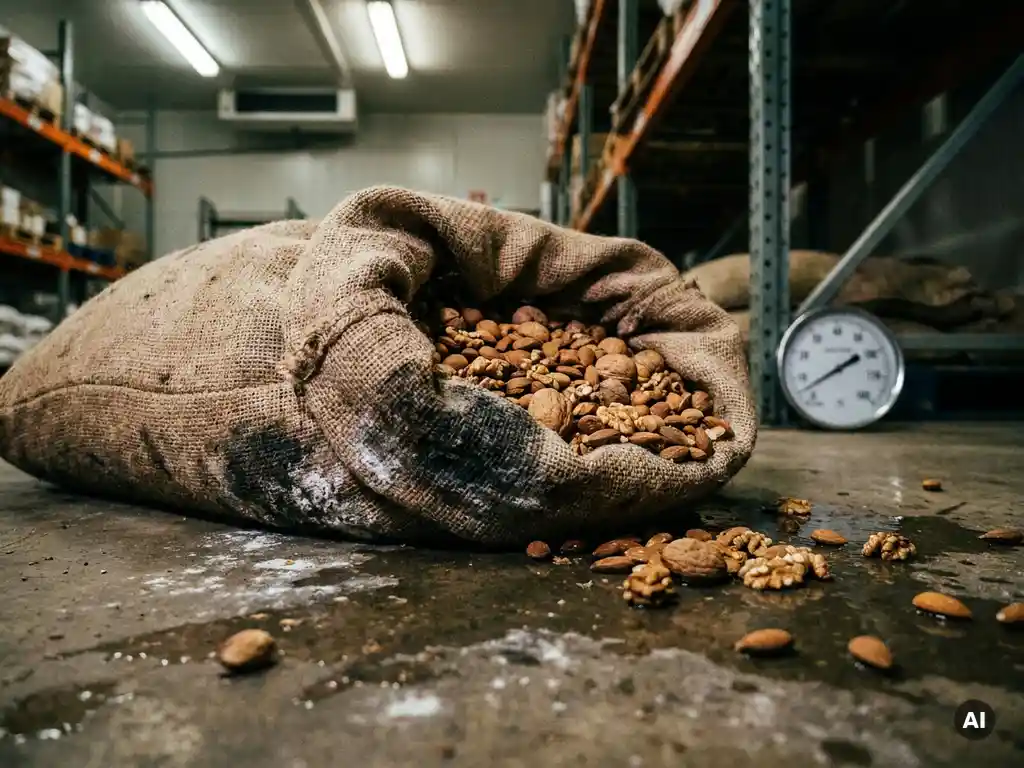
Yes, poor storage of nuts can directly lead to rejection during import inspection. When nuts are stored under incorrect temperature or humidity conditions, mold growth and dangerous mycotoxins such as aflatoxins can develop. Importers and logistics partners responsible for nut storage would do well to thoroughly understand the legal requirements and practical risks.
This article answers the most frequently asked questions about storage conditions, inspection processes, and documentation regarding the import inspection of nuts.
What storage conditions are mandatory for nuts upon import?
Strict requirements regarding temperature, humidity, and ventilation apply to the import of nuts. European regulations stipulate that nuts must be stored at a relative humidity of no more than 60 to 70 percent, depending on the type of nut, and at a temperature that prevents mold formation. Dry storage in a controlled environment is the standard in this regard.
The exact requirements depend on the product and the country of origin, but in general, the following storage conditions apply as a minimum:
- Dry environment with a relative humidity below 65 percent
- Stable temperature, usually between 10 and 20 degrees Celsius
- Sufficient air circulation to prevent moisture buildup
- Protection against direct sunlight and heat sources
- Separation from other goods that may emit odor or moisture
These requirements apply not only to final storage but also to the period between unloading and inspection. Nuts exposed to excessive humidity during transport or temporary storage are already at risk of contamination before the import inspection takes place.
How does poor storage cause rejections during import inspections?
Poor storage conditions lead to a loss of quality that is immediately visible or measurable during import inspection. When nuts are stored in an environment that is too humid or too warm, ideal conditions for mold growth arise. Molds produce mycotoxins, of which aflatoxins are the best known and most feared. Batches in which the standards for these substances are exceeded are rejected.
In addition to microbiological contamination, poor storage can also lead to:
Visible damage such as mold spots, discoloration, or rancid-smelling nuts, which are already marked upon visual inspection.
Elevated moisture levels in the product itself, which are revealed by laboratory analysis and assessed as a risk factor.
Cross-contamination when nuts are stored together with other products that can transfer moisture or mold spores.
Import inspections in the Netherlands are carried out by the NVWA and the KCB. They apply European standards for maximum levels of aflatoxins and other undesirable substances. A consignment showing signs of improper storage upon arrival is examined more closely and runs an increased risk of rejection.
What are aflatoxins and why are they decisive in inspections?
Aflatoxins are toxic substances produced by certain mold species, particularly Aspergillus flavus and Aspergillus parasiticus. They occur in nuts, peanuts, and seeds when they are stored under humid and warm conditions. Aflatoxins are heat-resistant, which means they remain present even after the product has been processed. Therefore, they are one of the most strictly controlled contaminants during import inspections of nuts.
The European Union applies maximum limits for aflatoxins in foodstuffs. For nuts intended for direct human consumption, a maximum level of 4 micrograms per kilogram applies to aflatoxin B1 and 10 micrograms per kilogram to total aflatoxins. Batches exceeding these limits are refused and may not enter the EU market.
The danger of aflatoxins is that they do not always manifest as visible mold growth. A batch of nuts may look visually acceptable but still contain excessively high levels of aflatoxins. Laboratory analysis is therefore a standard part of import controls for high-risk products and countries of origin.
What happens to a batch of nuts after rejection?
When a batch of nuts is rejected during import inspection, there are in principle three outcomes: the batch is destroyed, returned to the country of origin, or diverted to an application for which the standards are less strict, such as industrial use. The importer is responsible for the costs of all subsequent actions and is not entitled to compensation from the government.
Disapproval also has consequences that extend beyond the direct party:
- The importer is registered as a high-risk company, which leads to more intensive checks on future shipments.
- The country of origin can be placed on the European enhanced control list, resulting in all shipments from that country being checked more frequently.
- Reputational damage among buyers and trading partners can be significant, especially when disapproval becomes public via the European Commission's RASFF system.
- Contractual obligations towards customers are not being met, which can lead to fines or the loss of customers.
Consequently, the financial and commercial consequences of a rejection are often much greater than the value of the rejected batch itself.
How do you prevent rejection through proper storage conditions?
Rejection during import inspections of nuts can in most cases be prevented by consistently maintaining controlled storage conditions throughout the entire chain. The key lies in monitoring humidity, temperature, and ventilation, both during transport and in temporary storage prior to inspection.
Practical measures that significantly reduce the risk of quality loss and rejection:
- Use only dry, ventilated storage spaces with humidity and temperature monitoring
- Minimize the time between unloading and storage in temperature-controlled rooms
- Ensure proper pallet arrangement so that air can circulate freely around the load
- Check the condition of the packaging upon receipt and take samples immediately if in doubt
- Work with certified storage locations that demonstrably comply with BRC or similar standards
- Continuously document the storage conditions so that you can demonstrate during an inspection that the cargo has been handled correctly
It is also wise to take the origin of the nuts into account during the purchasing phase. Batches from countries on the European enhanced surveillance list are subject to more intensive checks upon arrival. A well-documented storage history can make all the difference in that case.
Which documents are required to demonstrate storage quality upon import?
During the import inspection of nuts, the importer must be able to demonstrate that the consignment has been stored and handled correctly. Without the proper documentation, it is virtually impossible to have a batch exempted from additional examination. The burden of proof lies with the importer.
The most relevant documents are:
- Certificates of origin confirming the origin of the nuts
- Phytosanitary certificates issued by the competent authority in the country of origin
- Temperature and humidity logs of the storage location, preferably digital and continuously maintained
- Laboratory analyses for aflatoxins and other mycotoxins, performed before shipment or upon arrival
- Storage certificates for the facility used, such as a BRC certificate
- Transport documents showing the transit time and conditions during transport
The KCB and the NVWA may request additional documentation in case of doubt. Anyone unable to provide this information risks delays, additional sampling, or immediate rejection of the batch. Completeness and accuracy of the records are therefore just as important as the physical storage conditions themselves.
How ZZColdstores helps with the safe storage of nuts
ZZColdstores has a dry storage warehouse with a capacity of 12,000 pallet spaces, specifically designed for the storage of nuts, peanuts, and seeds. The facility meets the requirements of BRC, SKAL, and Demeter, and offers the controlled conditions necessary to prevent quality loss and rejection. More information about the options for dry storage of nuts is available on the ambient warehousing page of the website.
For importers, wholesalers, and supply chain managers who want certainty regarding the storage quality of their nuts, ZZColdstores offers:
- Certified dry storage with continuous monitoring of humidity and temperature
- Separate rooms for nuts, peanuts, and seeds to prevent cross-contamination
- Support with import inspections via the KCB, part of the NVWA
- Flexible storage tailored to your shipment arrival schedule
- Complete documentation of storage conditions to support your inspection process
Would you like to know how ZZColdstores correctly stores your nuts and prepares them for a smooth import inspection? Contact us for a no-obligation discussion about the possibilities.
Frequently Asked Questions
How far in advance do I need to submit my storage documentation for the import inspection?
There is no fixed statutory deadline for submitting documentation, but it is strongly recommended to have all relevant documents—such as temperature logs, laboratory analyses, and phytosanitary certificates—available upon arrival of the shipment. The NVWA and the KCB may request documentation immediately upon arrival, and delays in submitting this can lead to additional sampling or an extension of the inspection time. Therefore, ensure that your records are complete before the cargo reaches the port.
What should I do if I have doubts about the storage quality of a batch of nuts that is in transit?
In case of doubt, contact your logistics partner or storage facility as soon as possible to assess the current condition of the cargo. Upon arrival, have a sample analysis performed immediately for aflatoxins and moisture content, before the official import inspection. By acting proactively, you can make an informed decision about whether or not to forward the consignment for inspection, and avoid unpleasant surprises.
Are there specific types of nuts that run a higher risk of rejection than others?
Yes, peanuts, pistachios, and Brazil nuts are considered high-risk products due to their higher susceptibility to aflatoxin contamination, partly because of the conditions under which they are grown and stored in the countries of origin. Consequently, stricter control requirements apply to these products in the EU, and shipments are sampled more frequently and intensively. Importers of these types of nuts would do well to pay extra attention to the storage history and to have laboratory analyses performed prior to shipment.
Can I have a rejected batch of nuts re-inspected after additional treatment?
In principle, re-inspection is possible, but only if the reason for rejection is correctable — such as an administrative deficiency or a moisture content exceeding the limit that has been reduced after drying. In the event of exceedance of aflatoxin standards, re-inspection for human consumption is generally not possible, as aflatoxins cannot be removed by drying or other standard treatments. In that case, the importer must choose between destruction, return, or diversion for industrial use, always under the supervision of the competent authority.
How do I know if the country of origin of my nuts is on the European enhanced surveillance list?
The European Commission regularly publishes and updates the list of countries and products subject to enhanced import controls, which can be found in the annexes to EU Implementing Regulation 2019/1793. It is advisable to consult this list before every purchase so that you can take additional measures in a timely manner, such as having a pre-shipment analysis performed. Your importer, customs broker, or warehousing partner can also advise you on this based on current regulations.
What minimum certification must a storage facility have for the storage of nuts intended for the EU market?
For the storage of nuts intended for human consumption on the EU market, BRC (British Retail Consortium) certification is the most recognized and sought-after standard in the sector. Additionally, depending on your customers, certifications such as IFS Food, FSSC 22000, or organic certifications such as SKAL may be required. A certified storage facility not only offers demonstrable quality assurance but also strengthens your position during import inspections, as storage conditions are objectively documented and audited.
How often should the humidity and temperature be recorded in a nut storage area?
The best practice within the sector is continuous digital recording of humidity and temperature, whereby measurements are captured at least every hour and automatically stored in a system that cannot be manually modified. This provides a reliable and verifiable storage history that can be presented during the import inspection. Manual recording is insufficient in most cases, as gaps in the data or irregular measurement times can raise doubts with the inspection authority.