Ukrainian buyers choose storage via Dutch ports because the Netherlands is one of Europe's best-connected logistics hubs, with direct access to key European markets via road, rail, and inland waterways. For companies importing or exporting food products to Ukraine, ports such as Vlissingen and Rotterdam offer a combination of rapid transshipment, professional storage facilities, and efficient customs clearance that is hard to match elsewhere in Europe. This article answers the most frequently asked questions about how this logistics route works in practice.
What advantages do Dutch ports offer Ukrainian importers?
Dutch ports offer Ukrainian importers a combination of geographical location, excellent infrastructure, and specialized warehousing services that simplify the entire logistics chain. The Rotterdam-Antwerp corridor is the largest distribution center in Europe and serves as a natural transit point for goods shipped from overseas markets to Ukraine or vice versa.
The benefits for Ukrainian importers are concrete:
- Direct maritime connections with Latin America, Africa, and Asia, enabling the efficient arrival of exotic fruits, nuts, and other agri-food products.
- Multimodal transport via road, rail, and inland waterways towards Ukraine and Central Europe
- Specialized storage facilities for both refrigerated and dry products, available directly at the port.
- Consolidated customs clearance for EU imports, which reduces administrative burdens
- Flexible storage capacity that adapts to the sailing schedules of seagoing vessels
For Ukrainian companies trading in food products, the proximity of Germany as the largest European market is an additional argument. Goods cleared through the Netherlands can be forwarded from the same storage location to both Germany and Ukraine, which limits logistical costs and lead times.
How does customs clearance for Ukrainian goods work in the Netherlands?
Goods imported from non-EU countries such as Ukraine via Dutch ports undergo a standardized EU customs procedure. Upon arrival, the products are declared to Dutch Customs, after which import duties and VAT are calculated based on the commodity code and the origin of the product.
For food products, the KCB, part of the NVWA, additionally handles the import inspection. This is mandatory for fresh products such as fruit and vegetables entering the EU market. After approval, the goods are freely tradable throughout the entire European Union, which significantly simplifies the flow to other EU countries.
A logistics partner that combines both warehousing and customs clearance at a single location significantly shortens lead times. Goods do not need to be moved between different service providers, which limits the risk of delays and loss of quality.
What is the difference between cold storage and dry storage for agri-food products?
Cold storage and dry storage are two fundamentally different storage methods, each tailored to specific product categories and their storage requirements. The choice between the two has a direct impact on the shelf life, quality, and cost of the stored goods.
Cold storage for fresh and perishable products
Cold storage, also known as climate- controlled storage , is intended for fresh and perishable products that require precise temperature and humidity control. Examples include bananas, citrus fruits, and other exotic products that spoil quickly at temperatures that are too low or too high. In cold storage, temperature, humidity, and air circulation are continuously monitored and adjusted.
Dry storage for non-perishable food products
Dry storage, also known as ambient storage or dry port storage, is suitable for products that do not require active cooling but do require a stable, dry, and clean environment. Examples include nuts, peanuts, seeds, grains, flakes, and dried fruit. The storage temperature is typically around 11 degrees Celsius, which prevents loss of quality due to moisture or temperature fluctuations without the cost of full refrigeration. More information about this form of storage can be found on the page about dry storage in the Netherlands.
For Ukrainian buyers trading in a wide range of agri-food products, it is practical to work with a partner who offers both types of storage at the same location. This allows mixed shipments to be handled efficiently without intermediate transfers.
Which certifications are required for the storage of food products in the Netherlands?
Strict quality and food safety requirements apply to the storage of food products in the Netherlands. Storage companies working with importers and exporters of agri-food products must possess recognized certifications demonstrating compliance with international standards for food safety and quality assurance.
The most relevant certifications for the storage of food products in the Netherlands are:
- BRC (British Retail Consortium), an internationally recognized standard for food safety required by many European supermarkets and purchasing organizations
- SKAL, the Dutch certification body for organic products; mandatory for companies that store or process certified organic goods
- Demeter, a supplementary certification for biodynamic products, a step further than regular organic standards
- KCB/NVWA approval, required for import inspection of fresh fruit and vegetables upon import into the EU
For Ukrainian importers supplying European supermarkets or processing plants, BRC certification of the storage location is often a strict requirement. Its absence can mean that goods are not accepted by the end customer, regardless of the quality of the product itself.
How quickly can goods be stored and forwarded from the port?
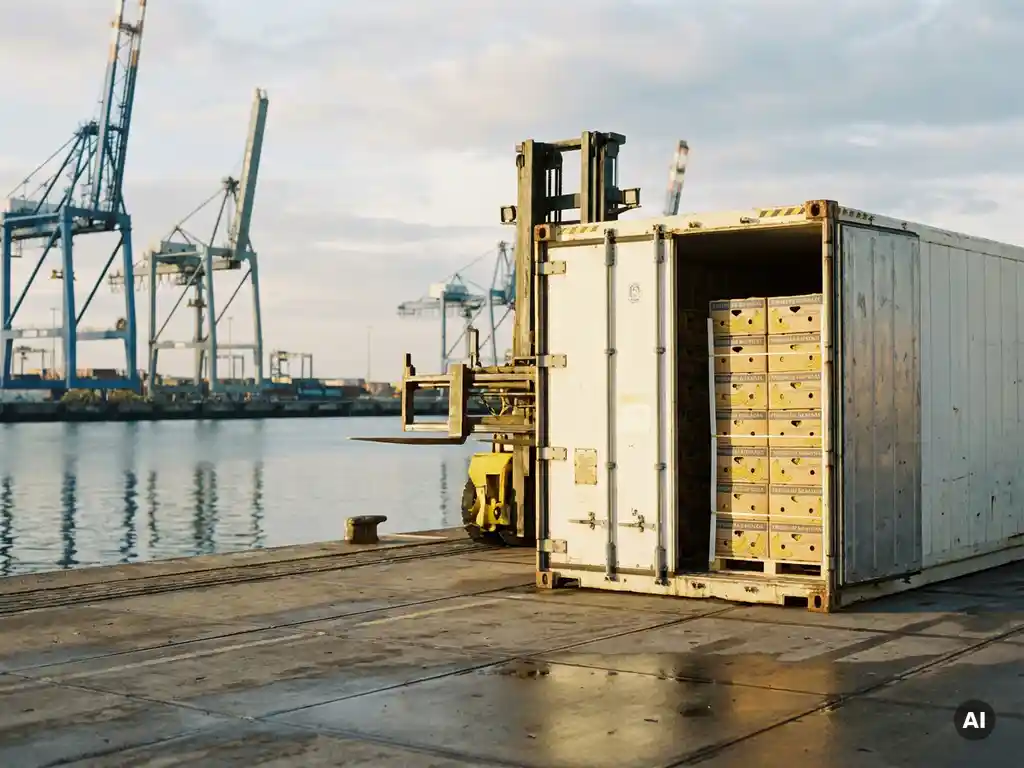
The speed at which goods are stored and forwarded from the port depends on the distance between the quay and the storage location, the availability of capacity, and the efficiency of the inbound process. At a storage location with its own quay directly adjacent to the cold storage facility, goods can be placed in storage within minutes of unloading, which minimizes quality loss due to unnecessary exposure to external conditions.
After storage, goods are typically forwarded based on orders from the end customer. With an integrated approach, this process unfolds as follows: upon arrival, goods are checked for quality, immediately sorted, and repalletized if necessary. They are then stored until the order is ready for shipment. EDI connections between the warehouse and the client's systems ensure automatic order processing and real-time inventory updates, significantly accelerating throughput.
For time-sensitive products such as fresh fruit, the combination of a dedicated quay, direct storage, and automated order processing is decisive for maintaining quality and meeting delivery times.
Which products do Ukrainian buyers typically store via Dutch ports?
Ukrainian buyers operating via Dutch ports typically store two categories of products: fresh agri-food products requiring refrigeration and dry, non-perishable products that benefit from a stable storage environment. The composition of the flow depends on the direction of trade, whether it is import into Ukraine or export from Ukraine to Western Europe.
Imports into Ukraine via Dutch ports often involve:
- Exotic fruits such as bananas and citrus fruits, originating from Latin America or Africa
- Nuts, peanuts and seeds for further processing or distribution
- Dried fruit and grains for the food industry
- Potato flakes and other processed agri-food products
When exporting from Ukraine to Western Europe, Dutch ports are used as transit points for Ukrainian agricultural products destined for European processing plants or supermarket chains. In both cases, the combination of cold and dry storage at a single location offers the flexibility required for a wide range of products.
How ZZColdstores helps with storage via Dutch ports
ZZColdstores offers importers, exporters, and logistics partners a fully integrated solution for storage and transshipment via the Port of Vlissingen. From its own quay in Vlissingen, goods are stored immediately after unloading in climate-controlled or dry storage areas, depending on the product. This shortens the supply chain and protects the quality of time-sensitive products.
What ZZColdstores specifically offers for Ukrainian customers and their logistics partners:
- Own quay in Vlissingen for direct transshipment of seagoing vessels to the cold storage facility
- Climate-controlled cold storage for fresh products such as exotic fruit, with 24/7 monitoring of temperature and humidity.
- Dry ambient storage for nuts, peanuts, seeds, and other non-perishable food products at approximately 11 degrees Celsius
- Quality control and import inspection via KCB/NVWA immediately upon arrival
- Certifications including BRC, SKAL, and Demeter for access to European supermarket chains
- Value Added Services such as repalletizing, labeling, barcode traceability, and EDI connections
- Flexible scheduling aligned with seagoing vessel sailing schedules
Contact ZZColdstores to discuss how your goods flow via Vlissingen can be organized. The team is happy to help determine the most efficient and cost-effective approach for your specific products and routes.
Frequently Asked Questions
What are the minimum storage volumes that Ukrainian importers can store at ZZColdstores or similar port facilities?
Most specialized storage companies at Dutch ports work with a minimum storage capacity per batch, but are generally flexible for importers just starting out on this route. It is advisable to contact the storage partner directly to discuss feasible volumes, including options for consolidated shipments where multiple smaller batches are combined. This way, medium-sized Ukrainian importers can also benefit from the advantages of port storage without having to commit to large volumes immediately.
How does the transport from Vlissingen or Rotterdam to Ukraine proceed after goods have been stored?
After storage in the port, goods are typically transported to Ukraine via road, rail, or a combination of both. Many logistics partners offer multimodal solutions where trucks pick up the goods at the storage location and drive to the Ukrainian destination via the fastest or most cost-efficient route. For larger volumes, rail transport via European corridors is an increasingly popular alternative, partly due to the lower cost per ton for larger shipments.
What happens if my goods do not pass the import inspection upon arrival at the port?
If goods are rejected during the KCB/NVWA import inspection, they are not admitted to the EU market and must be returned to the country of origin, destroyed, or diverted to a non-EU destination. To minimize this risk, it is essential to work in advance with reliable suppliers who comply with EU phytosanitary requirements and correctly provide the required export documentation. An experienced logistics partner in the port can advise you on the necessary documentation and certificates that must be arranged before shipment.
As a Ukrainian importer, can I also have products packaged or reprocessed during storage in the Netherlands?
Yes, many warehousing companies at Dutch ports offer so-called Value Added Services (VAS), such as repalletizing, reprocessing, labeling, quality sorting, and the application of barcodes for traceability. This is particularly valuable when products need to be converted from bulk packaging to retail packaging or when European customers impose specific labeling requirements. By having these operations performed directly at the storage location, you save an extra transport step and shorten the total lead time.
How can I, as an importer, maintain real-time insight into my stock stored in the Netherlands?
Modern warehousing companies at Dutch ports work with Warehouse Management Systems (WMS) that make real-time inventory data available to the client via EDI connections or an online portal. This means that you can see at any time how much of which product is stored, which orders have been processed, and what the expected execution date is. It is advisable to explicitly ask about available system integrations when selecting a warehousing partner, so that your own ERP or purchasing system can be seamlessly linked.
What are the most common mistakes Ukrainian importers make when setting up a storage route via Dutch ports?
A common mistake is underestimating the required documentation, such as phytosanitary certificates, certificates of origin, and the correct commodity codes for customs declarations, causing goods to be delayed at the border. Additionally, importers sometimes choose the cheapest storage option without considering the required certifications of the end customer, leading to cargo rejection. Finally, capacity planning around busy shipping schedules is frequently underestimated; reserving storage capacity in a timely manner and coordinating arrival times with the storage partner prevents unnecessary waiting times and loss of quality.
Is port storage in the Netherlands also interesting for Ukrainian exporters who want to reach European markets?
Absolutely. Dutch ports function not only as import points but also as strategic distribution hubs for Ukrainian exporters wishing to serve multiple European markets simultaneously. By storing goods centrally in the Netherlands, exporters can deliver from a single location to customers in Germany, Belgium, the United Kingdom, and other European countries, without having to set up a separate logistics solution for each country. This reduces total logistics costs and makes it easier to respond quickly to fluctuating demand from different markets.