
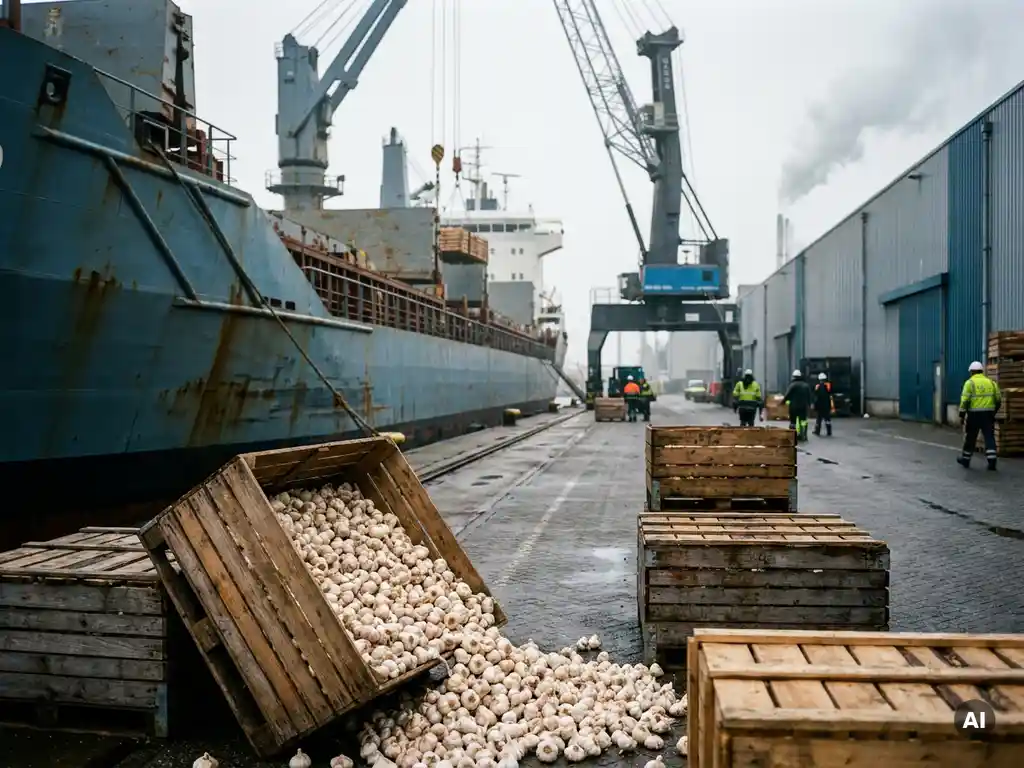
The supply of garlic from China to Europe takes place almost entirely via sea freight in refrigerated or dry containers, with Rotterdam and Antwerp as the main landing points. China is by far the largest producer and exporter of garlic in the world and supplies the vast majority of Europe's import needs. This article answers the most frequently asked questions regarding transport, customs procedures, storage, and risks in the supply chain.
Why does most garlic come from China?
China dominates the global garlic market because the country possesses ideal growing conditions, vast agricultural land, and low production costs. Estimates from international agricultural organizations consistently point to a Chinese market share of over eighty percent of global production. For European importers, Chinese garlic is therefore simply the most available and cost-effective option for large-scale production.
Cultivation is highly concentrated in provinces such as Shandong, Yunnan, and Jiangsu, where the climate and soil conditions are optimal for growing large, uniform bulbs. Furthermore, the Chinese government has supported the agricultural sector for years with investments in irrigation, mechanization, and export infrastructure, causing production capacity to far exceed that of competing countries such as Spain, Argentina, and Egypt.
For European buyers and wholesalers, the scale of the Chinese supply is decisive: the volumes required for supermarket chains or the processing industry are simply not available elsewhere on a comparable scale. This makes garlic imports from China a structural part of the European food chain.
Which European ports receive the most garlic from China?
Rotterdam and Antwerp are the two largest landing ports for garlic from China in Europe. As Europe's largest container port, Rotterdam handles a substantial share of all agricultural container cargo from Asia, while Antwerp holds a strong position due to its direct connections to the European hinterland via inland waterways and rail.
In addition to these two main ports, Hamburg, Le Havre, and Barcelona also play a role, particularly for distribution to Germany and Eastern Europe, France, and the Iberian Peninsula, respectively. The choice of a specific port depends on the final destination of the cargo, the availability of ship space, and the costs of inland transit.
For importers working with larger volumes or specific quality requirements, the location of the storage site relative to the port is a critical factor. The shorter the time between unloading and controlled storage, the better product quality is guaranteed.
How long does transport from China to Europe take by ship?
Sea freight transport from China to European ports typically takes between fifteen and thirty days, depending on the port of departure in China, the chosen route, and the number of stopovers. Direct services from Shanghai or Qingdao to Rotterdam average around twenty to twenty-five days.
Most container shipping companies sail via the Suez Canal, which is the traditional route for freight traffic between Asia and Northern Europe. Disruptions on this route, such as those in 2024 caused by tensions in the Red Sea, can significantly extend transit times because ships must detour via the Cape of Good Hope. This adds up to ten extra days to travel time and has direct consequences for the planning of garlic logistics.
During transport, garlic is typically transported in dry containers at a controlled temperature, depending on its ripeness and intended use. The conditions inside the container partly determine the condition in which the product arrives and how long it remains edible thereafter.
What customs and import regulations apply to garlic from China?
Garlic from China is subject to a specific customs tariff upon import into the European Union and is subject to additional import duties in the form of anti-dumping measures. These measures have been in force for years and are intended to protect European growers against price competition from outside the EU. Importers must provide the correct CN code when making a declaration and possess the appropriate certificates.
In addition to customs duties, phytosanitary requirements apply: garlic must comply with European standards for pesticides, diseases, and pests. The NVWA and its inspection services check batches against these requirements. Importers working with certified logistics partners can have the inspection and customs clearance carried out as part of the logistics process, saving time and administrative burden.
Specific points of attention regarding the import of garlic from China include:
- Anti-dumping duties on top of the regular import tariff, unless the importer holds an exemption or works through a registered exporter
- Phytosanitary certificate from the Chinese authorities as an accompanying document with the shipment
- Monitoring of maximum residue limits (MRLs) for plant protection products
- Certificate of origin to confirm the country of origin and apply the correct rate
How is garlic stored after arrival in the port?
Upon arrival at the port, garlic is stored in dry, ventilated rooms or climate-controlled environments, depending on the type of product and the intended destination. Fresh garlic requires a stable temperature and sufficient air circulation to prevent drying out, sprouting, and mold formation. Dried or processed garlic can be stored under dry conditions.
The transition from container to storage location is a critical moment in the garlic cold chain. The sooner the shipment is stored under the right conditions after unloading, the lower the risk of quality loss. Storage locations near the port have a logistical advantage in this regard.
The following factors determine the shelf life of garlic:
- Temperature: Fresh garlic is preferably stored between zero and five degrees Celsius to slow down sprouting.
- Humidity: Relative humidity that is too high promotes mold growth; humidity that is too low leads to drying out of the bulbs.
- Air circulation: Sufficient ventilation prevents the accumulation of ethylene and heat, which negatively affects quality.
- Stacking and packaging: Proper palletizing and packaging prevent mechanical damage and ensure an even airflow through the stack.
What are the biggest risks in the garlic supply chain?
The garlic supply chain from China has several vulnerable links, from harvesting and processing in China to storage and distribution in Europe. The greatest risks concern transport delays, loss of quality due to poor conditions in the container, customs issues, and price volatility caused by geopolitical developments.
Disruptions on shipping routes, such as sailing via the Cape of Good Hope, significantly extend transit times and increase the risk of quality deterioration, particularly for fresh products. The availability of container space and highly fluctuating freight rates also pose a persistent risk to importers working with tight margins.
In terms of quality and compliance, the main risks are:
- Residues of plant protection products exceeding European MRL standards, which can lead to rejection at the border
- Germination or mold formation as a result of improper conditions during transport or transshipment
- Administrative errors in the customs documentation resulting in consignments being detained
- Price fluctuations due to changing anti-dumping measures or currency movements
Solid risk management in the European garlic supply chain begins with selecting reliable partners at every link: from the exporter in China to the storage location and the customs broker in Europe. Transparency regarding product quality and timely documentation are indispensable in this regard.
How ZZColdstores helps with the storage of garlic after arrival
ZZColdstores supports importers and logistics partners with the storage of garlic and other dry agricultural products immediately upon arrival at the port. From locations in Kruiningen and Vlissingen, ZZColdstores offers a reliable link between the port and further distribution, with a focus on product quality and administrative diligence.
What ZZColdstores specifically offers for the storage of garlic and similar products:
- Dry storage capacity of 12,000 pallet spaces, suitable for nuts, seeds, peanuts, and other dry food products
- Climate-controlled options for fresh or delicate products that require precise temperature and humidity control
- Support with customs clearance and import inspection via KCB (part of the NVWA)
- Own quay in Vlissingen for direct transfer from ship to cold storage, with minimal downtime
- Certifications including BRC and SKAL for assured quality and traceability
For importers looking for a reliable storage partner for dry agricultural products, ZZColdstores' dry storage a logical first step. Contact ZZColdstores to discuss which storage solution aligns with your supply volumes and planning.
Author: Frans van der Maas, Operations Director ZZColdstores
Frequently Asked Questions
How do I find a reliable exporter of garlic in China?
Start by verifying that the exporter is registered with the Chinese General Administration of Customs (GACC) and possesses the necessary export licenses. Always ask for references from European importers with whom they have previously worked, and have an independent quality inspection performed before shipment. Platforms such as Alibaba can be a starting point, but a personal visit to the supplier or engaging a specialized purchasing agent in China provides a more reliable picture.
What is the best time of year to import garlic from China?
The Chinese garlic harvest primarily takes place between May and July, after which the export peak typically falls between June and September. Importers purchasing during this window benefit from the best availability and generally the most competitive prices. Those importing outside this season work with stored garlic, which can mean higher storage costs and a shorter shelf life — keep this in mind when planning your purchasing calendar.
How can I check the quality of a batch of garlic before arrival in Europe?
Before shipment, have a pre-shipment inspection performed by a recognized inspection body such as SGS, Bureau Veritas, or a local Chinese inspection agency. During the inspection, check for bulb size, degree of dryness, pesticide residues, and the absence of mold or damage. Additionally, always request a laboratory analysis of the batch demonstrating compliance with European MRL standards, so that you are not faced with any surprises at border control.
What should I do if my shipment of garlic is held up by customs or the NVWA upon arrival?
Contact your customs broker immediately to ascertain the reason for the detention: this may involve missing or incorrect documentation, an elevated MRL level, or a phytosanitary issue. In many cases, a consignment can still be released after additional inspection or correction of the documents, but in the event of an MRL exceedance, destruction or return is the outcome. Prevention is the best strategy here: work with a regular broker who is well-versed in European import regulations for agricultural products and checks your documentation in advance.
Can I import garlic from China by air freight or rail instead of by ship?
In practice, air freight is barely profitable for garlic due to the product's low value-to-weight ratio; freight costs rarely outweigh the market price of garlic. Rail transport via the China-Europe corridors (such as the New Silk Road) is a more realistic alternative for time-sensitive or smaller loads, with a transit time of approximately fourteen to eighteen days. However, the availability of refrigerated wagons on these rail routes is still limited, which restricts their applicability for fresh garlic for the time being.
How do the anti-dumping measures affect the total import costs of garlic from China?
Anti-dumping duties on garlic from China can amount to hundreds of euros per ton, on top of the standard import tariff of 9.6 percent, depending on the specific exporter and the assigned tariff code. This makes an accurate calculation of the total import costs — including customs duties, phytosanitary inspections, and logistics — essential before concluding a purchasing contract. Some importers work with a tariff quota (TRQ) to import under more favorable conditions; consult a customs advisor to determine if this applies to your situation.
How long does imported garlic keep after arrival in Europe, and what determines this?
Under optimal storage conditions — a temperature of zero to five degrees Celsius and a relative humidity of 60 to 70 percent — fresh garlic can remain edible for six to nine months after harvest. The actual shelf life upon arrival in Europe depends heavily on the condition of the product at the time of shipment, the quality of the container conditions during transport, and the speed with which the cargo is placed under controlled storage after unloading. Garlic that has been exposed to temperature fluctuations or excessive humidity during transport has a significantly shorter remaining shelf life.