
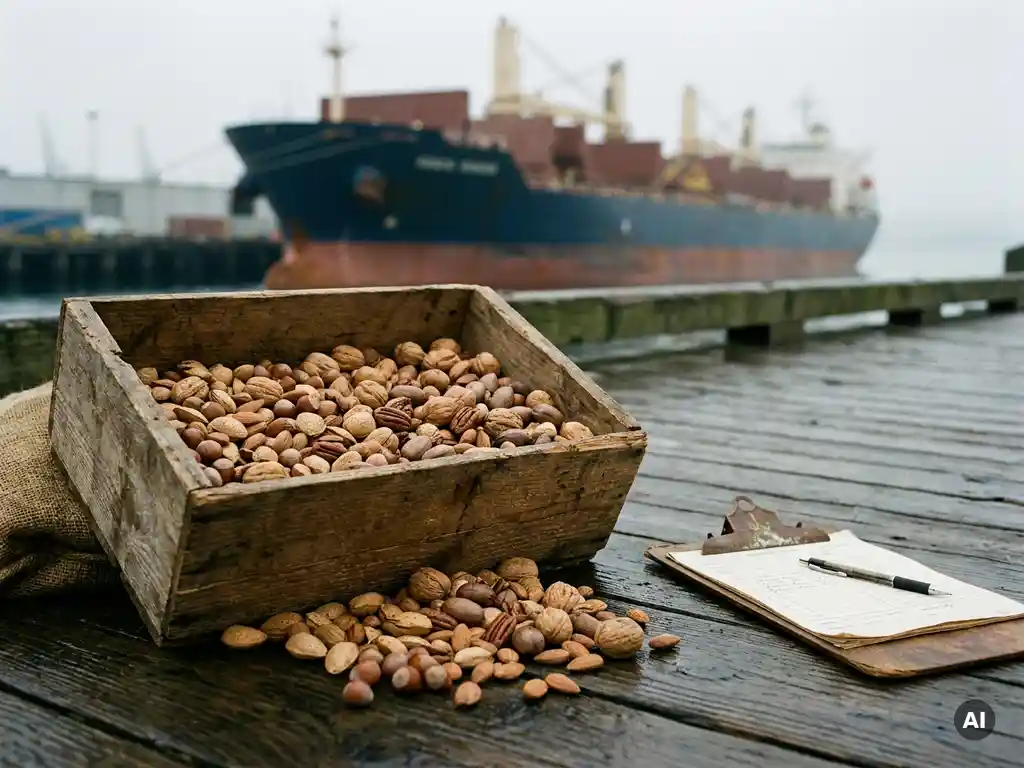
Customs clearance of nuts from China or Vietnam involves a combination of customs documentation, tariff classification, import duties, and a phytosanitary inspection by the NVWA. The process is governed by European customs legislation and requires proper preparation to avoid delays and additional costs. The following sections answer the most frequently asked questions about this process step by step.
Which customs documents are required for the import of nuts?
For the import of nuts from China or Vietnam into the European Union, at least a commercial invoice, a packing list, a valid certificate of origin, and a phytosanitary certificate are required. Depending on the type of nut and the country of origin, additional documents may be necessary, such as an import license or a certificate of conformity.
The certificate of origin is of particular importance because it determines which customs tariff applies. For Vietnam, a preferential tariff applies based on the EU-Vietnam Free Trade Agreement (EVFTA), but that tariff only applies if the certificate of origin meets the specified requirements. Different rules apply to China, and a Form A or REX declaration is generally the correct form.
In addition to the Certificate of Origin, the phytosanitary certificate is a mandatory document. This certificate is issued by the competent authority in the exporting country and demonstrates that the consignment is free from plant diseases and harmful organisms. If this document is missing or contains incorrect information, the shipment will be detained for inspection upon arrival.
How much are the import duties on nuts from China and Vietnam?
Import duties for nuts from China generally range between 0% and 9%, depending on the CN code of the specific product. For nuts from Vietnam, lower or even zero tariffs apply in many cases under the EVFTA, provided that the rules of origin are met. The exact rate always depends on the specific tariff classification.
Tariff classification is carried out via the Harmonised System (HS code) and is further elaborated in the EU Combined Nomenclature (CN). Incorrect classification not only results in an incorrect tariff but can also lead to additional assessments, fines, or delays in future shipments. It is therefore essential to determine the correct CN code in advance and apply it consistently.
In addition to regular import duties, anti-dumping duties may also apply to certain products from China. This depends on the specific product category and any trade measures instituted by the EU. A customs broker can identify these risks in advance.
How does the phytosanitary inspection proceed upon arrival in the Netherlands?
Upon arrival in the Netherlands, nuts from third countries such as China and Vietnam are subjected to a phytosanitary inspection by the NVWA (Netherlands Food and Consumer Product Safety Authority), or specifically by the KCB for certain product groups. The inspection takes place at the designated inspection post and includes a document check, an identity check, and in many cases a physical inspection of the shipment.
The document check involves the verification of the phytosanitary certificate and the associated import notification, which must be submitted in advance via the TRACES system. The identity check confirms that the consignment corresponds to the documents. The physical inspection comprises a visual assessment and, where applicable, sampling for laboratory analysis of residues or organisms.
The frequency of physical inspections varies by product type and country of origin. Shipments that have shown issues in the past or originate from countries with an increased phytosanitary risk are inspected more frequently and intensively. Following a successful inspection, the NVWA or the KCB issues a release notice, after which customs clearance can be completed.
What are the most common reasons for delays in customs clearance?
The most common causes of delays in the customs clearance of nuts are incomplete or incorrect documentation, an incorrect tariff classification, the absence of a valid phytosanitary certificate, and selecting the consignment for a physical inspection. Any of these factors can delay release by several days.
Specific points of attention are:
- Missing or expired phytosanitary certificates from the exporting country
- Incorrect or inconsistent descriptions on the commercial invoice compared to the packing list
- A GN code that does not correspond to the actual product
- Failure to submit the import notification in TRACES on time
- Additional checks for residues or contaminants in case of increased risk
- Missing or incomplete documentation of origin for preferential rates
Prevention begins with careful preparation of the documentation before the shipment departs. The sooner errors are detected, the lower the risk of delays upon arrival.
What role does a customs broker play in the import of nuts?
A customs broker handles the complete customs declaration on behalf of the importer, including tariff classification, calculation of import duties payable, and communication with Customs and the NVWA. For nuts from China or Vietnam, the use of a recognized broker is highly recommended due to the complexity of the regulations and the risk of costly errors.
The freight forwarder checks in advance whether all documents are complete and correct, submits the import notification via TRACES, and monitors the progress of the inspection and release. In the event of problems during the inspection, the freight forwarder acts as an intermediary with the competent authorities.
A good freight forwarder also has knowledge of current trade measures, preferential tariff agreements, and any anti-dumping duties. This is particularly relevant for nuts from China, where the trade relationship with the EU is subject to frequent change. Choosing a freight forwarder with experience in dry food products makes a noticeable difference in the turnaround time and reliability of the process.
How does the storage location affect the customs procedure for nuts?
The storage location has a direct impact on the customs procedure, particularly on the logistics chain between unloading and release. When nuts are stored in a bonded warehouse or an approved storage point near the port, goods may be stored before customs clearance is fully completed. This offers flexibility but also requires specific permits and administrative obligations.
For dry products such as nuts, storage conditions also play a role in the phytosanitary assessment. Nuts stored in a certified and climate-controlled environment run less risk of quality loss during the waiting period for inspection. A good storage facility therefore indirectly contributes to a smoother customs clearance process.
The steps that influence the storage location are:
- Arrival of the container in the port and notification to customs
- Transport to the storage location, whether or not under customs supervision
- Phytosanitary inspection at the designated inspection post
- Release by NVWA or KCB after approval
- Final customs declaration and payment of import duties
- Release of the goods for further distribution
A storage location designed for the handling of dry food products and holding the appropriate certifications reduces waiting times and minimizes the risk of quality loss during the customs clearance process. More information about certified dry storage for nuts is available on the ZZColdstores website.
How ZZColdstores helps with the customs clearance of nuts
ZZColdstores supports importers and logistics partners throughout the entire chain surrounding the import of dry products such as nuts, peanuts, and seeds. From locations in Kruiningen and Vlissingen, ZZColdstores offers a direct connection between arrival, storage, and customs clearance, including assistance with phytosanitary inspections via the KCB.
What ZZColdstores specifically offers for nut importers:
- Dry storage capacity of 12,000 pallet spaces in a certified environment (BRC, SKAL, Demeter)
- Separate storage areas for nuts, peanuts, and seeds in accordance with food quality standards
- Assistance with import inspections via the KCB, part of the NVWA
- Coordination of container handling from Rotterdam, Antwerp, or our own quay in Vlissingen
- Flexible deployment tailored to the sailing schedule of incoming vessels
Would you like to know how ZZColdstores can support your customs clearance process for nuts from China or Vietnam? Please contact us via the website for a no-obligation consultation with one of our specialists.
Author: Frans van der Maas, Operations Director ZZColdstores
Frequently Asked Questions
Can I import nuts from China and Vietnam under a single customs declaration?
No, nuts from China and Vietnam must in principle be declared as separate consignments, as they have different rules of origin, tariff regimes, and potentially different phytosanitary requirements. Combining consignments from different countries of origin in a single declaration can lead to classification errors and problems with the application of preferential tariffs. A customs broker can advise you on the most efficient approach if you regularly import from both countries.
How long does the average customs clearance of nuts take in practice?
With complete and correct documentation, standard customs clearance typically takes one to three working days, including the phytosanitary inspection. If the consignment is selected for a physical inspection with laboratory analysis, the turnaround time can increase to five to ten working days. Timely submission of the import notification in TRACES and pre-checking all documents are the most effective ways to minimize turnaround time.
What happens if my shipment of nuts is rejected during the phytosanitary inspection?
If a consignment is rejected by the NVWA or the KCB, there are generally three options: re-export to the country of origin, destruction of the cargo, or special treatment to remedy the identified problem (for example, heat treatment for certain organisms). The costs of these measures are entirely borne by the importer, which underscores the importance of a reliable supplier who issues correct phytosanitary certificates. Your customs broker and the storage location can assist you with the administrative handling of a rejection.
As an importer, do I need to create a TRACES account myself, or does the freight forwarder arrange that?
In most cases, the customs broker or the authorized importer submits the import notification via TRACES, but as the importer, you remain ultimately responsible for the accuracy of the submitted data. It is advisable to create a TRACES account yourself as well so that you can track the status of your shipment and intervene promptly in the event of any problems. Discuss with your broker who will assume which role to avoid duplication of work or miscommunication.
Which GN codes are most common for the import of nuts from China and Vietnam?
The most commonly used GN codes for nuts generally fall under Chapter 08 of the Combined Nomenclature, which covers edible fruits and nuts. Common codes include 0801 (coconuts, cashews, Brazil nuts), 0802 (other nuts such as almonds, hazelnuts, and walnuts), and 2008 (processed or preserved nuts). The exact code depends on the state of the product (raw, roasted, salted, shelled) and must be carefully determined for each product to avoid additional assessments or fines.
Are there specific labelling rules for nuts entering the EU?
Yes, in addition to customs and phytosanitary requirements, nuts intended for the European market must comply with the EU Food Information Regulation (EU 1169/2011), which sets requirements regarding, among other things, the labelling of allergens, the country of origin, and the best-before date. For packaged nuts, additional labelling requirements apply that must be arranged before being placed on the market. It is advisable to coordinate these requirements with your supplier during the purchasing phase to avoid relabelling in the warehouse.
Is it possible to temporarily store nuts in a bonded warehouse to postpone the payment of import duties?
Yes, storage in a bonded warehouse (type C or D) makes it possible to defer the payment of import duties and VAT until the goods are actually released into free circulation. This can be financially advantageous for large volumes or when the final destination of the goods has not yet been determined. However, please bear in mind that a bonded warehouse entails specific permits and administrative obligations, and that the phytosanitary inspection must be completed separately before the goods are released.
Related articles
- How does cold storage help limit quality loss of fresh products?
- What role does warehousing play between the port and the customer?
- What is the risk of condensation when unloading refrigerated containers?
- How does an inspection work for the import of peanuts from Brazil?
- How does the supply of garlic from China via European ports work?