
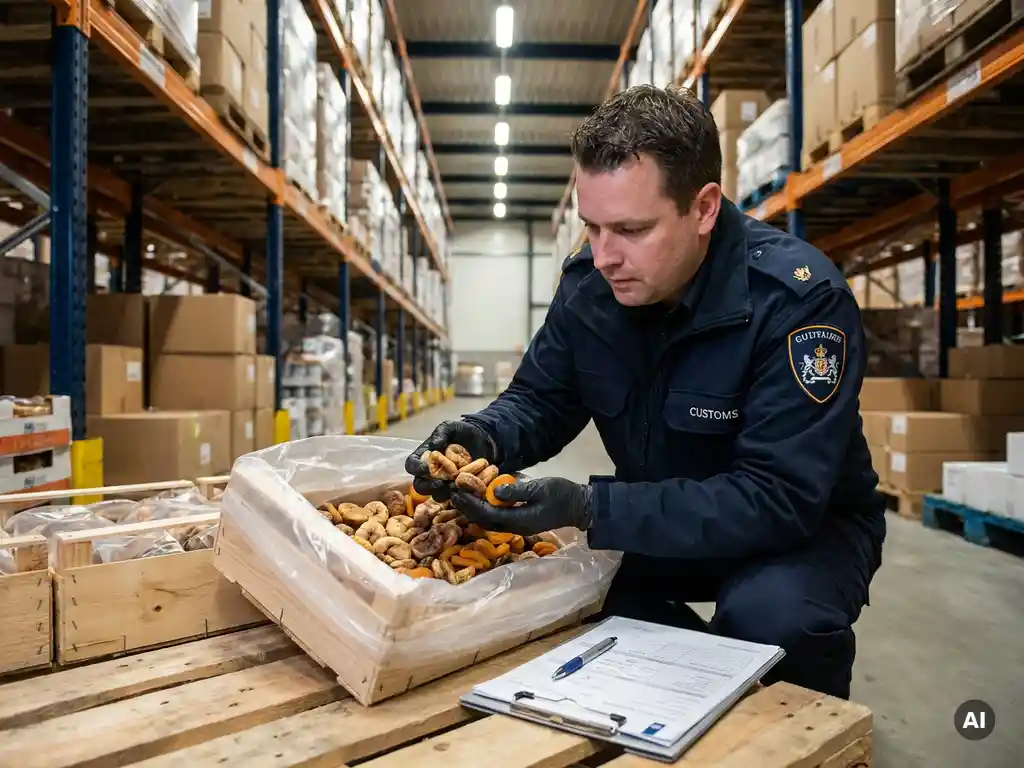
In 2026, the NVWA will apply strict import inspection rules for dried fruit entering the European Union. Specifically, this means that every shipment of dried fruit must comply with European phytosanitary requirements, residue standards, and documentation obligations before the product is freely available on the Dutch market. Importers and logistics partners who do not comply with these requirements risk rejection, destruction, or return of the entire shipment. This article answers the most frequently asked questions about the inspection process, the required documents, and storage after inspection.
Which products are subject to the NVWA import inspection for dried fruit?
The NVWA import inspection for dried fruit applies to all dried plant-based products produced outside the EU that enter the European internal market via the Netherlands. This includes products such as dried figs, dates, apricots, raisins, prunes, mango, pineapple, papaya, and coconut products. Nuts and seeds such as almonds, cashews, walnuts, peanuts, and sunflower seeds also fall into this category, as they are treated as dry agricultural products under phytosanitary and food safety regulations.
European regulations distinguish between high-risk and lower-risk products. An increased inspection frequency applies to certain countries of origin and product categories. Dried figs from Turkey and certain nuts from Asian countries, for example, have been on the list of products requiring increased attention for years due to demonstrable risks of aflatoxin contamination. The NVWA adjusts the inspection frequency based on European risk assessments that are revised annually.
Which documents are required for the import of dried fruit in 2026?
For the import of dried fruit in 2026, at least three documents are required: a valid phytosanitary certificate issued by the competent authority in the country of origin, a commercial document or invoice with an accurate product description, and a pre-notification via the European TRACES NT system. Without pre-notification, a consignment may not be unloaded at a recognized border inspection post.
Depending on the product and the country of origin, additional documents may be required:
- A certificate of analysis from an accredited laboratory, particularly for products with an increased aflatoxin risk
- A certificate of origin for customs purposes
- An organic certificate if the shipment is imported as an organic product
- A supplementary statement to the phytosanitary certificate for specific quarantine pests
It is the responsibility of the importer or their forwarder to submit all documents in a timely and complete manner. Missing or incorrect documents almost always lead to delays and may result in a formal notice of non-conformity.
How does the NVWA inspection process proceed upon arrival in the port?
The NVWA inspection process for dried fruit upon arrival at the port takes place in three consecutive steps: document check, identity check, and physical inspection. Not every shipment undergoes all three steps; the frequency of the physical inspection depends on the risk level of the product and its origin.
The procedure is as follows:
- Pre-notification via TRACES NT: The importer or his representative registers the consignment in the European system at least one working day before arrival. Without a valid registration, the cargo may not be unloaded.
- Document check: The NVWA checks whether all mandatory documents are present, complete, and valid. This is done digitally or on location at the border inspection post.
- Identity check: The inspector verifies whether the shipment corresponds to the description in the documents. This includes a visual check of the packaging, labels, and quantities.
- Physical inspection: Samples are taken from selected consignments for laboratory analysis of contaminants, residues, and phytosanitary risks. The consignment remains under surveillance until the results are known.
- Release or measure: Upon approval, the importer receives a Common Health Document of Entry (CDO), allowing the consignment to enter the EU. In the event of rejection, an official notification follows.
The turnaround time for the inspection process varies. A document check is often completed within a few hours, but a laboratory analysis can take three to five working days.
Which contaminants and residues does the NVWA check for in dried fruit?
During the NVWA inspection of dried fruit, the primary checks are for aflatoxins, pesticide residues, and phytosanitary organisms. Aflatoxins are mold toxins that occur particularly in nuts, dried figs, and dried dates, and which pose a risk to public health even at low concentrations. The European Maximum Residue Limits (MRLs) for pesticides are laid down in Regulation (EC) No 396/2005 and are regularly reviewed.
In addition to aflatoxins and pesticide residues, the NVWA also monitors ochratoxin A, another mycotoxin found in dried grapes and figs. Regarding phytosanitary organisms, this concerns quarantine pests such as certain insects or fungi that are not permitted to be present in the EU. The specific control parameters are determined by the risk level assigned to a product category by the European Commission.
What are the consequences if a shipment of dried fruit fails the inspection?
If a consignment of dried fruit fails the NVWA import inspection, there are three possible outcomes: return to the country of origin, destruction of the consignment, or conversion to another use outside the food chain. The importer is responsible for the costs of all subsequent measures, including storage during the waiting period and the implementation of the measure.
Rejections are reported in the European RASFF (Rapid Alert System for Food and Feed) system if the shipment poses a serious risk to public health. This affects the exporter's reputation and can lead to a temporary import ban on similar shipments from the same company or region. Importers would be wise to have their own laboratory analysis performed in advance for high-risk products so that they are not faced with surprises at the border.
How does the NVWA inspection for organic dried fruit differ?
Organic dried fruit undergoes the same phytosanitary and food safety checks as conventionally dried fruit, but additional requirements apply regarding organic certification. The importer must be able to demonstrate that the product has been produced and certified in accordance with the European Organic Production Regulation (EU) 2018/848, which entered full force in 2022 and remains the applicable standard in 2026.
In concrete terms, this means that every shipment of organic dried fruit must be accompanied by a valid Certificate of Inspection (COI), issued via the TRACES NT system by the competent control authority in the country of origin. Without this COI, the organic status of the shipment cannot be recognized and the product is treated as conventional, which has direct consequences for sales opportunities and the value of the shipment.
Where should dried fruit be stored after the import inspection?
Following a successful NVWA import inspection, dried fruit must be stored in a dry, temperature-controlled environment that meets the requirements for food storage. Specifically, this means a storage location with a stable temperature, low humidity, and adequate ventilation to prevent mold formation and loss of quality. For certified organic products, additional requirements apply regarding the separation from conventional products.
Shipments awaiting the results of a laboratory analysis may not be freely traded or moved. They must remain at a designated location under the supervision of the NVWA until release is officially confirmed. This places demands on the storage location: it must be traceable, registered, and accessible to inspectors.
How ZZColdstores helps with the storage of dried fruit after import inspection
ZZColdstores offers B2B logistics partners a complete storage solution for dried fruit that has passed import inspection. From locations in Kruiningen and Vlissingen, ZZColdstores handles the storage of dry agricultural products in a controlled environment that meets the requirements for food storage. The facilities are certified according to BRC, SKAL, and Demeter standards, underscoring their suitability for both conventional and organic products.
What ZZColdstores specifically offers for importers of dried fruit:
- Dry storage with a capacity of 12,000 pallet spaces, with separate areas for nuts, peanuts, seeds, and other dry food products
- Strict separation of product flows, essential for organically certified shipments
- Support with import inspections via KCB, part of the NVWA
- Flexible storage planning that aligns with the arrival schedule of ships and containers
- Direct port access in Vlissingen via a dedicated quay, which minimizes the transition period between unloading and storage
Would you like to know how ZZColdstores can store and further process your shipment of dried fruit after the import inspection? View the options on the dry storage or contact us directly for a no-obligation consultation with one of our specialists.
Author: Frans van der Maas, Operations Director ZZColdstores
Frequently Asked Questions
How far in advance do I need to register my shipment of dried fruit via TRACES NT?
The minimum notification period via TRACES NT is one working day before the consignment arrives at the border inspection post. In practice, experienced importers recommend submitting the pre-notification two to three working days in advance to allow time to correct any errors or missing data without delaying unloading. Please note that weekends and public holidays do not count as working days.
What is the difference between a border inspection post and a regular customs office, and where should I present my cargo?
A Border Inspection Post (BIP) is an officially designated location where the NVWA conducts phytosanitary and food safety checks on products from outside the EU. A regular customs office only handles fiscal and administrative customs clearance but is not authorized to perform the substantive inspections that are mandatory for dried fruit. Dried fruit from third countries must always be presented at a recognized border inspection post first; only after release via the GGDB can the consignment be transported further to the final destination.
Can I sell or resell a batch of dried fruit while the laboratory analysis is still ongoing?
No, that is not permitted. As long as the results of the laboratory analysis are not available and the NVWA has not granted official release, the shipment may not be traded, moved, or resold. The shipment remains legally under the supervision of the NVWA and must be stored at a designated, traceable location. Contractual agreements with purchasers do not alter this; the legal obligation rests with the importer.
Which common mistakes lead to rejection or delays during the NVWA import inspection?
The most common errors are: an incomplete or incorrectly filled out phytosanitary certificate, a late or missing pre-notification in TRACES NT, and a discrepancy between the product description on the documents and the actual contents of the shipment. The absence of a current certificate of analysis for high-risk products such as dried figs or nuts from Asian countries is also a common reason for delays. Having the set of documents checked by an experienced freight forwarder before shipment from the country of origin prevents most of these problems.
How do I know if my product originates from a country of origin or category with an increased frequency of checks?
The European Commission regularly publishes updated implementing regulations stating which products and countries of origin are subject to increased control frequencies. This information can be found via the official EUR-Lex database and the European Commission website under the DG SANTE portal. Your freight forwarder or a specialized import consultant can help you determine the current control status of your specific product and country of origin before the cargo is shipped.
What should I do if my shipment is rejected and I disagree with the NVWA's decision?
As an importer, you have the right to lodge an objection against a decision of the NVWA via the official objection procedure under the General Administrative Law Act (Awb). This objection must be submitted in writing within six weeks of receipt of the official notification of non-conformity. However, during the objection procedure, the consignment remains under supervision and may not be released; it is therefore advisable to simultaneously seek legal advice and consider a second opinion from an accredited laboratory if the rejection is based on analysis results.
As a new importer of dried fruit, what is the best way to start setting up a compliant import process?
Start by appointing a recognized customs broker with demonstrable experience in agricultural products and phytosanitary regulations, as they are familiar with current documentation requirements and can handle the TRACES NT notification for you. Additionally, enter into a cooperation agreement with a certified storage partner who has direct port access and is familiar with NVWA procedures, so that the period between unloading and storage remains as short as possible. Finally, it is advisable to routinely have a prior laboratory examination performed in the country of origin for high-risk products, so that you know with certainty that your cargo complies with European standards before shipment.
Related articles
- What requirements must professional cold storage for food meet?
- Can you combine warehousing with container handling?
- How does the transfer of ownership work when storing goods in a third-party warehouse?
- How long can you safely store garlic in a temperature-controlled warehouse?
- How does the logistics chain from port to factory for dry raw materials work?