
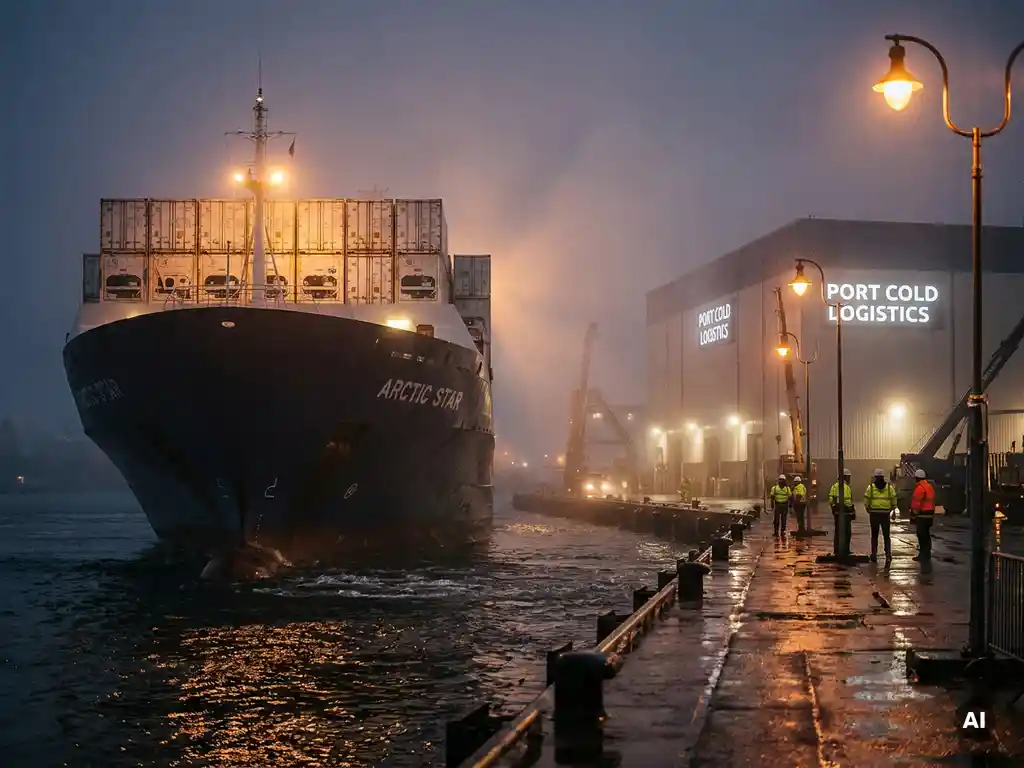
You manage irregular ship deliveries from Asia or Brazil by working with a storage partner that has its own quay, flexible climate control, and the capacity to handle peaks and troughs in supply without loss of quality. The key lies in combining rapid unloading, immediate cooling, and planning that scales with changing sailing schedules. This article answers the most frequently asked questions regarding this logistical challenge.
What makes shipping from Asia and Brazil so unpredictable?
Ship supply from Asia and Brazil is unpredictable due to a combination of long voyages, weather conditions at sea, delays in ports en route, and fluctuating production rhythms at the source. A ship expected in Rotterdam or Vlissingen may arrive days earlier or later than planned due to circumstances outside the port.
Routes from Brazil easily take two to three weeks at sea. Routes from Southeast Asia are even longer. During that period, multiple disruptions can occur: congestion in intermediate ports, weather systems in the Atlantic or Indian Ocean, or adjustments to the shipping company's own schedule. Add to this the seasonal peaks in the exotic fruit harvest cycle, and it becomes clear why importers can rarely work with a fixed supply calendar.
For supply chain managers, this means that planning on the receiving side must be at least as flexible as the supply side is uncertain. A rigid storage schedule based on fixed arrival dates is of little value in practice.
How does irregular supply affect the quality of exotic fruit?
Irregular supply increases the risk of quality loss in exotic fruit, as any delay between unloading and cooling shortens shelf life. Products such as bananas and citrus fruits are sensitive to temperature fluctuations and react quickly to environmental conditions that are not precisely controlled.
When a ship arrives later than expected, pressure is placed on receiving logistics: unloading must take place quickly, but storage capacity may be occupied by previously scheduled product. Conversely, an earlier arrival may mean that the cold storage space has not yet been cleared. In both cases, the time between leaving the hold and reaching controlled cooling is the critical factor.
For exotic fruit, that time window is not a matter of hours, but of minutes that count. The longer fruit is exposed to outdoor temperatures or uncontrolled environments, the greater the risk of accelerated ripening, moisture loss, or mold formation. Temperature-controlled storage that is available immediately after unloading is therefore not a luxury, but an operational necessity.
What role does a private quay play in absorbing supply fluctuations?
Having a private quay directly next to the cold storage facility virtually eliminates transport time between ship and cooling. This is the most effective way to limit quality risks associated with irregular deliveries, as the transition from the hold to the controlled environment takes minutes rather than hours.
When using an external terminal or a shared port location, the product must first be moved via internal transport, waiting times at locks or gates, and sometimes also via public roads. Each of these steps adds time and uncertainty, precisely at the moment when the chain is most vulnerable.
Having your own quay also offers operational flexibility: unloading can be coordinated with the ship's exact arrival time, without dependence on terminal schedules or external planners. This makes it possible to act quickly, even in the event of early or late arrivals, and to absorb supply fluctuations without compromising product quality.
How does flexible climate control provide a buffer for fluctuating supply times?
Flexible climate control provides a buffer for fluctuating delivery times, as temperature, humidity, and air circulation can be set per compartment to the specific requirements of the product being stored at that moment. This allows a cold room to be quickly adapted to a new shipment with different storage conditions.
When a ship arrives earlier than expected, space set up under the correct conditions must be immediately available. When a ship is delayed, the pre-configured space must be able to be kept at the correct temperature without affecting other stored products. Systems that monitor and adjust 24 hours a day, seven days a week, make this possible without manual intervention for every adjustment.
For products such as bananas, which are transported and stored in specific ripening stages, this is particularly relevant. Storage conditions directly determine when the product is ready for market, and a deviation of even a few degrees can disrupt the buyer's planning.
What is the difference between cold storage and dry storage in the event of irregular supply?
Cold storage is intended for fresh, perishable products that require a precisely controlled climate to maintain their quality. Dry storage, also known as ambient storage, is suitable for products that remain stable at room temperature, such as nuts, peanuts, and seeds. With irregular supply, each type places different demands on planning.
For fresh products from cold storage, the time pressure is greatest upon arrival. Any delay in the chain directly affects shelf life. With dry products, there is more leeway: a container arriving a day late does not necessarily lead to quality problems, provided the storage itself is properly organized.
That difference in urgency also has implications for storage planning. Cold storage capacity must be flexibly available and deployable quickly. Dry storage capacity can be buffered slightly more and planned based on expected supply volumes, without a one-day delay having immediate consequences for product quality.
How do you align storage planning with changing sailing schedules?
Aligning storage planning with fluctuating sailing schedules requires an approach where the storage partner scales along with the shipping company's uncertainty. This means: not reserving fixed blocks based on arrival times that shift anyway, but working with a system that dynamically allocates space and capacity.
In practice, there are a number of principles that help manage this uncertainty:
- Communicate arrival expectations to the storage partner as early as possible, even if they are still uncertain.
- Work with a margin in the available storage capacity so that early arrivals do not immediately lead to a capacity problem.
- Ensure that the storage partner is aware of the product specifications so that the correct climate settings are already in place.
- Please take into account the import inspection via KCB (part of the NVWA), which also needs to be scheduled and depends on arrival times.
- Align the planning of further loading with the storage duration, not the planned arrival date.
A storage partner that also handles customs clearance reduces the number of links in the chain and makes it easier to react quickly when a sailing schedule changes.
When is outsourcing cold storage the right choice for importers?
Outsourcing cold storage is the right choice when in-house storage capacity cannot scale to keep up with the irregularity of supply, or when the investment in in-house cooling infrastructure does not outweigh the volumes being processed. For most importers of exotic fruit, outsourcing is the most practical and cost-effective solution.
The decision depends on a number of factors:
- Supply volume and frequency: Anyone receiving multiple vessels per month with varying volumes benefits from a partner with scalable capacity.
- Product diversity: Different products require different storage conditions. An external specialist has the infrastructure to manage multiple climate zones simultaneously.
- Location and port access: Importers without their own quay or port location are dependent on external terminals, which slows down the transition speed from ship to cooling.
- Supply chain integration: A partner who provides container handling, import inspection, and customs clearance in addition to cold storage significantly reduces the coordination burden.
- Need for flexibility: Those dealing with irregular sailing schedules benefit more from a partner that operates 24/7 than from their own facility with fixed opening hours.
Outsourcing is not a sign of operational weakness, but a strategic choice to protect the core of the business: delivering a high-quality product to the customer, regardless of what happened at sea.
How ZZColdstores helps with irregular ship supplies
ZZColdstores offers importers of exotic fruit an integrated solution for managing irregular shipping shipments from Asia and Brazil. With locations in Kruiningen and Vlissingen, a private quay directly next to the cold storage facility in Vlissingen, and more than 25 years of experience in temperature-controlled storage, ZZColdstores is equipped to handle the uncertainties associated with these trade flows.
What ZZColdstores specifically offers for importers with fluctuating supply times:
- Direct unloading at our own quay in Vlissingen, with minimal transition time from ship to cooling
- 24/7 monitoring and control of temperature, humidity, and air circulation per compartment
- Flexible climate settings tailored to the specific requirements of the product
- Dry storage capacity of 12,000 pallet spaces for non-refrigerated products such as nuts and seeds
- Assistance with import inspection via KCB and customs clearance as part of the services
- Planning that scales with changing sailing schedules, without dependence on external terminal rosters
Would you like to know how ZZColdstores can stabilize your supply chain? Contact us via the storage page or send a direct question to the team for a discussion about your specific situation.
Author: Frans van der Maas, Operations Director ZZColdstores
Frequently Asked Questions
How far in advance do I need to inform my storage partner about an expected ship arrival?
It is advisable to notify your storage partner as early as possible, even if the arrival time is still uncertain. A rough forecast of 48 to 72 hours in advance gives the partner sufficient time to prepare capacity and climate settings. As soon as the ETA (Estimated Time of Arrival) is adjusted by the shipping company, pass on that update immediately — the more communication, the better the storage partner can anticipate early or late arrivals.
What happens to my product if the ship arrives much earlier than planned and the cold storage is still occupied?
This is precisely the scenario for which a professional storage partner with flexible capacity buffers is equipped. A good partner always maintains a margin in the available cold storage space to accommodate early arrivals without other stored products being displaced or their quality being compromised. When entering into a partnership, explicitly discuss how the partner handles these types of peak moments and what guarantees are in place regarding the immediate availability of refrigerated space.
Which documents and inspections are required for the import of exotic fruit, and how do they affect storage planning?
When importing exotic fruit from countries such as Brazil and Thailand, a phytosanitary certificate, a commercial invoice, a packing list, and a Bill of Lading are typically required. In addition, the KCB (part of the NVWA) conducts an import inspection on products such as citrus fruits and other fresh fruit. This inspection must be scheduled based on the actual arrival time, not the planned date — which means that a flexible storage partner who also takes on the coordination of this inspection results in significant time savings in the supply chain.
As an importer, can I also have partial loads or mixed containers stored in case of fluctuating supply?
Yes, an experienced storage partner is typically equipped to handle both full and partial loads, as well as mixed containers with different product types. When registering the load, always provide the exact product composition and the associated storage conditions so that the partner can assign the correct climate zones. This is particularly relevant when a single container contains multiple product types, each requiring a different temperature or humidity.
How do I know if my current storage partner is flexible enough for irregular ship deliveries?
A reliable indicator is whether your partner operates 24/7 and whether they have their own port access or a quay. Additionally, specifically ask about the refrigeration capacity utilization rate and how the partner handles supply peaks: do they have fixed buffer space available, or is capacity allocated solely based on reservations? Furthermore, a partner who also coordinates customs clearance and import inspection is a sign of an integrated approach that aligns well with the uncertainties of international shipping.
What are the most common mistakes importers make when planning storage around irregular sailing schedules?
The most common mistake is planning based on the expected arrival date rather than a realistic arrival window. Importers who reserve cold storage space on a fixed day risk that space already being occupied upon an early arrival, or unnecessarily tying up capacity in the event of a delay. A second common mistake is failing to provide product specifications in a timely manner, preventing the storage partner from adjusting climate settings on time. Always work with scenarios—early, early, and late—and actively communicate these with your partner.
Is temperature-controlled storage also relevant for dry products such as nuts and peanuts in case of irregular supply?
For dry products such as nuts, peanuts, and seeds, full cold storage is generally not necessary, but the storage environment is certainly important. Dry storage (ambient) must meet stable temperature and humidity conditions to prevent mold formation, oxidation, and loss of quality. In the event of irregular supply, dry storage offers more planning flexibility than cold storage, but here too, a partner with well-controlled ambient facilities and sufficient buffer space makes the difference between smooth handling and a logistical bottleneck.