
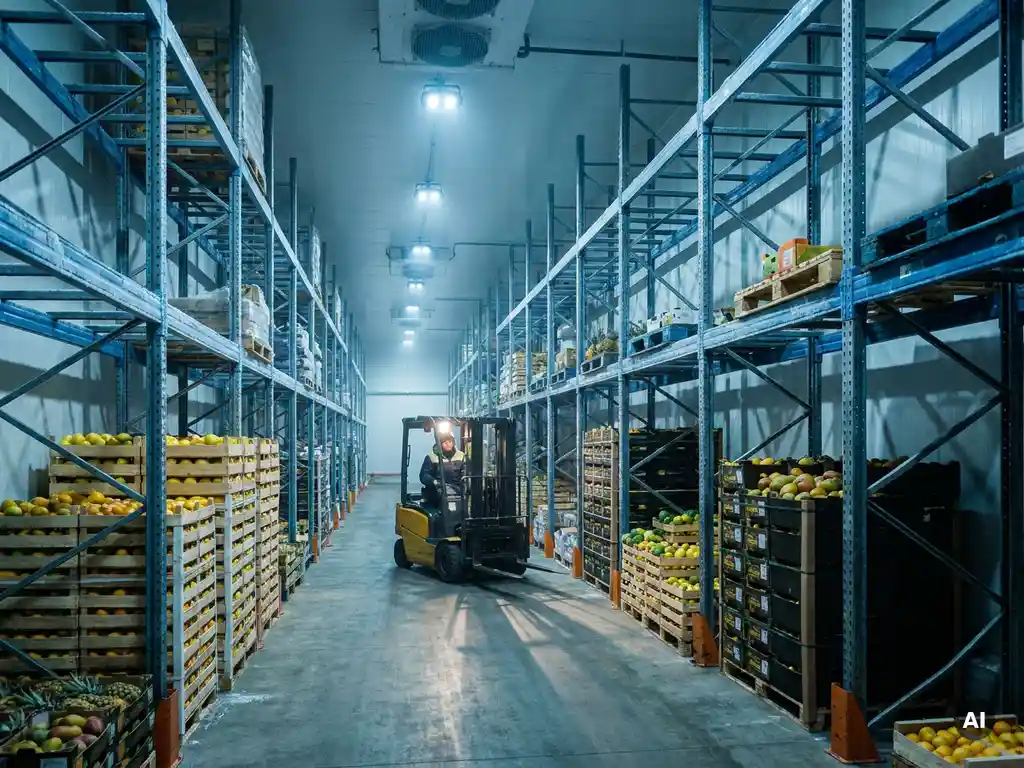
Warehousing helps manage fluctuating inventory volumes by aligning storage capacity with the actual demand at any given moment, without a company having to invest in fixed warehouse space itself. For importers, wholesalers, and logistics service providers working with seasonal products or irregular supply, flexible storage capacity is not a luxury but an operational necessity. The questions below delve deeper into the risks, choices, and practical considerations surrounding warehousing for variable volumes.
What are the risks of fixed storage capacity during seasonal peaks?
Fixed storage capacity entails two opposing risks during seasonal peaks: insufficient space when volumes increase, or structurally paying for empty warehouse space outside the season. Both situations lead to higher costs or operational disruptions that directly impact delivery reliability.
In practice, importers of exotic fruit, nuts, and other agri-food products observe that their supply fluctuates significantly. A shipment of bananas or citrus fruits can require a large number of pallet spaces in a short period, while the supply is considerably smaller weeks later. Those bound to a fixed amount of warehouse space have little leeway to adapt to this.
An additional risk is that an overly tight setup leads to emergency solutions: expensive express transport, storage with third parties without the proper conditions, or accepting a loss of quality. For products sensitive to temperature or humidity, this can mean direct damage to the cargo.
How does flexible warehousing adapt to fluctuating volumes?
Flexible warehousing adapts to fluctuating volumes by deploying storage capacity modularly: customers reserve only the space they actually need at that moment. The warehousing partner scales up and down based on actual supply, shipping schedules, and seasonal patterns, without the customer being tied to a fixed number of pallet spaces for an extended period.
This model works in practice because the storage location has sufficient total capacity to handle peaks, while simultaneously distributing occupancy across multiple customers and product flows. This allows an importer to deploy more space during a busy season and scale back during a quieter season without incurring vacancy costs.
Flexible warehousing goes beyond just square meters. It also includes the ability to adjust climate settings per product, adapt quickly to changed unloading times, and combine logistical operations such as transshipment and container handling with the storage service.
What is the difference between fixed and variable storage contracts?
With a fixed storage contract, a customer reserves an agreed number of pallet spaces for a fixed period and pays for them regardless of actual occupancy. With a variable contract, the customer pays based on actual usage, measured per pallet, per day, or per period. The difference therefore lies in the distribution of the capacity risk.
Fixed contracts offer certainty regarding availability, which is relevant for companies with a constant, highly predictable supply. Variable contracts are more favorable for parties with irregular volumes, because they do not pay for space they do not use.
For many importers and traders of agri-food products, a hybrid approach is the most practical: committing to a base volume to guarantee availability, supplemented with flexible additional capacity for peak periods. This provides certainty without the rigidity of a fully fixed contract.
Which products benefit most from flexible storage?
Products with a strongly seasonal supply, a short shelf life, or an irregular import rhythm benefit most from flexible storage. Examples include exotic fruits such as bananas and citrus fruits, but also nuts, peanuts, and seeds, whose supply depends on harvest periods and shipping schedules.
Moreover, fresh and perishable products place specific demands on storage conditions. Temperature, humidity, and air circulation must be accurately monitored and tailored to the product. A flexible warehousing partner capable of configuring climate chambers per product provides these parties with the assurance that quality remains guaranteed, even when volumes fluctuate significantly.
Dry products such as nuts and peanuts, which are stored at a controlled temperature of approximately eleven degrees, also fall into this category. Supply is tied to harvest cycles and international transport routes, meaning volumes can vary significantly from period to period.
How do irregular ship schedules affect storage planning?
Irregular shipping schedules make storage planning complex because the exact arrival time of a shipment is often only known shortly in advance. This means that warehouse space must be available at the time of unloading, not at a predetermined time. A warehousing partner who anticipates this prevents delays and loss of quality for sensitive products.
In the port of Vlissingen, where ZZColdstores has its own quay directly next to the cold storage facility, the transfer from ship to storage is a matter of minutes. This is operationally relevant for products that must spend as little time as possible outside controlled conditions.
Storage planning around ship schedules also requires the warehouse to be able to scale up quickly. If a ship arrives earlier than expected or carries a larger cargo, the operation must be able to adjust immediately. Flexibility in personnel, equipment, and available space is a requirement for this.
When is outsourcing storage better than having your own warehouse space?
Outsourcing storage is better than owning your own warehouse space when volumes are too variable to operate an on-premise warehouse profitably, when investments in climate control and certification are too high, or when the company's core activity does not lie in logistics. For most importers and traders of agri-food products, all three of these considerations apply.
Owning your own warehouse entails fixed costs: rent or depreciation, energy, maintenance, personnel, and certification costs. With fluctuating volumes, these costs per unit of product are high during quieter periods. Outsourcing makes these costs variable: you pay for what you use.
In addition, certified storage facilities for food products require specific qualifications such as BRC, SKAL, or KCB approval. A specialized warehousing partner already holds these certifications, which removes a significant barrier for a trader or importer.
How do you choose the right warehousing partner for variable volumes?
The right warehousing partner for variable volumes has sufficient total capacity to handle peaks, offers contract flexibility so you do not pay for unused space, and holds the appropriate certifications for your product category. In addition to capacity, location also matters: proximity to the port shortens transport time and reduces the risk of quality loss.
Relevant criteria for the selection include:
- Climate control: can the partner set the correct temperature, humidity, and air circulation per product?
- Certifications: does the partner hold BRC, SKAL, KCB, or other qualifications relevant to your product?
- Contract type: does the partner offer variable or hybrid contracts, or only fixed capacity?
- Operational flexibility: can the partner adapt to irregular ship schedules and short turnaround times?
- Additional services: are container handling, transshipment, and customs clearance also offered, so that you work with a single partner?
A partner that manages the entire process from arrival to delivery gives supply chain managers the most control over quality and lead time, even when volumes fluctuate significantly from week to week.
How ZZColdstores helps with fluctuating storage volumes
ZZColdstores offers flexible warehousing for importers, wholesalers, and logistics service providers working with variable volumes. Specifically, this means:
- Climate-controlled storage in Kruiningen and Vlissingen, with settings per product type for temperature, humidity, and air circulation
- Dry storage at approximately eleven degrees for nuts, peanuts, seeds, and other food products, with a capacity of 12,000 pallet spaces
- A private quay in Vlissingen for direct transshipment from ship to cold storage, with minimal exposure outside controlled conditions
- Certifications including BRC, SKAL, and KCB, ensuring import inspection and quality assurance
- Flexible operation that aligns with changing ship schedules and seasonal peaks
Would you like to know how climate-controlled warehousing aligns with your specific product flow and volume pattern? Contact ZZColdstores for a no-obligation discussion about the possibilities.
Frequently Asked Questions
How quickly can a warehousing partner make extra storage capacity available during an unexpected peak?
A good warehousing partner can free up extra pallet spaces within 24 to 48 hours, provided there is sufficient total capacity in the warehouse. This requires the partner to work with a diversified customer base and not maintain full occupancy. Preferably, communicate expected peaks as early as possible, even if shipping schedules are not yet final, so that the partner can adjust the planning in a timely manner.
What happens if my shipment is delayed and the reserved storage space is not utilized on time?
With variable and hybrid contracts, billing is generally based solely on actual usage, meaning that a shipment delay does not automatically lead to unnecessary costs. However, it is advisable to inform the warehousing partner in a timely manner about delays in the ship's schedule, so that the reserved space can potentially be temporarily utilized elsewhere. When concluding a contract, specifically inquire about the arrangements regarding no-shows and shifts in arrival times.
Which certifications are required for the storage of my agri-food products, and how do I check if a partner meets these requirements?
Which certifications are required depends on the product type and destination: BRC is widely accepted for food safety, SKAL is mandatory for organic products, and KCB is relevant for fresh fruit and vegetables destined for the European market. Always ask a potential warehousing partner for current certification documents and verify their validity via the official registers of the relevant inspection bodies. A reliable partner shares this documentation proactively and without hesitation.
Can I store multiple product types with different climate requirements simultaneously at one warehousing partner?
Yes, this is possible with partners who have multiple climate chambers or zones that can be set independently of each other for temperature, humidity, and air circulation. This is particularly relevant if you import both fresh products and dry goods such as nuts or seeds. Discuss all product types and their specific storage requirements during the intake interview so that the partner can confirm whether the correct conditions can be guaranteed for each product.
How do I ensure a smooth transition when switching from my own warehouse space to outsourced warehousing?
Start by mapping out your current volume patterns, seasonal peaks, and product-specific storage requirements before engaging in discussions with a warehousing partner. Ideally, schedule the transition outside the busiest season to allow time to fine-tune processes and resolve any teething issues without operational pressure. Establish clear agreements regarding communication lines, reporting, and response times to ensure you maintain control over your inventory from day one.
What are common mistakes when choosing a warehousing partner for variable volumes?
A common mistake is selecting solely on price without verifying whether the partner has sufficient total capacity to actually handle seasonal peaks. Additionally, importers often underestimate the importance of location: a warehouse situated far from the port increases transport costs and raises the risk of quality loss for temperature-sensitive products. Finally, many parties forget to inquire about contract flexibility in practice — a variable contract on paper that offers little room to scale up or down in reality provides little benefit compared to a fixed contract.
Is it possible to combine customs clearance and inspection services with the storage service at a single partner?
Yes, an increasing number of specialized warehousing partners are offering a complete package where customs clearance, import inspection, and storage are handled under one roof. This significantly shortens lead times, as products can be inspected and cleared immediately after unloading without additional transport movements. For importers of products subject to phytosanitary controls or KCB inspections, this represents a major operational simplification that also reduces the risk of quality loss during waiting periods.
Related articles
- What should you look out for when outsourcing food storage?
- How does the temperature remain stable during long-term cold storage?
- What should you pay attention to when warehousing imported food products?
- Why is Zeeland a logical location for European food storage?
- Why is conditioned storage better than a regular warehouse for nuts?