
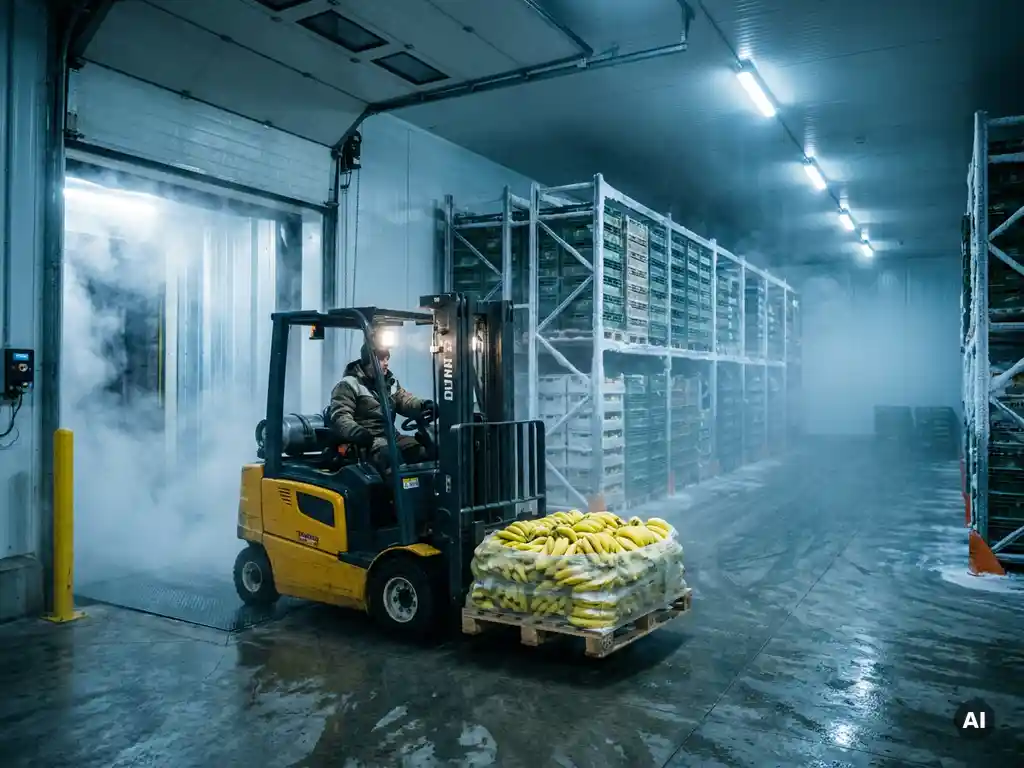
Upon receipt of refrigerated goods in a warehouse, a shipment goes through a series of fixed steps: registration and document verification, unloading, temperature recording, quality control, and registration in the inventory system. This process is tightly controlled because the cold chain must remain uninterrupted to prevent product loss and food safety risks. The questions below answer everything logistics managers and importers need to know about this process.
What steps does a shipment go through upon arrival at a cold storage facility?
Upon arrival at a cold storage facility, a shipment typically goes through five core steps: pre-notification and document checks, physical unloading, temperature measurement, quality inspection, and registration in the warehouse management system (WMS). The sequence and speed of these steps largely determine whether the cold chain remains intact and whether the product reaches storage in good condition.
The pre-notification is the starting point: before a truck or container arrives, the warehouse receives the relevant documents such as the bill of lading, the packing list, and any phytosanitary certificates. As soon as the shipment arrives, the receiving department checks whether the physical cargo matches the paperwork. This is followed by unloading, during which the ambient temperature in the unloading zone is kept as low as possible to limit temperature fluctuations. After unloading, pallets are registered via barcode scanners and booked into the WMS, ensuring that every unit is immediately traceable.
What is a temperature log and why is it mandatory for the receipt of refrigerated goods?
A temperature log is a recorded series of temperature measurements maintained during the transport and storage of refrigerated goods. This recording is mandatory because European food legislation, in particular the General Food Regulation (EU 178/2002) and the HACCP guidelines, requires demonstrable control of the cold chain. Without demonstrable temperature data, an importer or warehouse cannot fulfill its duty of care.
Upon arrival at the cold storage facility, the transport temperature log is checked and compared with the product specifications. For exotic fruits such as bananas and citrus fruits, the margins are narrow: a deviation of just a few degrees can accelerate ripening or cause cold damage. The log provides insight into possible interruptions of the cold chain during transport, enabling a warehouse to immediately assess upon arrival whether the shipment meets the specified requirements or if additional measures are necessary.
How is the quality of exotic fruit checked upon arrival?
Quality control of exotic fruit upon arrival consists of a visual inspection, product measurements, and optional sampling. Inspectors check for damage, incorrect labeling, packaging deviations, and the overall condition of the product. Additionally, temperature, humidity, and Brix measurements are performed to assess whether the product meets the agreed product specifications.
Sampling is an efficient method for large shipments where a full inspection is too time-consuming. By performing random checks, the warehouse quickly gains insight into the quality of the batch without slowing down the logistics process. Products that do not meet quality standards are immediately separated from the approved batch to prevent contamination or loss of quality of the remainder. Upon request, a comprehensive QC report is prepared, giving importers and clients full insight into the condition of each shipment and enabling them to make quick decisions regarding further processing or returns.
What happens to refrigerated goods during customs clearance?
During customs clearance, refrigerated goods generally remain in the climate-controlled environment of the warehouse or in a designated bonded warehouse. The goods are only released for further distribution after customs clearance has been completed and any import inspections have been passed. For fresh products such as exotic fruit, this is a critical moment: delays at customs can have direct consequences for quality.
In the Netherlands, the import inspection of fresh fruit falls under the responsibility of the KCB, a division of the NVWA. The KCB checks whether products comply with European trade standards for fruit and vegetables before they are allowed onto the market. A warehouse that coordinates customs clearance itself can significantly shorten lead times because goods are not moved unnecessarily and the cold chain remains intact. Good coordination between the warehouse, the freight forwarder, and the customs service is essential in this regard.
What is the difference between cold storage and dry storage at warehouse receiving?
The difference between cold storage and dry storage at warehouse receiving lies in the climate conditions under which goods are received and stored. Cold storage requires precisely controlled temperature and humidity for fresh, fragile products such as exotic fruit. Dry storage, also known as ambient storage, is intended for products that do not require active cooling but do require a stable, controlled environment, such as nuts, peanuts, and seeds.
Cold storage upon receipt
Speed is crucial upon the receipt of refrigerated goods. The time between unloading and placement in the cold room must be as short as possible. Unloading areas are kept refrigerated, and the transfer from container to cold room is carried out as quickly as possible. Temperature and humidity are continuously monitored and recorded.
Dry storage upon receipt
In dry storage, the emphasis is on a stable ambient temperature, typically around 11 degrees for products such as potato flakes or nuts, and on protection against moisture and pests. The receiving procedure is less time-critical than for refrigerated goods, but document checks, weight registration, and quality inspection remain just as important.
Which certifications are required for the receipt of refrigerated food products?
For the receipt of refrigerated food products in a warehouse, the most relevant certifications are BRC (British Retail Consortium Global Standard for Storage and Distribution), HACCP, and, depending on the product type, SKAL for organic products and Demeter for biodynamic products. These certifications demonstrate that a warehouse complies with international standards for food safety, hygiene, and traceability.
In practice, BRC is the most requested certification by supermarket chains and processing plants because it covers a wide range of requirements: from temperature management and pest control to personnel hygiene and document management. SKAL certification is mandatory for warehouses that wish to receive and store organically certified products without losing the organic label. Importers and suppliers delivering to certified purchasing organizations would do well to verify that their warehouse partner holds the correct certifications before entering into an agreement.
How do you choose a warehouse partner for the receipt of refrigerated goods?
When choosing a warehouse partner for the receipt of refrigerated goods, five criteria are decisive: the location relative to the point of delivery, the available climate conditions, existing certifications, the possibility of customs clearance, and the flexibility of the system. A partner that manages all these elements in-house shortens lead times and limits the risk of quality loss.
Location is an underestimated criterion. A cold storage facility with its own quay or direct connection to a port eliminates transport time between ship and cold storage, which for fresh products such as bananas and citrus fruits can make the difference between optimal and suboptimal product quality. Additionally, it is important that the warehouse partner has a barcode system for full traceability, including linking grower and LOT numbers to the correct parties. EDI connections with the client's system ensure automatic order processing, inbound notifications, and inventory updates without manual intervention.
How ZZColdstores supports the receipt of refrigerated goods
ZZColdstores combines climate-controlled cold storage, dry storage, and port logistics at a single location in Vlissingen, with its own quay directly adjacent to the cold storage facility. This makes it possible to transport refrigerated goods from the ship to the cold room within a minimal timeframe. The climate-controlled storage facilities are operational 24/7 and equipped with flexible climate settings tailored to the specific requirements of each product.
- Quality control upon arrival, including temperature, humidity, and Brix measurements
- Full traceability via barcode systems linking grower and LOT numbers
- EDI connections for automatic order processing and inventory updates
- Import inspection via KCB and in-house customs clearance
- Certifications: BRC, SKAL and Demeter
- Dry storage for nuts, peanuts, and seeds alongside refrigerated storage
Would you like to know if ZZColdstores is the right partner for receiving your refrigerated or dry goods? Contact us for a no-obligation discussion about the possibilities.
Frequently Asked Questions
How long does it take on average to fully book a shipment of refrigerated goods after arrival?
The turnaround time from arrival to full registration in the WMS typically varies between 2 and 6 hours, depending on the size of the shipment, the complexity of customs clearance, and the available capacity at the time of arrival. At a warehouse with its own quay and integrated customs clearance, this time can be significantly reduced because the goods are not moved unnecessarily. Proper pre-notification with complete documentation well before arrival is the most effective way to minimize booking time.
What are the most common errors when receiving refrigerated goods and how do you prevent them?
The most common errors are incomplete or missing documentation upon arrival, prolonged exposure to ambient temperature during unloading, and failure to detect anomalies in the temperature log in a timely manner. These errors can largely be prevented by implementing a strict pre-notification procedure, keeping unloading areas actively cooled, and checking the temperature log prior to unloading. A standardized receiving protocol with clear escalation procedures for deviations prevents minor problems from escalating into costly quality incidents.
What should I do if the temperature log shows an exceedance upon arrival?
In the event of a recorded temperature overshoot in the log, the shipment must be immediately separated from other batches and may not be released for further distribution until an additional quality assessment has taken place. Contact the carrier, the freight forwarder, and, if necessary, the insurer immediately to document the overshoot and establish liability. Depending on the product and the extent of the overshoot, an expedited sales process, reclassification, or return may be the most appropriate next step.
Is it possible to temporarily store refrigerated goods in a bonded warehouse if the import inspection is delayed?
Yes, refrigerated goods can be temporarily stored in a recognized climate-controlled customs warehouse to ensure the cold chain remains intact during customs clearance. This is particularly relevant during peak periods or when additional documentation is required for the import inspection by the KCB. It is essential that the warehouse possesses the correct customs status as well as the required refrigeration infrastructure; not all customs warehouses are equipped for fresh, refrigerated products.
How does the traceability of refrigerated goods work after receipt in the warehouse?
Upon receipt, pallets and packages are linked via barcode scanners to grower and LOT numbers in the WMS, making every unit fully traceable from arrival to delivery. In the event of a discrepancy or recall, the warehouse can use this data to quickly determine exactly which parties are involved and where they are located in the chain. EDI connections with client systems ensure that inventory information and movements are automatically synchronized without manual entry.
Which documents do I, as an importer, need to submit before the arrival of a shipment of chilled fruit?
The minimum required documents are the consignment note (CMR or Bill of Lading), the detailed packing list, the commercial invoice, and any phytosanitary certificates required for the country of origin. For organically certified products, a valid organic certificate from the producer is also necessary to maintain SKAL status. The sooner these documents are submitted to the warehouse and the freight forwarder, the faster the pre-notification can be processed and customs clearance prepared.
Can a warehouse also perform quality control on behalf of my organization, or do I need to send someone for that myself?
Most certified warehouses with a BRC label have their own qualified QC personnel who can perform quality control upon arrival on behalf of the importer or client, including preparing a detailed QC report. This is not only more efficient but also prevents unnecessary delays, as the inspection takes place immediately upon unloading. However, ensure that the product specifications, measurement methods, and acceptance criteria are documented in writing beforehand so that the warehouse partner knows exactly which standards to be tested against.
Related articles
- What role does warehousing play between the port and the customer?
- When does a wholesaler need extra refrigerated storage space?
- What happens to goods between arrival and departure from a warehouse?
- What happens in the event of a temperature deviation during cold storage?
- What is the difference between refrigerated storage and dry storage?