
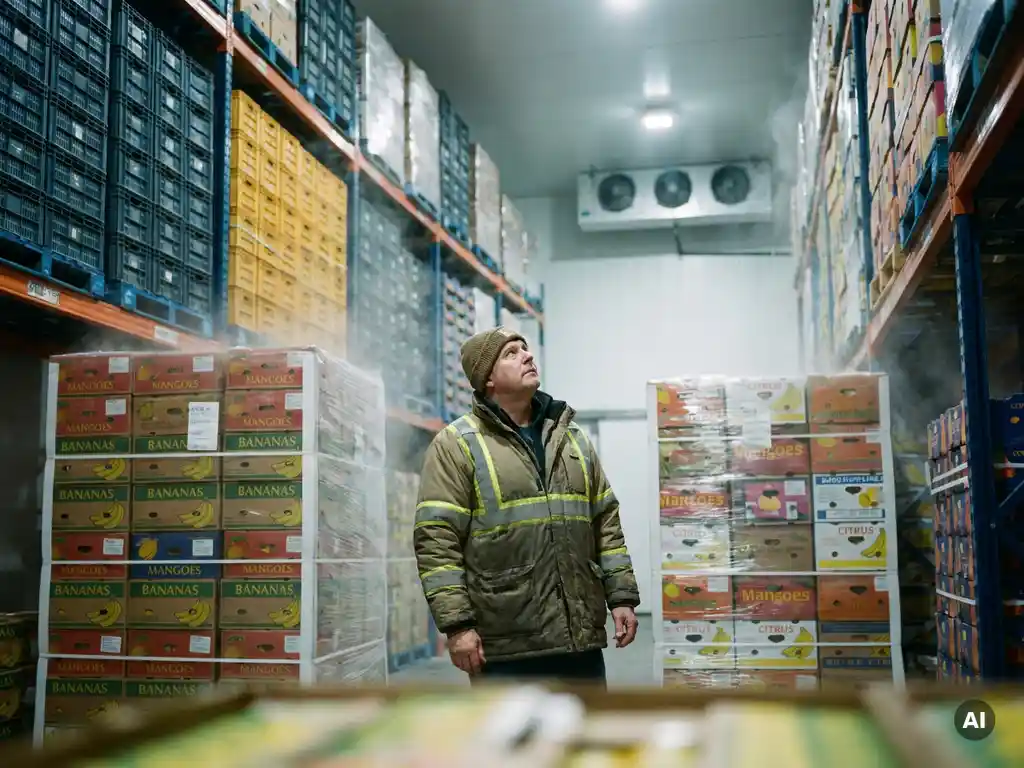
A wholesaler needs additional refrigerated storage space as soon as their own capacity no longer meets demand, for example during seasonal peaks, new product lines, or expansion of the assortment. For wholesalers of fresh food products such as exotic fruit, vegetables, and nuts, temperature-controlled storage is not a luxury, but a basic requirement for maintaining quality. The questions below will help you determine when renting external storage space is the right step and what to look out for.
Which products require refrigerated storage at a wholesaler?
Products requiring refrigerated storage at a wholesaler are all fresh, perishable food products where temperature and humidity directly affect shelf life and quality. Examples include exotic fruits such as bananas and citrus fruits, but also fresh vegetables, soft fruits, and other products with a short shelf life at room temperature.
Bananas are a good example of just how precise the requirements can be: they ripen quickly at temperatures that are too high and are damaged at those that are too low. Citrus fruits tolerate more variation but still require a stable climate to prevent drying out and spoilage. For all these products, it is not just about temperature, but also about humidity and air circulation. An environment that is too dry draws moisture out of the product; an environment that is too humid promotes mold growth.
Moreover, strict quality standards apply to wholesalers supplying supermarket chains or processing plants. Products stored outside the required temperature range are rejected upon arrival. This results in loss of the shipment, reputational damage, and disrupted delivery agreements. Refrigerated storage is therefore not an operational afterthought, but a direct condition for fulfilling delivery obligations.
When does a wholesaler's own storage capacity fall short?
A wholesaler's own storage capacity falls short when the volume of incoming goods is structurally or temporarily greater than the available refrigerated space. This happens more often than expected, and not only at growing companies. Stable wholesalers also run up against capacity limits due to external factors.
The most common situations are:
- Seasonal peaks: larger volumes arrive during the tropical fruit harvest or due to increased demand around the holidays than outside the season.
- Delay in sales: if customers pick up later than planned, stock accumulates in their own cold storage.
- New product lines: expanding the product range requires extra space that is not always immediately available internally.
- Growth in revenue or customers: structural volume growth requires structurally more capacity, not a larger own investment in real estate.
- Technical problems: a malfunction in the in-house cooling system can temporarily disable the entire storage capacity.
In all these cases, renting external storage space is a flexible and cost-effective solution. You pay for what you use, without investing in your own real estate or facilities.
What is the difference between cold storage and dry storage for food products?
Cold storage keeps products at a low temperature to slow spoilage, while dry storage aims for a stable ambient temperature without active cooling to below ambient temperature. For food products, the nature of the product determines which type of storage is required.
Fresh products such as exotic fruit and vegetables require cold storage, where temperature and humidity are precisely controlled. Dry storage is suitable for products such as nuts, peanuts, seeds, and dried food products that are not susceptible to spoilage at room temperature but do require a stable and dry environment. A storage temperature of approximately 11 degrees, as maintained in specialized dry storage facilities, offers a good compromise for products that do not need to be refrigerated but benefit from a controlled environment.
The distinction is relevant for wholesalers who carry multiple product categories. An importer of both fresh fruit and nuts ideally has access to both storage types, preferably with a single logistics partner. This significantly simplifies administration, planning, and quality control.
How quickly can a wholesaler bring in extra cold storage space during a peak period?
With a specialized external storage partner, a wholesaler can in most cases activate additional refrigerated storage space within a few working days, provided capacity is available. The speed depends on the partner's location, the required volumes, and whether an existing relationship or framework agreement already exists.
It is wise to make arrangements with an external storage partner in advance, even if you do not need the space at that moment. A framework agreement gives you access to capacity when needed, without having to negotiate terms during busy periods. This is particularly valuable for wholesalers working with seasonal products or cargo ship schedules that are not always predictable.
Moreover, an external partner with its own quay and direct connection to the cold storage facility reduces the time between unloading and storage to a minimum, which directly benefits the quality of fragile products.
Which certifications are important when choosing external cold storage?
When choosing external cold storage for food products, BRC, SKAL, and KCB/NVWA are the most relevant certifications. These certifications provide assurance regarding food safety, biological integrity, and compliance with import inspection requirements.
- BRC (British Retail Consortium): an internationally recognized standard for food safety and quality management in the storage and distribution of food products. Supermarket chains and processing plants often require this certificate as a condition for cooperation.
- SKAL: required for the storage of organically certified products. Without SKAL certification, a storage location may not receive or forward organic products without the organic status lapsing.
- KCB/NVWA: The KCB (part of the NVWA) conducts import inspections for fresh products from outside the EU. A storage location that collaborates with the KCB can facilitate import inspections directly on-site, saving time and transport costs.
- Demeter: relevant for the storage of biodynamically certified products, a stricter label than SKAL.
When selecting an external partner, always check which certifications are up-to-date and whether they meet your customers' requirements. A storage partner without the proper certification can jeopardize your delivery agreements.
Where is the best location for refrigerated storage in the Rotterdam-Antwerp corridor?
The best location for refrigerated storage in the Rotterdam-Antwerp corridor is one that connects directly to the supply routes for fresh products, with short turnaround times between unloading and cooling. Zeeland, and specifically the area around Vlissingen and Kruiningen, offers a strategic advantage for wholesalers importing products via the Western Scheldt.
The distance between the port and the cold storage facility is a critical factor for fresh and perishable products. Every hour a product spends outside the controlled environment affects its quality. A storage location with its own quay directly next to the cold storage facility virtually eliminates this downtime, which immediately improves the quality of the product upon arrival at the end customer.
For wholesalers supplying the German market or Ukraine, Zeeland also offers logistical advantages: its location between Rotterdam and Antwerp makes the region easily accessible for road transport to Central and Eastern Europe, while the port capacity enables direct supply by sea vessel.
How ZZColdstores helps with extra refrigerated storage space
ZZColdstores offers wholesalers and importers a complete solution for climate-controlled storage of fresh and dry food products, with locations in Kruiningen and Vlissingen. The main benefits at a glance:
- Climate-controlled cold storage with 24/7 monitoring of temperature, humidity, and air circulation, especially suitable for exotic fruits, vegetables, and other delicate products.
- Dry storage warehouse with 12,000 pallet spaces for nuts, peanuts, seeds, and other dry food products, stored at approximately 11 degrees.
- Own quay in Vlissingen for direct unloading of seagoing vessels to the cold storage, without unnecessary transport time.
- BRC, SKAL, and Demeter certifications, with on-site import inspections via KCB/NVWA.
- Full traceability per pallet via barcode system, from arrival to departure.
- Additional services such as quality control, repalletization, box picking, labeling, and EDI connections.
- Flexible capacity tailored to your volume and sailing schedule, without fixed investments in your own cooling infrastructure.
Would you like to know if climate-controlled storage at ZZColdstores suits your situation? Contact us for a no-obligation discussion about the possibilities.
Frequently Asked Questions
How do I know which temperature zone is suitable for my specific products?
The correct temperature zone depends on the type of product, its origin, and the desired shelf life for the end customer. For exotic fruits such as bananas, a range of 13–14°C generally applies, while citrus fruits are better stored around 8–10°C. If in doubt, request a technical consultation with your storage partner; a specialized cold storage facility can set a different temperature per cell or zone and provide advice based on your specific product range and market.
What are the most common mistakes when choosing an external storage partner?
The most common mistake is selecting solely based on price without checking whether the partner holds the correct certifications for your product categories and customers. A second common mistake is waiting for a capacity problem to arise before contacting an external partner, leaving you with little room for negotiation in a tight market. Preferably, conclude a framework agreement well before the season or the expected peak period, so that capacity and conditions are already established.
As a smaller wholesaler, can I also use external cold storage, or is that only beneficial for large volumes?
External cold storage is also attractive for smaller wholesalers, precisely because you pay for the actual number of pallet spaces used rather than a fixed capacity. This makes external storage financially more attractive than investing in your own cooling infrastructure, especially if your volumes fluctuate seasonally or by sailing schedule. Discuss with the storage partner whether a minimum purchase applies and what flexibility is available regarding scaling up and down.
How is the traceability of my products handled at an external storage location?
A professional external cold storage facility uses a barcode or RFID system that individually registers every pallet upon arrival, storage, and departure. As a wholesaler, this provides you with real-time insight into inventory status and makes it possible to quickly identify the affected batch in the event of a quality incident. Ask your storage partner if EDI connections are also available so that traceability data is processed directly into your own systems.
What happens if the cooling system at the external storage location fails?
Reliable external cold storage features redundant cooling systems and a 24/7 monitoring protocol that triggers an immediate alarm in the event of temperature deviations, ensuring that problems are detected and resolved before products are damaged. When selecting a partner, explicitly ask about the disaster recovery plan: how quickly can a switch be made to a backup system, and what are the contractual agreements regarding damage caused by a technical malfunction? This is an essential part of your risk management as a wholesaler.
Can an external storage partner also handle the import inspection for my products?
Yes, storage locations that collaborate with the KCB (part of the NVWA) can facilitate import inspections for fresh products from outside the EU directly on-site. This saves an extra transport movement to an official inspection point and reduces the time that vulnerable products remain outside controlled storage. Check in advance whether the storage partner has an active KCB partnership and whether the inspection can take place immediately after unloading.
How do I efficiently combine cold storage and dry storage if I feed multiple product categories?
The most efficient approach is to collaborate with a single logistics partner that offers both storage types under one roof, so that planning, administration, and quality control are centralized. This prevents duplicate transport movements between locations and simplifies reporting to your customers. Discuss with the partner whether combined orders—involving both chilled and dry products in a single shipment—are operationally feasible, as this can significantly reduce logistics costs per delivery.
Related articles
- How does warehousing work after the arrival of a sea container?
- How does import inspection via the KCB and NVWA work in the Netherlands?
- How does the traceability of dry raw materials work in a European warehouse?
- What are the NVWA rules for import inspection of dried fruit in 2026?
- How does repalletization work and when is it necessary for bulk import?