
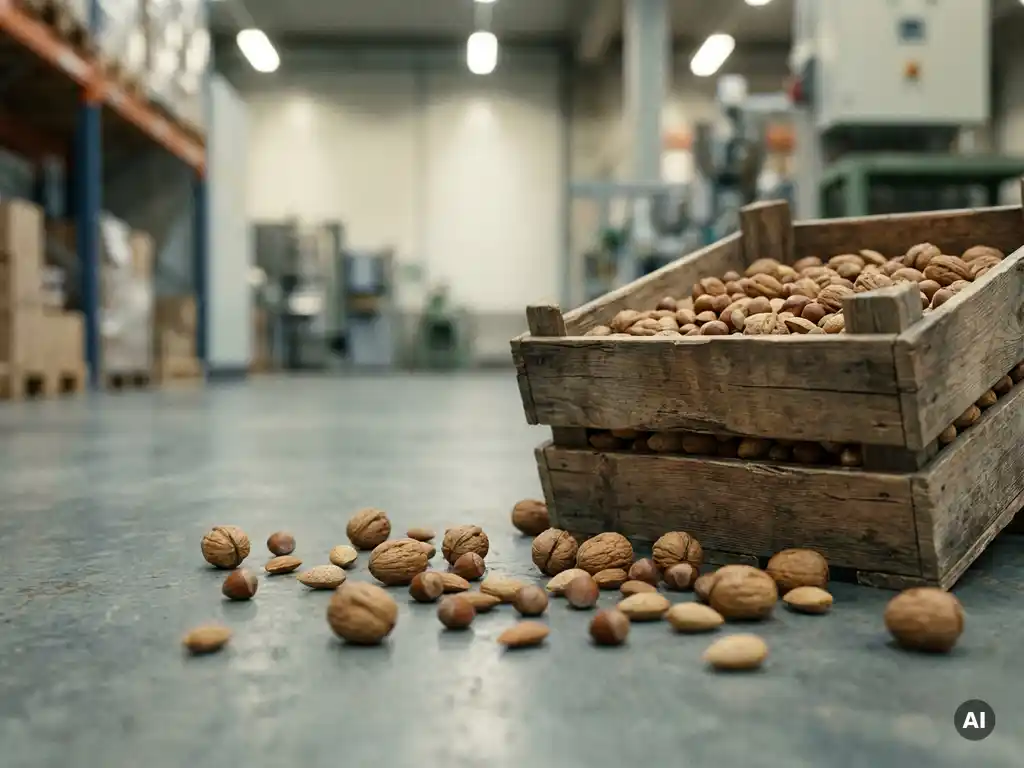
A storage location is suitable for nuts if it can maintain a stable temperature of approximately 10 to 15 degrees Celsius and a relative humidity of no more than 65 percent, combined with a dry, clean, and well-ventilated space. This applies to all common types of nuts, from cashews to walnuts and peanuts. The questions below will help you assess, step by step, whether your current location meets these requirements.
What conditions do nuts need during storage?
During storage, nuts require a stable, dry environment with a temperature between 10 and 15 degrees Celsius and a relative humidity not exceeding 65 percent. Under these storage conditions, nuts remain fresh longer, the fat retains its quality, and mold growth is prevented. Good air circulation is just as important as the temperature itself.
Nuts naturally contain a high percentage of unsaturated fats. These fats are susceptible to oxidation, which means that heat, moisture, and oxygen degrade their quality. The more stable the storage environment, the longer the shelf life and the better the taste and texture are preserved.
In addition to temperature and humidity, the following factors also play a role:
- Air circulation: stagnant, humid air promotes mold formation on the outside of packaging and products.
- Exposure to light: direct sunlight accelerates the oxidation of the fats present.
- Odor insulation: nuts easily absorb foreign odors from the environment, which harms product quality.
- Hygiene: pests and dust are direct risks to food safety and certification.
What are the risks of improper storage conditions for nuts?
Incorrect storage conditions for nuts lead to loss of quality, economic damage, and possible rejection upon inspection. The greatest risks are mold formation, rancidity due to fat oxidation, and contamination with aflatoxins, a group of toxic mold compounds that can develop under insufficiently dry storage conditions.
Aflatoxins pose a particularly serious risk to nuts. They are produced by certain molds that thrive in high humidity and heat. Batches containing excessive aflatoxin levels are rejected by the NVWA and European authorities and are not permitted to enter the food chain. This results not only in direct product losses but also reputational damage to buyers such as supermarket purchasers and processing plants.
Rancidity is another common problem. When nuts are exposed to excessively high temperatures or fluctuating conditions, the oxidation of the fats present accelerates. The result is an unpleasant taste and smell that makes the product unsaleable, even if the packaging appears outwardly intact.
How do you check if a storage location provides the correct temperature and humidity?
You check a storage location for suitability for nuts by verifying whether continuous monitoring of temperature and humidity takes place, preferably with recorded measurement data that can be consulted afterwards. A location without automated monitoring or logbooks cannot guarantee the actual storage conditions.
Perform the following steps during an assessment:
- Request measurement reports: a reliable storage location has historical temperature and humidity data for the storage area. If these are not available, that is an immediate point of attention.
- Check the configuration options: can the space be adjusted to the specific requirements of your product, or is it a fixed setting for all goods?
- Assess the ventilation: walk through the space and note air circulation, damp spots on walls or floors, and any condensation near doors or loading docks.
- Alarm response question: what happens if the temperature or humidity falls outside the set margins? Is there a protocol and who is responsible?
- Check the separation of product categories: are nuts stored together with products that emit strong odors or require a different optimal storage temperature?
Which certifications must a nut storage location have?
A storage facility that stores nuts for the food industry must hold at least a BRC (British Retail Consortium) certification for food safety. For organic nuts, a SKAL certification is required. Without these certifications, most supermarket buyers and processing plants do not accept the products into their supply chain.
BRC is the most sought-after standard in the European food sector for food storage facilities. The certificate covers, among other things, hygiene protocols, traceability, pest control, and quality management. For nuts intended for the organic market, the storage facility must additionally be SKAL-certified to ensure the organic status of the product is safeguarded throughout the entire chain.
Also check whether the location is connected to NVWA supervision and whether there are procedures for import and export inspections. Especially for consignments imported from non-EU countries, this is a requirement for legal trade within Europe.
What is the difference between cold storage and dry storage for nuts?
Cold storage actively brings products back to low temperatures, often below 8 degrees Celsius, and is intended for fresh and perishable products with a short shelf life. Dry storage for nuts, also known as ambient storage, keeps the temperature stable at around 10 to 15 degrees without active cooling, which is more cost-effective and better suits the storage characteristics of nuts.
For most nut varieties, cold storage is unnecessary and even undesirable. Condensation caused by temperature fluctuations, for example when refrigerated products are moved to a warmer room, increases the risk of moisture absorption. Dry storage at a controlled ambient temperature aligns better with the physical properties of nuts and avoids unnecessary costs for cooling capacity that does not benefit the product.
The choice for dry storage of nuts is therefore not only a technical but also an economic consideration. Ambient storage offers the right conditions without the energy costs and logistical complexity of a cold room.
When is it time to switch storage locations?
It is time to switch storage locations when you observe structural quality problems upon arrival at the customer, when the location cannot meet your customers' certification requirements, or when there is no demonstrable monitoring of storage conditions. One-off incidents can be resolved, but recurring problems indicate a structural shortage.
Signs indicating an unsuitable storage location for notes include:
- Disapprovals or complaints from customers regarding the taste, smell, or appearance of the product.
- Elevated aflatoxin levels in laboratory analysis of samples.
- Inability of the location to demonstrate or renew BRC or SKAL certification.
- No availability of historical measurement data on temperature and humidity.
- Varying storage conditions due to shared spaces with products that have different climate requirements.
Changing storage locations is a logistical decision that must be carefully prepared, but in practice, delay costs more than the switch itself. Loss of quality, rejected batches, and reputational damage among supermarket buyers or processing plants outweigh the temporary inconveniences of a transition.
How ZZColdstores helps with nut storage
ZZColdstores offers ambient storage, specifically designed for dry and non-perishable food products such as nuts, peanuts, seeds, and dried fruit. The storage facilities in Kruiningen and Vlissingen are designed for a stable, dry, and clean storage environment, without unnecessary cooling capacity. This makes storage cost-efficient and technically suitable for the storage characteristics of nuts.
What ZZColdstores specifically offers for nut storage:
- Controlled storage environment at the correct temperature and humidity, tailored to your product specifications.
- BRC and SKAL certification, so that your batches meet the requirements of supermarket buyers and organic chains.
- Quality control upon arrival, including inspection for damage, labeling, and product condition.
- Barcode-driven traceability per pallet, with linking of LOT numbers and grower information.
- Flexible capacity of 12,000 pallet spaces in the dry storage warehouse, with separate areas per product category.
- Own transport for shuttle services within a radius of 40 kilometers around Kruiningen.
Do you want to know if your nuts or other dry food products end up in the right location at ZZColdstores? Contact us for a no-obligation consultation about your storage needs.
Frequently Asked Questions
How long do nuts keep if stored correctly?
At a stable temperature of 10 to 15 degrees Celsius and humidity below 65 percent, most types of nuts can be stored for six to twelve months without noticeable loss of quality. The exact shelf life varies by type: walnuts and peanuts are more susceptible to oxidation than, for example, cashews or almonds. Always store nuts in closed, airtight containers to maximize shelf life.
What is the difference in storage requirements between different types of nuts?
The basic requirements for temperature and humidity are similar for most nut varieties, but there are nuanced differences in sensitivity. Walnuts and pine nuts contain relatively high levels of polyunsaturated fats and become rancid faster than cashews or macadamias. Furthermore, peanuts are particularly susceptible to aflatoxin contamination due to their botanical characteristics, making strict humidity control even more critical for this species than for other nuts.
Can I also temporarily store nuts in a regular warehouse if the conditions are not ideal?
Temporary storage in a non-specialized warehouse is possible for very short periods, but entails immediate risks, especially if humidity or temperature is not demonstrably monitored. Even a period of a few weeks at excessive humidity can lead to mold formation or the onset of grease oxidation, which is irreversible afterwards. For commercial batches destined for supermarket chains or processing plants, non-certified storage is not an acceptable option in practice.
How do I prevent odor transfer when storing nuts next to other products?
You can prevent odor transfer by storing nuts physically separated from strongly scented products such as spices, coffee, onions, or cleaning agents. When considering a storage location, always inquire about the layout of the space and which other product categories are stored in the same warehouse. Sealed packaging offers some protection but is not a guarantee: nuts can absorb odors even through cardboard boxes during prolonged exposure.
What should I do if I suspect that a batch of nuts has been exposed to excessive humidity during storage?
In case of doubt, always have a laboratory analysis performed on aflatoxin and free fatty acid content before the batch is resold or processed. Visual inspection alone is insufficient, as mold growth and oxidation are not always visible on the outside of the packaging or the product. Document the measurement data from the storage period and contact the storage location for a written statement regarding the storage conditions so that you can prove liability if necessary.
What questions should I ask when selecting a new storage location for notes?
At a minimum, inquire about the availability of historical climate data, existing certifications (BRC and possibly SKAL), the protocol for climate deviations, and the separation of product categories within the warehouse. Also inquire about the traceability systems the location uses, such as linking LOT numbers to pallets, and whether the location has experience with the specific storage characteristics of nuts and other dry food products. A location that cannot answer these questions transparently poses a risk to your product quality and customer satisfaction.
Is SKAL certification mandatory if I store both organic and conventional nuts?
SKAL certification is mandatory for the storage of organic nuts if that organic status is to be maintained throughout the supply chain. If you store both organic and conventional nuts at the same location, these batches must be kept physically separated and administered separately to prevent mixing and loss of status. A storage location without SKAL certification may physically store organic nuts, but the products will lose their organic certification, rendering them unsaleable in organic retail chains.
Related articles
- How much does it cost to rent a storage unit?
- Which checks are important when storing imported food products?
- What happens in the event of a temperature deviation during cold storage?
- What is the difference between ambient storage and room temperature storage?
- How do you recognize insect infestation in stored nuts or garlic?