
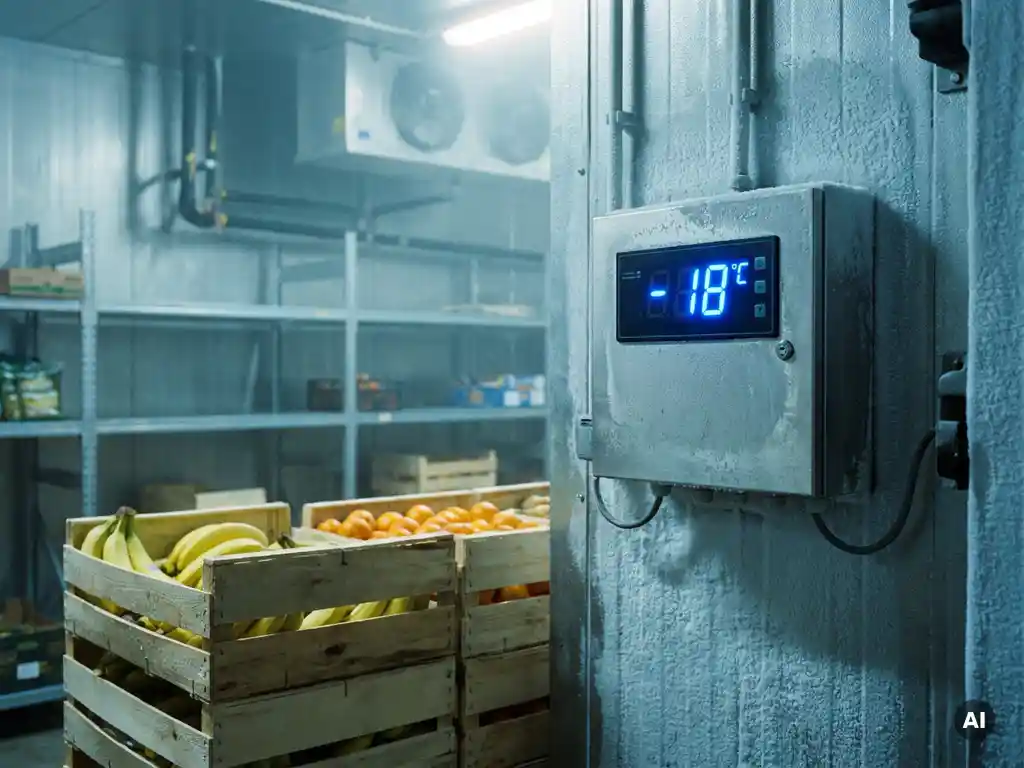
The temperature during cold storage is controlled via automated cooling systems that continuously measure, regulate, and adjust based on pre-set parameters. Sensors register the temperature in the cold room and control compressors, fans, and valves to maintain the desired climate. For fresh and delicate products such as exotic fruit, this continuous monitoring is essential to prevent loss of quality. The questions below delve deeper into exactly how this works, from the technology behind the systems to the requirements that certifications place on temperature recording.
Which systems regulate the temperature in a cold storage facility?
The temperature in a cold storage facility is regulated by a combination of refrigeration units, sensors, control computers, and ventilation systems that together form a closed climate control system. The control computer continuously compares the measured temperature with the set target value and automatically adjusts the refrigeration system. This process repeats continuously, even outside office hours.
The cooling system itself typically consists of compressors that circulate a refrigerant. This refrigerant extracts heat from the air in the cell and releases that heat outside the building. Fans ensure even air circulation within the space, preventing the formation of hot spots where products spoil more quickly. Temperature sensors are placed at multiple points in the cell, not only near the entrance but also deeper into the storage area, so that the measurement is representative of the entire space.
Modern cold storage facilities connect these systems to a central management environment, also known as a Building Management System (BMS) or a specific cold storage management system. This allows operators to remotely view the status of each cell and intervene if necessary. Alarms are automatically sent in the event of deviations, ensuring the team is always notified in a timely manner.
How accurately can the temperature in cold storage be set?
In professional cold storage, the temperature can typically be set with an accuracy of plus or minus 0.5 to 1 degree Celsius relative to the target value. The exact accuracy depends on the quality of the refrigeration system, the insulation of the cell, and the stability of the load. The less the doors are opened, the more stable the climate remains.
For products sensitive to small temperature fluctuations, such as bananas or citrus fruits, this precision is of great importance. Bananas ripen quickly at temperatures above the recommended storage temperature and can suffer cold damage if the temperature is too low. Citrus fruits require a similarly precise regime. A setting of, for example, 13 degrees Celsius for bananas requires a system that does not structurally overshoot to 15 or 11 degrees.
Flexible cell settings are a requirement for this. A cold storage facility that stores multiple product types simultaneously must be able to maintain a different temperature in each cell without the cells influencing one another. Good insulation between cell walls and separate cooling circuits per zone are technical prerequisites for this.
What happens if the temperature in a cold room deviates?
If the temperature in a cold storage cell deviates from the set value, the system triggers an alarm and attempts to automatically correct the installation. If this is not successful within a certain margin or time frame, the operational team is alerted so they can intervene immediately. Depending on the severity of the deviation, products are temporarily moved or a technician is called in.
The causes of a temperature deviation can vary. A common cause is a malfunction in the refrigeration unit or a leak in the cooling circuit. Frequent opening of cell doors, a recently arrived load that is too warm, or a defective sensor can also affect the measured temperature. Therefore, it is important to distinguish between an actual temperature rise in the cell and a measurement that gives a false reading due to a defective sensor.
In practice, deviations are recorded in a logbook or data logger. This recording is not only operationally relevant but is also mandatory in the context of food safety certifications. Every incident involving a temperature deviation must be demonstrably followed up, including the measures taken and the restoration of the desired temperature.
How does temperature control differ by product type?
Temperature control varies by product because each product has its own optimal storage temperature and reacts differently to deviations. Bananas are typically stored at around 13 to 14 degrees Celsius, while citrus fruits tolerate slightly lower temperatures. Nuts and seeds require dry conditions with a stable ambient temperature, but no active cooling to just above zero.
Chilled products: exotic fruit
Fresh tropical fruits are particularly sensitive to both excessively high and excessively low temperatures. Being too warm accelerates the ripening process and shortens the shelf life. Being too cold causes cold damage, visible as discoloration or soft spots. The storage temperature must therefore be tailored to the specific fruit and the desired stage of ripening upon arrival.
Dry products at room temperature
Nuts, peanuts, and seeds are not refrigerated but stored in so-called ambient storage, where the temperature is kept stable at approximately 11 degrees Celsius. Here, temperature control is aimed at preventing mold formation and slowing down oxidation, not at inhibiting a biological ripening process. Humidity requirements in this segment are at least as important as the temperature itself.
What role does humidity play besides temperature in cold storage?
Humidity plays just as important a role as temperature in the cold storage of fresh products. Humidity that is too low leads to moisture loss in the product, resulting in weight loss and loss of quality. Humidity that is too high promotes mold growth and bacterial development. For optimal cold storage, temperature and humidity are always regulated in conjunction.
For exotic fruit, the correct humidity is crucial for presentation and shelf life upon arrival at the customer. Products stored too dry lose weight and look less appealing. Products stored too humid risk condensation, which promotes mold growth. The ideal humidity varies by product, but for most fresh fruit, it lies between 85 and 95 percent relative humidity.
Modern climate control regulates humidity via humidifiers or dehumidifiers integrated into the ventilation system. As with temperature, measurements are continuously compared with the set target values and automatically adjusted. Humidity control is particularly relevant during container unloading, as products are transferred from a different climate to the storage cell and conditions can change rapidly.
How is temperature control verified for certification?
Temperature control is verified for certification through continuous data recording, periodic inspections, and documentation of deviations and corrective measures. Certifications such as BRC require that temperature data be demonstrably recorded, stored, and available for audit. Data loggers or calibrated sensors provide the evidence for this.
BRC is an internationally recognized food safety standard that sets strict requirements for the control of storage conditions. BRC-certified cold storage facilities must be able to demonstrate that the temperature in every cell is continuously measured, that sensors are regularly calibrated, and that deviations are documented, including the actions taken. Auditors check not only the systems but also the procedures and their practical compliance.
In addition to BRC, there are supplementary requirements for specific product streams. SKAL certification is relevant for organic products and sets requirements for the separation of certified and non-certified streams. KCB, part of the NVWA, conducts import inspections for fresh fruit and vegetables and verifies whether products meet the phytosanitary requirements for the European market. Temperature recording also plays a role in these inspections as proof that the cold chain has remained intact during transport and storage.
How ZZColdstores manages cold storage for fresh and perishable products
ZZColdstores offers climate-controlled cold storage in Kruiningen and Vlissingen, specifically designed for fresh and perishable products such as exotic fruit. The approach focuses on reliability, traceability, and flexibility for B2B partners in food logistics. What that means in concrete terms:
- Temperature and humidity are monitored and regulated 24/7 via advanced systems
- Each cell is flexibly adjustable, tailored to the specific requirements of the product
- In Vlissingen, ZZColdstores has its own quay directly next to the cold storage facility, ensuring the transition from ship's hold to refrigerated storage is minimal
- Every pallet is fully traceable via a barcode system, from arrival to departure
- Quality checks upon arrival, including temperature and humidity measurements, are carried out according to the agreed product specifications
- ZZColdstores is certified according to BRC and SKAL and collaborates with KCB for import inspections
Would you like to know if ZZColdstores' cold storage meets your product specifications and logistical requirements? Contact us for a no-obligation consultation.
Frequently Asked Questions
How long does it take for a cold storage unit to reach the correct temperature after receiving a new shipment?
The time a cold storage cell requires to restore the desired temperature after the arrival of a new shipment depends on the mass and initial temperature of the products, the capacity of the cooling system, and the insulation quality of the cell. In practice, this can vary from a few hours to a full day for large, warm shipments. It is therefore important to deliver products chilled whenever possible and not to exceed the cell capacity, so that the climate stabilizes quickly and quality loss is limited in the first few hours after arrival.
What is the difference between a data logger and a calibrated sensor, and which one do I need for my certification?
A data logger is a device that records and stores temperature and humidity measurements at regular intervals, whereas a calibrated sensor is a measuring instrument whose accuracy is periodically checked and certified against a recognized reference standard. For certifications such as BRC, both elements are required: the sensor must be demonstrably calibrated, and the data logger must provide continuous, traceable records available to auditors. Without a calibration report, the measurement data is legally and certifiably insufficient as evidence.
Can I store products with different temperature requirements in the same cold storage without them affecting each other?
Yes, that is possible provided the cold storage facility has separate cells with independent cooling circuits and good thermal insulation between the cell walls. Each product requires its own climate zone: bananas at approximately 13-14°C, citrus fruits slightly cooler, and dry products such as nuts at ambient temperature around 11°C. When choosing a cold storage partner, ensure that the cells are individually adjustable and that no heat transfer occurs between adjacent zones, as even small temperature differences can cause noticeable quality differences in sensitive products such as exotic fruit.
How do I know if the cold chain remained intact during transport to the cold storage?
The integrity of the cold chain during transport is typically demonstrated via transport data loggers that record temperature data throughout the entire journey, combined with a temperature measurement upon arrival at the cold storage facility. During import inspections by authorities such as KCB, this data is used as proof that products have been transported within the permitted temperature margins. Always request a temperature report per shipment from your logistics partner and check visually and instrumentally upon arrival for signs of cold damage or premature ripening, as these may indicate a broken cold chain.
What common mistakes should I avoid when choosing a cold storage partner for exotic fruit?
A common mistake is focusing solely on the price per pallet space without verifying whether the technical infrastructure meets the specific requirements of the product. Always check whether the cold storage partner offers flexibly adjustable cells, continuous monitoring, certified measuring equipment, and relevant certifications such as BRC and SKAL. Additionally, the location relative to the unloading point is important: the shorter the transition from the ship's hold or truck to refrigerated storage, the lower the risk of temperature fluctuations that negatively affect the quality of fragile products such as tropical fruit.
How often do temperature sensors in a cold storage facility need to be calibrated?
The calibration interval for temperature sensors in a cold storage facility is typically once a year, but may be required more frequently depending on certification requirements or internal quality procedures. BRC stipulates that the calibration frequency be determined on a risk-based approach: sensors in critical zones or with a higher risk of drift are checked more often. It is advisable to have a certificate issued by a recognized calibration agency after each calibration and to retain these documents for at least three years, so that you can always provide complete historical evidence during an audit.
What should I do if my product has an abnormal temperature upon arrival at the cold storage?
If a product has a temperature upon arrival that deviates from the expected value, the first thing you must do is perform a quality control and document the deviation with the time, measured temperature, and product identification. Next, inform your cold storage partner so that they can adjust the storage unit and the cooling process to the actual starting temperature of the shipment. Depending on the degree of deviation and the product type, it may be necessary to inform the buyer or request an additional inspection, especially if the deviation indicates a broken cold chain that could affect the shelf life or phytosanitary approval of the shipment.
Related articles
- How does warehousing work after the arrival of a sea container?
- How does inventory tracking work within a warehouse?
- How does packaging quality affect the shelf life of dried fruit?
- What are the customs tariffs for importing nuts from Vietnam in 2026?
- How does ambient storage for nuts and dried fruit work?