
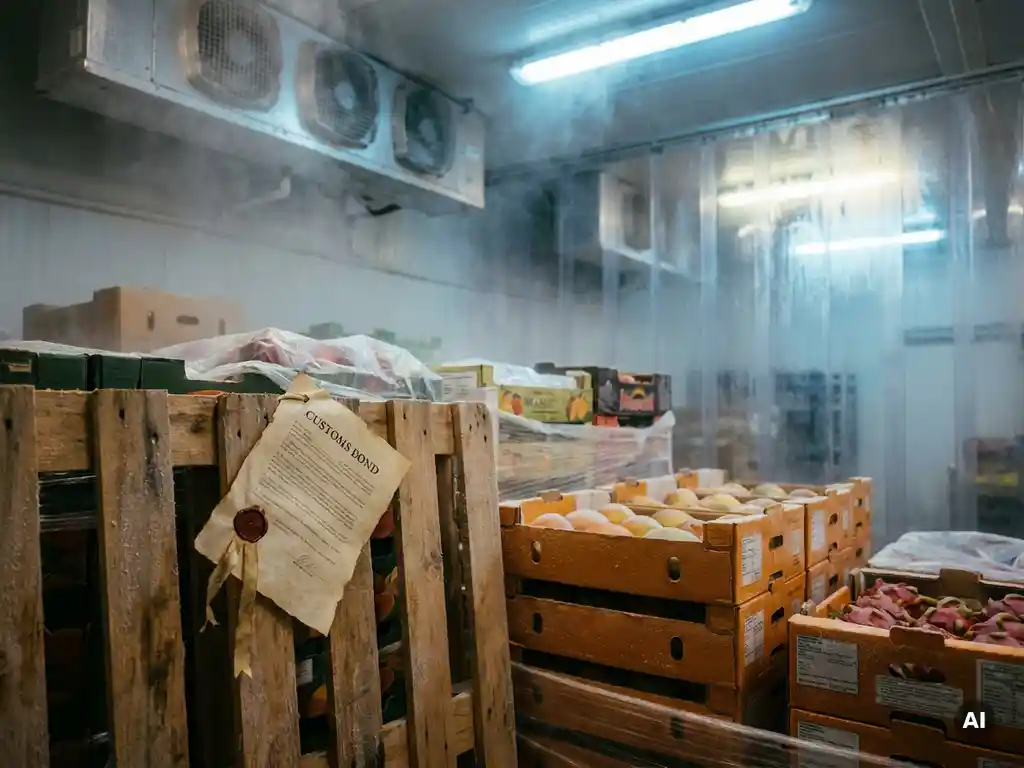
A bonded warehouse, also known as a customs bonded warehouse or customs storage facility, differs from a regular warehouse in that goods are stored there without import duties or excise taxes being paid immediately. The duties due are only remitted when the goods leave the customs storage facility and enter the European market. A regular warehouse has no customs status: goods have already been cleared and are freely tradable. This distinction is a crucial consideration for importers, wholesalers, and logistics managers in the Rotterdam-Antwerp corridor when structuring their supply chain.
What are you allowed to store in a bonded warehouse?
Goods that have not yet been cleared for the European market may be stored in a bonded warehouse. This typically concerns products from outside the EU, such as nuts, seeds, grains, dried fruit, and other dry food products, but also non-food goods. The goods are under customs supervision and may not be traded or processed without permission from customs.
Within a customs warehouse, strict rules apply regarding which operations are permitted. Limited processing such as sorting, packaging, labeling, and sampling are generally permitted, provided that customs has granted permission. More extensive processing, such as the transformation of raw materials into finished products, falls outside standard customs storage and requires a different customs procedure, such as inward processing.
Goods subject to excise duty, such as tobacco and alcohol, are stored in a specific type: the excise warehouse. This is a separate category within customs legislation and has its own licensing requirements. For dry food products such as nuts and seeds, a regular customs bonded warehouse is the appropriate route in most cases.
How does customs warehousing work in a bonded warehouse?
Customs warehousing in a bonded warehouse operates via a system whereby goods are placed under suspension of import duties. The goods are declared to customs, assigned a customs status, and physically stored in an approved storage location. As long as the goods remain in the bonded warehouse, no import duties accrue. The duties are only calculated and paid upon release for free circulation.
The process proceeds broadly as follows:
- The goods arrive in the EU port, for example via Vlissingen or Rotterdam, and are declared to customs.
- A customs declaration is submitted for placement under the customs procedure “storage” (customs warehouse).
- The goods are physically transferred to the approved bonded warehouse and registered there in the warehouse keeper's records.
- During the storage period, the warehouse keeper maintains accurate records of all incoming and outgoing goods.
- At the time of release, the goods are cleared: the importer pays the applicable import duties and VAT, after which the products are freely tradable within the EU.
The warehouse keeper bears legal responsibility for the goods as long as they are under customs supervision. This requires accurate records and regular coordination with Customs.
What are the advantages of a bonded warehouse compared to conventional storage?
The most important advantage of a bonded warehouse compared to conventional storage is the deferred payment of import duties. This significantly improves the liquidity position of importers and wholesalers, as they only pay when the goods are actually sold or processed. For parties that purchase large volumes and hold them in stock, this can yield a substantial financial benefit.
Other benefits are:
- Destination flexibility: Goods can be forwarded from the bonded warehouse to other EU countries or even re-exported outside the EU without import duties being paid. This makes the supply chain more flexible.
- Avoiding unnecessary duties: If goods ultimately do not enter the EU market but are re-exported, no import duties are paid at all.
- Cross-border inventory management: Importers can maintain larger inventories without immediately bearing the full customs burden, enabling purchasing optimization.
- Centralized logistics: In a bonded warehouse, goods can be bundled, sorted, and distributed to multiple destinations, which increases logistical efficiency.
When is a standard warehouse the better choice?
A standard warehouse is the better choice when goods have already been cleared and need to be immediately available for the European market. For parties working with regular customers, short lead times, and products that flow quickly, a regular warehouse offers fewer administrative burdens and more operational freedom. Customs formalities have already been handled, allowing goods to be processed, traded, or shipped immediately.
Conventional storage is also more practical when the quantity of goods is relatively small or when the storage period is short. In such cases, the administrative obligations of a bonded warehouse, such as maintaining customs records and applying for a permit, do not outweigh the financial benefits of deferred duties. Therefore, for dry food products intended for direct delivery to supermarket chains or processing plants in Europe, a conventional warehouse is often the most pragmatic solution.
In addition, not all storage locations hold a customs license. A warehouse without customs status generally offers more flexibility in daily operations, as there is no customs supervision of goods movements.
Which certifications and permits apply to bonded warehouses?
A bonded warehouse must hold a license from the national customs authority, in the Netherlands the Customs (part of the Tax and Customs Administration). This license is issued after an assessment of the company's records, the physical storage location, and the reliability of the applicant. Without this license, a warehouse may not function as a customs bonded warehouse.
In addition to the customs license, bonded warehouses storing food products are subject to additional food safety requirements. Relevant certifications include:
- BRC (British Retail Consortium): An internationally recognized standard for food safety, which is required by many supermarket chains and retailers from their logistics partners.
- SKAL: Certification for the storage and transport of organic products, required when organically certified goods are stored.
- KCB/NVWA: Quality inspection for fresh products such as vegetables and fruit is carried out in the Netherlands by the KCB, part of the NVWA. An import inspection is mandatory for the import of certain fresh products.
For the storage of excise goods, such as alcohol or tobacco, a separate license for an excise warehouse is required. This is a different legal category from a regular customs bonded warehouse and has its own administrative obligations.
How much does it cost to use a bonded warehouse?
The costs of a bonded warehouse consist of several components: storage costs per pallet space or per m³, costs for customs administration and declarations, and any costs for value-added services such as quality control, labeling, or repalletization. The exact rates vary by location, volume, and type of goods.
In addition to direct storage costs, there are indirect costs to take into account. Customs declarations upon entry and exit require the involvement of a customs broker or an internal customs department, which entails additional costs. The administrative obligations of the bonded warehouse operator are also passed on in the rates.
Offsetting these costs is the financial benefit of deferred import duties. For products subject to high import duties, such as certain nuts or seeds, this benefit can more than offset the additional costs of customs storage. It is advisable to compare the total costs of bonded warehousing with the costs of standard storage plus immediate duty payments to determine which option is financially more favorable for the specific situation.
How do you choose the right bonded warehouse partner?
The right bonded warehouse partner possesses the necessary customs license, relevant food safety certifications, and demonstrable experience with the product categories you wish to store. Additionally, the location of the warehouse relative to the ports of arrival and the final destinations is a determining factor for logistical efficiency and transport costs.
Pay attention to the following aspects when selecting a partner:
- Licenses and certifications: Check whether the partner holds a valid customs license and the certifications relevant to your products, such as BRC, SKAL, or KCB/NVWA approval.
- Location and accessibility: A location in the Rotterdam-Antwerp Corridor offers direct access to the largest European import ports and reduces transport time and costs.
- Flexibility: Can the partner adapt to fluctuating volumes, seasonal peaks, and specific requirements per product type?
- Administrative support: Does the partner provide support with customs administration, or do you need to engage an external freight forwarder for this?
- Additional services: Think of quality control, labeling, repalletization, and EDI connections with your own systems.
A good partner is transparent about their rates, working methods, and responsibilities, and actively helps think about the optimization of your supply chain instead of just renting out storage space.
How ZZColdstores helps with dry storage and warehousing
From locations in Kruiningen and Vlissingen, ZZColdstores offers both refrigerated and ambient storage for dry food products. The dry storage facilities are specifically designed for products such as nuts, peanuts, seeds, grains, flakes, and dried fruit, stored in a stable, dry, and clean environment without unnecessary cooling capacity. This keeps costs manageable while ensuring quality is maintained throughout the entire storage period.
For importers, wholesalers, and logistics service providers, ZZColdstores offers, among other things:
- Dry ambient storage with approximately 12,000 pallet spaces, tailored to dry food products
- Quality control upon arrival, including temperature, humidity, and Brix measurements
- Unloading, loading, and repalletizing containers, also for bulk goods
- Labeling, barcode-driven traceability, and EDI connections with customer systems
- Own transport for shuttle runs within a 40 km radius of Kruiningen
- Import inspection via KCB/NVWA and customs clearance
Would you like to know if ZZColdstores is the right partner for your dry storage or warehousing needs? Contact us for a no-obligation discussion about the possibilities.
Frequently Asked Questions
How long may goods be stored in a bonded warehouse?
In principle, there is no legally established maximum storage duration for goods in a customs warehouse within the EU, but in practice, the customs authority may set time limits or conduct periodic checks. It is advisable to coordinate in advance with your bonded warehouse partner and your customs broker regarding which time limits are realistic in your specific situation. Also, bear in mind that long-term storage of food products such as nuts and seeds entails product-specific shelf-life requirements that are separate from customs regulations.
What happens if a shortage or damage to goods is detected in the bonded warehouse?
If a discrepancy is found between the registered and the physically present quantity of goods, the warehouse keeper is legally responsible, and Customs may still impose the applicable import duties. It is therefore crucial that the warehouse keeper maintains accurate and up-to-date records and performs a thorough quality and quantity check upon arrival. As an importer, it is advisable to always receive a detailed receipt report upon entry and to immediately record any discrepancies in writing.
Can I forward goods directly from a bonded warehouse to another EU country without clearing them first?
Yes, this is possible via an external customs transit procedure, whereby goods are moved under customs supervision to a recognized bonded warehouse in another EU country without import duties being paid. This makes a bonded warehouse at a port of arrival such as Rotterdam or Vlissingen particularly attractive as a central distribution point for the entire European market. However, this requires the correct customs documents and a reliable freight forwarder who handles the transit shipment correctly.
Do I need my own customs license as an importer, or is the bonded warehouse license sufficient?
As an importer, in most cases you do not need your own customs license for the bonded warehouse; the bonded warehouse operator's license covers the storage of your goods. However, as the declarant, you are responsible for the customs declaration upon entry and exit, for which you typically engage a customs broker. It is advisable to make clear agreements in advance regarding who assumes which customs obligations, so that there is no ambiguity regarding responsibilities and liability.
What is the difference between a Type I and Type II customs warehouse, and which type is relevant to me?
In a Type I customs warehouse, responsibility for administration and customs debt lies with the warehouse operator themselves; in a Type II warehouse, this responsibility lies with the user (the importer) who manages their own goods. For most importers and wholesalers who use an external storage partner, a Type I warehouse is the standard situation: the warehouse operator manages the administration and bears the responsibility. Type II is more suitable for larger companies that wish to conduct their own customs administration internally.
What common mistakes should I avoid when using a bonded warehouse?
A common mistake is underestimating administrative obligations: incorrect or incomplete customs declarations can lead to fines or the subsequent imposition of import duties. Additionally, importers sometimes forget to engage a customs broker in a timely manner, causing goods to remain in the port unnecessarily long and incurring extra costs. Also, ensure you clearly understand in advance which processing operations are permitted in the bonded warehouse, so that you do not face surprises at customs afterwards.
How do I start if I want to use a bonded warehouse for my dry food products for the first time?
The first step is mapping out your flow of goods: which products do you import, from which country, in what volumes, and to which destination? Based on this, you can determine whether bonded warehousing is financially advantageous and which certifications the storage partner must have. Next, contact a potential bonded warehouse partner and a customs broker so that you have both the logistical and customs aspects of the process well organized before the first shipment arrives.
Related articles
- What data is recorded during the storage of foodstuffs?
- What is cross-docking and when is it an alternative to buffer storage?
- What is dry storage and when do you need it?
- How does a logistics partner ensure continuous delivery to your factory?
- Why is conditioned storage better than a regular warehouse for nuts?