
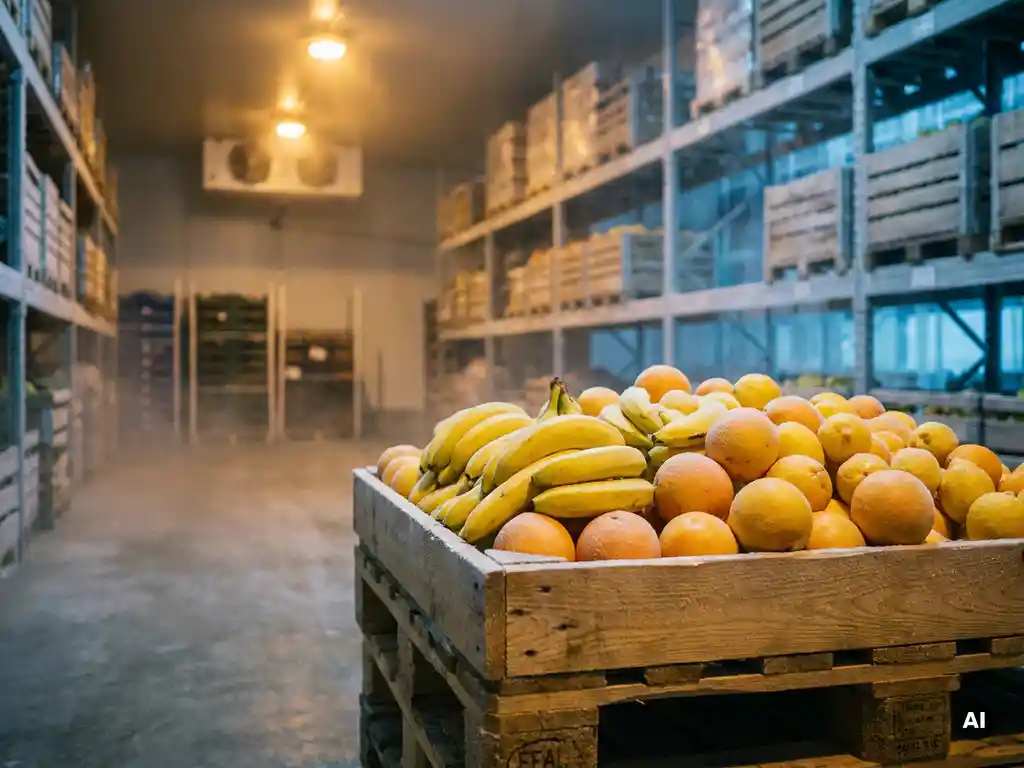
Yes, warehousing is ideally suited for temporary storage. Companies utilize an external warehouse when they temporarily need extra storage capacity, for example during seasonal peaks, delayed deliveries to customers, or a transition between two logistics links. This applies to both refrigerated and dry products. The questions below provide a complete picture of what temporary warehousing entails and when it is the right choice.
What are the benefits of temporary warehousing?
Temporary warehousing offers companies the opportunity to utilize storage capacity without fixed obligations. Instead of investing in your own warehouse space, you rent capacity when you need it. This provides flexibility in the supply chain and prevents products from being in transit for too long or waiting in the wrong place.
The main benefits at a glance:
- Flexible capacity: You scale up and down based on season, demand, or ship arrival, without fixed costs for your own storage.
- Faster turnaround times: A well-positioned warehouse, for example directly on a quay, reduces the time between unloading and storage to a minimum.
- Quality preservation: Products temporarily stored under the correct temperature and humidity conditions remain fresh and saleable for longer.
- Access to additional services: Many warehouse partners offer quality control, labeling, and traceability as part of the storage process.
- Lower risks: You are not dependent on your own infrastructure and can adapt quickly to changes in the market or the sailing schedule.
For importers, wholesalers, and suppliers of fresh food products, temporary warehousing is therefore not a stopgap solution, but a conscious choice within an efficient logistics chain.
How long can you keep goods in temporary storage?
The storage duration for temporary warehousing is in principle flexible, but in practice is determined by the type of product, the agreements with the warehouse partner, and the potential customs status of the goods. For fresh products such as exotic fruit, a shorter period applies due to their limited shelf life. Dry products such as nuts, peanuts, or seeds can generally be stored for longer.
In practice, logistics managers distinguish three situations:
- Short term (days to a few weeks): Customary for transshipment from a seagoing vessel to distribution. The goods await further loading instructions or the appropriate transport option.
- Medium term (weeks to several months): Relevant for seasonal products that are purchased in bulk and gradually delivered to customers such as supermarket purchasing organizations or processing plants.
- Longer term (several months): Possible for dry, stable products, provided the storage conditions are correct. This requires clear agreements regarding stock rotation and traceability.
Please note that specific rules apply to the maximum storage duration in a customs warehouse for goods under customs supervision. You can find more information about this later in this article.
What is the difference between dry storage and refrigeration in temporary warehousing?
The difference between dry storage and refrigerated storage lies in the climatic conditions and the type of product that can be stored. Dry storage, also known as ambient storage, stores products at a constant temperature without active cooling, typically around 11 degrees Celsius. Refrigerated storage actively and continuously regulates temperature, humidity, and air circulation.
Dry storage: stable and suitable for durable products
Dry storage is ideal for products that do not require extreme refrigeration but do require a constant, controlled environment. Think of nuts, peanuts, seeds, and other dry food products. The storage temperature of approximately 11 degrees prevents spoilage and mold formation without the energy costs of full refrigeration.
Climate-controlled cooling: necessary for fresh products
For fresh, delicate products such as bananas, citrus fruits, and other exotic fruits, climate-controlled cooling is indispensable. Here, temperature and humidity are monitored and adjusted 24 hours a day. Even a slight deviation in conditions can lead to loss of quality, accelerated ripening, or spoilage. The choice to use cooling is therefore not optional, but a requirement for maintaining quality.
When choosing between dry and refrigerated warehousing, you first determine the conditions your product requires, and then which location and partner can best provide them.
When is temporary storage via an external warehouse the best choice?
Temporary storage via an external warehouse is the best choice when your own storage capacity is insufficient, when products require specific climate control that you cannot provide yourself, or when the logistics chain needs a buffer. This is particularly relevant for imports from non-European countries, seasonal purchasing, and deliveries to multiple customers simultaneously.
Concrete situations in which external temporary warehousing is preferred:
- A seagoing vessel docks and the goods must be unloaded and stored immediately, while the final destination is not yet ready for receipt.
- You purchase large volumes during the harvest season and deliver to supermarket chains or processing plants over several weeks.
- Your product requires an import inspection or quality control before it moves further up the chain.
- You want to decouple the supply chain from the sailing schedule, so that delays at sea do not have a direct impact on delivery to customers.
- You temporarily need more space than your own facilities offer, without entering into long-term rental obligations.
For logistics managers and buyers at trading houses and agri-food companies, external warehousing is therefore a strategic instrument, not merely an operational emergency measure.
Which certifications are important when choosing a temporary storage partner?
When choosing a temporary storage partner, certifications are a reliable indicator of quality, food safety, and compliance with regulations. The most relevant certifications for food product warehousing are BRC, SKAL, and KCB/NVWA accreditation.
- BRC (British Retail Consortium): An international food safety standard that demonstrates that the warehouse meets strict requirements regarding hygiene, temperature control, and traceability. Many supermarket purchasing organizations require BRC certification.
- SKAL: Relevant for companies that store or trade organic products. SKAL certification guarantees that organic products are stored separately and that their organic status is maintained.
- KCB/NVWA accreditation: The KCB (Quality Control Bureau), part of the NVWA, carries out import inspections on fresh fruit and vegetables entering the EU. A warehouse with KCB accreditation can facilitate this inspection on-site, saving time and transport movements.
- Demeter: For biodynamic products, Demeter certification is an additional guarantee.
When selecting a partner, always check which certifications are current and whether they meet your customers' requirements. A warehouse that combines multiple certifications can generally handle a wider product range and offers greater certainty for the entire supply chain.
How does customs clearance work for temporary storage in a port?
Customs clearance plays a central role in the temporary storage of goods originating from outside the European Union. Goods that have not yet been cleared can be stored in a customs warehouse or under a temporary storage status. During this period, the goods are not yet freely available on the European market, and specific rules regarding security and administration apply.
The customs procedure for port-related warehousing generally proceeds in the following steps:
- Arrival and declaration: Upon arrival at the port, the goods are declared to customs. The warehouse partner or an engaged freight forwarder takes care of the necessary documents.
- Temporary storage or bonded warehouse: Goods can be placed under temporary storage (maximum 90 days in the EU) or introduced into a customs bonded warehouse for a longer period.
- Import inspection: For fresh products such as fruit and vegetables, the KCB (part of the NVWA) performs a phytosanitary inspection. A warehouse with its own KCB accreditation can have this inspection carried out directly on-site.
- Customs clearance: As soon as the goods are released, final customs clearance takes place and the products are available for distribution within the EU.
A warehouse partner capable of coordinating both storage and customs clearance saves significantly on lead time and reduces the risk of errors or delays. Especially when the warehouse is located directly on a quay, the time between unloading and storage can be kept to a minimum, which benefits the quality of fresh products.
How ZZColdstores helps with temporary storage and warehousing
ZZColdstores offers temporary storage solutions for both dry and refrigerated products, fully tailored to the requirements of B2B partners in the food sector. With locations in Kruiningen and Vlissingen, its own quay in the Port of Vlissingen, and more than 30 years of experience, ZZColdstores is a reliable link in the supply chain of importers, wholesalers, and suppliers.
What ZZColdstores offers for temporary warehousing:
- Climate-controlled cold storage for fresh and perishable products such as exotic fruit, with 24/7 monitoring of temperature, humidity, and air circulation.
- Dry storage for nuts, peanuts, seeds, and other dry food products, with a total capacity of 12,000 pallet spaces.
- Direct connection to the quay in Vlissingen for minimal transport time between unloading and storage
- Quality control and traceability via barcode systems, QC reports, and linking of grower and LOT numbers
- Customs clearance and import inspection via KCB/NVWA accreditation, so that the entire process from arrival to release is handled at one location.
- Certifications: BRC, SKAL, and Demeter, aligned with the requirements of supermarket purchasing organizations and processing plants.
Would you like to know if temporary warehousing at ZZColdstores aligns with your logistics situation? View our range of climate-controlled storage or contact us directly for a no-obligation consultation. ZZColdstores is happy to help find a solution that fits your product and schedule.
Frequently Asked Questions
How quickly can I deploy temporary storage capacity during an unexpected peak in my inventory?
With most external warehouse partners, you can deploy additional storage capacity at short notice—sometimes within one to two working days—provided there are free pallet spaces available. It is advisable to conclude a framework agreement or a flexible contract with a fixed partner in advance, so that you can scale up immediately during unexpected peaks without loss of time. This prevents products from being forced to be stored in a suboptimal location or remaining in transit for unnecessarily long periods.
What are the most common mistakes when choosing a temporary storage partner?
A common mistake is comparing solely on price per pallet space, without taking into account the location relative to the port, available certifications, and additional services such as customs clearance or quality control. Furthermore, companies frequently underestimate the importance of traceability systems: without proper lot registration and reporting, you run a risk in the event of a recall or quality complaint. Choose a partner that aligns with your customers' requirements, not just your immediate storage needs.
Can I have my goods partially delivered from temporary storage, while the rest remains in the warehouse?
Yes, this is one of the biggest practical benefits of temporary warehousing: you can stock goods in bulk and then have them delivered in smaller, planned batches to various customers or locations. This is also known as staggered or phased distribution and is particularly useful for suppliers to supermarket chains or processing plants that operate with fixed delivery time windows. However, ensure that your warehouse partner has a good inventory management system that accurately tracks the partial shipments.
How do I know if my product needs dry storage or climate-controlled cooling?
The determining factors are the optimal storage temperature of the product, sensitivity to moisture, and the desired shelf life during the storage period. Dry, stable products such as nuts, peanuts, and seeds can generally be stored well at a constant ambient temperature of around 11 degrees Celsius. Fresh and fragile products such as exotic fruit require active climate control with continuous monitoring of both temperature and humidity. If in doubt, consult the supplier's product specifications or the guidelines of industry organizations, and then discuss this with your warehouse partner.
What happens if my goods do not meet the import inspection upon arrival?
If the KCB/NVWA detects a deviation during the import inspection — for example, a phytosanitary problem or a quality defect — the goods may be detained, destroyed, or returned to the country of origin. A warehouse with its own KCB accreditation offers the advantage that the inspection takes place directly on-site, ensuring that any problems are identified quickly and damage remains limited. It is also advisable to make clear quality agreements with your supplier in advance and to have pre-shipment inspections carried out in the country of origin.
Are minimum storage volumes or contract durations required for temporary warehousing?
This varies by warehouse partner, but many external storage providers work with a minimum number of pallet spaces per week or a minimum billing period. For smaller volumes, it makes sense to inquire about flexible pricing structures or shared storage space (also known as public warehousing). Always discuss your expected volume, desired flexibility, and lead time during the initial contact so that the partner can make a suitable offer without you being tied to unnecessary obligations.
As a logistics manager, how do I keep track of my inventory during temporary storage?
A reliable warehouse partner offers access to a digital inventory management system or reporting portal that provides real-time insight into your inventory levels, inbound and outbound transactions, and LOT numbers. When selecting a partner, always inquire about data exchange options, such as EDI connections or export functions to your own ERP system. Furthermore, regular QC reports and barcode tracing give you the assurance that the quality of your products remains guaranteed throughout the entire storage period.
Related articles
- What is the difference between bulk and packaged storage of potato powder?
- Why is humidity just as important as temperature in dry storage?
- What are the customs tariffs for importing nuts from Vietnam in 2026?
- How does pallet barcoding work in a logistics warehouse?
- Why is conditioned storage better than a regular warehouse for nuts?