
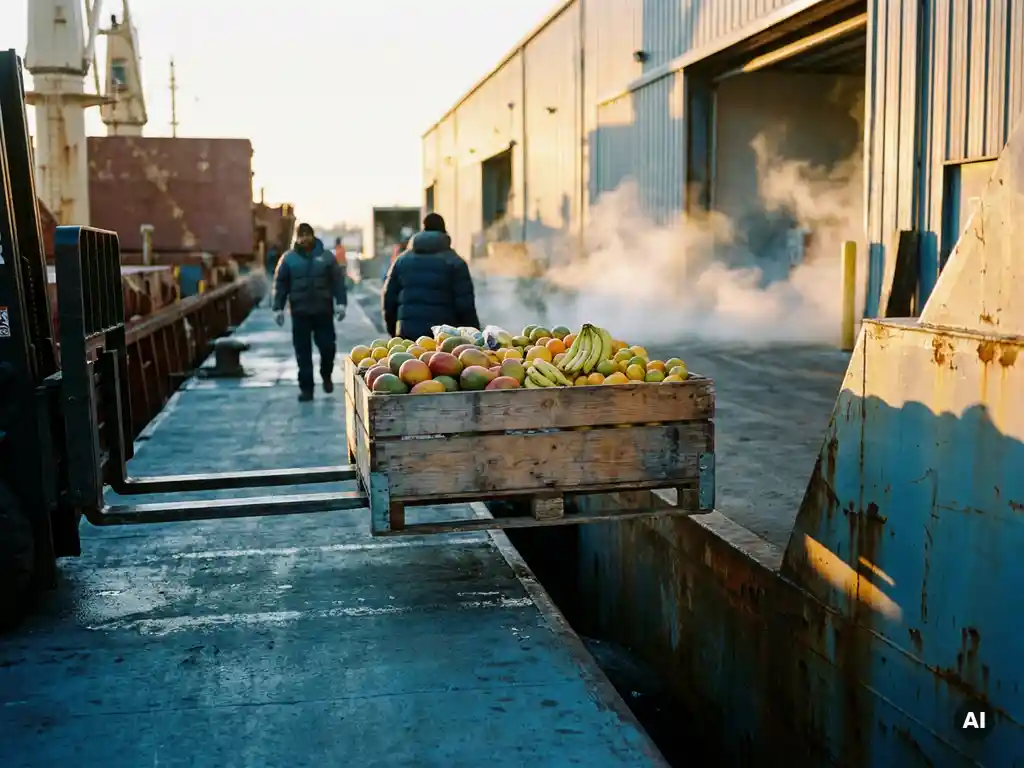
Short-term cold storage is beneficial for importers when there is a temporary gap between the arrival of a shipment and final delivery to customers. This applies particularly to fresh, temperature-sensitive products such as exotic fruit, where even a brief interruption in the cold chain can cause a loss of quality. The questions below will help you determine whether short-term cold storage is the right choice for your logistics situation.
What are the advantages of short-term cold storage compared to direct throughput?
Short-term cold storage gives importers control over the timing of delivery without compromising product quality. With direct transit, you are dependent on tight time windows at both the point of arrival and the customer. An intermediate storage step offers a buffer that increases logistical flexibility and reduces quality risks.
In direct transit, everything must be right: the ship arrives on time, the customer is ready, and the transport schedule aligns seamlessly. In practice, this is rarely the case. Delays at the shipping company, a full loading dock at the supermarket distributor, or a production stoppage at a processing plant can disrupt the entire chain. Short-term cold storage absorbs this variation.
In addition, temporary storage enables logistical operations that are not possible with direct throughput, such as quality control upon arrival, repalletization according to customer specifications, the application of labels and barcodes, or the consolidation of multiple shipments into a single delivery. These are valuable steps that streamline the product flow and prevent errors in the chain.
Which products benefit most from temporary cold storage?
Products that benefit most from temporary cold storage are fresh, fragile goods with a limited shelf life and high sensitivity to temperature fluctuations. Examples include exotic fruits such as bananas and citrus fruits, but also vegetables and other fresh food products that require precise climate control.
Bananas are a good example: they are imported green and ripen at specific temperatures and ethylene concentrations. A deviation of even a few degrees Celsius can accelerate ripening or cause damage. Citrus fruits, on the other hand, are susceptible to drying out and mold formation if humidity levels are not maintained. For these products, a climate-controlled storage facility is not a luxury, but a necessity.
Products shipped from distant destinations, where quality still needs to be verified upon arrival, also benefit greatly from a short storage step. This intermediate period allows for quality measurements such as temperature, humidity, and Brix measurements, ensuring that batches not meeting standards are separated from the rest in a timely manner.
How long does short-term cold storage last on average for importers?
Short-term cold storage typically lasts between one and fourteen days for importers. The exact duration depends on factors such as the delivery frequency to the customer, the ripening stage of the product upon arrival, and the planning rhythm in the supply chain. In many cases, it involves a few working days.
For products such as bananas, the duration is partly determined by the ripening process: only when the fruit has reached the desired degree of ripeness does it go to the distributor or processing plant. This requires not only storage but also active climate control during that period.
For importers receiving multiple shipments per week, the cold storage location functions as a logistics hub. Goods arrive, are inspected and processed, and leave storage as soon as the customer is ready for receipt. The storage duration is then less of a fixed term and more of a dynamic link in a continuous flow.
When is cold storage at the port the smartest choice from a logistical perspective?
Cold storage directly at the port is logistically the most efficient when products need to be moved quickly from the ship to a controlled environment. The shorter the time between unloading and storage, the lower the risk of quality loss due to temperature fluctuations. Port-attached cold storage eliminates unnecessary transport links.
With a private quay next to the cold storage facility, the transition from the ship's hold to refrigerated storage is a matter of minutes. This is a fundamental difference compared to situations where goods are first transported by road to an inland location. Every extra minute of transport outside a controlled environment poses a risk to fresh products.
Port-bound storage is also a smart choice when customs clearance and import inspection have yet to take place. Products can be stored safely in the meantime without interrupting the cold chain. As soon as the paperwork is in order, the shipment can be forwarded directly to the recipient, without additional handling or movement.
What are the costs of short-term cold storage for importers?
The costs of short-term cold storage for importers depend on factors such as the volume in pallet spaces, the desired temperature range, the duration of storage, and any additional services such as quality control, labeling, or repalletizing. There is no single standard rate that applies to all situations.
What importers can take into account in the cost assessment is the total value of the cold chain. Cold storage is not only a cost item, but also a risk management measure. A batch of exotic fruit that ripens prematurely or is damaged due to a break in the cold chain results in a loss that far exceeds the storage costs.
In addition, supplementary services performed during the storage period, such as quality control, barcode-driven traceability, or repalletization, can save costs elsewhere in the chain. When products leave the warehouse with the correct labels, correctly stacked pallets, and an attached QC report, the customer needs to perform fewer actions.
For a concrete price indication, it is advisable to contact a cold storage partner directly so that the quotation aligns with the specific product requirements and logistical situation.
Which certifications are important when choosing a cold storage partner?
When choosing a cold storage partner, BRC, SKAL, and KCB/NVWA are the most relevant certifications for importers of fresh food products. These certifications provide assurance regarding food safety, biological integrity, and compliance with import inspection requirements within the European Union.
BRC (British Retail Consortium) is an internationally recognized standard for food safety and quality assurance in storage and distribution. Supermarket chains and major customers often require this certificate as a condition for acceptance as a supplier. A cold storage partner with BRC certification demonstrates compliance with strict requirements regarding hygiene, temperature control, and traceability.
SKAL is the supervisory body for organic production in the Netherlands. Importers of organically certified fruit or other organic products are required to work with SKAL-certified partners in the supply chain. Without this certificate, a product's organic status may be lost.
KCB/NVWA is relevant for the import inspection of fresh fruit and vegetables from third countries. The KCB, part of the NVWA, carries out phytosanitary inspections and checks for compliance with trade standards. A cold storage partner that works closely with or is recognized by the KCB significantly accelerates the inspection process and prevents unnecessary delays during customs clearance.
In addition to these three, it is also useful to check whether the partner holds Demeter certification when working with biodynamic products.
How ZZColdstores supports importers with short-term cold storage
ZZColdstores offers importers a fully integrated solution for short-term cold storage of fresh and perishable products. From locations in Kruiningen and Vlissingen, with a private quay directly next to the cold storage facility in Vlissingen, products are transported quickly and safely from the ship's hold to controlled storage. The benefits at a glance:
- 24/7 climate control with precise temperature, humidity, and air circulation control
- Full traceability via barcode systems linking grower and LOT numbers
- Quality control upon arrival, including temperature, humidity, and Brix measurements
- Additional services such as labeling, repalletizing, and EDI system connections
- Certifications: BRC, SKAL and Demeter
- Assistance with import inspection via KCB/NVWA and customs clearance
Whether it concerns a one-off shipment or an ongoing logistics flow, ZZColdstores adapts to the specific requirements of the product and the sailing schedule. Would you like to know what climate-controlled cold storage can mean for your situation? Contact us and discuss the possibilities directly with the specialists.
Frequently Asked Questions
How do I know if my product was at the correct temperature during transport to the cold storage location?
Upon arrival, a professional cold storage partner routinely performs a temperature measurement as part of the incoming quality control. Many importers also use temperature loggers that travel in the container or truck, providing insight into the complete temperature history. If the measured values deviate from the agreed standards, the batch can be immediately separated from the rest, allowing for timely intervention before delivery to the customer.
What do I need to arrange if I use short-term cold storage with a new partner for the first time?
Start by providing the product specifications: the desired storage temperature, humidity requirements, packaging method, and any certification requirements from your customers. Also discuss the expected arrival frequency, the volume per shipment, and whether additional services such as labeling or repalletizing are required. Based on this, a good cold storage partner will propose a customized working method to ensure the first shipment runs smoothly.
What are common mistakes when organizing short-term cold storage?
A common mistake is notifying the cold storage partner too late about an incoming shipment, leaving insufficient time to prepare the appropriate storage capacity and climate settings. Another pitfall is underestimating the turnaround time for customs clearance and import inspection, which can lead to unexpected storage extensions. Finally, importers sometimes forget to communicate product-specific requirements in advance—such as ethylene concentrations for bananas or moisture sensitivity for citrus—resulting in a loss of quality.
Can short-term cold storage also be used if my customer postpones delivery at the last minute?
Yes, this is precisely one of the greatest practical advantages of short-term cold storage. When a customer delays delivery due to, for example, a full loading dock, a production stoppage, or changed schedules, the product remains safe and quality-preserved in the controlled storage space. However, ensure that your cold storage partner is flexible regarding extended storage periods and that the storage conditions for your specific product are guaranteed in the long term as well.
How does traceability work for short-term cold storage, and why is it important for importers?
Traceability via barcode systems links every pallet to grower and lot numbers, ensuring that the origin and storage history of each product are always traceable. This is not only a requirement for large supermarket chains and retailers but is also essential in the event of quality complaints or recalls. A cold storage partner with a good traceability system can indicate at any time exactly which batch is located where, how long it has been stored, and under what conditions.
Is short-term cold storage also suitable for organic or biodynamic products?
Yes, but it is crucial that the cold storage partner holds the correct certifications, such as SKAL for organic products and Demeter for biodynamic products. Without these certifications, the organic or biodynamic status of a product can be lost in the supply chain, which has direct commercial and legal consequences. Therefore, always check in advance whether the partner is certified for the specific product category you are importing.
How can I keep the costs of short-term cold storage as efficient as possible?
The most effective way to control costs is to align storage duration with actual logistical needs: ensure tight communication between arrival planning and customer planning so that products do not remain in storage longer than necessary. Additionally, bundle supplementary services such as labeling, repalletizing, and quality control into a single storage event, rather than having them performed later in the chain. This way, you pay once for operations that would otherwise generate costs multiple times and at multiple locations.
Related articles
- How do you keep batches of food products separated in a warehouse?
- Can you rent storage space for seasonal peaks in fresh produce?
- How many pallet spaces do you need for temporary food storage?
- Which temperature zones are possible in cold storage?
- What is the risk of condensation when unloading refrigerated containers?